Full Calendar
THIS DAY IN U.S. MILITARY HISTORY • DECEMBER 6 1917 U.S. Navy World War I

Torpedo Strike off the Scilly Isles

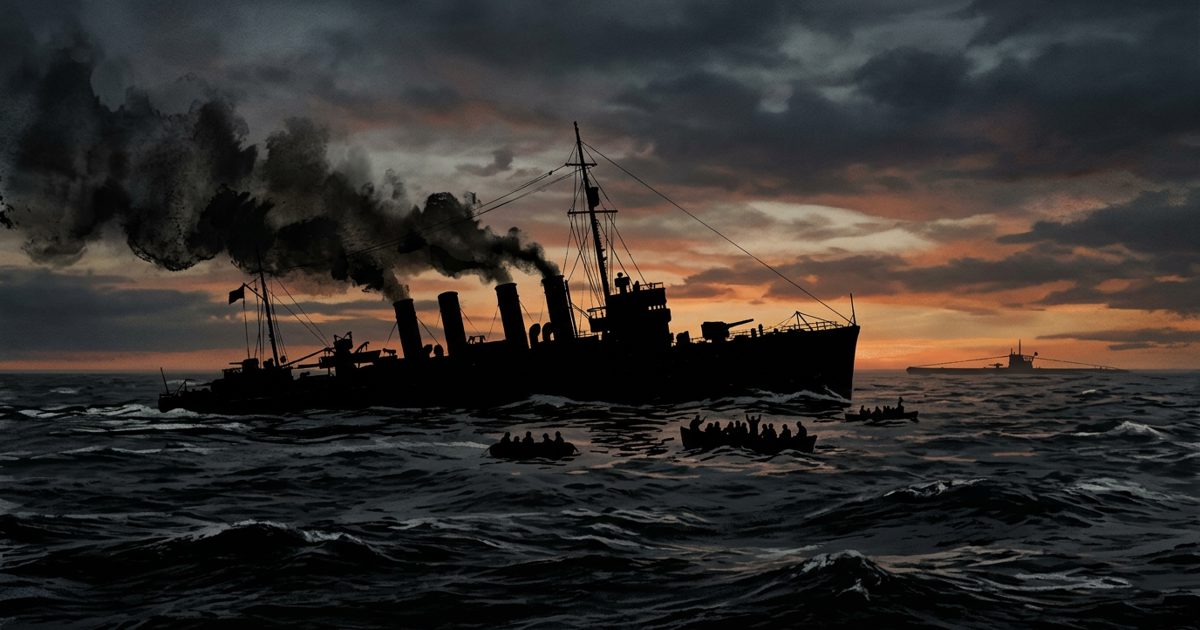
German submarine U-53 sinks USS Jacob Jones in the Western Approaches, marking the first combat loss of an American destroyer in naval history.
Torpedo Strike off the Scilly Isles

Lookouts aboard USS Jacob Jones scanned the choppy waters of the English Channel south of the Isles of Scilly while returning from convoy escort duty. Lieutenant Commander David W. Bagley guided the Tucker-class destroyer toward Queenstown, Ireland, unaware that German submarine U-53 stalked the vessel from periscope depth. Kapitänleutnant Hans Rose spotted the unescorted American warship and launched a single torpedo from a submerged firing position at four in the afternoon. Crewmen on the starboard wing bridge sighted the white wake cutting through the swells at eight hundred yards and sounded the collision alarm. Bagley ordered hard rudder, but the torpedo slammed into the hull near the stern fuel bunkers before the ship could evade the strike.

Torrents of seawater rushed into the shattered hull, disabling the steering gear and cutting electric power across the warship. Crew members scrambled across the slanting deck to deploy life rafts while damage control parties attempted to secure the compartments. Lieutenant Commander Bagley recognized that the vessel was foundering and ordered all hands to abandon ship before the stern submerged completely. Armed depth charges on the stern racks broke loose and sank into the depths beneath the escaping crew. Underwater explosions detonated the charges at their preset hydrostatic depths, sending massive concussion waves upward that killed or stunned dozens of sailors in the water.

Lifeboats and wooden rafts drifted apart in the gathering dusk as Jacob Jones slipped beneath the waves just eight minutes after the torpedo impact. Sixty-six officers and enlisted men perished in the sinking and subsequent underwater blasts. Kapitänleutnant Rose surfaced U-53 among the wreckage thirty minutes later, pulled two wounded American sailors aboard the submarine, and provided them medical care. Rose then transmitted an uncoded radio dispatch to the American naval base at Queenstown giving the precise latitude and longitude of the survivors. British patrol vessels and escort craft rushed to the reported location through the night and recovered the surviving crewmen from the sea.

CHRONOLOGICAL RECORD

December 6 Across U.S. Military History

10 Verified Events
1830 U.S. Navy Landmark Event • Early Republic

Depot of Charts and Instruments Established

Lieutenant Louis M. Goldsborough received orders establishing the Depot of Charts and Instruments in Washington, D.C., on December 6, 1830. The small naval facility collected nautical charts, navigational equipment, and chronometers for American warships. It evolved into the United States Naval Observatory, providing critical astronomical calculations and standardized timekeeping for the entire fleet.

1846 U.S. Army Landmark Event • Mexican-American War

Battle of San Pasqual Begins in California

Brigadier General Stephen W. Kearny led one hundred battered dragoons and California scouts in an assault against Andres Pico's mounted lancers near San Diego. Californio horsemen armed with eight-foot lances counterattacked swiftly, inflicting thirty-one casualties and surrounding the exhausted American column. Kearny held a rocky hill position until naval reinforcements arrived from San Diego days later.

1863 U.S. Navy • Civil War

Monitor USS Weehawken Sinks in Charleston Harbor

Ironclad monitor USS Weehawken foundered at its Morris Island anchorage during a moderate gale in Charleston Harbor. Heavy ammunition recently loaded into forward compartments lowered the ship's bow freeboard, allowing seawater to pour through an open deck hatch. Thirty-one sailors drowned when the ironclad sank in five fathoms within five minutes.

1917 U.S. Army • World War I

Seventh Infantry Division Activated at Camp Wheeler

War Department officials formally activated the 7th Division at Camp Wheeler, Georgia, to bolster the American Expeditionary Forces in France. The unit completed training and deployed overseas aboard the transport USS Leviathan before fighting along the Saint-Mihiel salient. Soldiers known as the Bayonet Division later served across World War II, Korea, and modern conflicts.

1941 U.S. Army Air Forces • World War II

Unarmed Flying Fortresses Depart for Pearl Harbor

Major Truman Landon led twelve Boeing B-17 Flying Fortresses into the night sky from Hamilton Field, California, bound for the Hawaiian Islands. The bombers carried extra fuel tanks instead of machine gun ammunition to survive the fourteen-hour ocean crossing. Crews flew straight into the Japanese air raid over Oahu the following morning without weapons to defend themselves.

1944 U.S. Army • World War II

Armored Task Force Clashes at Singling

Sherman tanks of Task Force Abrams pushed into the heavily defended village of Singling near the German border. The 4th Armored Division detachment encountered concealed Panther tanks and 88mm antitank guns during fierce street fighting that lasted all afternoon. American forces knocked out several German vehicles before withdrawing slightly to regroup behind artillery support lines.

1946 U.S. Navy • Cold War

Douglas Skyraider Enters Active Fleet Inventory

Attack Squadron 19A accepted delivery of the Navy's first production AD-1 Skyraiders at Naval Air Station Alameda, California. Built by Douglas Aircraft, the heavy single-engine attack plane carried substantial ordnance payloads from carrier decks. Skyraiders served as primary close air support platforms across two decades of combat over Korea and Vietnam.

1950 U.S. Marine Corps Landmark Event • Korean War

First Marine Division Begins Hagaru Breakout

Major General Oliver P. Smith launched the division-wide breakout from the perimeter at Hagaru-ri toward Koto-ri. Marine infantry and armor battled through blizzard winds, sub-zero cold, and multiple Chinese ambush positions across steep mountain passes. The column evacuated thousands of wounded personnel while crushing enemy blocking forces along the main supply route.

1957 U.S. Navy Landmark Event • Cold War

Vanguard Satellite Launch Vehicle Explodes on Pad

Technicians launched Vanguard Test Vehicle 3 from Cape Canaveral in America's first attempt to orbit an artificial satellite. The rocket lost booster thrust two seconds after ignition, sank back onto the launch stand, and exploded in a massive fireball. Project Vanguard salvaged the undamaged satellite payload, leading to successful orbital flights three months later.

1968 U.S. Navy • Vietnam War

Riverine Forces Launch Operation Giant Slingshot

Patrol boats of Task Force 116 began combat patrols along the Vam Co Dong and Vam Co Tay rivers southwest of Saigon. The combined naval operation aimed to interdict Viet Cong weapons and personnel infiltrating from the Cambodian border area known as the Parrots Beak. Crews fought over one thousand skirmishes before transitioning duties to South Vietnamese forces.

MEDAL OF HONOR ACTION 1864

Ironclad Colors Raised at Bells Mills

Artillery batteries manned by Confederate gunners at Bells Mills opened a fierce barrage on December 6, 1864, targeting Union vessels along the Cumberland River below Nashville. Lieutenant Samuel Howard maneuvered the sternwheel ironclad monitor USS Neosho directly into the bombardment to suppress the shore positions. Confederate shot struck the iron plating more than one hundred times, shattering deck fittings and shooting away the ship's signal mast. Solid shot sheared the halyards, sending the American flag crashing onto the unprotected open deck under relentless cannon fire.

Quartermaster John Ditzenback and civilian pilot John H. Ferrell climbed through the armored hatch into the storm of flying iron and splinters. Both men sprinted across the ruined deck, retrieved the fallen flag, and lashed the colors securely to the remaining timber stump. Their rapid action kept the colors flying throughout the two-hour engagement, signaling to Union commanders that the monitor remained fully operational. Naval authorities recommended both men for the Medal of Honor, which they received the following summer for gallantry under fire.