CHRONOLOGICAL RECORD
December 8 Across U.S. Military History
9 Verified Events
1776
U.S. Army
Landmark Event
• American Revolutionary War
Washington Crosses the Delaware into Pennsylvania
General George Washington completed the evacuation of his retreating Continental Army across the Delaware River into Pennsylvania. American rear guards secured or destroyed all watercraft along the river to deny British forces under Lord Cornwallis a means of pursuit. Securing the western shore enabled Washington to reorganize his freezing troops and plan the counterattack at Trenton.
1846
U.S. Navy
• Mexican-American War
Brig USS Somers Capsizes off Veracruz
Lieutenant Raphael Semmes pursued a Mexican blockade runner off Veracruz when a violent squall struck the ten-gun brig USS Somers. Heavy winds capsized the warship within ten minutes, plunging eighty crewmen into the surf. British, French, and Spanish warships assisted in rescuing survivors, though thirty-six American sailors drowned in the disaster.
1941
Joint
Landmark Event
• World War II
United States Congress Formally Declares War on Japan
President Franklin D. Roosevelt addressed a joint session of Congress following the surprise raid on Pearl Harbor. Senators and representatives passed the war resolution with only one dissenting vote within an hour of the speech. Signature of the resolution formally propelled the United States Armed Forces into global conflict across the Pacific and European theaters.
1941
U.S. Marine Corps
Landmark Event
• World War II
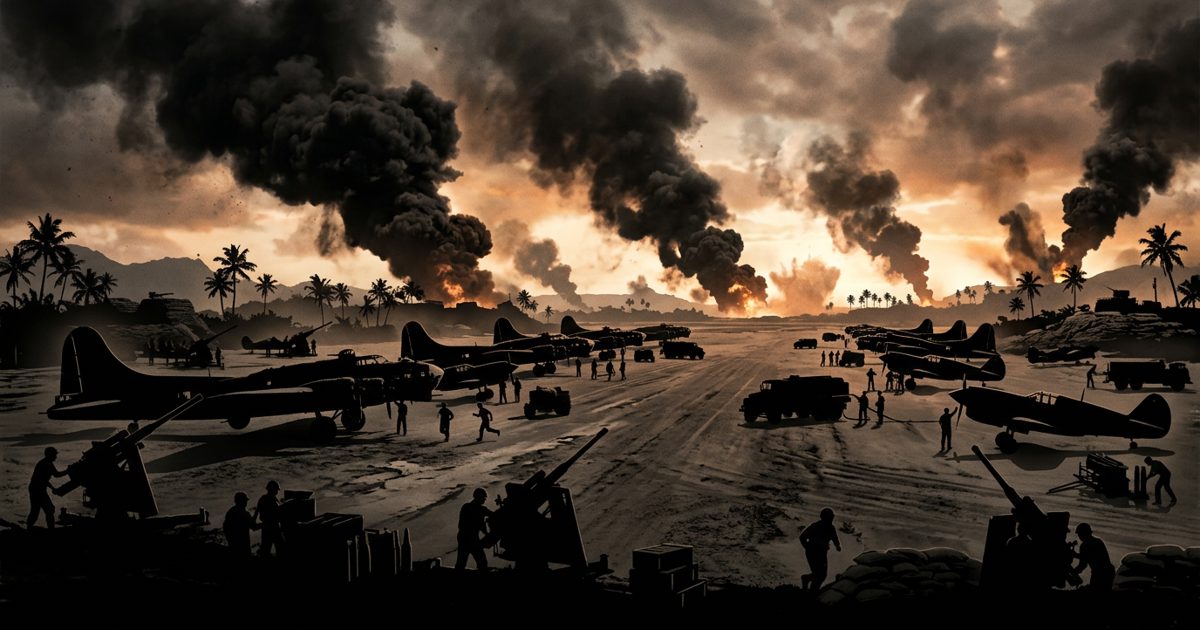
Japanese Bombers Strike Wake Island Outpost
Bombers of the Imperial Japanese Navy struck Wake Island hours after the raid on Pearl Harbor. Explosions destroyed seven Grumman F4F-3 Wildcats belonging to Marine Fighting Squadron 211 on the airstrip. Major James Devereux rallied coastal artillery gunners of the 1st Defense Battalion, digging in to resist Japanese invasion forces over the next fifteen days.
1942
U.S. Navy
• World War II
Patrol Torpedo Boats Turn Back Tokyo Express at Guadalcanal
Motor Torpedo Boat Squadron Two intercepted eight Japanese destroyers attempting to deliver supply drums to Guadalcanal. Eight American patrol craft, including PT-109 and PT-59, engaged the heavily armed destroyers with torpedoes and automatic gunfire off Cape Esperance. Fierce resistance forced the Japanese warships to jettison their cargo and withdraw without reinforcing ground troops.
1944
Joint
• World War II
Allied Ships and Bombers Open Bombardment of Iwo Jima
Cruisers USS Chester, USS Pensacola, and USS Salt Lake City unleashed hundreds of heavy artillery rounds against Japanese fortifications on Iwo Jima. Consolidated B-24 Liberators from the Seventh Air Force simultaneously pounded airfields across the island. Bombardment missions initiated a continuous seventy-two-day air and naval campaign preceding the February 1945 amphibious assault.
1950
U.S. Marine Corps
• Korean War
Marine Column Storms Hill 1081 at Funchilin Pass
Captain Robert H. Barrow led Company A of the 1st Battalion, 1st Marines up the icy slopes of Hill 1081 in subzero temperatures. Marines eliminated dug-in Chinese defenders guarding Funchilin Pass to protect the southern exit from Chosin Reservoir. Victory secured the high ground needed for engineers to deploy air-dropped treadway bridge spans over the gorge.
1965
U.S. Marine Corps
• Vietnam War
Marines Open Operation Harvest Moon in Que Son Valley
Task Force Delta launched Operation Harvest Moon alongside South Vietnamese army units to sweep communist forces from the Que Son Valley. Marine infantry battalions moved across flooded rice paddies to relieve regional outposts and engage the Viet Cong 1st Regiment. Heavy contact developed immediately as transport helicopters flew rifle companies into hot landing zones.
1987
Joint
Landmark Event
• Cold War
United States and Soviet Union Sign Landmark Nuclear Treaty
President Ronald Reagan and Soviet General Secretary Mikhail Gorbachev signed the Intermediate-Range Nuclear Forces Treaty at the White House. Agreement required the elimination of all ground-launched ballistic and cruise missiles with ranges between three hundred and thirty-four hundred miles. Compliance resulted in the United States military dismantling its Pershing II missiles and ground-launched cruise missiles.