Full Calendar
THIS DAY IN U.S. MILITARY HISTORY • NOVEMBER 23 1943 U.S. Marine Corps World War II

Marines Secure Betio Island After Grueling Fight for Tarawa

Major General Julian C. Smith declares the battered atoll secure in 1943 after the Second Marine Division overcomes entrenched defenders across bloodstained coral beaches.
Marines Secure Betio Island After Grueling Fight for Tarawa

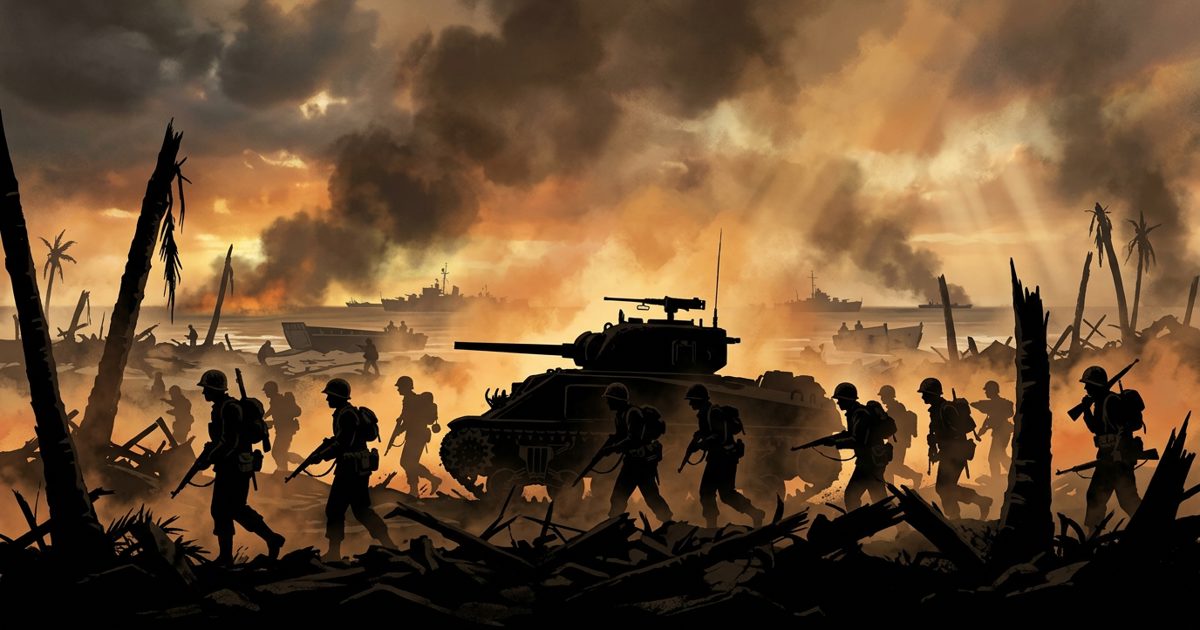
Marines of the 2nd Marine Division faced their final major trial on Betio Island during the early morning hours of November 23, 1943. Hundreds of Japanese imperial naval infantry staged a desperate banzai charge against the lines held by the 1st Battalion, 6th Marines on the eastern tail of the atoll. Battery personnel from the 10th Marines lowered their 75mm pack howitzers to fire point-blank canister rounds, while the destroyers USS Schroeder and USS Sigsbee hurled high explosives directly into the attacking formations. Close-quarters rifle fire and coordinated artillery barrages broke the enemy wave before dawn, leaving more than three hundred Japanese dead sprawled across the sand.

Infantrymen of the 3rd Battalion, 6th Marines immediately launched a sweeping advance eastward at daylight to eliminate remaining defensive pockets. M4 Sherman tanks and combat engineers armed with flamethrowers moved methodically along the strip, blasting through fortified coconut-log bunkers and concrete emplacements that still housed enemy snipers. Navy Grumman F6F Hellcats and Douglas SBD Dauntless dive-bombers hammered the eastern tip of the island with 500-pound bombs to suppress lingering resistance. Combat teams eradicated each strongpoint with satchel charges, pushing forward until reaching the eastern shoreline by early afternoon.

Major General Julian C. Smith signaled the offshore fleet at 1330 that organized Japanese resistance had completely collapsed across Betio. American forces found only seventeen Japanese soldiers alive out of an initial garrison of nearly 4,900 defenders, alongside 129 captured Korean laborers. Naval authorities counted 1,027 Marines and sailors killed in action and another 2,292 wounded over the seventy-six hours of combat. Planners analyzed the operation immediately, instituting critical doctrine changes in pre-invasion naval gunfire preparation and amphibious tractor deployment for subsequent Pacific landings.

CHRONOLOGICAL RECORD

November 23 Across U.S. Military History

9 Verified Events
1780 Continental Army • American Revolutionary War

Major Benjamin Tallmadge Raids Fort St. George

Major Benjamin Tallmadge led eighty Continental dragoons across Long Island Sound in whaleboats, launching a predawn surprise assault against the fortified Loyalist outpost at Manor St. George on November 23, 1780. Raiders breached the twelve-foot stockade, killed seven defenders, captured fifty-four prisoners, and incinerated vast British supply stores before safely returning across the sound.

1862 U.S. Navy • American Civil War

Lieutenant William Cushing Raids Jacksonville

Lieutenant William B. Cushing steered the gunboat USS Ellis up North Carolina's New River on November 23, 1862, striking Confederate installations deep behind enemy lines. Bluejackets demolished an enemy salt works, captured two blockade-running schooners, and seized valuable Confederate military mail at Jacksonville before withdrawing downriver under heavy cannon fire.

1863 U.S. Army Landmark Event • American Civil War

Union Troops Capture Orchard Knob at Chattanooga

Major General George H. Thomas deployed 14,000 Union soldiers in a sweeping advance from Chattanooga lines on November 23, 1863, initiating the Battle of Chattanooga. Federal infantry overran roughly 600 Confederate defenders stationed on Orchard Knob, transforming the rocky knoll into Major General Ulysses S. Grant's forward headquarters for the subsequent assaults against Missionary Ridge.

1914 U.S. Army Landmark Event • Mexican Revolution

United States Armed Forces Evacuate Veracruz

Brigadier General Frederick Funston directed the final embarkation of U.S. Army infantrymen and Marines aboard transports at Veracruz on November 23, 1914. Soldiers concluded a seven-month American military occupation of the Mexican port city following the Tampico Affair, returning municipal control and harbor defense facilities to local Mexican authorities without incident.

1942 U.S. Navy • World War II

Experimental Vought Flying Flapjack Takes Flight

Boone T. Guyton piloted the experimental Chance Vought V-173 pancake-shaped aircraft aloft for its maiden flight at Stratford, Connecticut, on November 23, 1942. Engineers designed the circular craft for the U.S. Navy to investigate short-takeoff capabilities from escort carriers, demonstrating exceptional low-speed stability that paved the way for advanced carrier fighter trials.

1947 U.S. Air Force • Cold War

Convair Giant Cargo Transport Makes Maiden Flight

Russell R. Rogers flew the massive Convair XC-99 military transport prototype for the first time from Lindbergh Field in San Diego on November 23, 1947. Engineers constructed the double-deck transport using the wings and six pusher engines of the B-36 bomber, creating an aircraft capable of carrying 400 fully equipped troops or 100,000 pounds of cargo.

1951 U.S. Army • Korean War

Private Noah Knight Defends Kowang-San Outpost

Private First Class Noah O. Knight of the 7th Infantry Regiment, 3d Infantry Division, defended a critical outpost near Kowang-San on November 23, 1951, when enemy waves assaulted his perimeter. Knight engaged advancing squads at point-blank range and disabled two demolition teams with his rifle before sustaining mortal wounds, posthumously receiving the Medal of Honor.

1966 U.S. Navy • Vietnam War

Navy Destroyers Strike Logistics Barges in Operation Sea Dragon

Destroyers USS Mullany and USS Warrington carried out concentrated coastal bombardment sweeps off North Vietnam on November 23, 1966, during Operation Sea Dragon. American gun crews disabled or destroyed forty-seven communist waterborne supply craft in a single day, choking off maritime ammunition and supply deliveries bound for the Demilitarized Zone.

1967 U.S. Army Landmark Event • Vietnam War

Paratroopers Capture Hill 875 to Conclude Dak To

Paratroopers from the 173rd Airborne Brigade and 4th Infantry Division secured the summit of Hill 875 on November 23, 1967, ending five days of ferocious close-range combat. Soldiers routed entrenched North Vietnamese regiments from reinforced bunker complexes, bringing the costly three-week Battle of Dak To to an end.

MEDAL OF HONOR ACTION 1944

First Lieutenant Edward Silk Overcomes Stronghold in the Vosges

Lieutenant Edward A. Silk commanded the weapons platoon of Company E, 398th Infantry Regiment, 100th Infantry Division, near Saint-Prayel, France, on November 23, 1944. German machine gunners entrenched inside a stone farmhouse pinned down his lead scouting squad in an open clearing. Silk deployed his light machine guns to return fire, but enemy resistance showed no sign of slackening. Silk decided to neutralize the strongpoint alone and sprinted one hundred yards through heavy fire to a low stone wall.

Silk vaulted the wall and dashed fifty yards to the building, hurling a grenade through a window to eliminate a machine-gun crew. He charged an adjacent woodshed under direct fire, destroying a second automatic weapon with hand grenades. Depleted of explosives, Silk seized heavy rocks and hurled them through the window while bellowing surrender demands. Twelve German soldiers surrendered to the solitary American officer, allowing his battalion to advance and seize high ground overlooking Moyenmoutier.