Full Calendar
THIS DAY IN U.S. MILITARY HISTORY • NOVEMBER 24 1863 U.S. Army Civil War

Union Soldiers Storm Lookout Mountain in the Battle Above the Clouds

Major General Joseph Hooker commands twelve thousand Federal troops to seize the rocky heights overlooking Chattanooga and break the Confederate siege.
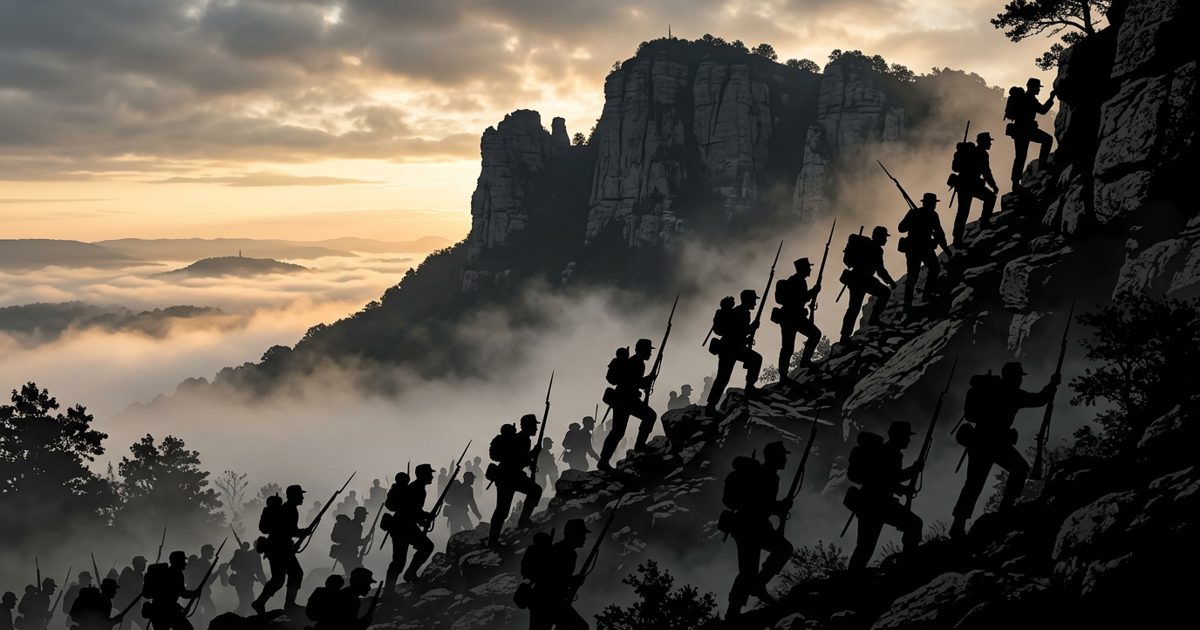
Union Soldiers Storm Lookout Mountain in the Battle Above the Clouds

Major General Joseph Hooker launched a three-division assault against the northern slopes of Lookout Mountain outside Chattanooga, Tennessee, on November 24, 1863. High command had assigned Hooker twelve thousand troops from the XI and XII Corps under Brigadier General John W. Geary and Brigadier General Charles Cruft, alongside Peter J. Osterhaus from the Army of the Tennessee. Confederate General Braxton Bragg had garrisoned the towering promontory with roughly twenty-seven hundred defenders under Major General Carter L. Stevenson to maintain artillery observation over Union supply routes. Federal infantry crossed Lookout Creek early in the morning and formed attack lines beneath the steep limestone palisades.

Fog rolled down the steep ravines and shrouded the rocky plateau in white mist by midday, giving the clash its famous name as the Battle Above the Clouds. Union soldiers scrambled over jagged boulders and felled trees while driving Confederate pickets backward across the bench of the mountain. Geary and his brigade commanders pressed their lines directly into the rifle pits surrounding the Cravens farmstead, sustaining heavy musketry while cutting off enemy retreat routes. Confederate defenders launched counterattacks around the homestead, but superior Union numbers and steady rifle volleys forced them to yield their earthworks.

Confederate infantry abandoned the mountain during the night under orders from Bragg to consolidate along Missionary Ridge. Dawn revealed the American flag flying from the high precipice of Lookout Point, signaling to thousands of Union troops in Chattanooga that the left flank of the Confederate siege line had collapsed. Union casualties totaled eighty-nine killed and four hundred seventy-one wounded, while Stevenson lost more than twelve hundred men, including over a thousand captured. Victory on the mountain cleared the southern approaches to the city and enabled Hooker to advance against the Confederate southern flank the following afternoon.

CHRONOLOGICAL RECORD

November 24 Across U.S. Military History

8 Verified Events
1777 Continental Army • American Revolution

Continental Congress Reorganizes the Board of War

Delegates of the Second Continental Congress expanded the Board of War and Ordnance to five permanent members on November 24, 1777. Lawmakers appointed Major General Horatio Gates as board president to oversee military administration, supply depots, and prisoner custody while General George Washington struggled with severe logistical shortages at Whitemarsh.

1861 U.S. Navy • Civil War

Union Naval Expedition Captures Tybee Island

Sailors and Marines commanded by Commander Christopher Raymond Perry Rodgers landed on Tybee Island, Georgia, on November 24, 1861. Gunboats USS Flag, USS Seneca, and USS Pocahontas bombarded Confederate shore pickets, who burned the lighthouse before retreating. Federal forces secured the entrance of the Savannah River, establishing siege positions against Fort Pulaski.

1877 U.S. Navy • Post-Civil War Era

Naval Gunboat Huron Wrecks off Nags Head

Steam gunboat USS Huron ran aground during a storm off Nags Head, North Carolina, on November 24, 1877. Pounding surf tore the vessel apart only two hundred yards from shore, killing ninety-eight crewmen. Seaman Antonio Williams earned the Medal of Honor for repeatedly braving the heavy breakers to rescue four shipmates from the wreck.

1941 Joint Service Landmark Event • World War II

United States Grants Lend-Lease to Free French Forces

President Franklin D. Roosevelt declared the defense of Free French territories vital to American security on November 24, 1941. Presidential authorization extended direct Lend-Lease military supplies and munitions to General Charles de Gaulle and his resistance forces. Shipments strengthened Free French units fighting Axis armies across Equatorial Africa and the Levant.

1943 U.S. Navy Landmark Event • World War II

Japanese Submarine Sinks Carrier Liscome Bay

Torpedoes from Japanese submarine I-175 struck the escort carrier USS Liscome Bay southwest of Butaritari Island on November 24, 1943. Detonating aircraft bombs tore the warship apart, sinking the hull in twenty-three minutes with six hundred forty-four sailors lost. Casualties included Rear Admiral Henry M. Mullinix and Navy Cross recipient Mess Attendant Doris Miller.

1944 U.S. Army Air Forces Landmark Event • World War II

Superfortresses Launch First Tokyo Strike from Saipan

Boeing B-29 Superfortress bombers of the 73rd Bombardment Wing lifted off from Isely Field, Saipan, on November 24, 1944, to bomb Tokyo. Brigadier General Emmett O'Donnell Jr. led the one-hundred-eleven-plane raid in the flagship Dauntless Dotty against the Musashino aircraft plant. Operation San Antonio 1 inaugurated the long-range strategic bombing campaign against the Japanese home islands.

1950 U.S. Army Landmark Event • Korean War

Eighth Army Launches Home-by-Christmas Offensive

General Douglas MacArthur ordered the Eighth Army to open its final offensive across northwestern North Korea on November 24, 1950. Lieutenant General Walton H. Walker advanced three corps toward the Yalu River, anticipating light resistance from remnant communist units. Hidden Chinese People's Volunteer Army forces launched a massive counteroffensive twenty-four hours later, shattering the Allied lines.

1995 U.S. Coast Guard • Post-Cold War Era

Cutter Dauntless Conducts Record Maritime Rescue

Coast Guard Cutter Dauntless intercepted an overloaded seventy-five-foot wooden coastal freighter adrift in the Caribbean Sea on November 24, 1995. Crewmen evacuated five hundred seventy-eight migrants from the listing vessel without a single loss of life. Operations concluded as the largest successful rescue from a single vessel in the history of the Coast Guard.

TACTICAL OPERATION 1964

Operation Dragon Rouge Delivers Tactical Hostage Rescue in Stanleyville

Lockheed C-130 Hercules transport aircraft from the U.S. Air Force 322nd Air Division appeared over Sabena Airport outside Stanleyville, Congo, at dawn on November 24, 1964. Combat controllers Captain Donald R. Strobaugh and Sergeant Robert J. Dias guided the lead transport at low altitude as more than three hundred Belgian paratroopers jumped onto the runway perimeter. Simba rebels holding the airfield fired machine guns at the American aircraft, but the paratroopers swiftly eliminated resistance and cleared hundreds of water-filled fuel barrels blocking the tarmac.

Aircrews landed additional transports directly on the cleared airstrip under rifle fire while the paratroopers advanced into downtown Stanleyville to reach the Victoria Hotel. Rebel forces began shooting captives upon hearing the aircraft engines, killing twenty-four hostages before the assault force overran their positions. Evacuation flights carried more than sixteen hundred foreign nationals and Congolese civilians aboard American C-130s and Belgian transports back to Leopoldville over the next two days. Air Force crews completed forty-one operational sorties during the mission, executing one of the largest multinational tactical rescue airlifts of the Cold War.