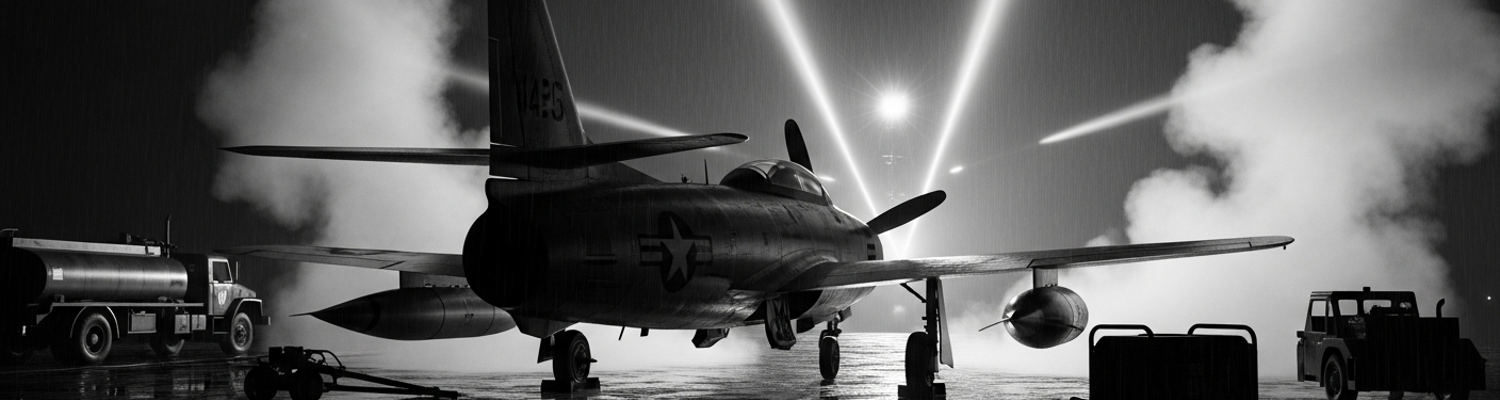

UN Command Airspace Restrictions
The air war over Korea presented a paradox. United Nations Command air forces possessed a clear technological advantage over the swarms of North Korean and Chinese aircraft. Yet, for UN pilots, the primary source of operational anxiety was not enemy capability but the sheer volume of hostile targets combined with paralyzing operational restrictions. The conflict was not a contest of heroic dogfights. It was a grueling, unglamorous war of supply chains and political compromise, with rules written in distant halls of power, far from any cockpit.
Operational logs show that politically motivated airspace restrictions were one of the most significant factors hamstringing the UN’s night-interception campaign. A deep-seated fear of provoking a wider conflict with the People’s Republic of China and the Soviet Union led UN Command to establish strict rules of engagement. These rules effectively created a sanctuary for enemy forces north of the Yalu River. UN pilots were forbidden from pursuing hostile aircraft into Manchurian airspace. Even when in hot pursuit of bombers returning from raids over South Korea, interceptors had to break off their attack at this invisible line. This directive provided a protected staging ground for Chinese and North Korean air assets. Bomber streams could assemble, launch attacks, and retreat to the safety of airfields like the massive complex at Antung, knowing pursuers would halt at the border. The policy ceded all tactical initiative, forcing UN night-fighter crews into a purely defensive posture. They could only wait for the enemy to cross the river and strike first.
This policy gave rise to politically protected corridors for enemy bombers. The airspace over Manchuria functioned as a dedicated logistical highway for nighttime bombing operations. Enemy bombers, often flying without fear during the vulnerable takeoff and landing phases of their missions, operated with a degree of impunity. This arrangement was a source of intense frustration for UN aircrews who watched damaged bombers, otherwise easy targets, slip across the river to safety. The policy extended beyond preventing direct attacks on Manchurian soil. UN pilots also had to endure anti-aircraft fire from the Chinese side of the river without being able to retaliate, creating a bizarre and dangerous tactical situation where the enemy could fire from a protected zone.
Technical challenges compounded these political restrictions. Enemy aircraft learned to operate below the effective ceiling of UN radar coverage. The mountainous terrain of the Korean peninsula created vast radar shadows, which savvy enemy pilots exploited. This tactic was most famously employed by the pilots of the Polikarpov Po-2, a biplane from 1928. Nicknamed “Bedcheck Charlie” by UN troops, these antiquated aircraft, made of wood and fabric, presented a minimal radar cross-section. They were nearly invisible to the advanced radar of the time. North Korean pilots flew these planes low and slow through valleys, completely masked from ground-controlled intercept (GCI) systems. They would approach targets like airfields packed with expensive UN aircraft, throttle back their engines for a near-silent glide, drop small bombs, and disappear into the darkness. The technological mismatch was absurd. State-of-the-art jet interceptors like the F-94 Starfire were scrambled to stop them but struggled to engage a target moving slower than their own stall speed. In at least one documented case, an F-94 attempting to engage a Po-2 stalled and crashed, handing the biplane a victory without firing a shot.
Night Fighter Radar Procurement Labyrinth
The effort to field effective night interceptors over Korea became a logistical competition within the United Nations Command itself. A fractured procurement environment saw inter-service and inter-allied interests actively undermine the war effort. The U.S. Air Force, Navy, and Marine Corps each championed their own platforms and, by extension, their own distinct supply chains. The Air Force pushed the Lockheed F-94 Starfire. The Navy and Marines operated the Douglas F3D Skynight. The British Royal Air Force contributed the Gloster Meteor NF.11. This created three separate, often competing, streams for spare parts, maintenance personnel, and specialized test equipment, all flowing into the same constrained theater. Archival evidence (NARA Record Group 341) shows the U.S. Air Force, controlling most airlift and depot priority, frequently relegated requests for non-USAF platforms to a lower status. Marine F3D squadrons and allied Meteor units often waited longer for components. The situation was worsened by a fundamental disagreement on doctrine. Each service guarded its own operational methods and refused to standardize, ensuring the bureaucratic labyrinth remained inefficient.
The technological centerpiece of the Air Force’s F-94B Starfire, the Hughes-built AN/APG-33 radar, proved to be a maintenance disaster in the harsh conditions of forward air bases in Korea like K-13 at Suwon. Derived from earlier World War II designs, the system was a complex assembly of vacuum tubes and delicate wiring, notoriously sensitive to moisture, vibration, and temperature fluctuations. Maintenance crews from units like the 319th Fighter-Interceptor Squadron lacked the pristine, climate-controlled workshops and specialized oscilloscopes required for proper calibration. The result was a constant struggle against failing components. The radar’s magnetron would lose power, diminishing detection range. The cathode-ray tube display would flicker out, leaving the crew blind. The procurement pipeline for spare vacuum tubes was slow and unreliable, forcing flight-line crews to cannibalize parts from already grounded aircraft just to keep a handful of interceptors mission-capable. This single radar system’s unreliability had a direct, measurable impact, grounding dozens of sorties.
In contrast, the AN/APQ-35 radar system in the bulbous nose of the Marine Corps' F3D Skynight was a more robust and capable package. It integrated search, fire control, and a tail-warning radar, giving its crews a significant advantage. Marine night-fighter squadron VMF(N)-513, the “Flying Nightmares,” used the system to great effect, scoring the first radar-guided jet-on-jet kill at night. The Skynight and its advanced radar faced a different obstacle: institutional neglect. As a Navy/Marine asset, the F3D was an outsider in a theater dominated by the Air Force’s logistical command structure. VMF(N)-513, operating from bases like Pusan, found their requisitions for AN/APQ-35 spare parts consistently de-prioritized in favor of the Air Force’s F-94s. A superior night-fighting platform was often left sitting on the tarmac. This bureaucratic friction meant the most capable night interceptor in-theater was frequently unavailable for combat escort missions with B-29s, which were suffering heavy losses to enemy night fighters.
Critical Component Supply Chain Bottlenecks
The mechanical heart of the night-interceptor fleet was dangerously fragile. The advanced AN/APG-33 radar system in the Air Force’s F-94 Starfire interceptors, a technological advantage on paper, was a maintenance disaster in the field. This system depended on an array of delicate, glass vacuum tubes fundamentally unsuited for the crude operating conditions at forward air bases like Suwon. These components, sensitive to the constant vibration of unimproved runways and extreme temperature shifts, failed at an alarming rate. Maintenance crews of the 319th Fighter-Interceptor Squadron lacked climate-controlled facilities or the sophisticated oscilloscopes needed for precise calibration, turning every repair into an improvisation. The supply pipeline for replacement tubes was agonizingly slow, with spare parts programmed at peacetime rates, not the levels required for active combat. This forced ground crews into a constant practice of cannibalization, stripping working tubes from one grounded F-94 to get another into the air for a single mission.
The problem extended beyond the main radar sets. The complex avionics suites of early jets like the F-94 and F3D Skynight generated tremendous heat in confined spaces, requiring specialized cooling systems to prevent catastrophic failure. Modern jets often use fuel as a primary coolant, a technique not yet perfected in these early designs. Instead, they relied on more conventional heat exchangers and dedicated fluid coolants. The supply of these specialized coolant fluids, along with replacement pumps and lines, was just as precarious as that of vacuum tubes. An aircraft could be mechanically perfect, fully armed and fueled, but a low reservoir of coolant would keep it grounded. A pinhole leak in a coolant line, a simple fix in a stateside depot, could render an interceptor useless for weeks in Korea as crews waited for replacement parts that were a low priority in the overall theater supply chain. This scarcity meant that even when airborne, radar operators watched their systems anxiously, knowing that overheating could degrade performance or cause a complete shutdown at the most critical moment of an intercept.
These cascading component shortages had a direct and crippling effect on the operational readiness of the entire night-fighter force. Mission capability rates for technologically advanced aircraft like the F-86 were recorded as low as 45 percent in early 1952, a figure likely mirrored or exceeded by the even more complex night interceptors. At any given time, a significant portion of the fleet was non-operational, waiting for parts. This created a grim triage for maintenance chiefs, who had to decide which of the few available aircraft would receive the scarce components. The practice of cannibalizing parts from designated “hangar queens” provided a short-term boost in sortie numbers but steadily eroded the total number of potentially flyable airframes, creating a downward spiral of fleet availability. For the B-29 bomber crews relying on these aircraft for protection from MiG-15s, this logistical failure meant fewer escorts in the sky and a greater chance of not returning from a mission.
Specialized Technician Manpower Crisis
The sophisticated night-fighting aircraft deployed to Korea were only as effective as the men trained to maintain them. The U.S. Air Force entered the conflict with a severe deficit of technicians possessing the specialized skills needed to service the delicate, vacuum-tube-based fire control systems like the AN/APG-33. This was not general mechanical work. A qualified radar technician required months of highly focused electronics training stateside, a pipeline entirely unprepared for the sudden demands of a shooting war. The Air Force had expanded dramatically, but the need for these specialized technicians grew even faster, stripping units of the experienced non-commissioned officers who were the backbone of any maintenance effort. Technicians needed a deep understanding of oscilloscopes, frequency modulation, and the idiosyncrasies of magnetron and cathode-ray tube assemblies. The training programs simply could not produce qualified specialists fast enough to replace personnel rotating out of the theater or to build up the maintenance capacity required by the expanding jet inventory.
This personnel shortfall directly impacted the availability of the night-fighter fleet. A significant percentage of aircraft, particularly the F-94 Starfires of squadrons like the 68th and 319th Fighter-Interceptor Squadrons, were frequently grounded not for lack of parts, but for lack of a qualified technician. Maintenance records from air bases like Suwon (K-13) show airframes sitting dormant for extended periods, their logs marked “Awaiting Specialist.” While precise figures for night-fighter availability are difficult to isolate, overall mission capability rates for advanced jets like the F-86 fell as low as 45 percent by early 1952. This number was likely surpassed by the more electronically complex interceptors. This created the absurd spectacle of perfectly good aircraft, fully armed and fueled, being unable to fly because no one on base was authorized to diagnose or sign off on a radar repair. An entire interceptor could be rendered useless by a single faulty vacuum tube that a general mechanic was forbidden to touch.
The few available radar specialists in-theater were stretched to their breaking point, often working more than 50, and sometimes up to 70, hours a week. This extreme workload, spread thin across multiple squadrons, inevitably led to burnout and errors. To manage the scarcity, commanders were forced to abandon the efficient crew chief system, where a senior NCO oversaw all maintenance for a specific aircraft, and centralize their handful of specialists. This created a constant backlog, as flight crews had to queue up and wait for a roving expert to become available. The intense pressure for sorties forced a disastrous workaround to become standard procedure: cannibalization. It was faster for a line mechanic to pull a functioning radar component from a grounded “donor” aircraft than to wait for a specialist to troubleshoot and repair the original part. While this practice generated a short-term increase in flyable aircraft, it steadily consumed the overall fleet, creating “hangar queens” that were stripped bare and might never fly again. This downward spiral of readiness meant fewer available escorts for B-29s on their perilous night missions, a direct tactical consequence of a failure in the personnel supply chain.
Command Committee Decision Paralysis
The command-and-control apparatus for night interception was dangerously slow and fractured. The process for getting a night fighter airborne was a study in bureaucratic inertia. A ground-controlled interception (GCI) radar station might detect inbound hostile aircraft, but this was merely the first step in a long chain of communication. The local GCI controller did not have the authority to scramble fighters. That request had to be relayed up to a sector-level Air Defense Direction Center, which in turn would often need to coordinate with the Fifth Air Force’s Joint Operations Center (JOC) at Taegu. Each step introduced delays as watch officers cross-referenced data and sought authorization. Against slow-moving threats like the Po-2 “Bedcheck Charlie” biplanes, this time lag was fatal. By the time an F-94 Starfire or F3D Skynight was cleared for takeoff, fueled, and climbing to altitude, the enemy aircraft had often already completed its nuisance raid on a UN airfield and was disappearing back into the mountainous terrain.
This procedural sluggishness was made worse by direct political interference filtering through the UN command structure. The United Nations Command was a multinational coalition, and the headquarters in Tokyo was staffed with political liaisons from the participating nations. Archival evidence shows these liaisons frequently voiced concerns that directly influenced mission planning. A proposed night interdiction mission against a key railway bridge might be rerouted or canceled if a liaison from a partner nation objected, citing the risk of civilian casualties that could create negative press back home. Similarly, routes for B-29 escort missions were often dictated not by the most direct path to the target, but by a politically acceptable corridor that kept the bombers and their night-fighter escorts well clear of sensitive areas, particularly the Soviet-Manchurian border. This gave enemy MiG-15 pilots a significant advantage, as they could anticipate the general flight paths of incoming raids. Political sensitivities often took precedence over sound military strategy, forcing aircrews into predictable patterns and increasing their exposure to attack.
The operational tempo was ultimately dictated by high-level command committees, which frequently re-routed scarce night-fighter resources with little warning. A flight of Marine F3D Skynights from VMF(N)-513, tasked with the critical role of escorting B-29s on deep penetration raids, could find their mission abruptly changed while en route. A report of a North Korean ground offensive could prompt the JOC or even Far East Air Forces (FEAF) headquarters to divert the interceptors for an emergency armed reconnaissance mission, a task for which the aircraft and their crews were not primarily equipped. This created a direct conflict between the priorities of FEAF Bomber Command, which was responsible for the strategic air campaign and desperate to protect its vulnerable B-29s, and the Fifth Air Force, which was focused on the tactical ground battle. For the bomber crews, the sudden disappearance of their night-fighter escort was a recurring nightmare. Records show instances where B-29 formations, stripped of their protection by a last-minute command decision, suffered heavy losses to enemy night fighters they would have otherwise been prepared for.
Tactical Erosion Via Diversion
Operational logs from the Korean War expose a persistent and debilitating pattern of tactical diversion that directly undermined the effectiveness of the UN’s scarce night-interceptor assets. The most capable platforms, particularly the Marine Corps’ F3D-2 Skynights of VMF(N)-513, were frequently pulled from their primary missions of escorting B-29 Superfortress bombers and conducting combat air patrols. Instead, they performed duties with high political visibility but low combat value. These advanced, maintenance-heavy jets were re-tasked to escort unarmed C-54 Skymaster and C-47 transport aircraft carrying senior officers or other dignitaries. This practice represented a fundamental misunderstanding of the platform’s purpose and a gross misuse of a limited, life-saving resource.
Using a 500-mph jet fighter, equipped with a powerful but delicate AN/APQ-35 radar system, to shepherd a 200-mph propeller-driven transport was a logistical absurdity. It burned through precious engine hours, consumed specialized fuel, and placed unnecessary stress on airframes and avionics, all for a mission that had no bearing on the air war. While B-29 crews faced determined, radar-guided MiG-15 attacks, a flight of their best protection could be miles away, circling a slow-moving transport. This diversion was not a rare occurrence but a routine demand from a command echelon far removed from the flight line. The insistence by Far East Air Forces (FEAF) headquarters to provide these “prestige” escorts drained the pool of available interceptors, directly contributing to bomber losses and eroding the morale of both the fighter crews and the bomber crews they were supposed to protect.
The UN’s self-imposed restriction against flying reconnaissance missions north of the Yalu River created a tactical vacuum that combat patrols could not overcome. Night-interceptor crews were forced to fly reactive, defensive patrols, acting as airborne sentries waiting for an attack. Without intelligence on enemy airfield activity, aircraft assembly points, or likely ingress routes from Manchurian bases, mission planners at the Joint Operations Center could only draw defensive lines in the sky and hope for the best. An F-94 Starfire or F3D Skynight crew from a unit like the 68th Fighter-Interceptor Squadron or VMF(N)-513 would spend hours patrolling a designated sector of sky, blind to the enemy’s intentions until a GCI controller hopefully painted a target. This turned proactive hunting missions into low-probability guessing games. The enemy, aware of these restrictions, held the initiative, able to launch and recover their aircraft from a protected sanctuary.
Every non-combat flight hour was an hour stolen from B-29 escort details. The constant re-tasking of night fighters to politically motivated escorts or low-probability patrols directly worsened the logistical crisis. These diversions accelerated the consumption of critical, hard-to-source components. The Westinghouse J34 turbojets on the F3D Skynight and the Allison J33 on the F-94 Starfire had finite service lives, measured in mere hundreds of hours between major overhauls. Burning these hours on transport escort duty meant that an interceptor would be grounded for extensive maintenance far sooner, shrinking the already small pool of mission-capable aircraft. This strain extended to every part of the machine. Tires, brakes, and airframes wore down from the increased number of take-off and landing cycles, while the sensitive vacuum tubes of the radar systems failed with greater frequency due to the added operational time. Maintenance crews, already facing a manpower crisis, were forced to work on aircraft worn out by non-essential duties, taking time and parts away from jets needed for actual combat operations. On any given night, fewer interceptors were available to protect the bomber streams, a direct consequence of prioritizing political appearances over tactical necessity.