
Cold War Arctic Deterrence Context
A review of strategic maps from the early Cold War reveals a geographic truth. The shortest path for a Soviet nuclear bomber to reach the industrial heart of the United States was not east or west, but north, over the pole. This fact transformed the Arctic from a remote wilderness into a primary front of a potential nuclear exchange. For American defense planners, the region became a direct corridor for attack. Soviet long-range bombers like the Tupolev Tu-95, operating from forward airfields on the Kola Peninsula near Murmansk, could traverse the polar region and threaten North American cities with minimal warning. The U.S. and Canada responded by constructing a layered system of radar installations, most notably the Distant Early Warning (DEW) Line. This was a string of 63 stations across the Alaskan and Canadian Arctic designed to detect inbound bombers. The strategic importance was not limited to the air. Beneath the ice, the Arctic Ocean provided the Soviet Northern Fleet’s nuclear-powered ballistic missile submarines (SSBNs) with an ideal sanctuary. Operating from fortified bases in the Murmansk Oblast, such as Zapadnaya Litsa, these submarines could use the permanent ice cap as cover from Western anti-submarine warfare (ASW) efforts. This bastion strategy aimed to protect the Soviet Union’s most survivable nuclear assets, ensuring they could launch a retaliatory strike. The Arctic was a dual-threat environment, a launchpad for Soviet air power and a hiding place for its ultimate naval deterrent.
Military operations contended with an environment where basic physics became a constant adversary. In temperatures that could plummet below -60°F, standard steel alloys used in ship hulls and aircraft frames were subject to low-temperature embrittlement. The metal loses its ductility and can fracture catastrophically under stress. Lubricants thickened into useless sludge. Rubber seals and hoses cracked. Batteries lost their charge almost instantly. For naval vessels, the accumulation of sea spray freezing on superstructures was a persistent threat. This buildup of ice, sometimes accumulating rapidly when winds exceeded 17 knots and air temperatures dropped below 28°F, added enormous weight high above the ship’s center of gravity. It compromised stability and created a real danger of capsizing. Logistical support was a severe challenge. Resupplying remote radar sites required one of the largest air and sea lifts in history, moving hundreds of thousands of tons of material to a region with virtually no infrastructure. Even basic communication was unreliable, as magnetic phenomena and solar activity near the pole frequently disrupted radio transmissions.
The initial objectives for the U.S. Navy in this environment were surveillance, anti-submarine warfare, and credible presence. The first objective was to prove that the Navy could operate there. This was demonstrated by the submerged transit of the North Pole by the nuclear submarine USS Nautilus (SSN-571) on August 3, 1958. Codenamed Operation Sunshine, this mission gathered invaluable data on under-ice topography and water conditions, opening a new ocean for naval operations. The second objective was anti-submarine warfare. The Soviet bastion strategy meant the U.S. had to find a way to hunt for enemy SSBNs under the ice. This drove the extension of the Sound Surveillance System (SOSUS), a network of undersea hydrophones, into chokepoints like the Greenland-Iceland-UK (GIUK) gap. The Arctic’s unique acoustic environment, where the ice canopy scattered sound and created unpredictable distortions, made sonar detection exceptionally difficult. Finally, the Navy sought to establish a persistent presence to deter Soviet aggression. This involved projecting power by sending surface combatants to the edge of the ice pack, demonstrating that American naval force could reach and hold at risk the Soviet Union’s northern maritime approaches.
Acoustic Intelligence Misinterpretation
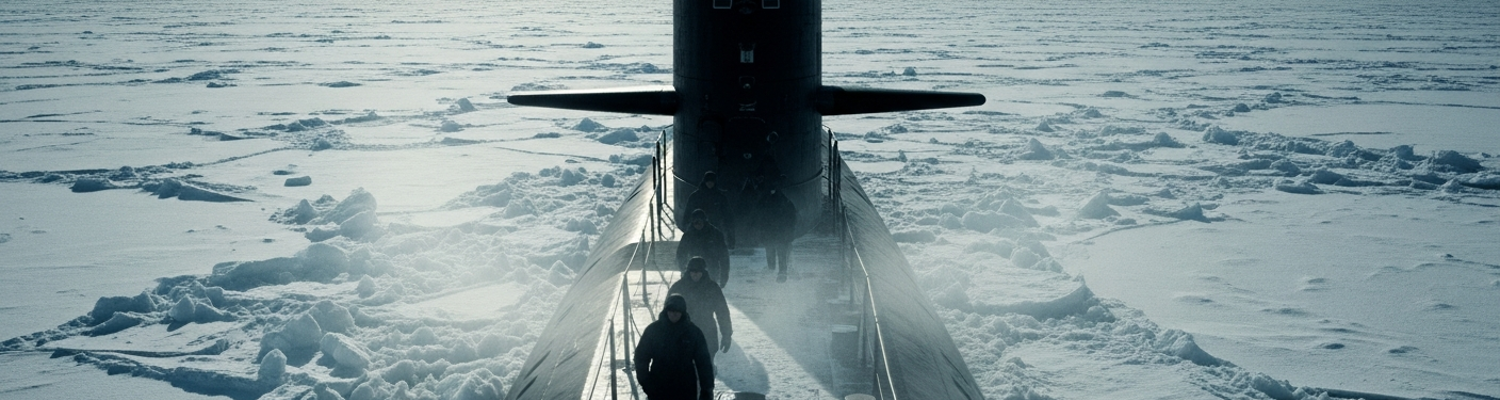
Operational logs from a mid-1970s Naval Special Warfare deployment, codenamed Operation Quiet Creep, reveal a failure rooted in the misinterpretation of acoustic intelligence. The mission tasked a four-man U.S. Navy SEAL team, designated Reconnaissance Team Vesper, with confirming the presence of a new class of Soviet ballistic missile submarine. Intelligence analysts at a Naval Facility (NAVFAC) in Iceland, monitoring a new extension of the SOSUS, had isolated a unique, low-frequency acoustic signature deep within the ice pack of the Kara Sea. The signature was believed to be a new, quieter propulsion system. Based on this data point, Team Vesper was inserted by a Sturgeon-class submarine to establish a forward observation post on the ice, provide visual confirmation, and gather signals intelligence. The team was deployed onto the sea ice with specialized cold-weather gear and rations for a 72-hour mission.
The acoustic signature was not a submarine.
Archival evidence shows an inter-service dispute preceded the mission. Air Force weather reconnaissance had flagged the target area as a region of intense geologic instability and dynamic ice formation. Their reports noted that the specific hydrographic features of the shallow basin, combined with pressure from the polar ice cap, were known to create anomalous acoustic events. The ice itself, grinding and fracturing under stress, was capable of producing a wide array of sounds, from low rumbles to high-frequency pings. Navy intelligence, however, held confidence in the capabilities of the SOSUS network. They theorized that the unique sound was a Soviet boat using the complex under-ice topography to mask its acoustic fingerprint. The analysts had filtered the raw data, removing what they considered background noise. In doing so, they amplified a harmonic resonance that matched, in their database, the profile of a submarine’s machinery. The decision was made to trust the electronic signal over the environmental analysis.
This decision sent Team Vesper into an environment where their reconnaissance tools were rendered inert. The perpetual twilight of the polar winter, combined with near-constant whiteout conditions, made traditional optical surveillance impossible. High-powered camera lenses and spotting scopes were useless against the swirling ice crystals and fog. The extreme cold, dipping below minus 40 degrees Celsius, caused the lithium batteries powering their electronic surveillance gear to fail within minutes. Magnetic compasses were unreliable due to proximity to the magnetic pole. The team was operating blind, dependent on coordinates from a flawed intelligence assessment. Their mission rested on finding a submarine that was not there.
The mission’s compromise was a direct result of this cascading failure. Following their pre-planned route, Team Vesper moved across the ice toward the coordinates where the Soviet submarine was believed to be. Instead of a polynya, an opening of clear water, they found a chaotic field of pressure ridges and unstable ice pans. The same geologic forces generating the acoustic anomaly were actively reshaping the ice from below. Without warning, the ice sheet fractured. A post-operation analysis concluded that a powerful upwelling of warmer, denser saltwater, driven by the same sub-sea feature that created the acoustic resonance, likely shattered the ice pan occupied by the two-man forward element. The men and their equipment were lost to the water. The two surviving members of the team were forced to abort the mission, their extraction complicated by the same environmental conditions. The official report listed the cause of loss as an environmental hazard, a statement which obscured the intelligence failure that placed them in that location.
Inter-Service Air Support Disputes
For the two surviving members of Reconnaissance Team Vesper, stranded on the Kara Sea ice pack, the immediate concern was survival. A review of operational logs shows the extraction request was filed almost immediately. The response was not swift. The team’s parent unit, a Naval Special Warfare Group, had a dedicated helicopter squadron on alert. The squadron’s Sikorsky SH-3 Sea Kings were workhorses of naval aviation. The primary rescue helicopter designated for Team Vesper was grounded hundreds of miles away. The extreme cold had caused the MIL-H-5606 hydraulic fluid in its main rotor servo-actuators to congeal, rendering the aircraft non-operational. A replacement part was available, but it would take at least 24 hours to fly it in and complete the field repairs. This was a timeline the freezing SEALs could not afford.
A jurisdictional chasm opened between the services. With its own assets disabled, the Navy’s tactical command sent an urgent request to the nearest U.S. Air Force authority: the Strategic Air Command (SAC) post at Thule Air Base, Greenland. A conflict erupted. SAC’s mission was global and nuclear. Its commanders saw the world through the lens of deterring a Soviet bomber attack. Their primary duty was maintaining readiness for the Single Integrated Operational Plan, the blueprint for nuclear war. From the perspective of the SAC duty officer at Thule, diverting a strategic asset for a tactical-level Navy rescue was an unacceptable degradation of their core mission. Archival evidence shows a series of heated teletypes between the naval command and SAC. The Navy argued for immediate action to save its men. The Air Force contended that the SEALs were a tactical unit engaged in a tactical operation, and their extraction was a problem for the Navy’s tactical support structure, not a strategic command.
This doctrinal impasse led to conflicts over specific airframes and protocols. The Navy, lacking organic long-range capability, requested the one aircraft suited for the job: the Air Force’s HH-3E Jolly Green Giant. An evolution of the same Sea King airframe the Navy used, the HH-3E was purpose-built for long-range combat search and rescue, equipped with armor, self-sealing fuel tanks, and a retractable in-flight refueling probe. Allocating an HH-3E was not a simple matter. To reach the SEALs’ position and have enough time on station for a search, the helicopter would require multiple in-flight refuelings from an HC-130 tanker aircraft. These tanker assets were also under SAC’s operational control, viewed as essential components of the strategic bomber force. The argument devolved into a dispute over fuel allocation, flight hours, and risk. SAC commanders refused to release an HC-130 tanker for what they deemed a non-strategic mission without a direct order from the Joint Chiefs. This process would add many more hours to the delay. Every hour spent arguing over refueling protocols was another hour the survivors of Team Vesper were exposed to the polar environment.
Arctic Cold Weather Medical Failures
After-action reports from a late-1982 joint-service exercise off the northern coast of Alaska reveal the consequences of systemic medical unpreparedness. The incident centered on a reconnaissance platoon from the 2nd Reconnaissance Battalion, inserted by helicopter to establish covert observation posts along a 50-kilometer stretch of coastline. Their mission was to simulate the detection of a Soviet amphibious landing. The unit was equipped with standard-issue M-1951 cold-weather gear, based on Korean War-era designs known to be bulky with poor moisture-wicking properties. Within 36 hours, an un-forecasted weather front descended, plunging temperatures to -40 degrees Fahrenheit before wind chill. The platoon’s light infantry tents were shredded. The Marines, caught in exposed positions, fell victim to the environment. Man-portable PRC-77 radios, their only link to command, suffered from degraded battery life in the cold, reducing their effective broadcast range and forcing them to conserve power. The first reports, when they did get through, were grim. Multiple instances of severe frostbite were reported, particularly on the hands and feet of Marines who had handled metallic equipment. Worse were the reports of advancing hypothermia: uncontrollable shivering, slurred speech, and confusion. The platoon was no longer a functioning reconnaissance element. It was a mass casualty situation.
The crisis was precipitated by a single, abortive logistics flight.
A CH-46 Sea Knight helicopter, operating from the deck of the USS Guadalcanal (LPH-7) steaming 100 nautical miles offshore, was scheduled to deliver supplies, including arctic fuel additives for the platoon’s stoves and replacement batteries for their radios. That mission never arrived. An examination of the ship’s maintenance logs (Log ID 7-A-821104) shows the designated aircraft suffered a mission-killing mechanical failure. The cold caused the seals in the hydraulic actuators for the forward rotor system to contract and fail, leading to a major leak. While the part was available in ship stores, the weather on deck, with heavy sea spray freezing on contact and winds gusting over 50 knots, made a flight-line replacement impossible. The on-deck commander, weighing the risk to the aircrew against a platoon he believed was simply uncomfortable, made the decision to scrub the flight until the weather broke. That decision was based on a misunderstanding of the platoon’s actual condition, a gap in knowledge created by the failing radio batteries. The Marines on the ice were now alone.
The medical evacuation that followed was a study in systemic failure. With his men deteriorating, the Recon platoon leader declared a medical emergency, using the last of his battery power to send a single nine-line MEDEVAC request. The Navy’s own assets were useless. The Guadalcanal was too far and its helicopters were not equipped for the long-range flight. The request was relayed to the regional joint-task-force command at Fort Richardson, Alaska, where it fell into a bureaucratic chasm. Per doctrine, the request was for Air Force assistance, specifically for a long-range HH-3E Jolly Green Giant. Communications traffic shows a command paralyzed by procedure. The Air Force duty officer at the rescue coordination center refused to scramble the asset without formal approval, arguing the HH-3E was a strategic resource tasked for downed pilot recovery, not for supporting a Marine ground unit in a tactical exercise. The Navy’s request lacked the correct joint-service authorization codes (per JCS Directive 1558.2). No pre-established protocol existed for this contingency. As officers argued over jurisdiction, the Marines on the ice waited. Field medical care was nearly impossible. Morphine syrettes were frozen solid. The corpsman’s treatment doctrine was for trauma, not the complex rewarming required to save a hypothermic patient. By the time an Air Force HC-130 tanker and HH-3E helicopter were finally dispatched six hours later, two Marines had succumbed to the cold. More than a dozen others suffered injuries from frostbite so severe they would require amputations.
Systemic Inter-Service Command Flaws
An examination of declassified reports and inter-service communications from the Cold War reveals that operational failures in the Arctic were not isolated incidents. They were symptoms of a persistent dysfunction in the American military command structure. The architecture established by the National Security Act of 1947, while intended to unify the armed forces, in practice created powerful, semi-independent service branches, each with its own budget, doctrine, and culture. This structure was ill-suited for the demands of the Arctic theater, which required seamless, rapid cooperation between air, sea, and land assets. Instead of a unified force, what existed was a collection of rivals in temporary alliances. Requests for support between services were not tactical conversations. They were formal, multi-stage processes that had to travel up one rigid chain of command before being passed over and sent down another. This cumbersome system was designed for the large-scale contingencies of a European war, not the sudden emergencies that defined Arctic operations.
The doctrinal chasm between the services was a source of constant friction. This was most apparent in the philosophical divide between the U.S. Air Force's Strategic Air Command and the U.S. Navy. SAC’s existence was predicated on a single mission: executing the Single Integrated Operational Plan (SIOP), the nation’s playbook for global nuclear war. Its commanders were indoctrinated with the belief that their sole purpose was to maintain readiness to deliver a massive nuclear strike against the Soviet Union. From the perspective of a SAC duty officer, every asset was a component of this strategic deterrent. A request from the Navy to divert a rescue helicopter and its essential HC-130 tanker to save a handful of SEALs was seen as a direct degradation of their ability to perform this primary mission. It was a conflict not just of priorities, but of worldviews. The Air Force saw the Arctic as a strategic corridor for bombers and a defensive zone against a Soviet air attack. The Navy viewed it as an anti-submarine warfare battlespace and a sanctuary for its own ballistic missile submarines. These conflicting perspectives, ingrained by decades of separate training and budget battles, fostered a culture of mutual distrust where cooperation was the exception.
This recurring friction had a corrosive, long-term impact on overall Arctic operational readiness. Analysis of joint-service exercise schedules from the late 1970s through the mid-1980s indicates a trend away from complex, multi-service operations in the high north. The institutional scars left by failed operations and inter-service disputes made commanders risk-averse. Planners at the unified Alaskan Command, which was itself disestablished and reformed multiple times due to unity-of-command problems, increasingly favored simpler, service-specific drills that were easier to manage and less likely to result in jurisdictional fights. This created a dangerous feedback loop. As joint exercises became less frequent, the ability of different branches to operate together atrophied. The specialized skills needed to coordinate a Navy SEAL team’s insertion with Air Force weather reconnaissance, Army logistical support, and Coast Guard ice patrols were never fully developed. While individual units often possessed exceptional capabilities, the connective tissue needed to bind them into a coherent joint force for an Arctic crisis was dangerously weak. The United States military maintained a presence in the Arctic, but its actual warfighting capability in the region was consistently undermined by the very command system designed to enable it.