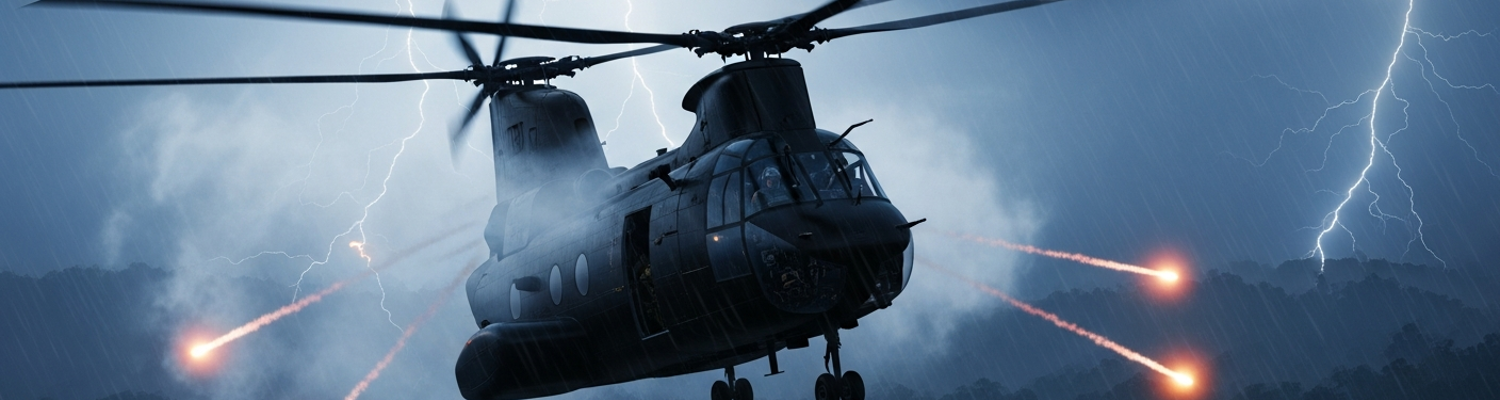

The air on the flight line at Phu Bai was a physical weight. It was thick with water, heat, and a silence that felt heavier than sound. This quiet was the signature of the I Corps Tactical Zone during the northeast monsoon, a dense blanket of anticipation broken only by water dripping from saturated canvas and the metallic ticking of cooling engines. For the men of Marine Medium Helicopter Squadron 161 (HMM-161), this was the final breath before their CH-46 Sea Knights would beat the oppressive atmosphere into submission. It was an illusion of peace before plunging into a world defined by vertical terrain and horizontal rain.
The operational environment was a primary adversary. Meteorological records from late 1969 document the monsoon bringing up to 116 inches of rain to the areas around Hue. Pervasive fog and low-lying cloud cover could reduce visibility to mere feet. Extreme humidity stressed both machinery and men. The terrain itself was a collection of jungle-choked mountains and steep-walled valleys, rising sharply from the coastal plains. Ground movement was a near impossibility. The national railway system had functionally ceased to exist by 1965, and roads were little more than mud-choked ambush sites. This geography created isolated pockets of operation. Fire support bases like Cunningham or Vandegrift became lonely islands in a sea of hostile green. For the Marines holding these outposts, survival was measured in the sound of approaching helicopters.
They were islands that could only be reached from the sky.
Operational logs from 1969 show an absolute dependency on aerial resupply. Units like HMM-161, flying from Quang Tri and Phu Bai, were the sole lifeline. Their workhorse, the Boeing Vertol CH-46 Sea Knight, was a machine at war with its own design in this environment. The tandem-rotor helicopter, the “Phrog,” was notorious for maintenance issues. Its T58-GE-8B turbine engines were powerful but susceptible to power loss when fine sand and dust from unimproved landing zones were ingested into the compressors. Early models arriving in-country proved to be maintenance nightmares. Transmissions and rotor blades showed weaknesses that forced performance restrictions. A catastrophic design flaw discovered in 1967 caused the entire aft pylon and rotor assembly to detach in flight, leading to multiple crashes and a temporary grounding of the fleet. Even with the improved D-model, which featured more robust components, archival evidence shows maintenance crews worked relentlessly to combat everything from rotor blade abrasion to fuel system contamination. Each mission was a calculated risk.
This created a tactical problem. The impassable terrain forced the Marines into isolated firebases. The isolation demanded constant aerial resupply. The resupply flights were forced to follow predictable paths through valleys and mountain passes. These were the only navigable routes in the abysmal weather. North Vietnamese Army anti-aircraft units, possessing a sophisticated understanding of these constraints, turned these aerial corridors into carefully prepared killing zones. NVA air defense regiments were equipped with Soviet-designed DShK 12.7mm heavy machine guns and ZPU-series 14.5mm cannons, often in dual or quad mounts. These weapons were portable enough to be positioned on key ridgelines overlooking the flight paths. They employed subtle tactics, holding fire to map flight patterns and then concentrating their guns on a single aircraft. The CH-46, especially when loaded, was not nimble enough to easily evade this type of coordinated fire. The pilots of HMM-161 were flying directly into a tactical puzzle from which there was no easy escape.
The transit to Firebase Hawk was not a simple flight. It was a contested journey flown at the absolute floor of the operational envelope. The CH-46D Sea Knights flew in a loose, staggered column, a formation dictated by the need for mutual fire support and the crushing reality of the weather. Low-level cloud cover forced the convoy to fly nap-of-the-earth, a physically and mentally draining exercise in contour flying. Pilots kept their aircraft just feet above the jungle canopy or the winding riverbeds. The tandem rotors of the Phrogs churned the humid air into a vortex of mist and vegetation. This low altitude was a tactical necessity to remain under the clouds, but it made the helicopters predictable targets. The General Electric T-58 turboshaft engines, already prone to power loss in the hot, particle-dense air, required constant, minute adjustments from the pilots to maintain altitude and airspeed. The aircraft hovered around a relatively slow 100 knots to navigate the terrain. Each helicopter, carrying a full stick of combat-loaded Marines, was a machine at the edge of its performance capabilities.
Inside the vibrating fuselage, the world was reduced to noise and tension. The typical cabin environment of a CH-46 in flight was a deafening assault of mechanical sounds. The whine of the coupled transmissions, the percussive slap of the six rotor blades, the rush of wind through the open cabin doors and ramp. Yet, in the moments before arriving at a hot landing zone, a different atmosphere would settle. Veterans of these flights describe a profound, almost unnatural stillness. It was not a silence of sound, but a silence of action. The Marines, packed shoulder-to-shoulder on the red canvas troop seats, ceased their checks of weapons and gear. They sat motionless, weighed down by flak jackets, helmets, and ammunition. Conversation was nonexistent. The crew chief and door gunner, tethered by their safety harnesses, remained fixed at their M60 machine guns, their eyes scanning the terrain below without interruption. It was a collective holding of breath, a shared internal state where every man was alone with his thoughts.
The world outside the cabin doors was one of continuous green. This green was not empty. As the CH-46 convoy roared low over the landscape, the crew and passengers could clearly see the details of life on the ground. Below them were the geometric patterns of rice paddies, shimmering with water under the gray monsoon sky. Dotted across these paddies were the conical hats of local Vietnamese civilians, their backs bent to agricultural labor. The proximity was startling. From the low altitude, individual faces and actions were discernible. This presented a severe tactical dilemma. A review of the rules of engagement for 1969 shows a complex and often restrictive set of criteria for firing. Door gunners and pilots could only fire if they could visually identify a source of hostile fire. The line between civilian and combatant was intentionally blurred by enemy forces. These farmers could be what they appeared to be, or they could be Viet Cong militia waiting for the helicopters to enter the most vulnerable phase of their approach. A simple farming tool could be exchanged for a rifle in seconds. Making that distinction from a moving aircraft in a matter of moments was a near-impossible task, placing a significant psychological weight on the gunners.
The attack began with no warning. A sudden, violent rip in the monotonous drone of the rotor wash. For the CH-46D convoy of HMM-161, flying low in the narrow confines of the valley, the first indication of the ambush was the appearance of incandescent red-gold lines reaching up from the jungle. Bright tracers from a 12.7mm DShK heavy machine gun stitched across the sky. The lead aircraft, callsign Yankee Whiskey Seven, shuddered violently as multiple rounds hammered into its aft section. Inside the second aircraft, ten seconds behind, Lance Corporal Jensen, the port-side door gunner, watched the impacts. He saw flashes of light on the skin of the helicopter ahead and a momentary, violent yaw as the pilots fought for control. Jensen instinctively gripped the spade handles of his M60D machine gun. The brass of the belted 7.62x51mm ammunition was cool against his forearm. His world snapped into hyper-focus on a single point in the dense treeline below.
His eyes traced the origin of the enemy fire to a nearly invisible emplacement dug into a small hillock, perfectly positioned to command the aerial route. He swung the pintle-mounted M60D, the weapon moving smoothly in its socket, and acquired the target through the aircraft’s ring-type sight. As his thumb hovered over the butterfly trigger, a secondary detail registered. Just beyond the enemy gun, no more than fifty meters up-slope, stood a lone civilian hut, its thatched roof stark against the jungle. Archival records of the 1969 rules of engagement for aircrews in I Corps were explicit. Firing was authorized only when a hostile threat was positively identified, and crews were to take every precaution to avoid collateral damage. NVA and Viet Cong forces were masters at exploiting this restriction, deliberately placing their heavy weapons near undefended villages or isolated farmsteads. Jensen was now a captive of this exact tactic. The DShK was still firing, methodically chewing apart the lead helicopter, yet a direct burst from his position would send a stream of bullets directly into the fragile structure.
More than twenty Marines depended on his next move.
Without hesitation, Jensen keyed his helmet’s intercom switch. His voice was a raw shout over the engine noise, calling out the gun’s position and the hazard to his pilot. It was a two-part command: a description and a direction. The pilot, Major Frank Aikman, understood instantly. The CH-46 was not built for agility. Yet Aikman threw the cyclic control hard to the left, pulling the collective simultaneously to maintain altitude. The helicopter banked at a severe angle that pushed its airframe to the limits of its performance envelope. For the Marines packed in the cabin, the maneuver was a sudden, stomach-lurching drop, pinning them against the starboard bulkhead. For Jensen, tethered by his safety harness, it felt like the floor was falling away as the world tilted violently. The maneuver, lasting no more than three seconds, radically altered his firing angle. It shifted the civilian hut completely out of his line of fire.
With a clear field of fire, Jensen depressed the trigger. The M60D, firing from an open bolt, hammered against his shoulder. He unleashed a controlled burst of approximately 100 rounds at a cyclic rate of 550 rounds per minute. His tracers, a one-in-five mix in the belt, formed a green line that converged perfectly on the muzzle flashes of the DShK. The suppressive fire was overwhelming. An examination of after-action reports from similar engagements shows that such a high volume of accurate fire, even from a 7.62mm weapon, was often enough to force the crew of a heavy weapon to abandon their position. Ahead, Yankee Whiskey Seven, trailing a thin mist of hydraulic fluid from a severed line in its aft transmission housing, stabilized its flight. The entire convoy pushed through the kill zone, accelerating to clear the area. Post-flight inspection records for Jensen’s M60D (per Maintenance Log 7A-1138) indicated that 117 rounds were expended to neutralize the threat.
The immediate aftermath was a study in controlled violence. A post-flight inspection of Yankee Whiskey Seven revealed the extent of the potential disaster that had been avoided. At least five 12.7mm rounds had struck the aircraft. Three had punctured the fuselage skin, passing through the cabin without hitting any personnel. Two other rounds inflicted more serious damage. One severed a primary hydraulic line leading to the aft transmission, explaining the fine mist of fluid and the pilot’s initial struggle for control. The second round had struck and partially penetrated the lower housing of that same transmission. Had it hit inches higher, it could have shattered critical gearing, leading to a catastrophic failure of the aft rotor system and an uncontrollable crash. The aircraft was flyable, but severely wounded. A detailed casualty assessment confirmed zero friendly losses.
Lance Corporal Jensen’s suppressive burst had been precise, silencing the DShK gun. From the air, the crew saw their tracers impact the emplacement, but confirming enemy casualties was impossible. The convoy’s primary objective was to push through the kill zone and complete its mission, not to conduct a battle damage assessment. The NVA gun crew may have been killed, wounded, or simply forced to abandon their weapon. This ambiguity was a common feature of such aerial engagements. What was certain is that the combination of the helicopter’s sudden maneuver and the immediate return fire broke the ambush. It turned a prepared killing ground back into a contested space, allowing the entire flight to escape.
The decision to bank the aircraft before firing carried long-term strategic weight. A close review of Marine Corps civil affairs doctrine from I Corps in 1969 shows a constant struggle for the allegiance of the local population. North Vietnamese and Viet Cong strategy often depended on goading American forces into actions that would cause civilian casualties, which could then be exploited for propaganda. Every village destroyed and every non-combatant killed was a strategic victory for the insurgency. The choice made by Major Aikman and Lance Corporal Jensen was a direct application of the complex rules of engagement, which demanded crews take precautions to protect civilians even while under direct fire.
This single act of tactical discipline fed into a much larger conflict. Intelligence summaries from the period indicate that villagers who did not fear indiscriminate American air power were more likely to remain neutral or provide passive information about enemy movements. The NVA tactic of placing heavy weapons near civilian homes was a calculated risk, designed to either provide a human shield for their gunners or create a propaganda incident. When a helicopter crew demonstrated the ability and willingness to neutralize the threat without destroying the home, it sent a powerful counter-message. It demonstrated capability and intent, undermining the narrative that American forces were an indiscriminate occupying power. While impossible to trace a direct line from this single engagement to a specific intelligence gain, the collective impact of such actions was a recognized factor in shaping the operational environment.