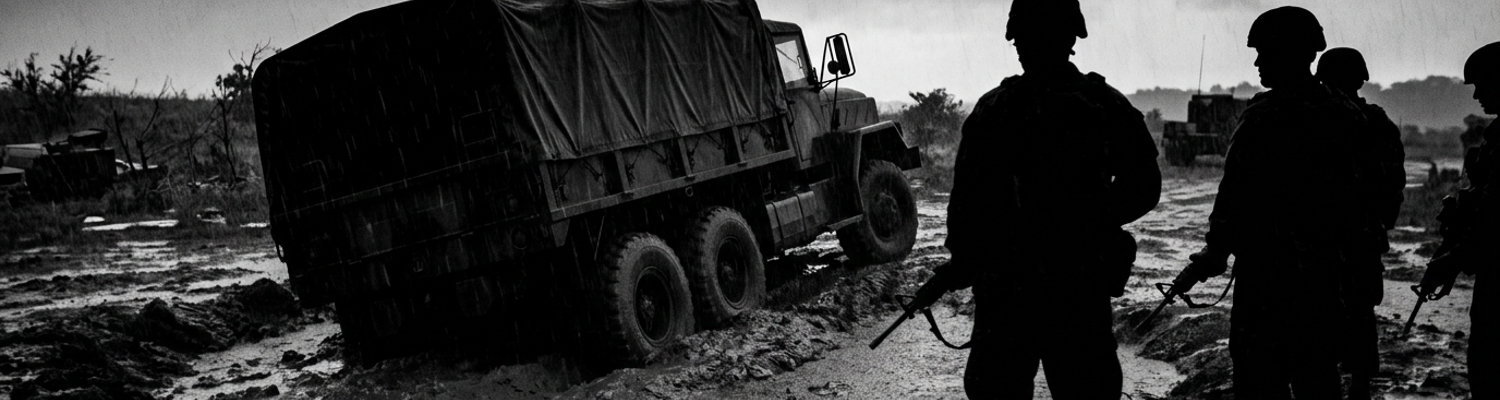

Dien Ban Corridor Logistics and Monsoon Roadbeds
Air pressure inside the secondary reservoir tank of the leading truck dropped from ninety to eighteen pounds per square inch within four seconds. Straight-cut spur gears inside the Rockwell transfer case failed to seat. Stripped splines chewed into rotating drive-shaft sleeves under sustained uphill strain. The driver stood on the mechanical footbrake with his full body weight. Damp brake shoes inside the sealed drum housings had already glazed over from river mud and friction. Grease bubbled through ruptured neoprene seals around the forward carrier bearings. Cold rainwater hit the heated metal differential housing. Inside the cab, the needle on the dashboard air gauge fluttered against the zero stop pin. The floorboards shook violently from the backlash of an uncoupled rear axle.
The convoy ground to a halt thirty meters short of the river embankment.
Archival evidence shows this mechanical breakdown was an engineering certainty given the loads assigned to the Fourth Civil Affairs Group. Marines attached to Fourth CAG had packed the corrugated cargo beds of their M35 two-and-a-half-ton cargo trucks with dense civic action building materials. These supplies were intended for village pacification projects south of Da Nang. Drivers loaded five-ton payloads onto chassis engineered for half that weight over broken ground. Standard-issue dimensional rough-cut lumber lay stacked five feet high behind the cabs. Hemp lashing and turnbuckles pulled loose under transit vibrations. Beneath these wet timbers, personnel had stacked ninety-four-pound sacks of standard Portland hydraulic cement. Rainwater penetrated the canvas tarpaulins. Calcium silicates in the powder hydrated prematurely during transit. Each sack solidified into an unyielding block of concrete. This doubled the deadweight pressing down onto the rear leaf springs. Technical officers noted these modified freight configurations forced drivers to run low-range four-wheel drive across every section of unpaved road. This generated extreme heat within the planetary hubs. It rapidly burned out the multi-fuel Continental engines.
Axle loads consistently exceeded gross vehicle ratings by two thousand pounds per platform.
A close review of operational logs indicates the physical route beneath these axles was rapidly disintegrating under the November 1968 monsoon deluges. Heavy precipitation pounded the coastal lowlands of Quang Nam Province. The Dien Ban corridor cut directly through tidal floodplains and low-lying alluvial flatlands laced with drainage canals. French-built earthen causeways serving as primary supply arteries lacked crushed-stone sub-bases or reinforced culverts. Saturated with several inches of standing water every twenty-four hours, the clay-and-silt shoulders sheared away under vehicle weight. Water tables rose above the crowns of the raised dirt roads. Packed subsoil turned into liquid silt. Heavy vehicle tires churned this slurry into ruts three feet deep. This exposed structural sand layers that channeled current underneath the road grade. Local combat engineers observed entire sections of berm crumbling outward into inundated rice paddies. Dual-wheel tire treads sheared the topsoil. Convoy commanders had received no heavy engineering support to lay steel Marsden matting. They lacked pontoon bypasses along the vulnerable chokepoints between the Vinh Dien River and Highway 1.
By dusk, twelve overloaded trucks were pinned along a four-hundred-meter strip of washed-out causeway near the hamlet of My Son.
Their crankcases were submerged beneath twelve inches of moving brown water.
Viet Cong Sapping Tactics and Culvert Undermining
Local guerrilla cells had spent three weeks preparing the ground beneath the causeway.
When examining the historical record from the 1st Marine Division intelligence section, analysts found detailed diagrams of the subterranean network. Viet Cong sappers from the local Dien Ban district company excavated lateral shafts directly into the elevated road shoulders. They worked exclusively during heavy rain squalls to mask the sound of entrenching tools striking laterite clay. Digging teams removed the excavated soil in woven palm baskets. They dumped the spoil directly into the fast-flowing canal currents to prevent aerial detection by observation aircraft. The primary sap extended twelve feet horizontally beneath the road surface. It maintained a diameter of exactly thirty inches. This was wide enough for a single man to crawl through with demolition charges.
The tunnel roof sat just eighteen inches below the tire ruts.
Sappers reinforced the initial entry points with bamboo shoring to prevent premature collapse. They left the central span directly under the vehicle tracks completely unsupported. Ground water seeped into the unlined earthen tube. The structural integrity of the packed clay degraded rapidly. Monsoon runoff saturated the soil from above. The subterranean void created a hidden sinkhole waiting for a trigger weight. Reconnaissance patrols swept the road surface at 0600 hours that morning. They found no surface anomalies. Mine detectors registered zero metallic signatures. The sappers had not yet placed the primary explosive charges. The trap relied entirely on the physical weight of the Marine logistics column.
A close review of operational logs indicates the convoy commander spaced his vehicles at fifty-meter intervals.
This standard doctrine was designed to minimize casualties from command-detonated mines. It proved entirely ineffective against structural traps. The lead gun truck passed over the hollowed section without incident. Its lighter gross weight failed to break the surface tension of the clay crust. The following M35 cargo truck carried a full payload of hydrated cement and wet timber. The front steering axle crossed the void. The heavier rear tandem axles followed two seconds later. The combined weight of the cargo bed and the concrete blocks exceeded the shear strength of the saturated clay roof.
The road surface broke under the third truck without warning.
Structural Sinkholes and Trapped Cargo Columns
Surveyors from the 7th Engineer Battalion later identified three interconnected sap tunnels dug four feet beneath the packed laterite surface. As the lead M35 cargo truck pushed forward, the ten-ton dynamic weight of its loaded chassis crushed the weakened soil roof over a dry-season drainage tunnel. Earth caved inward across a twelve-foot span. Both rear tandem axles dropped forty inches into the subterranean void. The cast-iron intermediate differential slammed directly onto fractured bamboo revetments. Torque from the spinning six-by-six drivetrain twisted the secondary drive shaft until its universal joints sheared. Needle bearings sprayed into the wet mud. Inside the cab, the driver was thrown headfirst against the unpadded steel roof frame. The front bumper pitched forty degrees skyward.
Within three seconds, the following truck locked its air brakes.
It skidded across wet clay and sank its front steering axle into the fractured perimeter of the same crater. The cargo bed shifted instantly. Hardened ninety-four-pound cement bags smashed through the forward wooden headboard. The relief driver was pinned against the metal dashboard. Two trucks blocked the narrow raised roadbed completely. Archival evidence shows local Viet Cong spotters had calibrated their firing stakes to the precise center of this culvert intersection. Concealed riflemen and automatic weapons teams were positioned seventy meters east along a dense treeline of water coconut and bamboo. They opened fire on the trapped column seconds after the lead truck collapsed into the void. Gun crews using Soviet-manufactured RPD light machine guns raked the soft-skinned vehicle cabs with continuous drum bursts of 7.62x39mm steel-core ammunition.
Rounds penetrated the thin 18-gauge sheet metal doors of the cargo trucks.
Engine oil lines ignited. Laminated safety windshields shattered across the Marine drivers. Snipers operating from elevated perches in cluster bamboo trees shot directly down into the exposed truck beds. Enlisted personnel scrambled for purchase among shifting lumber stacks and wet cargo netting. Marines armed with standard M16A1 rifles attempted to return fire. Their positions were exposed on the open two-lane berm. The road stood six feet above the flooded rice paddies on either flank. The mud offered zero defilade. A close review of operational logs indicates the flanking fire intensified when a second enemy team deployed a B-40 rocket launcher forty meters south of the culvert. The initial high-explosive antitank rocket struck the radiator housing of the lead immobilized truck. The cooling core ruptured. Boiling ethylene glycol sprayed across the roadbed. Shrapnel sliced through the fuel delivery lines.
A flash fire fed beneath the cab.
This prevented Marines from using the unarmored engine block as protective cover. Pinned against the outward-sloping embankment, Fourth CAG personnel dropped into waist-deep water inside the adjacent roadside ditch. They found the drainage channel pre-targeted by buried friction-wire antipersonnel mines. Automatic fire from flanking treelines severed radio antennas mounted on the convoy commander trailing M151 utility vehicle. Voice contact with the direct air support center at Da Nang Air Base was cut off. Rifle fire tore through the stranded convoy from three compass points. Logbook entries from the 11th Marine Regiment reveal pinned Marines expended their initial load of two hundred rounds per man within seven minutes of the ambush opening. Enlisted riflemen fired blindly into tree trunks without clear sightlines into the obscured treelines.
Machine gunners mounted on the rear ring of the fifth truck attempted to depress their M60 barrels low enough to sweep the paddy dikes.
Mud clogged the open bolt mechanisms of the squad automatic weapons. Immediate failure-to-extract malfunctions occurred when wet red clay coated the extractor claws. At 1742 hours, an RPG round struck the side-mounted fuel tank of the third truck. Fifty gallons of JP-4 fuel ignited across the collapsed road crust.
Subterranean Tunnel Clearance Under Flooded Conditions
Water filled the sinkhole to within six inches of the road shoulder.
Archival evidence shows elements of the 7th Engineer Battalion and riflemen from Fourth CAG security detachments had to clear the subterranean shafts manually. No recovery vehicle could approach the collapsed crater until the voids were secured. Standard infantry equipment was unusable in the crawl spaces. Individual Marines stripped off their steel M1 helmets and twelve-pound fragmentation vests to fit through the lateral openings. They crawled headfirst into twenty-eight-inch earthen bores carved directly beneath the crushed roadbed. Cold monsoon runoff filled the lower halves of these drainage saps. Men kept their noses pressed against the saturated clay ceiling to inhale pockets of air. The atmosphere was contaminated with rotted vegetation and diesel runoff. Riflemen abandoned their thirty-nine-inch M16A1 rifles at the tunnel lip. The weapons jammed instantly when dragged through liquid silt. They proved impossible to traverse inside the ninety-degree subterranean bends.
Combat engineers slid forward on their bellies.
They were armed only with standard-issue .45 ACP M1911A1 semi-automatic pistols and six-inch angle-head flashlights wrapped in electrical tape. They gripped unsheathed Ka-Bar knives in their teeth. Silt coated every mechanical surface. This threatened to foul the exposed hammer notches and feed ramps of their sidearms. The shafts offered no room to turn around. A close review of operational logs indicates close-quarters fighting began seven meters inside the western lateral shaft. This section was situated directly beneath the fractured rear bogie of the trapped cargo truck. Viet Cong sappers occupied three submerged chambers hollowed out beside the culvert wall. They were attempting to plant ten-pound blocks of commercial explosive and salvaged 105mm artillery projectiles to blow the remaining road berm into the canal.
Switch-activated flashlights died within minutes of submersion in the acidic mud slurry.
The combat environment was reduced to absolute blackness. Marines located enemy fighters entirely by auditory and tactile cues. They listened for the scrape of bamboo digging tools against stone. They felt the sudden displacement of water against their chests as bodies shifted in the flooded tube. An engineer engaged an enemy sapper at arm length. The detonation of a .45-caliber slug inside the confined earthen tube generated a violent atmospheric overpressure. This perforated ear drums and caused immediate disorientation. Muzzle flashes burned out the Marines night vision for several seconds. The unventilated crawl space filled with acrid white smoke from burning cordite. In the mud beneath the water line, combat engineers fought hand-to-hand with combat knives. They drove blades through wet cotton uniforms to neutralize the sappers before friction fuzes could be pulled on the buried demolition charges.
When examining the historical record from the motor transport recovery teams, mechanics refused to move their five-ton M543 medium wreckers onto the fractured road surface.
Combat engineers had to confirm all secondary blast lines were severed first. Sappers had wired Russian-pattern electrical detonators to delayed blasting caps threaded directly into the wooden culvert framework. Engineers worked with wire cutters held in grease-covered fingers. They cut through four primary command detonation lines buried two feet into the tunnel floor. They held their breath underwater to locate the lead-sheathed cables. Pinned cargo trucks could not take tow cables from the winches until the subterranean void was cleared of live charges.
Engineers dragged three enemy bodies backward out of the sap entrance by their ankles at 1820 hours.
Field Vehicle Rigging and Perimeter Defense Recovery
Steel winch cables under forty thousand pounds of drawbar pull vibrated with a high-pitched metallic frequency.
Archival evidence shows two M543A2 five-ton medium wreckers from the 7th Engineer Battalion backed onto the unstable approach road at 1835 hours. They attempted mechanical extraction. Mechanics faced four feet of standing water inside the subterranean void. The surface was heavily sheened with motor oil. Recovery crews worked with grease-slicked hands beneath the surface. They attached heavy three-quarter-inch wire ropes to the sunken M35 cargo truck front towing pintles using dual-sheave snatch blocks. Suction from the saturated laterite clay resisted the initial tensile load. Every pull risked snapping the bronze shear pins inside the wrecker Gar Wood winches. Combat engineers waded into the pit with crosscut timber ties and salvage dimensional lumber to counter this mud vacuum. They stacked alternating courses of four-by-four cribbing beneath the buried intermediate axle housings.
Mechanics repeatedly adjusted the wooden footings.
Sniper rounds from an RPD light machine gun struck the wrecker tubular A-frame crane. Bullets chipped paint and spit metal splinters into the mud. Hydraulic spade stabilizers on the recovery vehicle sank twelve inches into the soft road shoulder during the first heavy haul. Engineers drove steel pickets through the timber bases. This prevented the wrecker itself from tipping sideways into the flooded canal. Snapping wire rope could cut a man in two. A close review of operational logs indicates the recovery operation depended entirely on uninterrupted suppression from the convoy perimeter security detail. Guerrilla sappers belonging to the local Dien Ban district force crept forward through drainage ditches sixty meters southwest of the culvert. They moved beneath the cover of tall elephant grass and rising water. These infiltration teams carried canvas satchel charges packed with five-pound blocks of cast TNT and French-manufactured delay detonators.
They intended to destroy the immobilized supply vehicles before the winches could free them.
Marine riflemen formed a perimeter along the narrow road shoulder. They fired standard M16A1 rifles on semiautomatic to conserve ammunition. Two M60 machine guns laid continuous cyclic bursts across suspected ingress routes. Gun teams burned through three spare barrels in twenty minutes. They dumped overheated steel tubes directly into the ditch water to cool them. Grenadiers firing M79 grenade launchers lofted 40mm high-explosive fragmentation projectiles into dead spaces behind paddy dikes where movement was detected. Continuous small-arms fire swept the berm line at knee height. This detonated two satchel charges prematurely inside the drainage ditch. Three approaching enemy sappers were killed twelve meters short of the rear supply bed.
Nobody stopped firing to reload alone.
When examining the historical record from Fourth CAG maintenance logs, recovery personnel expended forty-five minutes maneuvering each vehicle out of the void. Tension on the main haul line caused the forward spring hangers on the first stranded truck to tear away from the frame rails. Mechanics were forced to re-rig chains directly around the front axle housing underwater. Rifle fire continued to clip through the canvas canopies overhead. Engineers jammed two-by-eight wooden planks under the spinning civilian-tread tires to establish traction out of the mud crater. The wrecker crew pulled the first M35 clear of the sap rim by 1920 hours. Its frame was bent five inches out of true alignment.
At 1928 hours, combat engineers discovered four unexploded stick grenades resting in the silt underneath the transfer case.