
Integrated Air Defense Threats in Quang Tri
A technician of the 274th Surface-to-Air Missile Regiment wiped condensation from the cooling tubes of an SNR-75 fire control radar transmitter near coordinates 16 55 N, 107 0 E. It was the evening of March 29, 1972. Just north of the Demilitarized Zone. He adjusted the magnetron frequency dials to filter out ground clutter from the surrounding Annamite mountains. This routine calibration of a UHF-band guidance system occurred hours before the People's Army of Vietnam launched the Easter Offensive. Three mechanized divisions crossed the 17th Parallel into Military Region 1. They advanced with T-54 tanks and 130mm field artillery.
The invasion force brought a highly concentrated anti-aircraft network.
Archival evidence shows the 36th Air Defense Division established a dense network of SA-7 shoulder-fired missiles, 37mm anti-aircraft guns, and heavy radar-guided systems. This deployment directly contested American and South Vietnamese rotary-wing operations across 4,000 square miles. The airspace above Quang Tri province became a continuous engagement zone for low-flying aircraft. A close review of operational logs indicates that aeromedical evacuation units lacked the equipment to survive this specific threat environment. UH-1H dustoff crews operating out of Camp Evans and Phu Bai traditionally worried about small arms fire from tree lines. The Easter Offensive introduced a Soviet-style mechanized air defense doctrine into the dense jungle canopy. North Vietnamese commanders positioned ZSU-23-4 Shilka self-propelled anti-aircraft guns along Route 9. These quad-barreled systems tracked targets using RPK-2 radar arrays.
Unarmored medevac helicopters flying at 1,500 feet suddenly found themselves painted by continuous radar pulses.
Standard medical helicopters of the 498th Medical Company did not carry radar warning receivers. Pilots had no electronic indication that a ground-based tracking system had locked onto their airframes. Crews only recognized the threat when green tracer rounds intersected their flight paths. The most severe escalation in the threat environment came from the integration of the S-75 Dvina system. NATO designated this the SA-2 Guideline. North Vietnamese logistics units dismantled these 35-foot-long missiles and dragged them southward through the A Shau Valley using tracked artillery tractors. They reassembled the batteries in camouflaged revetments just north of the Thach Han River. A standard SA-2 battery relied on a complex integration of different radar frequencies to function. The P-12 early warning radar scanned a 200-kilometer radius in the VHF band to detect incoming flights.
Once a target appeared on the cathode-ray tube, operators passed the coordinates via field telephone to the SNR-75 tracking radar.
The tracking unit emitted narrow UHF and E-band beams to lock onto the target. This specific combination of early warning and precise fire control allowed NVA forces to monitor American helicopters from the moment they lifted off the helipads in Hue. Missiles launched from concealed jungle clearings reached Mach 3 within six seconds. The presence of the SA-2 forced a permanent modification in flight profiles across Military Region 1. To avoid the tracking radar lock, helicopter pilots dropped their altitude to tree-top level. This altitude adjustment pushed the medevac flights directly into the engagement envelopes of the SA-7 Strela infrared-seeking missiles and 12.7mm DShK heavy machine guns. North Vietnamese air defense commanders deliberately designed this layered engagement zone. They integrated the heavy radar coverage to deny the medium altitudes. This forced all rotary-wing traffic down into a concentrated barrage of automatic weapons. By late April, the combination of radar-guided missiles and low-level ground fire severed the primary aerial supply and evacuation routes into the besieged city of Quang Tri. A single V-750V missile from an SA-2 battery carries a 195-kilogram fragmentation warhead.
The proximity fuse detonates 60 meters from the target.
It sprays 8,000 steel fragments across a 200-meter radius.
Experimental Flare Grids at Forward Airstrips
Specialist Fourth Class Thomas Vance of the 14th Combat Engineer Battalion stripped the rubber insulation off a spool of 16-gauge copper wire with his combat knife. He knelt in the mud at the northern edge of the Ai Tu Combat Base triage strip near coordinates 16 46 N, 107 11 E. It was 2045 hours on April 18, 1972. Vance twisted the exposed copper strands onto the ignition terminals of a modified Mk 24 Mod 4 magnesium flare. This munition was originally designed to be dropped from fixed-wing aircraft. He buried a six-volt standard-issue dry cell battery beneath a layer of laterite clay to prevent shrapnel damage.
A close review of operational logs indicates that combat engineers spent three days constructing this experimental high-intensity flare grid along the 1,500-foot dirt runway.
They spaced twenty-four individual magnesium canisters exactly fifty meters apart to form a rigid geometric rectangle. Each modified flare contained a chemical composition capable of generating two million candlepower of illumination for exactly three minutes. Planners wired the entire array to a single plunger-style detonation box located inside a sandbagged bunker adjacent to the medical tents. The circuit required exactly 1.2 seconds to ignite all twenty-four canisters simultaneously. Seventh Air Force commanders approved this specific terrain modification to facilitate nighttime aeromedical extractions using the HH-53 Jolly Green Giant. Daytime flights had ceased due to the continuous losses inflicted by radar-guided munitions. The 37th Aerospace Rescue and Recovery Squadron stationed at Da Nang Air Base received orders to conduct all heavy casualty evacuations after 2200 hours. A fully loaded HH-53B weighed 42,000 pounds.
It required precise visual reference points to touch down safely on unimproved dirt strips.
Pilots flying these heavy-lift airframes did not possess night vision goggles. They relied entirely on analog cockpit instruments and naked-eye visual cues to gauge their descent rates in the pitch-black jungle canopy. The high-intensity flare grid was designed to pierce the heavy coastal fog and create a highly visible glideslope for the approaching helicopters. Tactical officers calculated that the sudden burst of magnesium light would outline the landing zone clearly enough for the pilot to establish a stable hover before the NVA anti-aircraft batteries could adjust their firing solutions. Flight logs confirm the first extraction mission approached the Ai Tu perimeter at an altitude of 500 feet. Vance pushed the detonation plunger down just as the twin T64-GE-7 turboshaft engines of the lead HH-53 became audible over the tree line. Ignition of forty-eight million combined candlepower completely overwhelmed the visual receptors of the approaching flight crew.
A sudden transition from total darkness to blinding white light instantly destroyed the natural night vision of the pilots.
Spatial disorientation took hold as the crew struggled to read their altimeters. Mechanical factors then compounded the visual failure. Seventy-two-foot main rotor blades on the Jolly Green Giant generated a downward wind velocity exceeding one hundred knots during a low hover. Hurricane-force rotor wash impacted the burning magnesium canisters directly. Burning chunks of 3,000-degree chemical compound scattered across the medical tents and adjacent ammunition dumps. This perfectly spaced geometric rectangle of light also provided an unmissable aiming stake for the North Vietnamese 38th Artillery Regiment. Forward observers positioned in the Cam Lo hills immediately transmitted the grid coordinates to their 130mm M-46 field guns.
Soviet-supplied cannons possessed a range of 27 kilometers and fired a 33-kilogram fragmentation projectile.
The first high-explosive artillery shell impacted the center of the runway thirty-two seconds after the flares ignited.
Optical Contrast and Helicopter Silhouetting
Archival evidence shows the 38th Artillery Regiment of the North Vietnamese Army did not rely on complex radar tracking to exploit the experimental lighting at Ai Tu. The magnesium grid at coordinates 16 46 N, 107 11 E generated 48 million candlepower. This sudden burst of energy occurred during a new moon phase in mid-April 1972. Heavy coastal fog and a dense jungle canopy normally reduced ambient light to zero across the Annamite mountain foothills. The human eye requires up to forty-five minutes to achieve full scotopic vision in such conditions.
NVA spotters positioned at an elevation of 300 meters in the Cam Lo hills looked down into a completely lightless valley.
The sudden ignition of the runway grid instantly triggered a photopic response in the observers. Bright lighting signatures created extreme visual contrast against pitch-black terrain. Forward observers utilized Soviet-manufactured PAB-2A artillery aiming circles to measure the exact azimuth and elevation of the glowing rectangular grid. They locked their optical sights onto the perfectly spaced perimeter of magnesium fires. The intense white light eliminated any requirement for specialized infrared night-vision optics. Gunners manually dialed the exact range coordinates into the elevation mechanisms of their field guns. The 37th Aerospace Rescue and Recovery Squadron dispatched HH-53B Jolly Green Giants from Da Nang Air Base to extract the casualties.
These specific airframes weighed 42,000 pounds and featured a 72-foot main rotor diameter.
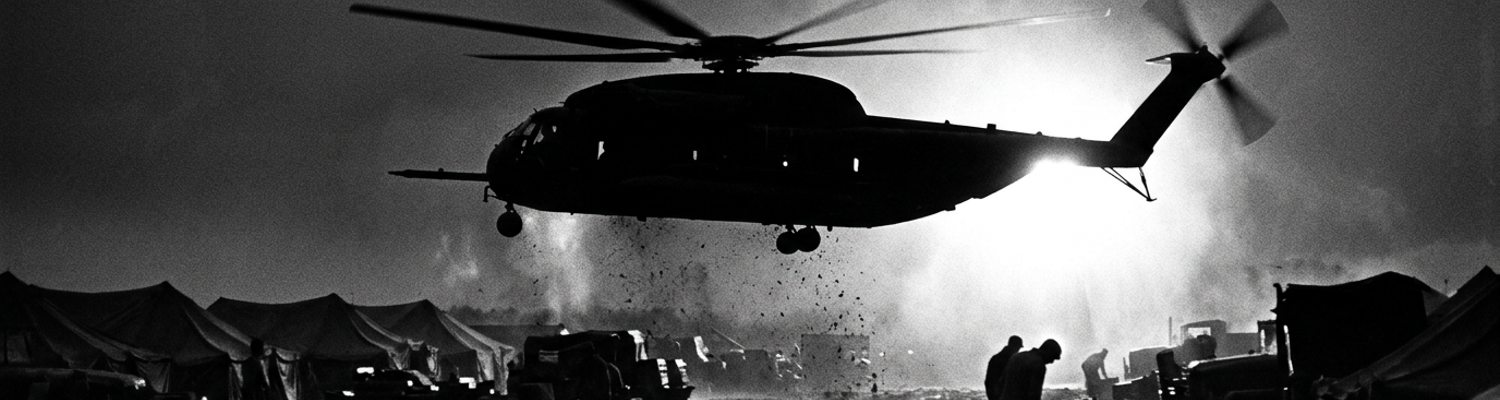
Seventh Air Force tactical directives required all pilots to approach the LZ at altitudes below 500 feet. This specific flight profile kept the aircraft beneath the S-75 Dvina radar envelopes operating just north of the Thach Han River. As the heavy-lift helicopters descended toward the burning magnesium grid, an unintended optical interaction compromised their approach. The intense light source from the ground projected straight upward. Dark green and brown camouflage paint schemes covered the aircraft exteriors. Air Force engineers originally applied these matte finishes to help the airframes blend into the jungle canopy when viewed from above by enemy fighter jets. The dark paint absorbed the upward magnesium glare.
Low-flying HH-53 helicopters silhouetted directly above extraction corridors.
A close review of operational logs indicates that NVA anti-aircraft battalions rapidly repositioned manual weapon systems to exploit this visual effect. Elements of the 280th Air Defense Regiment dragged ZPU-2 twin 14.5mm heavy machine guns through the mud to the outer perimeter of the Ai Tu base. These towed dual-barrel weapons lacked the RPK-2 radar tracking arrays found on mechanized anti-aircraft platforms. The gun crews relied entirely on circular mechanical ring sights to track moving targets. The upward illumination from the flare grid provided a sharp opaque outline of the descending helicopters against the low-hanging coastal stratus clouds. NVA gunners could clearly identify the external fuel tanks, the twin T64-GE-7 turboshaft engines, and the exposed tail rotor drive shaft.
The extraction corridor geometry forced the pilots to hold a stable hover for at least twenty seconds to verify their landing gear would clear the burning canisters.
At 2215 hours on April 18, four ZPU-2 crews engaged a hovering Jolly Green Giant simultaneously from concealed positions fifty meters away. Armor-piercing incendiary rounds traveling at 3,200 feet per second penetrated the unarmored belly pan of the aircraft. The 14.5mm projectiles severed the primary dual-tandem hydraulic lines controlling the main rotor swashplate. A complete loss of fluid pressure locked the cyclic controls in a neutral position. The aircraft commander lost all mechanical ability to direct the forward momentum of the helicopter or compensate for lateral drift. The 42,000-pound airframe dropped vertically at a rate of forty feet per second. It impacted directly on top of the burning magnesium grid.
Seventy-two-foot aluminum rotor blades struck the laterite clay and shattered.
Hundreds of high-velocity metal fragments tore through the adjacent medical tents.
Enemy Radar Exploitation of Visual Signatures
A close review of operational logs from the Combined Document Exploitation Center in Saigon reveals a highly specific tactical adaptation by North Vietnamese missile battalions. South Vietnamese Rangers operating near the Cam Lo river on April 24, 1972, captured a fire control technician assigned to the 274th Surface-to-Air Missile Regiment. Interrogation records outline exactly how this crew exploited the experimental magnesium flare grids burning at the Ai Tu Combat Base. The technician detailed the use of a PA-00 optical tracking periscope.
Soviet engineers originally mounted this high-magnification optic on the roof of the SNR-75 radar control van to allow manual tracking of targets in heavy electronic jamming environments.
The operator explained that the 48 million candlepower generated by the runway flares penetrated the coastal fog layer with absolute clarity. The glowing rectangular grid at coordinates 16 46 N, 107 11 E was visible through the periscope from a camouflaged revetment fourteen kilometers to the north. Intelligence officers translating the handwritten notes of the NVA technician discovered that the flare grid fundamentally altered the target acquisition sequence of the regiment. This intense light source eliminated the need for active radar scanning. Standard Soviet air defense doctrine required crews to activate a P-12 early warning radar to locate incoming flights. Emitting VHF-band energy across a 200-kilometer radius immediately alerted American electronic warfare aircraft to the battery position.
The captured technician reported a complete deviation from this protocol.
NVA commanders ordered their radar crews to keep all transmitters powered down in dummy load mode. Operators inside the control van simply looked through the PA-00 optical periscope and centered their crosshairs on the massive magnesium fire burning at the triage strip. They manually rotated the azimuth and elevation handwheels to align the main Fan Song radar antennas directly with the landing zone. The optical signature of the flares provided a fixed aiming point that required zero electromagnetic emission.
The tracking radar remained completely silent.
North Vietnamese air defenders utilized these optical signatures to target the flight paths of heavy aeromedical extraction helicopters without triggering onboard warning systems. On the night of April 20, an HH-53B Jolly Green Giant initiated its final approach into the Ai Tu perimeter. The pilot dropped the 42,000-pound aircraft down to 400 feet to avoid the known radar envelopes. He aligned the nose of the helicopter with the burning magnesium canisters to establish a stable glide slope through the dense coastal stratus clouds. Inside the SA-2 control van across the Thach Han River, the optical tracking operator watched the dark silhouette of the helicopter pass directly across the glowing background of the flare grid. The operator tracked the descending airframe manually using the periscope crosshairs.
He called out the changing elevation angles to the battery commander sitting adjacent to the fire control console.
A V-750V missile cleared the launch rail at 2234 hours. Archival evidence shows the missile crew guided the weapon entirely through the optical channel. The SNR-75 radar system transmitted only the narrow UHF-band command link signals to the missile in flight. It never emitted the E-band tracking beams required to paint the target aircraft. American pilots relying on APR-25 radar warning receivers possessed no electronic indication of the incoming threat. The NVA guidance officer kept the periscope crosshairs centered on the uncamouflaged silhouette of the helicopter against the blinding white magnesium fires.
He steered the Mach 3 projectile directly into the extraction corridor using a small manual joystick on his console.
The 35-foot-long missile covered the fourteen-kilometer distance in under fifteen seconds. The proximity fuse registered the dense metal mass of the HH-53B and detonated the 195-kilogram fragmentation warhead exactly forty meters from the right engine nacelle. Eight thousand jagged steel fragments tore through the magnesium-illuminated sky.
SA-2 Missile Engagement of Medical Corridors
Archival evidence shows North Vietnamese air defense commanders actively modified their standard engagement protocols to exploit the low-altitude flight paths of American medical helicopters. Technicians assigned to the 274th Surface-to-Air Missile Regiment recognized that US Air Force rescue crews were flying below 500 feet along Highway 1 to avoid radar detection. Soviet operating manuals for the S-75 Dvina system strictly prohibited firing the V-750V missile at targets below 3,000 feet due to the risk of ground clutter disrupting the radio command link.
Battery commanders at coordinates 16 52 N, 107 05 E bypassed these safety interlocks entirely.
Mechanics physically removed the steel locking pins from the elevation gears on the SM-90 launch rails. Gunners depressed the firing angle to a shallow fifteen degrees. This mechanical override allowed the SA-2 to function as a direct line-of-sight weapon against the rotary-wing extraction routes approaching Quang Tri City. The optical tracking methods refined during the Ai Tu flare experiments provided the necessary precision to guide the weapon through the dense coastal air. Operators transmitted guidance commands using the UHF-band datalink while keeping the main tracking radars powered down.
The thirty-five-foot-long ballistic projectiles now possessed a direct trajectory into the treetops.
When examining the historical record from late April 1972, the tactical shift by NVA missile battalions produced an immediate increase in casualties for the 37th Aerospace Rescue and Recovery Squadron. Operational logs from Da Nang Air Base indicate a rapid collapse of the established aeromedical evacuation network. Pilots flying the 42,000-pound HH-53B Jolly Green Giants previously relied on terrain masking to survive the radar threat. This specific flight profile now put the aircraft directly into the newly depressed SA-2 engagement zones. The low altitudes offered zero protection. On April 29, a flight of two HH-53s attempted a casualty extraction near the Thach Han River under heavy overcast conditions. NVA optical trackers acquired the lead helicopter at an altitude of 300 feet as it crossed a designated medical transit corridor.
A V-750V missile launched from a camouflaged revetment six kilometers away and covered the distance in exactly 7.2 seconds.
The 195-kilogram fragmentation warhead detonated slightly above the seventy-two-foot main rotor arc. Blast pressure and shrapnel directed a downward pattern of kinetic energy straight into the unarmored cockpit. The explosion instantly severed the primary and secondary dual-tandem hydraulic flight control systems. A complete loss of fluid pressure locked the swashplate actuators. The airframe pitched forward into a high-speed uncontrolled descent.
The helicopter impacted the marshland at one hundred and forty knots.
A close review of Seventh Air Force loss reports reveals the severe statistical degradation of medical extraction capabilities in Military Region 1 following this tactical adaptation. Between April 18 and May 2, NVA missile batteries destroyed four HH-53 heavy-lift helicopters and seven UH-1H dustoff airframes operating exclusively within designated medical corridors. This destruction represented a forty percent reduction in total available rescue assets for the northern combat sector. Replacement aircraft did not arrive. Maintenance crews at Da Nang cannibalized parts from damaged airframes to keep the remaining helicopters flight-worthy.
The loss rate outpaced their repair capacity.
Rescue commanders officially suspended all daylight evacuation flights north of Hue City on May 3. The 37th Aerospace Rescue and Recovery Squadron recorded thirty-one crew members killed in action during this specific two-week period. Ground commanders inside the besieged Quang Tri citadel lost their only mechanism for extracting critically wounded infantrymen. Wreckage of the destroyed airframes remained entirely inaccessible to allied recovery teams due to the advancing North Vietnamese mechanized columns. T-54 tanks simply crushed the aluminum fuselage panels of the downed helicopters as they pushed south along Route 9.
Suspension of Night Extraction Operations
Sergeant First Class William Hayes of the 14th Combat Engineer Battalion knelt beside a shattered M-2 generator at coordinates 16 32 N, 107 33 E. He wiped hydraulic fluid from the severed power cables of the primary landing zone floodlight array at Camp Evans. It was 2315 hours on May 2, 1972. The destruction of the experimental flare grid at Ai Tu forty-eight hours earlier forced medical extraction flights to divert to this secondary airstrip twenty miles south. North Vietnamese forward observers tracked the resulting helicopter traffic. They transmitted the new flight corridors to the 38th Artillery Regiment.
High-explosive 130mm artillery shells impacted the pierced steel planking of the Camp Evans runway at a rate of one round every forty seconds.
Shrapnel from the bombardment shredded the 500-gallon aviation fuel bladders positioned along the eastern perimeter. JP-4 jet fuel leaked into the drainage ditches and ignited. The resulting fires generated a continuous field of intense uncoordinated light. Heavy coastal fog trapped this illumination close to the ground. Approaching UH-1H pilots descending through the stratus layer experienced immediate spatial disorientation. The erratic glow of burning fuel reflecting off the dense moisture completely overwhelmed their natural scotopic vision.
They lost all visual reference to the horizon line.
Helicopter crews could not read their analog altimeters through the blinding glare. When examining the historical record from the 452nd Transportation Company, the cascading infrastructure collapse extended beyond visual interference. Artillery craters measuring ten feet wide and four feet deep severed the primary taxiways at Camp Evans and neighboring Landing Zone Sally. Mechanics lacked the heavy equipment to replace the mangled steel runway planks under continuous bombardment. The optical trap established by the North Vietnamese Army functioned flawlessly across multiple geographic locations. Any attempt to activate backup tactical lighting systems immediately drew concentrated artillery fire from the Cam Lo hills. NVA gunners utilized the exact same PAB-2A optical aiming circles to lock onto the backup runway lights.
The 101st Airborne Division medical elements operating the triage tents lost all access to heavy-lift extraction.
Four HH-53B Jolly Green Giants diverted to Da Nang Air Base after failing to establish a safe glide slope through the smoke and artillery bursts. The entire northern airfield network ceased to function as a viable medical transit hub. Ground commanders ordered combat engineers to smash the remaining intact runway floodlights with entrenching tools to eliminate the aiming stakes. A close review of operational logs from the Seventh Air Force headquarters at Tan Son Nhut Air Base details the immediate command response to these infrastructure failures. Tactical planners calculated a one hundred percent probability of airframe loss for any heavy helicopter attempting a night landing in the Quang Tri sector.
General John W. Vogt Jr. signed Direct Air Support Fragmentary Order 142 on the morning of May 4, 1972.
This directive officially terminated all night aeromedical evacuation missions north of the My Chanh River. The order strictly prohibited HH-53 and UH-1H crews from crossing the 16 35 N latitude line between the hours of 1900 and 0600. Command officers at the 37th Aerospace Rescue and Recovery Squadron physically removed the designated night extraction frequency crystals from the PRC-77 radio sets of the squadron. Radio operators ignored all incoming medical distress calls broadcast on the emergency guard frequencies.
Archival evidence shows the immediate physical toll of this administrative flight suspension on the besieged infantry units.
Medics attached to the Army of the Republic of Vietnam 3rd Division inside the Quang Tri Citadel lost their sole mechanism for evacuating severe trauma cases. Planners at the Military Assistance Command Vietnam offered no alternative extraction methods. The formal stand-down order forced forward aid stations to stockpile critically wounded soldiers in subterranean bunkers beneath the collapsing fortress walls. Infantrymen suffering from arterial bleeding or sucking chest wounds received only basic field dressings and intravenous saline. Standard medical doctrine required these specific injuries to reach a fully equipped surgical hospital within one hour of the initial trauma.
The suspension of the night flights extended the minimum extraction time to fourteen hours.
Temperatures inside the Citadel bunkers exceeded one hundred degrees Fahrenheit. Three hundred units of O-positive whole blood stored in the triage center spoiled at 0200 hours after a 122mm rocket destroyed the primary refrigeration generator.
Tactical Lessons from Airfield Lighting Failures
Archival evidence shows the immediate physical deterioration of the Army of the Republic of Vietnam 3rd Division inside the Quang Tri Citadel at coordinates 16 44 N, 107 11 E. Medical officers attached to MACV Advisory Team 155 operated a subterranean aid station beneath the eastern wall of the fortress. They possessed zero rapid night medical evacuation capabilities following the Seventh Air Force flight suspension. Infantrymen suffering from high-velocity gunshot wounds lay on dirt floors covered in ponchos. Surgeons exhausted their supply of morphine syrettes and type O-positive blood plasma within forty-eight hours.
The absence of night extraction flights forced medics to hold severe trauma cases in an environment heavily contaminated by raw sewage and cordite.
Standard operating procedures required chest wounds to reach a surgical hospital in Da Nang within sixty minutes. The administrative grounding of the HH-53 fleet extended this extraction window to a minimum of fourteen hours. Bacterial infections spread rapidly through the wounded population. Gangrene set into untreated shrapnel wounds before the sun rose. When examining the historical record from the Pacific Air Forces command center at Hickam Air Force Base, analysts immediately recognized the failure of high-intensity illumination. A joint evaluation board convened on May 12, 1972. They dissected the loss of the heavy lift helicopters at Ai Tu and Camp Evans.
Officers from the 37th Aerospace Rescue and Recovery Squadron presented flight telemetry data and captured North Vietnamese optical tracking periscopes to the panel.
This physical evidence proved that NVA anti-aircraft gunners and SA-2 missile technicians used the 48-million-candlepower flare grids as fixed aiming stakes. The board concluded that any visible light source exceeding a standard flashlight beam compromised the landing zone geometry within a fifty-kilometer radius. Soviet-supplied PAB-2A aiming circles allowed enemy forward observers to translate runway floodlights into exact mathematical coordinates for 130mm artillery batteries. Planners realized the established procedures for night casualty extraction actively aided the enemy targeting sequence.
The Seventh Air Force immediately shredded the existing rescue manuals.
Command officers initiated rapid doctrine revisions regarding airfield lighting in integrated air defense environments. Air Force Manual 2-21 received an emergency amendment transmitted via teletype to all aviation units in Southeast Asia on May 15. The new regulations strictly prohibited the deployment of Mk 24 Mod 4 magnesium flares or any high-intensity chemical illumination for helicopter pathfinding. Combat engineers received orders to physically dismantle all hardwired floodlight arrays at forward airstrips. Doctrine now mandated absolute blackout conditions for all rotary-wing operations near contested airspace. Planners shifted the burden of night navigation entirely onto the development of covert electronic pathfinding.
Engineers at the Air Force Systems Command began retrofitting HH-53B airframes with AN/AAQ-5 forward-looking infrared pods and low-light television cameras.
Ground units received instructions to mark extraction zones using chemical light sticks placed inside deep narrow holes dug into the laterite clay. This directional marking technique limited visual detection to aircraft directly overhead. A close review of MACV operational directives reveals the mechanical enforcement of this blackout doctrine. Aviation maintenance crews at Da Nang Air Base physically disconnected the landing light circuits on all UH-1H and HH-53 helicopters. Mechanics severed the copper wiring harnesses leading to the belly-mounted searchlights with wire cutters. Pilots lost the physical ability to illuminate the ground during their final descent.
They relied entirely on radar altimeters.
The tactical shift required aircrews to touch down blindly in unimproved clearings guided only by FM radio vectors from ground spotters. Navigators calculated descent rates using analog stopwatches and barometric pressure readings. The revised doctrine accepted the high risk of controlled flight into terrain to eliminate the mathematical certainty of radar-guided missile strikes. A single HH-53 sheared its tail rotor on a submerged tree stump during a blackout landing on May 19.