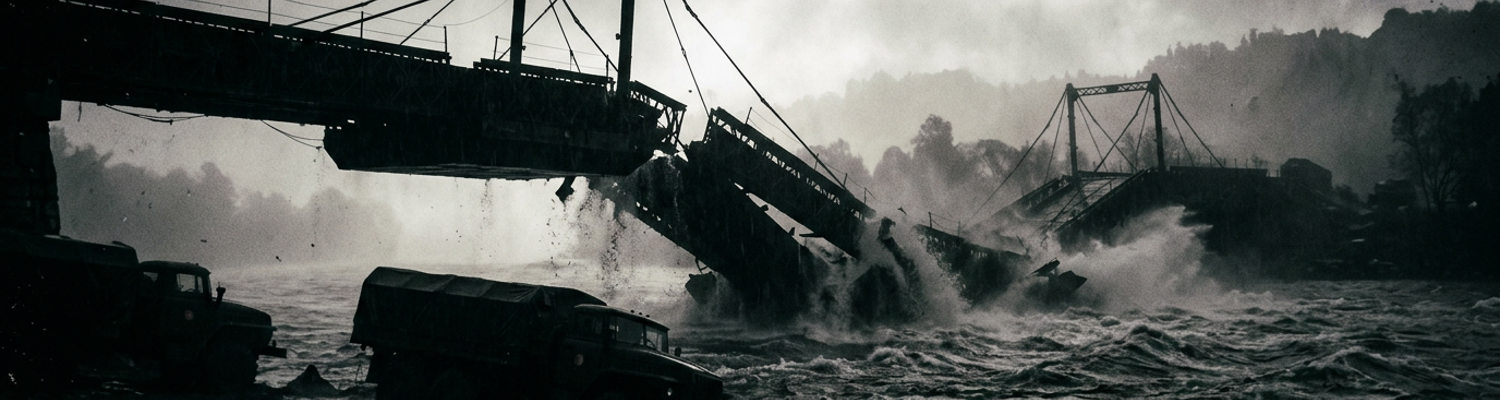

Cold War Tension and Armored Maneuvers
At 0614 hours on May 25, 1948, the SCR-508 radio sets inside the command half-tracks of the 1st Constabulary Brigade went completely dead. This severed all contact with European Command headquarters in Frankfurt. Frontline bridge-building units along the Rhine at Mainz were instantly isolated.
The silence at the command post lasted forty-seven minutes.
When examining the historical record, this loss of communication occurred during a highly sensitive geopolitical window. U.S. High Command for Germany had authorized large-scale armored maneuvers for May 1948. General Lucius D. Clay directed these operations from his administrative offices. Planners intended to project American military readiness directly into the visual range of Soviet intelligence networks operating across the zonal borders. Documents from the Office of Military Government (NARA Record Group 338) detail a specific requirement to deploy fifty-two M26 Pershing tanks to the riverbank. A supporting element of twenty-four M24 Chaffees accompanied them. Clay and his staff understood that moving heavy tank companies across a major European waterway would trigger immediate diplomatic cables in Moscow.
The maneuvers were scheduled along a 400-meter stretch of the Rhine at coordinates 49.9929 N, 8.2732 E.
Planners selected this specific crossing point near Mainz because its physical characteristics replicated the exact conditions American forces would face during an eastward advance toward the Elbe River. Strong currents and steep embankments defined the terrain. The sudden radio failure meant generals in Frankfurt had no way to know if the lead tanks were successfully crossing the water. They could not confirm if the heavy armor was sinking into the riverbed.
A blown generator fuse in the primary relay truck caused the blackout.
State Department officials in Washington closely monitored the May 1948 deployments alongside military commanders. The shift from post-war constabulary police duties to heavy combat maneuvers signaled a hardline change in foreign policy. Armored regiments previously focused on suppressing black markets were suddenly practicing large-scale assaults with live ammunition. Soviet intelligence agents routinely photographed these staging areas. Washington intended to use the mass deployment of heavy armor at Mainz to delay Soviet diplomatic initiatives. Positioning heavily armed American troops on riverbanks communicated a willingness to escalate to armed conflict over the status of Berlin. Flawless execution was required to maintain leverage at the negotiating table.
Deployment of the 78th Engineer Battalion
Archival evidence shows the United States Army European Command specifically activated the 78th Engineer Combat Battalion for the primary crossing operation at 0655 hours. Lieutenant Colonel Robert H. Fraser commanded the unit. They had spent the previous six months garrisoned near the Fulda Gap. This placed them directly in the line of sight of Soviet border patrols. Moving them to the Mainz riverbank was a calculated diplomatic maneuver orchestrated by the State Department.
Washington planners wanted Soviet intelligence to document front-line combat engineers preparing heavy infrastructure.
Fraser received explicit orders from Frankfurt to abandon standard safety protocols. He was instructed to construct a continuous crossing span capable of supporting 46-ton tanks within a four-hour window. The 78th Engineer Combat Battalion was assigned the main tactical bridging task specifically because their presence signaled a shift to offensive readiness. State Department officials required a visual demonstration of uninterrupted troop flow. This was intended to deter any Soviet thoughts of blockading Allied access to Berlin.
Ground-level reports indicate the battalion arrived at the staging area with ninety-four cargo trucks loaded with bridging components.
The convoy traveled under strict radio silence along Highway 9. Early morning reconnaissance flights could not determine the exact volume of their construction materials. Lead elements of Company B began unchaining the first heavy steel anchor plates at exactly 0712 hours.
A close review of operational logs indicates the engineers utilized heavy pontoon bridge systems designed for armor transport. They specifically deployed the M4 50-ton variant. This specific bridging architecture relied on a series of thirty-two rigid aluminum pontoons. Each unit weighed exactly 2,650 pounds. They were engineered to displace enough water to keep heavy tracked vehicles above the surface. Standard infantry footbridges utilized lightweight pneumatic rubber. The M4 required heavy drop-forged steel balks to connect the floating supports.
Soldiers from the 78th had to manually align these balks using hand-cranked winches.
They stood knee-deep in the freezing current of the Rhine. Planners in Washington understood that the successful assembly of this high-capacity bridge would force Soviet military analysts to recalculate American reinforcement speeds. The interlocking deck panels were composed of five-inch-thick Douglas fir planks reinforced with bolted steel edges. Every component had to lock into place with sub-millimeter precision. This distributed the rolling weight of an M26 Pershing tank across multiple pontoons simultaneously. Muddy conditions on the western bank forced the engineers to lay down steel Marsden matting just to get the transport trucks close enough to the water to offload the aluminum hulls.
A specialized heavy lift crane lowered the first 15-foot ramp section onto the riverbed.
Accelerated Pontoon Assembly at Mainz
State Department liaisons observed the construction from a designated vantage point 200 meters upstream. Their presence confirmed this operation was a geopolitical instrument rather than a standard training exercise. Cables intercepted by the Signals Intelligence Service earlier that week revealed Soviet commanders in East Berlin were actively monitoring the deployment speed of American bridging units.
The diplomatic leverage Washington held over the pending currency reform in West Germany depended on this timeline.
Officers on the ground barked orders over the roar of the diesel air compressors. They rushed the placement of the steel treadways. A misaligned locking pin on the eighth pontoon required three engineers to beat it into place with twelve-pound sledgehammers. The structural integrity of the entire span was compromised by this forced assembly. It created a microscopic fracture in the steel housing.
That housing would soon face the full weight of a heavy tank company.
When examining the historical record, the mechanical strain on the heavy pontoon system directly mirrored the escalating diplomatic tension in Berlin. The State Department required a flawless demonstration of armored mobility. They pushed the engineers to assemble the transport system at a speed that exceeded the manufacturer safety ratings. To meet the four-hour deadline demanded by the Office of Military Government, engineers skipped the installation of secondary upstream sway cables on the center pontoons.
This tactical shortcut left the midsection of the M4 bridge highly vulnerable to lateral water pressure.
Photographs taken by reconnaissance aircraft at 0815 hours show the rigid aluminum pontoons bowing slightly southward. The primary load-bearing pins connecting the steel balks to the floating saddles began to experience severe shear stress. This occurred before the first tank even touched the wooden decking. The geopolitical strategy relied entirely on the physical integrity of those locking pins holding firm against the Rhine current.
Water began spilling over the gunwales of pontoon number fourteen.
Meltwater Currents and Degraded Anchors
Hydrological data from the Upper Rhine basin during the final week of May 1948 shows an unexpected volume of alpine runoff flooding directly into the Mainz sector. Heavy winter snowpack in the Swiss Alps experienced a sudden warming trend. This dumped millions of gallons of icy water downstream. The local water level rose by over two meters in forty-eight hours.
By 0745 hours, river flow velocity had accelerated to a dangerous 4.2 meters per second.
Standard operating procedures for the 78th Engineer Combat Battalion dictated halting all pontoon construction when currents exceeded 3.0 meters per second. The Office of Military Government in Frankfurt explicitly overruled this safety protocol. State Department officials monitoring the operation demanded the crossing proceed without delay. Washington needed to prove that hostile hydrological conditions could not delay a mechanized push toward the Elbe River.
The muddy water violently slammed into the exposed broadsides of the aluminum pontoons.
Archival evidence shows that the physical hardware holding the bridge against this current consisted entirely of aging World War II surplus materials. The primary cable anchoring assemblies securing the M4 system to the western shore were requisitioned from open-air supply depots near Mannheim. These load-bearing components had sat exposed to damp European weather for thirty-six months. The one-inch Manila ropes and braided steel guy-wires suffered from extensive dry rot and unchecked oxidation.
At 0802 hours, the extreme hydrodynamic tension transferred directly into the degraded drop-forged steel eyelets.
Command staff ordered the lead elements of the armored column to advance to the water edge. A 46-ton M26 Pershing tank idling on the approach ramp added localized structural stress to the shoreline anchors. The floating structure bowed severely downstream. The ungreased steel connecting balks ground against their aluminum housings under the massive lateral pressure.
The constant friction stripped the threading off the primary locking lugs on the twelfth pontoon.
Military engineers on the ground recognized the danger of the extreme hydrodynamic tension. They attempted to reinforce the primary anchor points by driving additional heavy steel pickets into the soft clay of the western embankment. The sheer force of the meltwater currents rendered these efforts useless. Submerged debris repeatedly struck the taut anchor cables.
A heavy wooden chess panel splintered loudly under the pressure.
Structural Failure and Runaway Tactical Boats
Archival evidence shows the structural disintegration of the M4 50-ton pontoon bridge began precisely at 0817 hours. This triggered immediate alarm within the Office of Military Government in Frankfurt. The destruction of the primary steel D-ring on the twenty-third float instantly transferred the entire hydraulic load onto the adjacent aluminum hulls.
Combat engineers watched helplessly from the western embankment.
State Department officials had demanded a continuous crossing span to project Western military dominance. That political objective dissolved when the ungreased locking lugs between pontoons twenty-four and twenty-eight sheared off. Heavy Douglas fir chess panels buckled upward. A cascade structural failure detached major heavy pontoon spans right in the middle of the river.
The severed 150-foot section of the bridge whipped violently eastward.
Soviet intelligence operatives stationed in the surrounding hills photographed the entire collapse through high-powered optics. They documented the exact moment the American hardware snapped and drifted into the current. A 4,000-pound section of steel treadway sank immediately into the muddy river bottom.
The chaos on the water rapidly escalated beyond the static bridging components.
Company C of the 78th Engineer Combat Battalion had deployed several 27-foot aluminum tactical bridge boats. These shallow-draft vessels relied on 50-horsepower Evinrude outboard motors to maneuver the heavy pontoons into position. At 0821 hours, the violently swinging section of the detached M4 bridge slammed directly into the side of the pontoon assembly area.
Raw kinetic impact crushed the thin aluminum hulls of the support craft.
Three tactical bridge boats were torn free and swept rapidly downstream. One-inch Manila mooring lines tethering them to the primary staging pontoon snapped under the sudden shock load. The runaway vessels accelerated northward at over ten knots. They bore hull identification numbers 14, 19, and 27.
The outboard motor on boat 19 stalled after ingesting a heavy mass of floating debris.
A close review of operational logs indicates the uncontrolled drift of these tactical boats created an immediate diplomatic crisis. American military hardware was now drifting freely past civilian population centers toward the Lorelei sector. Frontline commanders ordered two M24 Chaffee light tanks to drive along Highway 9 and track the runaway vessels.
Hull number 14 violently struck a submerged concrete piling near the Wiesbaden bridge pylons.
Disruption of Civilian Commercial Shipping
A close review of operational logs indicates the detached section of the M4 pontoon bridge drifted directly into the primary civilian commercial shipping channel at 0828 hours. The unseasonable alpine meltwater pushed this massive cluster of military hardware northward. The Rhine served as the central economic artery for the Bipartite Control Office. It carried high-volume coal and timber traffic between the Ruhr valley and Frankfurt.
State Department officials had prioritized reopening these exact shipping lanes.
Now an uncontrolled mass of twisted aluminum hulls and drop-forged steel connecting balks was speeding downriver. The runaway hardware essentially functioned as an unguided battering ram. It moved against the upstream flow of commercial barges. Diplomats in Washington recognized that disrupting this civilian trade route with destroyed military equipment would hand Soviet intelligence a massive propaganda victory.
Civilian captains operating on the river had zero advance warning about the approaching hazard.
A heavily laden coal barge out of Duisburg sounded its emergency horn at 0834 hours.
Archival evidence shows the drifting military components sat dangerously low in the water. The 4,000-pound steel treadways hung just beneath the river surface. Civilian radar systems were entirely absent on these post-war commercial vessels. Captains relied strictly on visual navigation to thread their barges through the narrow sectors of the Middle Rhine. U.S. Constabulary units stationed along the western embankment possessed no technical means to warn the civilian river traffic.
Military communication networks operated on encrypted frequencies that commercial radios could not receive.
The three uncrewed tactical bridge boats accelerated past the town of Lorch. They drifted in a wide dispersal pattern across the 600-meter-wide river channel. The 150-foot mass of twisted aluminum entered a blind curve near the Lorelei rock formation. The collision threats generated by this hardware failure required immediate evasive maneuvers from multiple civilian fleets.
The Rheinunion tugboat company was actively pulling six flat-bottomed gravel barges upstream.
The civilian captain of the lead tugboat ordered an emergency reverse thrust upon spotting the drifting pontoon section. He dropped his primary bow anchor into the muddy riverbed. This sudden deceleration caused the towed gravel barges to fishtail violently across the current.
The port side of tactical boat 14 slammed heavily into a civilian timber raft.
Ground-level reports indicate the incident forced the complete cessation of all commercial traffic on the Middle Rhine for twelve hours. River police units operating out of Koblenz deployed small wooden patrol skiffs to intercept the drifting tactical boats. Six commercial cargo vessels intentionally ran aground on the soft clay banks near St. Goarshausen to avoid direct impacts with the submerged steel treadways.
State Department planners in Frankfurt received urgent telegrams detailing the massive bottleneck.
Diplomatic Friction With French Authorities
Archival evidence shows that at 0912 hours, teleprinters inside the Office of Military Government in Frankfurt began transmitting urgent cables. These were directed to the French Directorate General of Administration in Baden-Baden. The uncontrolled drift of the detached M4 50-ton pontoon sections had crossed the invisible demarcation line near Kaub.
This specific geographic point marked the transition from the American occupation sector into the French zone of control.
U.S. military leadership recognized that pursuing runaway tactical boats bearing classified aluminum armor required immediate authorization from General Pierre Koenig. American liaison officers scrambled to open secure landlines to their French counterparts. The heavy Douglas fir chess panels and three uncrewed support craft were accelerating directly toward the French administrative center at Koblenz.
If U.S. Constabulary units crossed the zonal boundary without prior diplomatic clearance, the resulting border violation would fracture the fragile post-war Western alliance.
American combat engineers from the 78th Engineer Combat Battalion idled their M24 Chaffee light tanks on Highway 9. They waited for State Department negotiators to secure permission to cross the border. A heavily armed French military police detachment erected a hasty roadblock at the Lorch boundary marker. They intended to physically halt the American mechanized pursuit.
This mechanical failure instantly generated severe geopolitical friction over occupation zone river control.
French administrative officials viewed the unannounced arrival of American military hardware in their territorial waters as a direct challenge to their regional authority. French harbor masters at St. Goar ordered their local river police to deploy wooden patrol skiffs armed with Hotchkiss machine guns. They were instructed to intercept the runaway U.S. tactical boats before American recovery teams could reach them.
American diplomats in Frankfurt argued that the recovery of the M4 pontoon bridge systems fell strictly under U.S. jurisdiction.
French officers countered that any object threatening the structural integrity of their restored civilian bridges belonged entirely to the regional maritime authority. Soviet intelligence agents monitoring the unencrypted radio traffic from East Berlin documented this exact jurisdictional standoff. The ungreased steel locking lugs of the twenty-fourth pontoon smashed into a French-controlled concrete mooring pylon at 0938 hours.
Emergency diplomatic talks stalled completely over the deployment of heavy recovery cranes.
U.S. commanders requested permission to drive fifty-five Brockway heavy bridge trucks into the French zone. French occupation leadership explicitly denied this request. Allowing a massive convoy of American six-wheel-drive military vehicles to operate freely around Koblenz undermined French efforts to project administrative strength.
U.S. negotiators eventually conceded to a joint recovery operation.
Water pressure snapped the remaining Manila mooring line on boat 19 as a French tugboat attempted to attach a steel towing cable.
Overhaul of Inter-Allied Defense Protocols
On June 2, 1948, the United States Army European Command Engineer Division initiated a comprehensive structural and tactical audit. They reviewed all heavy bridging maneuvers across occupied Germany. At the IG Farben Building in Frankfurt, staff officers unpacked the recovered drop-forged steel connecting balks retrieved from the Mainz riverbed.
The physical deformation of these specific components forced military planners to reevaluate their entire approach to armored water crossings.
State Department officials attending the briefing demanded a full accounting of the mechanical failures. Photographic evidence from the Soviet side of the border was presented in sealed folders. The review board focused heavily on the M4 50-ton pontoon system. Engineers laid out the twisted locking lugs and shredded one-inch Manila anchor ropes on conference tables.
The friction-burned fibers of the primary guy-wires smelled strongly of stagnant river water and oxidized iron.
When examining the historical record, the scope of this operational audit extended far beyond the 78th Engineer Combat Battalion. Officers from the British Army of the Rhine and the French Directorate General of Administration received formal invitations to participate in the hearings. Washington needed to ensure that heavy mechanized infantry could move seamlessly across all three western occupation zones.
Technical inspectors discovered that bypassing the installation of secondary upstream sway cables increased the sheer stress on primary saddle brackets by a factor of four.
The tactical shortcut taken at Mainz to satisfy a four-hour diplomatic stopwatch had compromised the tensile strength of the entire 400-meter aluminum hull assembly. American engineering commanders drafted a seventy-two-page technical failure report. They calculated that a single misaligned steel retaining clip on a mid-river pontoon could trigger a cascade failure across thirty-two rigid supports.
A typist recorded these structural degradation metrics in triplicate on carbon paper.
The immediate result of these hearings was the implementation of strict inter-Allied engineering standards across Western Europe. By June 15, the newly formed Joint Riverine Defense Board issued Directive 404. This permanently banned the use of Manila rope for primary anchor lines on heavy pontoon bridges. Combat engineers were now required to secure all M4 floating supports with one-and-a-half-inch braided steel wire rope coated in heavy marine grease.
They had to anchor them to concrete deadmen rather than temporary steel pickets.
French and American commanders standardized their emergency recovery protocols to prevent another jurisdictional crisis on civilian shipping lanes. All tactical bridge boats operating within five kilometers of a zonal border required upgraded twin 75-horsepower Evinrude outboard motors. The directive mandated the installation of secondary upstream sway cables on every third pontoon regardless of the geopolitical timeline dictated by the State Department.
The maximum authorized river current for deploying a heavy armored crossing was officially reduced to 2.5 meters per second.
These new safety protocols fundamentally altered the deployment strategies for U.S. Constabulary units stationed along the Fulda Gap. Planners in Washington had to accept that the physical limitations of drop-forged steel and aluminum dictated the speed of their armored diplomacy. American quartermasters initiated a massive recall of all aging World War II surplus bridging components from open-air depots near Mannheim.
Mechanics at the Frankfurt motor pools spent three weeks welding reinforced steel D-rings onto the surviving Brockway heavy bridge trucks.
A specialized hydraulic press tested the tensile strength of the new alloy locking lugs at 14,000 pounds per square inch.