
Typhoon Doris and Amphibious Fleet Dispersal
Radio operators monitoring fleet weather circuits copied an urgent alert tracking Typhoon Doris as the storm system gathered strength over the South China Sea in early September 1969. The incoming teletype placed the storm center on a direct path toward the Demilitarized Zone, creating a severe danger zone across the shallow roadsteads of northern South Vietnam. Watch officers carried the meteorological dispatch directly to the bridge, triggering a rapid series of tactical calculations among staff officers who knew that flat sided amphibious transports could not survive heavy rolling in open bays. Planners immediately canceled ongoing maintenance schedules and fuel transfers, determining that the vessels had to escape into deep water before the wind drove them onto coastal shoals. Task Group 76.4, operating as Amphibious Ready Group Alpha, weighed anchor and steamed south from Da Nang to evade extreme seas. Boiler technicians ignited standby burners to generate maximum steam pressure, driving the convoy southward through darkening rain squalls while deck crews secured all loose deck fittings against forty knot gusts.
Task Group 76.4 centered its evasive formation on the amphibious assault ship USS Iwo Jima, the amphibious transport dock USS Cleveland, and the tank landing ship USS Washtenaw County. Each hull design responded differently to the massive swells, creating severe mechanical friction across the convoy. Crewmen on the towering flight deck of USS Iwo Jima battled forty degree rolls to hook heavy steel chains through the landing gear of parked helicopters, working in pairs to prevent twenty ton airframes from breaking loose and wrecking the aviation maintenance shops. Inside the deep well deck of USS Cleveland, boat crews checked the tension on steel turnbuckles holding utility landing craft in place, as seawater surged through the stern gate seal and threatened to lift the boats off their timber resting blocks. Sailors aboard the flat bottomed USS Washtenaw County endured violent hull shuddering that knocked tools from workbenches and strained the welded deck cleats securing tracked amphibious tractors inside the vehicle hold. Engine room watches monitored bearing temperatures continuously, nursing aged steam plants that worked near their limits to keep the ships aligned against the battering seas.
Helmsmen swung the dispersed ships back toward the north to marshal off the coast of Quang Nam Province and prepare staging areas for Operation Defiant Stand after the typhoon passed on 2 September. Damage control teams immediately spread throughout the lower holds with flashlights and sounding tapes to check fuel tanks for seawater seepage and inspect strained hull welds. Aviation technicians on USS Iwo Jima peeled soaked protective covers from jet turbine intakes and washed down rotor heads to clear away thick deposits of corrosive sea salt before mechanics attempted engine run ups. Boatswains inside the well deck of USS Cleveland pumped out accumulated sea wash, inspected the hydraulic ramps of their landing craft, and re lashed ammunition pallets that had shifted against cargo nets during the retreat. Logistics officers on the flag bridge reorganized the scattered convoy into tight operating boxes, drafting revised launch schedules for the assault waves and recalculating fuel consumption rates for the landing boats.
Beachhead Insertion on Barrier Island
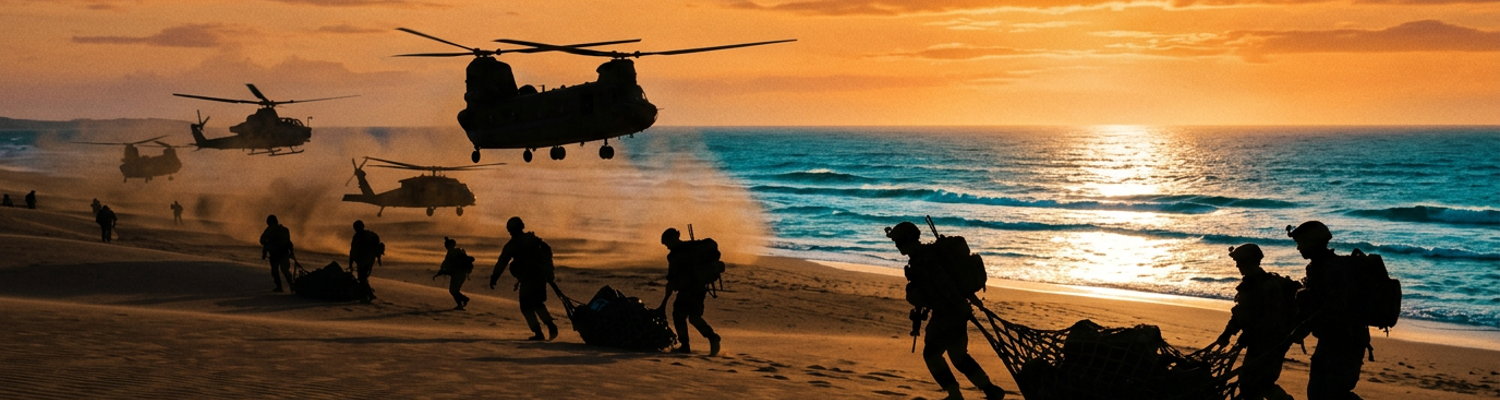
Task Group 76.4 translated these revised launch schedules into direct amphibious action on 7 September 1969, initiating the assault by landing Battalion Landing Team 1st Battalion, 26th Marines on the coastal terrain of Barrier Island, 34 miles south of Da Nang. Flight quarters sounded across USS Iwo Jima before dawn as deck handlers guided tandem rotor CH-46 helicopters into launching spots and loaded infantry squads carrying full combat packs, extra water bladders, and heavy ammunition tins. The assault force executed an unopposed vertical insertion into the littoral sand dunes while Vietnamese patrol craft established seaward cordons. Republic of Vietnam Navy gunboats and armed coastal junks patrolled the offshore breakers, sealing off the surf zone and tidal inlets to prevent local Viet Cong forces from escaping by boat or receiving waterborne supplies. Marine riflemen leaped from open rear cargo ramps into churning whirlwinds of grit, dropping into defensive perimeters across the crests of shifting dunes while flight leaders turned their empty transports back toward the amphibious ships to fetch follow on supply chalks.
Cargo handlers stacked wooden ammunition boxes, water cans, and radio batteries across the bare sand as these follow on supply flights touched down in rapid succession. Initial movement stalled as ground elements confronted trackless sand expanses that prevented vehicular maneuver and exposed landing forces to intense coastal heat. Foot patrols sank to their mid calves in loose, powdery quartz sand that offered no firm footing, doubling the physical effort required for every step and exhausting men who carried sixty pound combat loads. Wheeled jeeps and mechanical supply mules brought ashore by heavy lift helicopters spun their rubber tires helplessly, digging their axles into the loose surface within seconds of attempting to roll forward from the touchdown points. Battalion motor officers immediately ordered drivers to deflate tire pressures to widen the rubber contact patches, but the soft dunes still swallowed the undercarriages and forced infantry squads to unhook towing straps and push vehicles by hand.
Sweat soaked through green utility uniforms as Marines strained against the dead weight of the stalled vehicles under a morning sun that drove ambient temperatures past one hundred degrees. Salt crusts formed around the eyes and lips of the riflemen, burning raw skin while the dry coastal wind pulled moisture from their bodies far faster than medical officers had estimated during shipboard briefings. Canteens went dry before the lead companies reached their first inland phase lines, forcing company commanders to radio urgent requests back to the battalion combat operations center for emergency water drops. Radio operators struggled to keep their heavy backpack transmitters operating because fine sand penetrated casing seals and fouled battery terminals, distorting tactical calls and delaying requests for replacement batteries. Navy hospital corpsmen moved down the stalled columns with salt tablets and intravenous fluid bags, treating Marines who collapsed from severe heat cramps and propping casualties against the shady sides of abandoned supply trailers.
Battalion logisticians at the beachhead rapidly altered their distribution plans to bypass the broken supply chain caused by immobilized vehicles and mounting heat casualties. Flight crews diverted incoming helicopters away from the crowded central landing zones and flew directly to forward platoon coordinates, hovering just above the dune crests so crew chiefs could kick wooden crates of rations and five gallon water cans into sand gullies. Working parties of Marines dragged heavy nylon cargo nets across the sand by hand, rigging tow ropes through the mesh to haul mortar rounds and spare radio batteries over the steepest ridges. Company officers halted the forward advance at the inland margin of the dunes to consolidate their scattered squads, waiting for water details to distribute fresh plastic jugs before attempting to push into the contested tree lines beyond the beachhead.
Lighterage Failures and Heavy Surf Bottlenecks
Beachmasters signaled the offshore amphibious transports to rush bulk water trailers and heavy resupply craft into the surf zone to replenish the parched rifle companies. Heavy tidal surf along the Barrier Island coastline choked conventional ship to shore lighterage operations attempted by landing craft utility and mechanized units as soon as the vessels entered the outer shoals. Coxswains struggled against heavy swells that rolled in from the open sea, pitching the flat bottomed craft upward and knocking deck hands off their feet as they tried to secure cargo tie downs. High breakers threatened to broach utility craft attempting to drop ramps directly onto the uncompacted, shifting sand shelf, where the violent backwash stripped away the footing beneath their keels. Waves crashed over the lowered bow ramps, swamping vehicle compartments and drenching palletized supplies of rations, batteries, and small arms ammunition with salty ocean spray. Boat officers shouted over the roar of the surf, ordering their crews to back full speed on their diesels to escape the beach before the sideways pull of the current flipped the heavy hulls into the sand.
Coxswains hauled back on their throttle levers to back out into deep water, but the churning undertow seized several landing craft mechanized and pushed them sideways toward the breaker line. Steel kedge anchors dropped from the sterns failed to bite into the loose ocean floor, dragging across the shifting sand as the surge pushed the craft closer to disaster. Beach salvage parties waded into the foaming wash with heavy wire towing cables to lash the drifting boats to tracked bulldozers on the shore, but the massive pull of the receding waves snapped the braided steel lines under the excessive strain. Sand sucked into raw water cooling intakes rapidly clogged the internal heat exchangers of the marine diesels, triggering high temperature alarms that forced mechanics to shut down engines in the middle of the breakers. Beachmasters observed these propulsion failures and immediately declared the primary assault beach closed to all surface displacement craft to prevent wrecked hulls from permanently blocking the narrow approach channels.
USS Iwo Jima quickly became the central logistics platform for the entire landing force when the breakdown of surface lighterage forced task force commanders to rely almost entirely on rotary wing transport for all incoming logistical tonnage. Flight deck crews converted the flight operations schedule into a continuous vertical delivery shuttle, shoving aside empty troop transports to clear space for heavy cargo helicopters. Deck handlers dragged thousands of pounds of boxed rations, medical supplies, and five gallon water cans across the non skid deck plates to rig external cargo nets under hovering CH-53 Sea Stallions. Aircrewmen hooked steel sling cables to cargo pendants under the fuselage while rotor downwash blew loose debris and hot exhaust across the flight deck. Aviation fuelers continuously dragged heavy rubber hoses between aircraft, pumping thousands of gallons of JP-5 aviation fuel to keep transport helicopters cycling between the fleet and the barrier island.
Helicopter crews struggled against rising engine oil temperatures and severe abrasive dust as every touchdown on the barrier dunes kicked up blinding clouds of quartz powder. Aviation mechanics aboard USS Iwo Jima swarmed over returning airframes, inspecting turbine compressor blades for erosion and using high pressure air hoses to blow gritty dust out of sensitive rotor hub bearings. Ground crews at forward landing zones grabbed incoming cargo nets as the helicopters hovered, unhooking water cans and mortar rounds under the rotor wash before carrying the supplies to the waiting Marine rifle squads. Exhausted infantrymen tore open the wooden crates along the edge of the dunes, distributing the water bladders and ammunition boxes to restore the fighting capability of the stalled assault companies. Company commanders checked their replenished supply levels and radioed the battalion command post that their rifle squads were finally prepared to advance off the sand shelf and push into the fortified tree lines.
Aviation Maintenance and Turbine Sand Abrasion
Rifle squads pushed forward off the sand shelf toward the tree lines while the transport helicopters that brought their supplies lifted off to continue emergency shuttle runs across the beachhead. Every landing on the coastal dunes kicked up dense, choking vortexes of loose mineral dust that lingered in the stagnant maritime air. Pervasive fine quartz sand across the Barrier Island dunes blew directly into the engine air intakes of Marine CH-46 Sea Knight helicopters during touch and go sorties. Turbine compressors operating at high power settings sucked thousands of pounds of airborne grit into their combustion chambers with every rapid drop and takeoff. Pilots watched their engine gas temperature indicators climb rapidly as molten sand fused onto hot turbine nozzles and restricted internal exhaust gas expansion. Flight crews struggled against rising cockpit warning lights and engine vibrations, nursing their overheating aircraft back out over the surf toward the landing deck of USS Iwo Jima.
Aviation maintenance teams aboard USS Iwo Jima rushed across the landing deck with flashlights, inspection mirrors, and tool bags as soon as each transport shut down its dual rotor heads. Mechanics pulled off hot intake cowlings, unfastened engine intake screens, and scrubbed away thick cakes of compacted quartz dust using solvent tanks and stiff nylon brushes. Borescope technicians guided flexible optical probes into the compressor cases, shining narrow light beams along the leading edges of every spinning compressor stage. Airborne quartz particles had ground down the razor thin titanium blades, pitting the polished metal surfaces and stripping away critical aerodynamic curvature. Aviation maintenance teams aboard USS Iwo Jima had to conduct continuous filter cleanings and blade inspections to prevent catastrophic turbine erosion that could cause engine explosions during combat flight profiles. Exhausted mechanics worked through the night on the humid hangar deck, unbolting eroded turbine sections and wrestling hundred pound engine assemblies onto overhead maintenance dollies.
Mechanics discovered that fine quartz grit had penetrated deep into flight control linkages, rotor swashplates, and transmission drive shaft bearings across the returning fleet. Thick black sludge formed wherever loose sand mixed with synthetic lubricating oil, chewing through rubber pressure seals and causing chronic hydraulic fluid leaks throughout the lower fuselage compartments. Squadron maintenance officers marked red grease pencil lines through tail numbers across the shipboard status boards as aircraft after aircraft failed mandatory safety inspections. Helicopter availability dropped as abrasive grit fouled mechanical assemblies, severely limiting the daily air resupply sorties available to ground units fighting inland. Flight deck officers slashed the operational flight schedule by half, stripping combat companies of their promised resupply tonnage and leaving isolated rifle platoons stranded on reduced water rations.
Deck crews stripped heavy wooden shipping crates and packing materials from ammunition pallets to reduce dead weight for the remaining flyable helicopters. Aviation boatswains rigged cargo nets with only five gallon water cans, dry rations, and mortar rounds, refusing all personal mail and routine administrative supplies. Shore parties on Barrier Island laid canvas tarpaulins and pierced aluminum matting over the sand to stabilize forward landing pads and suppress the blinding dust clouds. Pilots approached these improvised dust control pads at steep angles, dropping cargo slings without cutting engine throttles and immediately climbing away toward the ocean to minimize rotor wash over the loose dunes. Ground crews dragged the delivered water bladders and ammunition tins into scrub brush ravines, distributing the bare minimum of supplies to infantrymen who had to ration every canteen while waiting for the fleet to restore air capacity.
Water Bladders and Dune Resupply
Infantrymen emptied their rationed canteens within hours as the morning sun heated the open ridges without offering a single patch of protective shade. Troops of Battalion Landing Team 1st Battalion, 26th Marines suffered immediate heat casualties amid the treeless dunes, creating an urgent demand for potable water that exceeded standard field allotments. Navy hospital corpsmen scrambled between fighting holes to treat Marines stricken with severe heat exhaustion, stripping off heavy flak jackets and pouring what little water remained onto burning skin. Platoon leaders reported that dozens of men could no longer carry their weapons or march through the loose sand, while standard daily planning factors of two gallons per man proved completely inadequate in the stifling coastal microclimate. Company commanders flooded the battalion tactical radio net with priority medical and resupply requests, warning the command post that dehydration was rapidly degrading the combat effectiveness of the entire assault force.
Water bladders holding five hundred gallons arrived at the surf zone to answer these frantic radio calls, but the bulky rubber containers proved nearly impossible to manage. Handling five hundred gallon water bladders between amphibious ships and the beachhead created severe friction due to a lack of ground transport equipment in deep sand. Heavy wheeled trucks and mechanical dollies sank up to their axles the moment their tires met the soft quartz dunes, preventing working parties from hauling the massive bladders inland. Marines attempted to pull the heavy rubber tanks across the dunes with steel winches and tracked recovery vehicles, but the abrasive sand snapped tow cables and threatened to rupture the thin rubber skins on jagged coral outcroppings. Shore parties had no choice but to leave the immovable reservoirs stranded along the high water line, forcing logistics planners to abandon bulk water pumping schemes and look for alternate delivery methods.
Helicopters were repeatedly diverted from tactical interdiction missions to deliver external sling water can loads directly to isolated company perimeters. Marine aircraft groups grounded planned rocket strikes and armed patrols over enemy infiltration routes, reassigning CH-46 Sea Knights and CH-53 Sea Stallions to fly dedicated logistics routes. Flight deck crews aboard USS Iwo Jima filled hundreds of five gallon plastic water cans, bound them tightly into heavy cargo nets, and latched the rigging onto external cargo pendants beneath hovering aircraft. Pilots flew low over the sand expanses through shimmering heat, fighting turbulent thermal updrafts to hover directly above the parched Marine outposts. Crew chiefs tripped manual release levers to drop the swinging cargo nets into forward sand gullies before rising engine oil temperatures and turbine dust alarms forced the aircraft to break away.
Marines scrambled from their fighting holes to drag the dropped cargo nets out of the sand dunes before sniper fire could pin them down. Squad leaders used combat knives to slash through the nylon netting and distributed the heavy plastic jugs to riflemen suffering from dry tongues and blistered lips. Hospital corpsmen mixed electrolyte powder into the warm water, administering salt solutions to the most severe heat cases while platoon sergeants strictly limited each man to measured canteen sips. Company commanders inspected the cleared drop zones, confirmed that their rifle platoons were adequately rehydrated, and radioed the battalion command post that the assault elements were ready to renew the inland sweep.
Radio Battery Shortages on Barrier Island
Radio operators keying their handset push to talk switches found their voices drowned out by rising static as company commanders attempted to coordinate the advancing rifle platoons across the open dunes. Platoon leaders separated by miles of trackless sand could not maintain direct line of sight over the undulating ridges, forcing every squad to increase transmitter power to bridge the distance. Continuous high wattage tactical radio transmissions across sprawling dune cordons drained BA-386 and BA-4386 radio batteries far faster than projected logistical burn rates. Radiomen pulled heavy dry cell power packs from their waterproof canvas pouches, discovering that fresh batteries designed to sustain field operations for a full day dropped below minimum operating voltage in less than four hours. Heavy current draw rapidly exhausted the internal chemical cells under the blazing sun, leaving operators unable to reach rear relay stations without shouting into dead handsets. Company communications sergeants quickly burned through their reserve stocks, reporting to battalion headquarters that their squads would soon lose all voice contact with supporting naval gunfire ships and medical evacuation helicopters if fresh cells did not arrive immediately.
Marine communicators struggled against cascading equipment breakdowns as corrosive salt air and blowing sea spray accelerated the degradation of PRC-25 and PRC-77 radio components, necessitating frequent field replacements. Moist maritime air seeped past deteriorated rubber seals on the transmitter housings, coating sensitive internal vacuum tubes and solid state circuit boards with sticky mineral deposits. Fine sand grains jammed the rotating channel selector knobs, while green oxidation fouled the antenna connector threads and microphone jacks. Radiomen used clean rags and pocket knives to scrape corrosion from copper contact points, but transmitter signal strength continued to drop as internal coils burned out under the intense heat. Fragile electronic modules failed throughout the morning as teams attempted to push their equipment through the relentless humidity. Battalion maintenance shelters overflowed with silenced manpack radios, forcing supply sergeants to transmit urgent emergency requisitions back to the amphibious ships for replacement transceivers and fresh power supplies.
USS Iwo Jima received these emergency demands as shipboard staff officers struggled to allocate cargo space on an increasingly crippled air transport fleet. Emergency requisitions for replacement batteries competed directly against ammunition allocations for limited cargo space on incoming CH-46 supply flights. Aviation deck officers had to calculate every payload down to the exact pound because abrasive quartz sand had already eroded helicopter turbine blades and slashed daily sortie rates. Deck crews faced difficult choices between loading crates of 5.56 millimeter rifle magazines and 81 millimeter high explosive mortar rounds versus strapping down hundred pound wooden boxes of BA-386 dry cells. Ground units fighting near the tree lines required both steady rifle ammunition to repel snipers and working batteries to call in air strikes. Flight schedulers resolved the standoff by stripping away supplemental mortar shells and hand grenades, prioritizing battery pallets so forward infantry units would not become completely isolated in the coastal scrub.
Helicopter crews guided their heavily laden CH-46 Sea Knights over the rolling surf zone, touching their rear wheels down onto the designated supply coordinates along the dunes. Crew chiefs rolled the banded wooden crates of BA-386 and BA-4386 batteries off the lowered ramps directly into the arms of waiting Marine shore parties. Working details tore open the cardboard cartons with bayonets, pulling out the fresh dry cell blocks and rushing them through the loose sand to parched radio operators crouched in fighting holes. Rifle company radiomen quickly swapped out their drained power packs, secured the battery box retaining clips, and tuned their handsets back to the primary tactical command net. Technicians confirmed operational voltage on their meters, discarding the dead casings into empty supply trenches. Static cleared from the company frequencies within seconds, allowing assault commanders to report their operational status to the battalion command post and direct forward squads into the inland tree lines.
Republic of Korea Marine Brigade Staging
Rifle squads advancing into the dense coastal scrub quickly ran into heavily fortified bunker complexes, forcing amphibious task force commanders to summon an allied reserve force to close the gaps in the cordon. USS Iwo Jima embarked nearly six hundred troops of the Republic of Korea 2nd Marine Brigade directly from the operational theater between 9 and 12 September 1969 to bolster the ground sweep. Transport helicopters ferried the Korean troops from forward mainland bases out to the ship, landing in rapid waves across the flight deck while deck handlers directed the heavily armed men toward the hangar bays below. Korean riflemen wearing field gear and carrying packs caked with red mainland dirt funneled down narrow companionways into the warm steel interior of the assault ship. Deck officers directed the incoming infantrymen down through tight hatchways into staging areas as shipboard supply divisions scrambled to absorb hundreds of extra personnel aboard an already crowded warship.
Navy and Marine logisticians reconfigured berthing spaces, flight deck schedules, and messing facilities within forty eight hours to accommodate the foreign contingent. Supply clerks unbolted cargo tie downs in auxiliary storage compartments and cleared out lower troop compartments, stacking aluminum cots four tiers high so every Korean Marine had a sleeping canvas. Galley crews fired up steam kettles on an around the clock rotation, adjusting standard daily recipes to prepare rice heavy field rations and boiling hundreds of extra gallons of potable water for the brigade water cans. Air boss coordinators redrew daily flight deck schedules on grease pencil plotting boards, rescheduling essential maintenance downtime and supply shuttles to clear deck space for the arriving allied infantry companies. Supply officers monitored shipboard freshwater reserves carefully, cutting off laundry services and strictly limiting showers to protect the drinking water supply needed for the upcoming ground assault.
Korean Marines assembled in full combat packs inside the hangar bay to begin pre assault equipment checks as soon as their living areas were organized. The embarked Korean Marines conducted rapid tactical rehearsals aboard the flight deck before their secondary vertical assault onto Barrier Island on 12 September. Rifle company commanders walked their squads through repeated chalk loading drills across the steel flight deck, practicing rapid embarkation and disembarkation drills around parked CH-46 helicopters while rotors were shut down. Interpreters stood alongside American deck directors and flight line crews, using hand signals and translated flight rosters to coordinate assigned sticks of troops for each helicopter spot. Armorers helped Korean troops inspect their carbines and machine guns, clearing chamber dust and lashing extra bandoliers and water canteens to their field harnesses before the loading horns sounded.
Turbine engines on waiting CH-46 helicopters spooled up across the flight deck on the morning of 12 September, sending deck crews running to their launch stations. Korean Marine chalks double timed from the hangar elevators into the prop wash of the turning rotors, ducking beneath spinning rotor blades to load their combat squads into the rear ramps of the assault aircraft. Deck directors signaled the loaded helicopters into the air one by one, launching the secondary vertical assault waves across the open water toward the southern coordinates of Barrier Island. Wheels touched down in swirling sand along designated landing zones behind the enemy rear, where Korean riflemen charged down open ramps to dig in and complete the encirclement of the island.
Combat Conclusion and Amphibious Backload
Shovels and entrenching tools chopped through tough root systems as the Korean Marines established fighting holes alongside American platoons to seal the southern perimeter of Barrier Island. Joint patrols pushed through dense hedgerows and hidden trench networks to compress the trapped insurgent companies against the sea. Operation Defiant Stand served as the first combined American and South Korean amphibious assault executed since the Inchon Landing during the Korean War. Platoon commanders from both forces had to coordinate their daily sweeps without shared radio frequencies, relying on bilingual liaison runners and grease pencil map overlays to prevent friendly fire incidents across the scrubland. Navy beachmasters and helicopter crews maintained emergency supply lines across the sand to provide both forces with compatible small arms ammunition, dry rations, and fresh water cans as allied riflemen cleared fortified bunker complexes. Ammunition supply points along the dunes distributed thousands of belted rounds and mortar charges to the advancing companies, ensuring that neither American nor Korean rifle squads ran dry while suppressing enemy machine gun positions.
Riflemen collapsed the final insurgent strongpoints along the tidal inlets over the following days, uncovering concealed weapon caches and clearing subterranean tunnels with satchel charges. Medical teams evacuated dozens of wounded troops to offshore surgical wards aboard USS Iwo Jima, freeing up forward aid stations to treat heat casualties and dehydration cases during the last sweeps. Technical intelligence specialists cataloged hundreds of captured firearms, mortar tubes, and rice stores discovered beneath the dunes, loading the war materiel onto cargo nets for transport to fleet staging areas. The action concluded on 19 September 1969 as the final Special Landing Force amphibious operation conducted by the United States Navy and Marine Corps in the Vietnam conflict. Battalion commanders radioed amphibious fleet headquarters that the island was entirely cleared, allowing combat service support elements to halt incoming supply flights and prepare for immediate backload operations.
Pilots flying CH-46 Sea Knights reversed their flight patterns over the dunes, landing repeatedly in swirling dust to lift out infantry platoons and salvageable logistics gear. Shore party Marines dragged empty five hundred gallon water bladders, pierced aluminum landing mats, and stacks of wooden battery crates across the sand shelf toward the extraction pads. Coxswains navigated mechanized landing craft and utility boats through treacherous coastal breakers to backload bulldozers, radio jeeps, and heavy trailers directly from the beachhead. Boatswains inside the well deck of USS Cleveland used guide lines and winches to secure the battered landing craft as churning seawater washed through the open stern gate. Flight deck crews on USS Iwo Jima tied down returning transport helicopters with heavy chains, while mechanics washed turbine blades to flush out the abrasive quartz sand that had choked engines throughout the operation.
Sailors dogging watertight hatches and securing vehicle lashings received new departure orders as soon as the last assault elements embarked from the beachhead. Special Landing Force shipping was reassigned to transport redeploying Marine units as the Nixon Doctrine phased out direct amphibious combat roles following the operation. Supply divisions throughout Task Group 76.4 unbolted combat ammunition racks and cleared troop berthing compartments to prepare living spaces for thousands of Marine personnel leaving the theater of operations. Deck hands converted cargo holds from tactical assault staging spaces into bulk storage areas for unit office safes, administrative footlockers, and crated vehicle spare parts bound for overseas bases. Boiler technicians ignited additional burners in the ship propulsion spaces, bringing the amphibious convoy up to cruising speed as the task group turned north toward Da Nang to embark the first redeploying regiments.