
### Quang Tri Patrol Ambush Aftermath
A review of operational logs shows Corporal Jennings of Echo Company cleaning the feed tray of his M60 machine gun. The afternoon heat was oppressive. His patrol, a reinforced squad designated Echo-2-Actual, had been tasked with a sweep and clear mission based on intelligence from Marine Tactical Air Command Squadron 18. The squadron’s analysts, using aerial photography and fragmented signals intercepts, flagged a small cluster of huts and a trail junction as a potential NVA sniper position. The objective was to confirm and neutralize this threat. Jennings placed the last round of the belted 7.62mm ammunition onto the tray, closed the cover, and gave a thumbs-up to his platoon sergeant. The patrol moved out, advancing toward grid coordinate YD 145 565.
The intelligence was wrong.
The attack was not from a lone sniper. It was a deliberately planned, L-shaped ambush, sprung from concealed spider holes and reinforced bunkers dug into a slight rise just 100 meters from the woodline. The point man, Private First Class Albright, triggered the event when he stepped on a pressure-activated flare. The NVA force, estimated later to be a full platoon, initiated contact with a coordinated volley of fire from at least three RPD light machine guns and numerous Type 56 assault rifles. The interlocking fields of fire were designed for maximum effect, scything through the center of the Marine column where the command element was located. The patrol’s radioman was hit in the first five seconds. His PRC-77 radio was destroyed by a direct hit that shattered the casing and handset. The platoon sergeant and the squad leader were also among the first casualties, effectively decapitating the patrol’s leadership and severing its communication. Pinned down in the open, the Marines’ return fire was sporadic and uncoordinated. Their M79 grenade launchers were ineffective against the well-fortified enemy positions.
After-action reports indicate that within three minutes, sixteen of the twenty-two Marines in the patrol were either killed or wounded. The volume of fire was so intense that the survivors could not move to assist the wounded, who were cut down by methodical, single shots if they showed any sign of movement. The NVA forces did not press the attack. Their objective was annihilation from a distance. After approximately five minutes of sustained fire, they ceased contact and melted back into the jungle. The silence that descended was absolute.
Fifteen minutes passed. It was broken by the frantic calls of the two nearest survivors, who had crawled nearly 200 meters back through the grass before they felt safe enough to stand.
The hours that followed were defined by a surreal quiet. A medevac helicopter from HML-367, callsign Sharkbait, arrived on station, landing in the paddy adjacent to the ambush site. There was no enemy fire. The NVA were gone. The crew chiefs and the remaining Marines from Echo Company’s other platoons worked in near silence. The only sounds were the whine of the Huey’s turbine, the metallic clink of dog tags being collected, and the soft squish of boots in the mud. There was no shouting. There was only the methodical work of sorting the living from the dead. A lieutenant, a recent replacement, stood apart, his face a mask of shock, staring at the map where MTACS-18’s intelligence had marked the supposed sniper lair with a neat, confident X. A gunnery sergeant moved through the scene with a camera, documenting the placement of each body and the location of the enemy firing positions. Each click of the shutter was a quiet indictment being gathered for the reports that would follow. The unprocessed lesson, a complete failure of intelligence analysis, was being seared into the institutional memory of every man present.
H&HS-18 Intelligence Post-Mortem
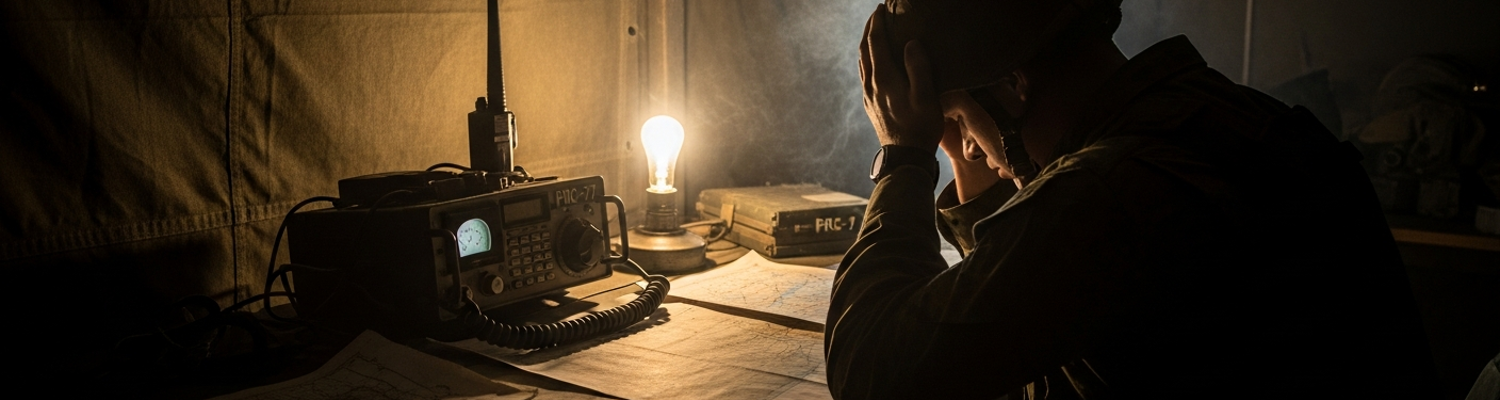
Inside the Headquarters and Headquarters Squadron 18 command post, the air was thick with the smells of stale coffee and ozone from humming radio banks. A junior intelligence officer, a first lieutenant, was tasked with assembling the initial post-mortem. His workspace was a small plywood desk littered with grease pencils, overflowing ashtrays, and maps of Quang Tri Province. The first fragments of information arrived not in orderly reports, but as chaotic bursts of radio traffic from the recovery operation and garbled debriefs from the first two survivors. He frantically scribbled notes onto a standard After Action Report form. The initial casualty estimates, relayed in clipped tones from the medevac chopper Sharkbait, were the first concrete entry. He then took the film canister handed to him by a mud-splattered runner. The gunnery sergeant's photos from the ambush site. There was no time for the photo lab. He held the negatives up to a bare lightbulb, seeing the ghostly, reversed images of bodies in the grass and the dark pockmarks of the NVA’s fortified firing positions.
This was not analysis. It was a desperate act of collection.
The lieutenant’s report became a catalog of unprocessed, contradictory observations. One section documented the original intelligence packet from MTACS-18. It showed the aerial photograph with its red circle around a trail junction and the accompanying analyst’s note postulating a single sniper team. Beside this, he began a new section titled GROUND TRUTH, the letters underlined so hard the pencil tip snapped. He listed the raw facts as they were understood. The attack was not a sniper. It was a platoon-sized force in prepared, interlocking bunkers. The initiation was not a single shot but a coordinated volley from multiple RPD machine guns. The patrol’s PRC-77 radio was destroyed on contact, a fact confirmed by the shattered casing visible in one of the negatives. The location of the ambush was not the target grid coordinate YD 145 565. The enemy had waited in a textbook L-shaped position on a rise 100 meters away, using the Marines' objective as a baited kill zone. Each entry was a direct refutation of the assumptions that had sent Echo-2-Actual into the elephant grass.
A review of archival documents (NARA Record Group 127) from that night shows the officer was building more than a report. He was compiling an indictment of a systemic failure. The lessons learned were not tactical suggestions but raw data points.
- Lesson One: Aerial photography of trail junctions in this sector was insufficient to distinguish between transient use and fortified enemy positions.
- Lesson Two: Signals intercepts suggesting a small enemy presence had failed to detect the platoon-sized unit that had been digging in for days.
- Lesson Three: Patrols acting on this type of intelligence lacked the requisite firepower.
He made a specific notation about the enemy’s fire discipline, noting from a survivor’s account that they ceased fire after five minutes, a clear indicator their objective was a high-speed ambush, not a sustained engagement. The report was a frantic attempt to capture these immediate truths before they could be softened or reinterpreted. The final entry on the first page was a simple notation: firepower from three machine gun bunkers had been focused on a kill sack less than 50 meters wide.
MTACS-18 1st MAW Intelligence Support
By January 1971, the mandate for Marine Tactical Air Command Squadron 18 was explicit. It was a primary node for processing and disseminating intelligence for all 1st Marine Aircraft Wing elements operating in I Corps. At its Da Nang headquarters, H&HS-18, the unit's designation until April 1971, functioned as a nerve center, tasked with equipping, manning, and operating the Tactical Air Command Center. The squadron was responsible for synthesizing a torrent of incoming data. Film canisters from RF-4B Phantom reconnaissance flights, signals intercepts from various platforms, and debriefings from ground patrols had to be turned into targetable information. This processed intelligence was meant to direct everything from helicopter tasks to fixed-wing sorties. The scale of 1st MAW's operations was immense, including over 1.2 million helicopter tasks between 1967 and 1971. The mechanical process involved analysts at light tables, poring over reconnaissance photos to spot changes in trail usage or new bunker construction. The output of this machine was intended to be the timely communication of perishable data.
This system was designed for a conventional battlefield. It broke down in the dense jungle of I Corps.
The operational environment of Quang Tri province presented a physical obstacle that no amount of processing power in Da Nang could easily overcome. The region was a mosaic of triple-canopy jungle, sharp-edged ridgelines, and plains covered in head-high elephant grass. This terrain systematically degraded the primary intelligence collection methods. A review of operational logs from the period shows that aerial photography, the bedrock of IMINT, was frequently rendered useless. A reconnaissance flight over a suspected enemy area would often return with images showing nothing more than an uninterrupted blanket of green. Beneath this, entire NVA units could maneuver, resupply, and build fortified positions undetected. The jungle canopy that defeated cameras also scattered radio waves, hampering the ability of signals intelligence to get a precise fix on enemy transmitter locations. The humid, metal-rich soil composition of the region further distorted electronic signals, adding another layer of uncertainty. This environment gave a massive advantage to the NVA and VC, who used their knowledge of the terrain to create camouflaged bunkers and ambush sites nearly impossible to spot from the air.
This intelligence deficit had its most lethal consequences in the execution of counter-sniper sweeps. By 1971, NVA and VC snipers had become a persistent threat, using hit-and-run tactics to inflict casualties and disrupt Marine operations. High-value counter-sniper sweeps were authorized, but their success was entirely dependent on precise data that MTACS-18’s apparatus was ill-equipped to provide. The theory was simple. An analyst would identify a suspected sniper's lair from a photograph or a radio fix, and a ground unit would be dispatched. The system was fundamentally flawed. The data was often hours or days old by the time a patrol was inserted. More pointedly, the intelligence itself was ambiguous. A faint radio signal or a slightly worn path on a photograph could be interpreted as a lone sniper, when it was actually evidence of a much larger enemy presence. The NVA were masters at baiting traps, deliberately creating small, observable signs of activity to lure Marine patrols into prepared kill zones. They understood the American intelligence cycle and used it against them. The ambush of Echo-2-Actual was a direct result of this systemic failure. The intelligence pointed to a single sniper team at grid coordinate YD 145 565. The ground truth was a platoon-sized NVA force waiting in pre-sighted, interlocking bunkers 100 meters away. The intelligence was not just wrong; it was fatally misleading.
Unheeded Acoustic Signature
A close review of operational logs from the MTACS-18 analysis center at Da Nang Air Base shows the first sign of disaster appeared as a ghost on a screen. For three consecutive nights leading up to the ambush, a faint, rhythmic signature was detected by an air-delivered ACOUSID (Acoustic and Seismic Intrusion Detector) sensor field. This sensor, designated AF-7B, was one of a dozen camouflaged devices dropped by an OP-2E Neptune aircraft to monitor potential infiltration routes. The specific signature from AF-7B, logged automatically by the IBM 360/65 computer at the Infiltration Surveillance Center in Thailand and relayed to Da Nang, fit no known profile. It was not the heavy, low-frequency rumble of truck engines, nor was it the sporadic chatter of human voices. Instead, it was a soft, repeating pattern: a low-impulse thump followed by a half-second of a high-frequency hiss. The pattern would recur with almost perfect mechanical regularity for two to three hours after midnight. It originated from a fixed position just 100 meters from the trail junction later designated as the objective for the Marine patrol.
The signal was filed under Spurious Data, Probable Fauna.
This miscategorization was not the result of a single analyst's error, but a systemic failure born of data overload. The ACOUSID sensors of Operation Igloo White were notoriously prone to false positives. Analysts were conditioned to expect and disregard signals triggered by animal movements, thunderstorms, or wind. The logs show the signature from AF-7B was initially flagged by a junior airman for further review. The signal’s perfect rhythm was unusual. Yet, when cross-referenced, there was no corroborating intelligence. No RF-4B reconnaissance flights showed ground disturbance, and no signals intercepts suggested enemy activity. A senior analyst, facing a daily deluge of thousands of similar low-grade alerts, made the final determination. The sound was attributed to a species of large cicada or a malfunction within the sensor itself. The North Vietnamese Army was also known to actively deceive the sensor network, playing recordings of truck engines or herding animals near the devices to trigger false alerts. An unidentifiable, low-energy acoustic signal with no other intel to back it up was statistically most likely to be noise. The query was closed.
Post-ambush analysis would reveal the truth. The rhythmic thump-hiss was the sound of NVA sappers digging. They were using manual, screw-type earth augers to silently excavate the complex of spider holes and reinforced bunkers. The thump was the sound of the auger handle being turned in the damp soil, and the hiss was the noise of displaced earth being carefully packed into sandbags to avoid leaving visible piles of dirt. The activity occurred at night to defeat aerial observation. The perfect regularity of the signal was not a malfunction; it was the steady pace of disciplined soldiers working in shifts. The acoustic signature was logged for three nights and then stopped. The silence on the fourth night was the most significant piece of intelligence, indicating the ambush position was complete. The intelligence system had not only failed to correctly identify the signal, but it had also failed to recognize the meaning of its absence.
Critical Data Link Hardware Failures
Operational logs from the 7th Communication Battalion detachment supporting MTACS-18 reveal the first point of failure occurred on a muddy flight line in Da Nang. The systems of Operation Igloo White depended on a constant flow of data. The acoustic sensor data from the Infiltration Surveillance Center in Thailand, relayed via EC-121R aircraft, had to be integrated with fresh aerial reconnaissance film and local signals intercepts. This fusion happened in van-mounted AN/GYK-3 processing shelters, hard-lined into the command post’s main intelligence hub. The link was a series of Amphenol multi-pin connectors, thick metal plugs designed for a secure, weatherproof data connection. The constant humidity of Quang Tri province, combined with airborne salt and red dust, had worked its way into the screw-down collars of these connectors. A technician’s log entry from the night before the ambush notes that the primary data port for the mobile SIGINT van, designated Argus-3, was unresponsive. A physical inspection showed the male and female ends of the main data cable were fused with galvanic corrosion. A crust of white and green oxides made it impossible to get a clean connection. The entire data feed from that van, tasked with monitoring low-level radio traffic in the specific area Echo-2-Actual was set to patrol, was lost for six hours while technicians worked with files and contact cleaner to physically remove the corrosion.
This was not a simple communications blackout.
The loss of that specific data stream created an unacknowledged blind spot in the analysis that followed. Inside the stifling confines of the primary AN/GYK-3 analysis van, a second hardware failure was compounding the first. These tactical computer systems were not designed for the sustained 95-degree heat and near-100% humidity of a Vietnamese monsoon season. The van’s primary air conditioning unit had failed two days prior. A field-expedient fix involving a repurposed helicopter oil cooler was all that kept the internal temperature below 110 degrees. The UNIVAC 1050-II computer, a rack-mounted system that formed the analytical heart of the shelter, began to suffer from heat-induced logic failures. A review of its diagnostic printouts (archived under MACV-SOG Annex-K 71-3) shows a cascading series of parity errors and non-responsive card readers. For the intelligence analysts, this meant the program meant to correlate the ACOUSID sensor data against known enemy unit profiles would repeatedly freeze. An analyst would initiate a query and wait ten minutes, only for the console to lock up, forcing a full system reboot that could take up to half an hour. The intelligence lag was not a matter of minutes, but of hours.
These technical impediments systematically degraded the quality of the intelligence. The rust-seized connector meant the analysts never saw the faint, anomalous radio chatter from the target area that the Argus-3 SIGINT van might have picked up. The overheating UNIVAC, in turn, meant the one remaining piece of data, the rhythmic acoustic signature from sensor AF-7B, could not be properly analyzed. A full correlation against the entire regional database was impossible. The system could only perform simple, short-duration queries. The final report passed to the 1st Marine Division planners was therefore a product of this cascading hardware failure: a single, uncorroborated data point which, without context, was interpreted as a low-level threat. The X on the map was not just an intelligence error; it was the direct output of a series of broken machines.
Consequences of Delayed Intelligence
Archival records from the 1st Marine Aircraft Wing’s intelligence sections show the catastrophe that befell Echo-2-Actual was rooted in time. The American intelligence apparatus in I Corps was a system built to process data, but it was consistently outpaced by the operational tempo. The intelligence lag contributed directly to the fatal misjudgment. An RF-4B reconnaissance flight might capture an image at 14:00, but by the time the film was flown to Da Nang, processed, and placed on a light table, hours had evaporated. An analyst would then have to interpret the subtle changes in the landscape. This analysis, once complete, would be bundled into a target packet and transmitted up the chain of command. In the case of the Quang Tri patrol, the initial aerial photograph was already six hours old when the analyst flagged the trail junction at YD 145 565. By the time Echo-2-Actual was briefed and inserted, a full eighteen hours had passed. In that time, what the analyst had interpreted as the possible lair of a lone sniper team had become the completed kill zone for a full NVA platoon. The system’s inherent delay transformed a piece of potentially useful data into a death warrant.
This systemic flaw placed an impossible burden on field commanders. A Marine captain or lieutenant receiving a mission packet from MTACS-18 was presented with what appeared to be concrete intelligence. It came with grid coordinates, aerial photographs, and a confident assessment. To question such intelligence was to risk being seen as hesitant. Yet, on the ground, these junior officers lived with the constant knowledge that the information could be dangerously out of date. They were the ones who had to lead their men into the elephant grass based on a photograph taken the previous day. A review of after-action reports from the period is filled with the understated language of officers trying to reconcile the intelligence they were given with the reality they encountered. Phrases like enemy force larger than anticipated or contact initiated from previously unidentified fortified positions appear with grim regularity. For the commander of Echo Company, the decision to send a single reinforced squad was a logical one based on the threat assessment provided. To have sent a larger force would have been an inefficient use of manpower. The system forced him into a fatal miscalculation.
The direct link between this misinterpreted data and the high casualties is undeniable. The patrol was equipped to fight the battle described in the intelligence report, not the one that was actually waiting for them. Their weapons loadout, M16 rifles, a handful of M79 grenade launchers, and a single M60 machine gun, was adequate for surprising a two or three-man sniper team. It was suicidal against a platoon of NVA regulars dug into mutually supporting, earth-and-log bunkers. The M79's 40mm grenades would have had little effect on the fortified positions, and the single M60 could be quickly silenced by the concentrated fire from the NVA’s three RPD machine guns. The NVA’s ambush plan was predicated on this exact scenario. They knew the likely composition of a patrol sent on a counter-sniper mission and designed their ambush to destroy it. Their initial volley was a targeted assault on the patrol’s command and control. The radioman, platoon sergeant, and squad leader were hit in the opening seconds, a textbook tactic to sow confusion and prevent the Marines from calling for support. The sixteen casualties sustained in under three minutes were not a result of a tactical blunder by the Marines on the ground. They were the direct outcome of sending a patrol armed for a skirmish into a prepared killing ground based on flawed intelligence.
Refined Intelligence Protocols
A review of archival records from the hours following the Echo-2-Actual ambush shows a frantic effort inside the MTACS-18 intelligence section to codify the disaster. It was an exercise in immediate, unprocessed lesson-learning. The first debriefs from the dazed survivors were not structured interviews but fragmented accounts of overwhelming fire from an unseen enemy. A young intelligence lieutenant, tasked with assembling the initial report, began cross-referencing these verbal accounts with the original intelligence packet. On one side of his log was the neat X marking the suspected sniper lair at grid coordinate YD 145 565; on the other, he scrawled the survivors’ descriptions of a platoon-sized force in hardened bunkers and the instantaneous destruction of the patrol’s PRC-77 radio. He held the undeveloped negatives from the gunnery sergeant’s camera up to a bare lightbulb. The ghostly images confirmed the location of the NVA firing positions nearly 100 meters from the assigned objective. This was not analysis; it was a desperate cataloging of raw data points that painted a picture of systemic breakdown.
This was intelligence triage.
The core failure, analysts quickly determined, was a breakdown in real-time data processing. The system had, in fact, detected the enemy, but the information was lost in a cascade of hardware failures and flawed assumptions. A close examination of operational logs from Operation Igloo White reveals the ACOUSID sensor had registered the rhythmic acoustic signature for three straight nights near the ambush site. Post-incident analysis later confirmed this was the sound of NVA sappers using manual earth augers. At the time, with no corroborating intelligence, the signal was dismissed as noise. The reason for the lack of corroboration lay in equipment failures. The primary data cable for the mobile SIGINT van monitoring the sector had become fused with corrosion. Simultaneously, the AN/GYK-3 analysis van’s primary computer, a UNIVAC system, was repeatedly overheating, preventing analysts from running the complex correlation programs that might have flagged the unique three-day acoustic signature. The intelligence sent to the Marines was not a complete picture; it was the degraded output of broken machines.
The ambush of Echo-2-Actual became a driver of institutional change within 1st MAW intelligence circles. The event exposed a fatal gap between the theoretical capability of high-technology surveillance and its practical application. The immediate impact was a mandated overhaul of counter-sniper protocols, outlined in a fragmentary order (FragO 71-04) issued by the 1st MAW G-2 section less than 48 hours later. A new emphasis was placed on intelligence confidence levels. Patrols would no longer be dispatched based on single, uncorroborated electronic intelligence signatures. A new doctrine emerged: if the only evidence for a target was a faint, ambiguous signal from a system known for false positives, the operational response was to assume a larger, prepared force. This meant subsequent counter-sniper missions based on similar intelligence were no longer squad-sized patrols but company-level operations with integrated mortar and artillery support. The raw lesson learned in the elephant grass of Quang Tri was that intelligence was only as good as its weakest link, and that acting on incomplete data was worse than having no data at all.