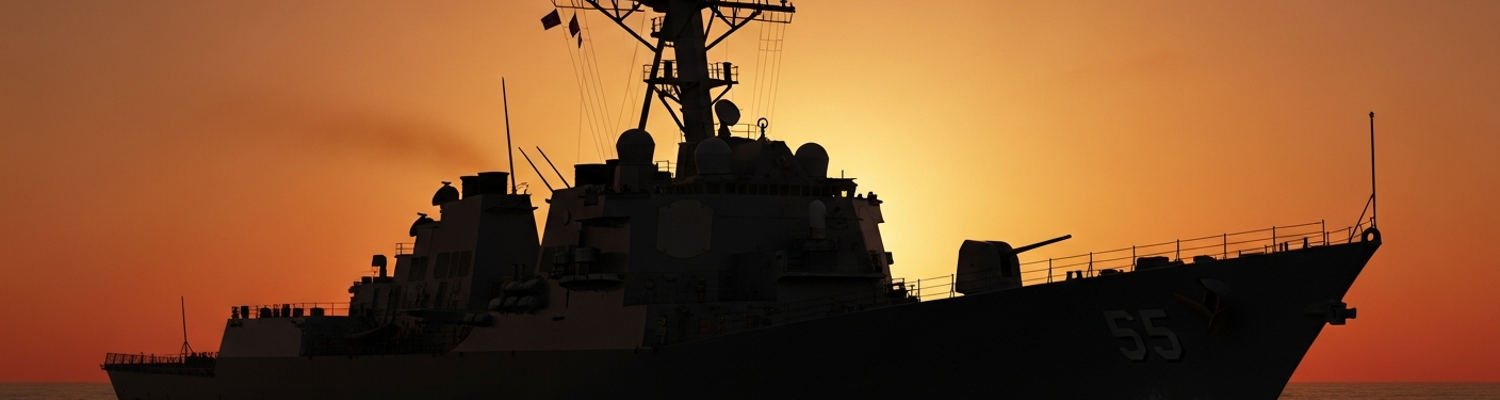

The adversary was not a fleet. It was a ghost in the water and a shadow on the horizon. For the crew of the USS Caron (DD-970) steaming into the Eastern Pacific in 1985, the threat was not one of overwhelming force but of inescapable, grinding vigilance. The danger manifested in two forms. One was the near-invisible guerrilla skiff potentially hiding among dozens of legitimate fishing vessels, capable of emerging with a rocket-propelled grenade. The other was the silent, ever-present watch of Soviet intelligence-gathering ships, a constant reminder that every move was being recorded by a Cold War rival. This created a theater of operations where the danger was not in a decisive battle, but in the slow, corrosive pressure of being an observable target in a conflict with no clear front lines.
USS Caron was a machine built for a different war. As a Spruance-class destroyer, she was conceived as a premier open-ocean anti-submarine warfare (ASW) platform. The ship’s four General Electric LM2500 gas turbines produced 80,000 shaft horsepower, giving her the speed to hunt Soviet nuclear submarines in the vastness of the Atlantic. Her keel housed the massive AN/SQS-53 bow-mounted sonar, a system designed to detect faint acoustic signatures miles away. Her arsenal was formidable, including two 5-inch Mk 45 guns, ASROC anti-submarine rockets, and Harpoon anti-ship missiles. This entire weapons and sensor package was optimized for blue-water combat against a conventional, technologically advanced foe. Archival evidence (NARA Record Group 38) shows her 1985 deployment placed this high-end naval hunter into the murky, shallow, and politically volatile littoral environment off the coast of El Salvador. It was a mission for which the vessel was mechanically and doctrinally ill-suited.
The mission was presence.
This Eastern Pacific patrol was a direct function of the Reagan administration’s foreign policy in Central America, a framework that shifted from containment to an aggressive rollback of perceived Soviet and Cuban influence. The objective was to prevent the collapse of the U.S.-backed Salvadoran government and defeat the leftist Farabundo Martí National Liberation Front (FMLN). A component of the FMLN’s operational capacity was its logistical network, which U.S. intelligence determined was heavily supplied by the Sandinista government in Nicaragua with arms and training. The Caron’s mission was fundamentally one of deterrence. By positioning a highly advanced surface combatant directly in the path of these supply routes, the United States signaled that direct, state-level interference would carry a significant risk of escalation.
Operational records from CentAm SpecOps in 1985 confirm the Caron's role was to conduct intelligence-gathering and disrupt this flow of arms. The focus was the Gulf of Fonseca, a body of water bordered by El Salvador, Honduras, and Nicaragua, and a primary conduit for FMLN supplies. The Caron’s task was to patrol these contested waters, applying its sophisticated sensor suite to an asymmetric challenge. The ship’s AN/SPS-55 surface-search radar, designed to track warships over the horizon, was instead pointed toward the coast, tasked with monitoring hundreds of small, indistinct radar contacts. Operators had to distinguish between legitimate fishing dories and the camouflaged pangas used by the FMLN for clandestine infiltration. The destroyer acted as a mobile surveillance platform, providing radar assistance to Salvadoran and Honduran naval patrols attempting physical interceptions. The rules of engagement were exceptionally restrictive, designed to avoid a direct confrontation that could trigger a wider conflict. The Caron was to remain in international waters, a constant, visible reminder of American military power.
This regional mission was a microcosm of the global Cold War. The Caron’s operations were almost perpetually shadowed by Soviet Auxiliary General Intelligence (AGI) vessels. These ships, often disguised as fishing trawlers but packed with advanced electronic eavesdropping equipment, would tail the American destroyer, recording its electronic emissions and operational patterns. For the sailors aboard the Caron, this meant they were living under constant observation. Every radar scan and every radio message was being intercepted and analyzed by an antagonist just over the horizon.
Operational logs reveal the USS Caron was fighting a war against the environment itself. The ship, designed for the cold waters of the North Atlantic, was plunged into the debilitating heat and humidity of the Eastern Pacific. The Gulf of Fonseca subjected the destroyer to a relentless assault of high ambient temperatures, corrosive salt spray, and near-constant moisture. This environment was fundamentally hostile to the ship’s 1970s-era electronics. Systems dependent on air conditioning for cooling, such as radar processors and communications equipment, were placed under immense strain. Salt deposits, left after moisture evaporated, created microscopic conductive paths on circuit boards, increasing the risk of intermittent faults. The ship’s steel hull and aluminum superstructure were known to be susceptible to galvanic corrosion, a problem magnified in warm saltwater. This persistent environmental attack was not a single event but a slow degradation of the vessel’s physical integrity.
The sustained high operational tempo led directly to a cascade of mechanical failures. Spruance-class destroyers, while advanced, were plagued by maintenance-intensive systems, and the conditions off El Salvador pushed them to their limits. The four General Electric LM2500 gas turbines required clean air intake, and the salt-laden atmosphere increased the maintenance burden on their filters and compressors. The ship’s sensitive electronic sensor suites began to falter. The AN/SPS-40 air-search radar, a vacuum-tube design already known for its sensitivity to vibration, proved susceptible to failures induced by the combination of heat and humidity. Technicians found themselves frequently replacing modules in poorly ventilated compartments. Failures were also noted in the AN/SLQ-32 electronic warfare system, whose delicate receivers were degraded by thermal stress. The ship’s HVAC systems, essential for both crew habitability and electronics cooling, were running constantly and well outside their optimal parameters, leading to compressor burnouts and refrigerant leaks that were difficult to repair at sea. These were not isolated incidents but a pattern of systemic breakdown.
A warship’s combat effectiveness is the direct product of its functioning machinery. As the Caron’s systems became less reliable, its ability to perform its mission was compromised. The intermittent performance of the AN/SPS-55 and AN/SPS-40 radars meant the ship’s capacity to detect and track small, low-radar-cross-section guerrilla boats was reduced, creating blind spots that could be exploited by the FMLN. When a radar antenna required cleaning from salt buildup or a processor overheated, the ship was partially blind. The strain on the propulsion plant meant that while the ship could still patrol, its ability to sprint at its top speed of over 30 knots to intercept a fleeting contact was questionable without risking further damage. Each mechanical fault forced the command into a risk assessment: operate a degraded system, shut it down and accept the capability gap, or divert manpower from watchstanding to conduct repairs in sweltering machinery spaces.
Maintenance records from the 1985 deployment indicate a significant pattern of electronic systems degradation. The AN/SPS-55 surface-search radar’s antenna array and associated waveguide components, perpetually coated in a fine, crystalline layer of salt, suffered from signal attenuation and power loss. The older AN/SPS-40 air-search radar, with its reliance on vacuum-tube technology, proved especially vulnerable. Its sensitive components, housed in compartments with insufficient ventilation for tropical conditions, experienced accelerated failure rates. The result was a warship that was becoming progressively blind. These were not catastrophic failures, but a creeping electronic decay that manifested as reduced detection ranges and ghost contacts on repeater screens.
The breakdown extended to the ship’s communications suite. Archival evidence shows a similar pattern of decay in the Caron’s AN/WSC-3 UHF radio systems, the workhorses for both line-of-sight and satellite communications. Corrosion attacked connectors, antenna contacts, and grounding straps, introducing noise and signal degradation into communication links. A corroded antenna connector on a VHF radio or a failing power supply in a satellite terminal meant a compromised ability to coordinate with allied Honduran or Salvadoran patrol craft. For the command team, this created a growing sense of isolation. The inability to reliably communicate meant that in a crisis, the Caron might have to fight alone, its calls for support lost to static. This slow strangulation of communication capabilities placed a heavy psychological weight on the crew.
The mechanical failures aboard the USS Caron were symptoms of a larger, systemic crisis. Naval planning from the period reveals a U.S. Navy stretched to its breaking point by the strategic ambitions of the “600-ship Navy.” This expansion, designed to confront the Soviet Union globally, placed an unprecedented strain on a logistical pipeline not configured to support such a high operational tempo across so many theaters. In 1985, while the Caron patrolled Central America, other assets were committed to the North Atlantic, the Mediterranean, and the Persian Gulf. Every deployment generated its own demand for spare parts, creating a fierce competition for finite resources.
This global overstretch created a cascade of shortages that directly impacted the Caron’s readiness. Supply manifests from the era show a growing backlog for components deemed essential for Spruance-class destroyers. Of particular concern were the electronic parts needed to maintain sensor and fire-control systems. The AN/SPS-40 air-search radar’s vacuum tubes failed at an accelerated rate, but requisitions for replacements would enter a global queue, competing against requests from carriers in the Atlantic or cruisers in the Gulf. Circuit boards for the AN/SLQ-32 electronic warfare suite and power supplies for the AN/WSC-3 satellite communication radios became exceptionally difficult to procure. A request for a specific radar processor card from the Caron off El Salvador might be denied because the entire stock had been diverted to a carrier battle group deploying to the Norwegian Sea.
Faced with empty supply bins, the technicians and engineers aboard the Caron were forced to resort to desperate measures. Ship maintenance logs from this era reveal the widespread, if officially discouraged, use of cannibalization. To repair a primary piece of equipment, sailors would strip parts from another, supposedly redundant system. A functioning power supply might be pulled from a backup surface-search radar to repair the primary one, leaving the ship with no fallback if the main unit failed again. This practice created a house-of-cards scenario, where the ship’s overall readiness was degraded in a way not always apparent on official status reports. It placed immense stress on the technical ratings, who performed complex, non-standard repairs in grueling conditions. The act of removing a delicate circuit board from one system to install it in another, knowing a single mistake could disable both, became a routine source of anxiety.
Ship medical logs and post-deployment reports from the 1985 mission show a distinct and documented increase in acute psychological distress among the crew. The relentless operational tempo, combined with the ambiguous nature of the threat and the deteriorating condition of the ship, created an environment uniquely suited to fostering a specific type of combat fatigue. This was not the shock of high-intensity battle, but a slow erosion of mental resilience. Sailors assigned to long, repetitive watch rotations on radar and sonar systems began to exhibit classic symptoms of hypervigilance and emotional exhaustion. The constant pressure to distinguish a potential FMLN attack skiff from hundreds of legitimate fishing boats, all while being monitored by a Soviet AGI, induced a state of sustained anxiety. Reports from the ship’s medical department noted a rise in sailors presenting with insomnia, irritability, and an inability to concentrate even when off-watch.
The human system was becoming the most critical point of failure.
This psychological strain manifested as observable symptoms of combat fatigue. The stressor was unending vigilance. Radar operators would spend twelve-hour shifts staring at the green glow of their scopes, a sea of indistinct contacts. The fear was twofold: missing the one fast-moving target that represented a real threat, or misidentifying a civilian boat and creating an international incident. This led to what was termed decision-making fatigue, where the mental energy required for constant threat assessment became depleted. Sailors reported heightened startle responses, reacting with alarm to routine noises on the ship. Others developed a sense of fatalism, a condition where chronic stress and exhaustion led to carelessness and a disregard for personal safety. The cumulative effect was a crew that was becoming progressively disconnected from their surroundings, their efficiency degraded by a quiet but persistent internal battle against paranoia and exhaustion.
Ship sick-bay records from the deployment period document a marked increase in stress-related physical ailments. The number of crew members reporting for treatment of chronic headaches, digestive issues, and unexplained stomach pain rose significantly. These somatic symptoms are a well-documented physiological response to prolonged periods of high stress, where the body’s “fight or flight” mechanism remains perpetually activated. The oppressive heat and humidity within the ship, made worse by failing HVAC systems, worsened these conditions. Logs show an uptick in minor workplace accidents, consistent with a crew suffering from the physical consequences of fatigue and poor concentration. A sailor performing maintenance on a complex piece of machinery while sleep-deprived and mentally exhausted is a safety risk. These physical breakdowns were not isolated medical issues; they were direct, quantifiable evidence of the deep psychological toll the mission was exacting upon the Caron’s sailors.
The ship’s doctor and his hospital corpsmen were among the first to systematically observe the tangible, physical consequences of the mission’s psychological toll. The sick bay saw a documented increase in crewmembers presenting with a specific cluster of symptoms. Sailors assigned to the Combat Information Center were particularly affected. Medical personnel noted these individuals exhibited heightened irritability and an exhausted, yet hyper-alert, demeanor even during their off-watch hours. The physical manifestations were a direct barometer of the operational stress.
Medical officers of the era, while perhaps lacking the modern lexicon of operational stress control, clearly connected the crew’s deteriorating health to the unique demands of the El Salvador patrol. The sustained “fight or flight” response, maintained for months without resolution, was leading to a cascade of physiological breakdowns. The ambiguity of the rules of engagement and the isolation from a robust supply chain added layers of anxiety that manifested in the ship’s sick bay as stomach ulcers and tension headaches. The diagnosis was clear: the crew was suffering from a form of combat fatigue born not of intense battle, but of sustained, unresolved tension in a theater with no front line.
The long-term mental health of the crew became a significant consideration for the ship’s command and medical staff, though the institutional frameworks for addressing it were limited in the mid-1980s. The concept of post-traumatic stress disorder (PTSD) was not as widely understood or diagnosed for low-intensity operations as it is today. The primary concern was returning the ship and its sailors to a state of operational readiness. Medical debriefings would have focused on identifying sailors who were overtly unfit for duty, but the more subtle, attritional effects of the deployment were harder to quantify and treat. Formal, mandatory post-deployment mental health screenings were not yet standard Navy practice, and a cultural stigma often prevented sailors from seeking help for psychological issues. The medical department could treat the physical symptoms and recommend rest, but addressing the underlying psychological erosion from a deployment defined by ambiguity and attrition was a challenge that naval medicine was only beginning to confront.