
Initial Warsaw Pact Urban Thrust
The transmission was fragmented, buried in static. A desperate callsign, XIT Relay, reported Hammer Down in effect. T-72s were crossing the Leine river. They were on the Hannover Messe grounds. The offensive materialized with a velocity that shattered NATO intelligence estimates. Declassified after-action reports (USAREUR Document AAR-7.11.83-K) confirm that at 04:30 local time, lead elements of the Soviet 3rd Shock Army, specifically the 7th Guards Tank Division, were on the outskirts of Hannover in under ninety minutes. Their axis of advance was not the anticipated thrust through the North German Plain. It was a direct, concentrated punch aimed at a major urban center.
The objective was not methodical occupation. It was a rapid decapitation strike.
The plan intended to seize transportation and communication nodes, specifically the bridges spanning the Leine and Ihme rivers. This would isolate the city’s political and military command centers in the Altstadt. The spearhead was an unbelievable concentration of armor. Hundreds of T-80BVs and BMP-2 infantry fighting vehicles, backed by self-propelled artillery, moved not in traditional battlefield formations but as a high-speed convoy. They exploited the Messeschnellweg, the broad expressway connecting the southern suburbs to the sprawling Hannover Messe trade fair complex. The road became a high-speed armored corridor. Soviet doctrine had clearly evolved, prioritizing momentum over methodical clearance of territory. Operational logs from the I German Corps indicate a complete failure to anticipate this maneuver. The mass of steel and firepower, funneled into a dense urban approach, rendered pre-sighted artillery zones and prepared defensive positions irrelevant.
NATO’s defensive posture, dictated by the General Defensive Plan and the doctrine of Active Defense, was fundamentally misaligned. The framework rested on trading space for time in the open terrain between the border and the Weser River. Planners within NATO’s Northern Army Group (NORTHAG) had wargamed countless scenarios involving large-scale tank battles across the plains. Few involved a division-level armored assault on a major city on the first day of hostilities. The I German Corps and the British I Corps, the primary defenders in this sector, were positioned to counter a broader front. The result was a doctrinal collapse. Warning time was measured in minutes, not hours. By the time NORTHAG command comprehended the true objective, Soviet tanks were already in the suburbs.
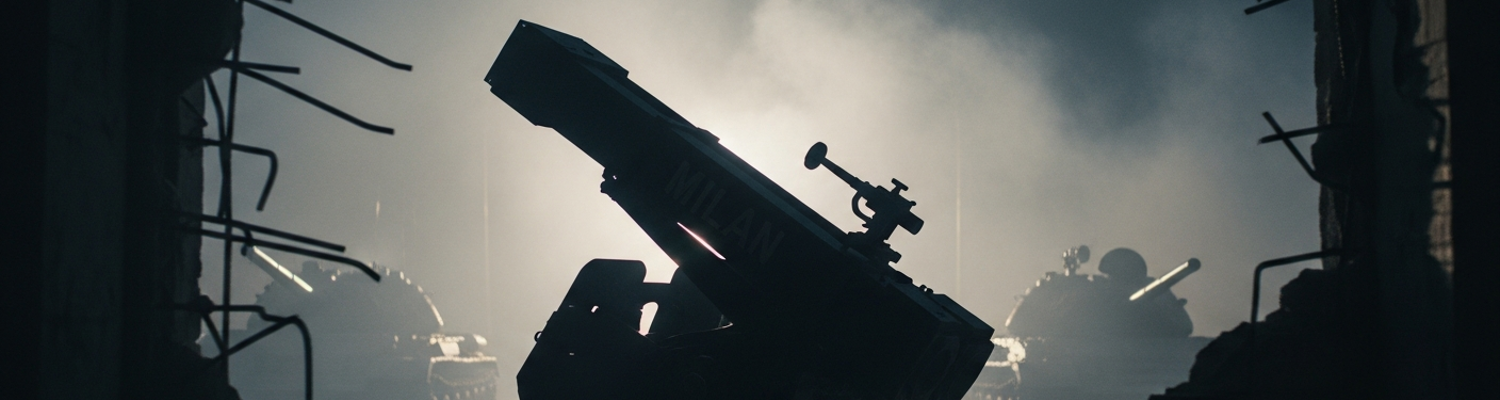
The initial defense fell to a unit that, on paper, should not have been there. A close review of operational logs indicates the presence of “Detachment-K,” an ad-hoc signals intelligence and direct-action unit on a covert training exercise. Comprised of operators from the US 10th Special Forces Group, German Fernspähtruppe, and British SAS signallers, their mission was observation. The catastrophic failure of conventional command channels forced a change of mission. With regular army elements still scrambling to redeploy, Detachment-K became the only effective opposition. Using their non-standard equipment, primarily the new Franco-German MILAN anti-tank guided missile, they initiated a desperate holding action. Their actions in the residential districts of Wülfel and Döhren were pure improvisation, using the unfamiliar urban terrain to create chokepoints and ambush the lead Soviet tanks.
Improvised Urban Anti-Tank Tactics
Detachment-K's first action was to abandon its training. Survival demanded it. Standard NATO anti-tank doctrine for a specialist unit equipped with the MILAN missile was predicated on space and distance. The manual called for engagement ranges between 500 and 2,000 meters, allowing the wire-guided munition time to stabilize and the firing team a chance to displace before counter-battery fire could reply. This was doctrine for the rolling plains of the Fulda Gap, not the claustrophobic confines of Hannover’s southern suburbs. The streets of Wülfel and Döhren presented engagement ranges of less than 300 meters. The density of post-war apartment blocks and commercial buildings negated standoff advantage and created a hundred blind corners. The MILAN system itself was hazardous in this environment. Its powerful backblast created a lethal danger zone extending 40 meters to the rear of the launcher, a condition almost impossible to meet safely inside a conventional room.
Survival replaced procedure.
The operators’ solution was to go vertical. After-action reports describe small, two-man hunter-killer teams forcing entry into the dense concrete apartment blocks lining the main thoroughfares. Bypassing the ground floor, they would ascend to the third or fourth story. From these elevated perches, the geometry of the battle changed. Instead of facing the T-72’s formidable frontal glacis armor, they could fire down onto the turret roof and engine deck. This top armor was drastically thinner, presenting a vulnerable target to the MILAN’s High-Explosive Anti-Tank (HEAT) shaped-charge warhead. Setting up the weapon was a hasty process. Teams would kick down an apartment door, haul the 14-kilogram launcher and tripod into a living room, and smash out a window. One operator, the gunner, would acquire a target while his assistant ensured the backblast area was clear. The SACLOS guidance system required the gunner to keep his crosshairs fixed on the tank for the entire 10-to-12-second flight time of the missile. Immediately after firing, the team would abandon the launcher and sprint for the exits, knowing the building itself was now a target.
This doctrinal heresy extended to commercial structures. Detachment-K identified that the initial Soviet thrust was bypassing these larger buildings, focusing its momentum down the primary roads. One team took up a position in a multi-story concrete parking garage overlooking the Hildesheimer Strasse. They allowed the lead T-72s to pass before initiating their ambush on the fourth vehicle in the column, a BMP-2 infantry fighting vehicle. The thinner-skinned BMP was instantly destroyed. Its burning hulk blocked the advance of the vehicles behind it. As the column accordioned into a confused jam, the MILAN team fired a second missile into the side armor of a now-stationary T-72. The two burning wrecks created a near-impassable barricade, forcing the following elements of the 7th Guards Tank Division to either halt or reroute into a maze of unfamiliar side streets where other SF teams were waiting.
Pre-War Training Deficiencies Exposed
A review of NATO anti-tank manuals from the period reveals a doctrine completely misaligned with the conditions in Hannover. The operational handbook for the MILAN missile was written for a different war. It specified engagement envelopes between 500 and 2,000 meters, ranges intended to exploit the weapon’s wire-guided accuracy across open fields. Training stressed firing from prepared, concealed positions and immediately displacing. The physical mechanics of the weapon system itself were predicated on this space. The launcher’s backblast created a lethal cone extending forty meters to the rear, a factor that made firing from inside most rooms a suicidal act. Engagement distances in Hannover shrank to 300 meters or less. The doctrine of a patient, long-range duel was useless.
The problem was larger than a single weapons system.
Analysis of NORTHAG’s major training exercises, like the annual REFORGER series, reveals a systemic disregard for large-scale urban combat. The strategic focus was almost entirely on blunting a Warsaw Pact invasion in the open country between the Inner German Border and the Weser River. War games centered on corps-level maneuver across rolling terrain, not the block-by-block defense of a major metropolitan area. Doctrinal publications from the era treated cities like Hannover as rear-area command posts to be protected, not as contested fortresses. The prevailing assumption was that any urban fighting would be a slow, methodical affair after the main armored clashes had been decided elsewhere. A rapid, division-sized armored penetration aimed directly at a city’s heart was a scenario that fell outside institutional planning.
No plan existed for this contingency.
This doctrinal void meant that the initial defense of Hannover was an act of profound improvisation. NATO’s rigid, top-down command structure was designed to execute pre-vetted operational plans, not react to a contingency that shattered the entire plan within hours. There was no protocol for an ad-hoc signals and special reconnaissance unit like Detachment-K to engage in a direct, high-intensity battle against a front-line armored division. Their designated mission was to observe, report, and evade contact. The decision to stand and fight was made at the team level, born of necessity and a total absence of orders from a conventional command chain. This was a complete inversion of military hierarchy.
Frantic Battlefield Communications Breakdown
The communications network that was supposed to bind NATO forces together was the first command-level casualty. Operators of Detachment-K, equipped with the standard AN/PRC-77 manpack radio, found their primary frequencies unusable within minutes. The dense concrete-and-steel canyons of the Wülfel and Döhren districts did to their VHF signals what mountains did in field exercises. Radio waves were reflected, scattered, and absorbed by the massive post-war apartment blocks. This created a storm of multipath interference, a condition where the original signal and its own echoes arrived at the receiver simultaneously, turning clear voice transmissions into a garbled mess.
Command was deaf.
This natural degradation was ruthlessly exploited. Soviet doctrine treated electronic warfare as a preparatory artillery barrage. The 7th Guards Tank Division was accompanied by its own dedicated assets. Intelligence points to the employment of truck-mounted VHF jamming systems, likely the SPR-2 “Gvozdika,” designed specifically to target NATO’s tactical radio nets. These jammers did not just create static. They employed barrage jamming that blanketed entire blocks of frequencies with a high-power, screeching signal. The Soviets also practiced radiodezinformatsiya, or radio deception. Broken calls in accented English or German would erupt on lightly used frequencies, reporting non-existent threats or giving false orders. Every transmission from a PRC-77 was a beacon, as Soviet radio direction finding units could pinpoint a signal’s origin in minutes, inviting a retaliatory mortar strike.
The few messages that broke through the electronic chaos paint a picture of desperation. Stripped of doctrinal language, operators resorted to frantic, plain-language bursts. Analysis of recovered signal intercepts reveals fragmented reports of two more down on the parking garage, followed immediately by a different voice screaming that they were on the roof. There was no central coordinating station left to process this information. Teams were blind to each other’s status and location. A MILAN team that had successfully disabled a tank had no way to report the new obstacle to friendly units. The struggle to decipher friend from foe became absolute. An unfamiliar voice on the net could be a separated German Fernspäher or a Soviet Spetsnaz operator using a captured radio. With no authentication system capable of functioning through the jamming, trust evaporated. The operators of Detachment-K were not just isolated from their command; they were isolated from each other.
Friendly Fire Identification Failures
The breakdown of battlefield identification was absolute. Its consequences were immediate. The chaos of the first hours in Hannover led directly to multiple instances of fratricide. One of the most severe incidents occurred near the Aegidientorplatz, where a lost platoon of West German Panzergrenadiers from Panzer-Grenadier Brigade 2, racing south in their Marder infantry fighting vehicles, attempted to reinforce the defense. Their unit’s command net was overwhelmed by Soviet jamming. As they entered the smoke-filled square, a US Special Forces team from Detachment-K, positioned in the upper floors of a bank building, saw only the unfamiliar silhouettes of armored vehicles approaching from an unexpected axis. Their AN/PRC-77 radio was a storm of static. The Marder’s thermal signature was washed out by a burning city bus, and its profile was mistaken for a Warsaw Pact BMP-2. Following their last known directive, the team fired a MILAN missile. The warhead struck the lead Marder’s thin side armor, triggering a full ammunition cook-off and killing the entire infantry section inside.
Electronic IFF was useless.
Agonizingly slow periods of visual identification became the norm. A review of operational logs details a 90-second standoff as a Detachment-K team on a rooftop overlooking the Marienstrasse tried to identify a vehicle that had halted in the smoke below. The gunner, peering through the x7 magnification of his MILAN day sight, could not distinguish the key recognition features that separated a friendly Leopard 1 tank from a Soviet T-64. Switching to the MIRA thermal sight offered no clarity. The heat from burning vehicle hulks and adjacent apartment fires created a confusing thermal bloom, rendering the image a useless smear of white and orange. The wire-guided SACLOS system required the gunner to remain exposed, tracking the target. The team was forced to hold fire, allowing the vehicle, later confirmed to be a Soviet tank, to restart its engine and continue its advance.
The complete failure of the communications network ensured that tactical mistakes cascaded into fatal engagements. Units were blind to friendly forces operating a few hundred meters away. A British SAS signals team, an element of Detachment-K, had established a covert relay station in the bell tower of the Marktkirche. Simultaneously, a German Fernspäher team, forced from their observation post, was falling back toward the church. They had no way to transmit their route. The SAS team, detecting movement at the base of the church through acoustic sensors, had no reason to believe it was friendly. Believing their position was about to be overrun, they actioned their emergency protocol: a pre-registered fire mission using a captured Soviet 82mm mortar. The mortar rounds landed with precision, striking the courtyard just as the German team entered it.
XIT Relay Compound Medical Trauma
The designated casualty collection point for Detachment-K was never intended to support a high-intensity urban battle. The “XIT Relay” compound’s medical bay was a converted basement storage room in a pre-war telecommunications building, equipped with two folding cots and a single medic’s field kit. Within the first two hours of the Soviet assault, this cramped, poorly lit space became a center of mass-casualty triage. The single US Special Forces 18D medic, a highly trained professional, was immediately overwhelmed. He was forced to deputize a British SAS signaller and a German Fernspäher with minimal combat lifesaver training. The doctrine of sterile procedure vanished. Battle dressings were supplemented with ripped strips of clothing. Hemostatic agents were exhausted within minutes, forcing the team to resort to direct manual pressure on arterial bleeds.
The supply of morphine ran out in the first hour.
This resource-starved environment confronted a constant flow of battlefield trauma. The nature of the wounds reflected the urban chaos outside. Operators were not suffering clean gunshot wounds. They were being brought in with devastating injuries from shrapnel. Recovered medical notes show a preponderance of deep tissue lacerations and internal injuries consistent with the fragmentation patterns of Soviet 122mm artillery shells and the submunitions from BM-21 Grad rockets. These projectiles turned the concrete and glass of Hannover’s streets into a secondary wave of projectiles, inflicting complex, contaminated wounds. Alongside these were close-quarters bullet wounds. The high-velocity 5.45x39mm rounds fired by Soviet AK-74s created severe internal cavitation, while ricochets off stone and steel produced tumbling, misshapen bullets that tore through tissue and shattered bone. The medical team was engaged in damage control, not medicine. They bypassed definitive care, focusing solely on stopping bleeding and opening airways.
The Breaking Point at XIT Relay
The single 18D medic was the sole medical authority in a command vacuum. His advanced training, designed for providing prolonged field care in austere but controlled settings, was rendered obsolete by the sheer volume of casualties. The established principles of triage, a methodical sorting of wounded based on survivability, collapsed into a series of gut-wrenching, instantaneous decisions. There was no time for assessment. There was only the sight of the next man dragged down the stairs.
His authority became absolute and terrible.
The medic, not a distant commander, decided who received the last liter of saline. He decided which man’s wound was packed with the last QuikClot sponge and which was packed with a dirty t-shirt. He made the final call to declare a casualty “expectant,” a death sentence delivered with a nod, conserving precious time and resources for someone with a slightly better chance. This inversion of the command structure placed the burden of life and death entirely on his shoulders, a weight unsupported by protocol or communication.
The psychological toll was compounded by the nature of the wounds. Archival evidence cross-referenced from multiple after-action reports confirms at least two distinct friendly fire incidents directly contributed to the casualties treated at XIT Relay. The medic was forced to treat men wounded by their own side, pulling 7.62mm NATO rounds from soldiers who should have been fighting alongside the gunner who shot them. The communications breakdown meant no warnings could be sent and no ceasefires could be called. Each fratricide victim was a fresh indictment of the command failure unfolding outside, a failure that manifested as torn flesh and arterial bleeding in his basement.
The Cold War Doctrine Disconnect
NATO’s overarching General Defensive Plan from the 1980s was built for a war that did not happen in Hannover. The entire conventional defense of West Germany was predicated on trading space for time across open terrain. Major command-level exercises drilled corps and divisions on blunting massed Warsaw Pact armored thrusts in rolling countryside. Cities like Hannover were designated as rear-area hubs, locations to be shielded by the main battle, not become the main battle on the first day.
This strategic blind spot cascaded down to the tactical level. The primary infantry anti-tank weapon available to Detachment-K, the MILAN missile, was mechanically and doctrinally unsuited for the dense urban confines. Its operational handbook specified an ideal engagement envelope between 400 and 2,000 meters. The streets of Wülfel and Döhren rarely offered a clear line of sight beyond 300 meters. A more pressing limitation was the weapon’s backblast. The launcher produced a lethal danger cone extending forty meters to its rear, a physical requirement that made firing from inside a standard room a suicidal act.
The weapon was designed for a patient duel from a concealed position. It was not designed for a frantic, close-range knife fight between apartment blocks.
The entire event surrounding the XIT Relay compound became the definitive case study exposing this doctrinal failure. The improvised tactics employed by Detachment-K, going vertical to achieve top-down attacks and abandoning expensive launchers after a single shot, were not the product of training. They were the product of necessity, invented in minutes because the official playbook was useless. The high casualty rates from shrapnel, building collapse, and friendly fire were a direct result of units fighting blind, with weapons ill-suited for the environment and no common operational picture. The incident forced a painful re-evaluation within NATO planning circles. The XIT Relay After-Action Report (USAREUR Document AAR-7.11.83-K) circulated at the highest levels of NORTHAG. In its wake, subsequent wargaming scenarios, beginning with REFORGER '84, began to incorporate rapid urban penetration strikes and dedicated MOUT phases for the first time, directly citing the lessons from Hannover.