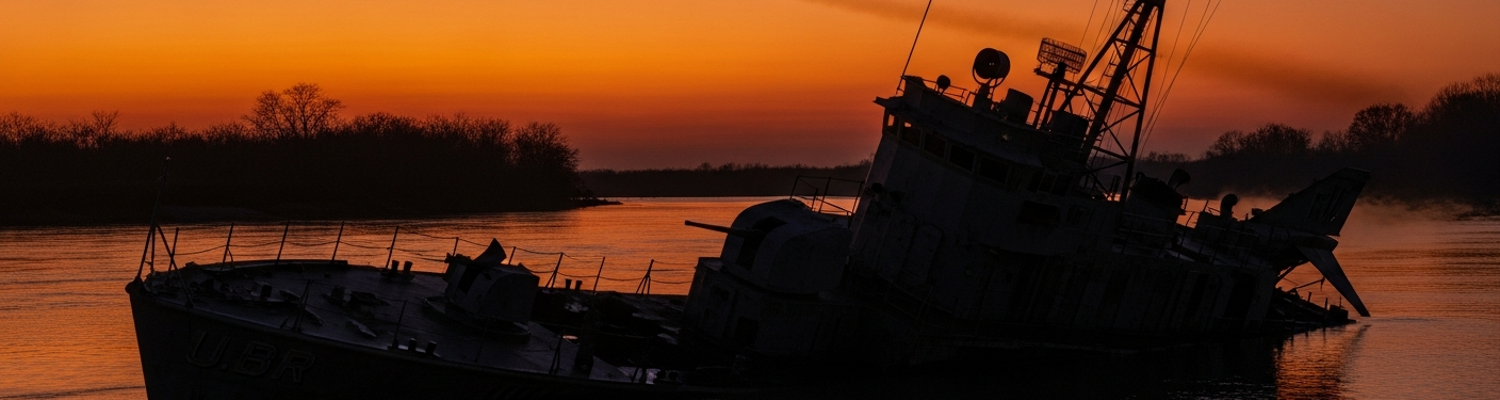

By 1968, the North Vietnamese Army and its allies in South Vietnam’s northern provinces fielded a substantial force. Tens of thousands of NVA regulars, supported by heavy artillery, rockets, and a deeply entrenched local insurgency, created a persistent and lethal threat against a thin line of American marines. For the United States Marine Corps, tasked with defending this hostile territory, the situation was defined by a single, precarious logistical artery: the Cua Viet River.
This was not a grand naval channel. It was a narrow, muddy waterway that snaked inland from the South China Sea, just kilometers south of the Demilitarized Zone (DMZ), to the Dong Ha Combat Base. Dong Ha was the lynchpin of the entire American military effort in Quang Tri Province. It served as the primary logistics and support hub for the 3rd Marine Division, whose regiments were scattered across exposed and isolated combat bases like Con Thien, Gio Linh, and Khe Sanh. Everything these Marines needed to fight, from 105mm howitzer rounds and C-rations to gasoline and medical supplies, traveled up this river. The journey began 90 nautical miles south at the Naval Support Activity Da Nang, where ocean-going Landing Ship, Tanks (LSTs) were loaded. These vessels navigated to the treacherous mouth of the Cua Viet, an entrance marked by shifting sandbars and harsh monsoon winds. At a small, constantly shelled facility, their cargo was transferred to smaller Landing Craft, Mechanized (LCM-8s) and Landing Craft, Utility (LCUs) for the final, eight-mile trip upriver to Dong Ha. By late 1967, this riverine supply chain was moving over 72,500 tons of supplies per month.
The operational environment was a death trap. The river’s path through a flat, sandy coastal plain left supply convoys completely exposed. From concealed positions on the northern bank, often inside the supposedly neutral DMZ, NVA artillery units armed with Soviet-supplied 130mm field guns and 140mm rocket launchers could observe and engage the slow-moving American watercraft at will. The waterway itself was a constant menace. Viet Cong sappers and NVA commandos mined the channel almost daily. A close review of operational logs indicates that the Navy was losing three to five LCM landing craft to mines weekly during peak periods. Ambushes from the shoreline were a daily occurrence, with rocket-propelled grenades and sniper fire targeting the unarmored boats. The American response was Task Force Clearwater, a naval unit established in February 1968 specifically to protect this waterway. Its PBRs (Patrol Boat, River) would sweep ahead of the convoys, searching for mines, while armed helicopters flew overhead. The threat was never eliminated. The attacks were relentless. In one instance, enemy artillery struck the Cua Viet port facility, detonating an ammunition dump and 64 fuel bladders, killing one American and wounding 22.
The Marine Corps presence in the I Corps Tactical Zone was defined by this logistical razor’s edge. The 3rd Marine Division, with its headquarters at Dong Ha, was spread perilously thin. Battalions from regiments like the 1st, 3rd, and 4th Marines were tasked with conducting aggressive search-and-destroy missions and defending the string of firebases along the DMZ, all while being tied to this single, vulnerable supply line. Units like the 1st Amphibian Tractor Battalion found themselves in near-constant combat along the river’s banks, fighting to keep the area clear of NVA forces. Archival evidence shows that in January 1968, intense NVA pressure forced the temporary closure of the waterway, threatening to starve the inland bases. The defense of I Corps was not just a fight for hills or outposts; it was a grueling, continuous battle to keep one small river open.
The primary instrument for projecting American air power in South Vietnam by the summer of 1968 was the McDonnell Douglas F-4 Phantom II. It was a machine built for brute force, a physical manifestation of Cold War doctrine. Two massive General Electric J79 engines could push the 30-ton airframe to over twice the speed of sound, generating a distinctive roar that became synonymous with its presence. A close examination of its design reveals a platform optimized for two divergent missions: air superiority and ground interdiction. For air-to-air combat, the Phantom was a high-altitude interceptor. Its powerful AN/APQ-72 radar and long-range AIM-7 Sparrow missiles were designed to destroy enemy bombers far from the fleet. This capability was managed by a second crewman, the Radar Intercept Officer (RIO), a recognition that the complexity of modern air combat had exceeded the capacity of a single pilot.
Its second role was that of a blunt instrument against ground targets. The Phantom could carry an ordnance load of over 18,000 pounds distributed across its centerline and wing pylons, more than the bomb load of a World War II-era B-17 Flying Fortress. The term 'precision' in 1968 did not involve lasers or GPS. Precision was the skill of the pilot, pitching his aircraft into a steep dive, aligning the target in a simple gyroscopic gunsight, and releasing ordnance at the calculated moment. A typical strike involved a variety of munitions, from 500-pound Mk 82 general-purpose bombs and cluster munitions to napalm canisters and Zuni rockets, often delivered in a low-angle pattern to strip foliage and expose enemy positions. The two-man crew again proved advantageous. The pilot focused on flying the aircraft through the intense physical and mental demands of a combat dive while the RIO assisted with navigation, threat detection, and weapons management.
For Marine Fighter Attack Squadron 122 (VMFA-122), operating their F-4B Phantoms from Da Nang Air Base in July 1968, these capabilities were tested daily. Archival records show the squadron, known by its nickname the Crusaders, was deployed to Vietnam in August 1967. Their combat duties were relentless. A significant portion of their sorties consisted of close air support (CAS) missions for Marine infantry units engaged in close-quarters fighting across I Corps. Other missions were dedicated to interdiction, striking North Vietnamese Army supply lines, troop concentrations, and the artillery positions concealed in and around the DMZ. These NVA gun crews were responsible for the constant shelling of Marine bases and the Cua Viet waterway. A review of the squadron’s operational data from the period reveals an intense tempo. During the defense of Khe Sanh in February 1968 alone, VMFA-122 flew 629 combat sorties, dropping 1,300 tons of ordnance. By July, the pressure had not relented. The squadron’s daily flight schedule was a mix of pre-planned strikes and rapid-response scrambles to aid troops in contact. The squadron would rotate out to Japan in September 1968 after more than a year of continuous combat operations.
Ground commanders held an almost desperate expectation for the effectiveness of air support. For outnumbered Marine infantrymen, the sound of friendly jets overhead was a massive psychological boost. The system revolved around the Forward Air Controller (FAC), an aviator either on the ground with the infantry or circling the battle in a light observation aircraft like an O-1 Bird Dog. The FAC’s job was to identify the enemy’s position, often marked with a white phosphorus rocket, and then talk the F-4 pilot’s eyes onto the target for the strike. The expectation was for a response time of minutes, and for ordnance delivered with pinpoint accuracy, often dangerously close to friendly positions. The execution, however, was often complicated by bad weather, the difficulty of spotting camouflaged NVA positions, restrictive rules of engagement around the DMZ, and the simple physics of coordinating a Mach-2 jet with a squad of infantry on the ground.
The American intelligence apparatus in I Corps faced a fundamental, structural problem in assessing the mine threat on the Cua Viet River. A close review of operational logs indicates that information was dangerously fragmented, arriving in disconnected streams from a variety of sources with no effective central analysis. Naval units assigned to Task Force Clearwater, primarily PBRs and specialized minesweeping landing craft, would locate mines during their daily sweeps, providing raw data on location and type. Concurrently, Marine infantry patrols from units like the 1st Amphibian Tractor Battalion might observe NVA or Viet Cong sappers operating near the river banks, generating a separate report. Aerial reconnaissance flights and signals intelligence contributed additional, often uncorroborated, pieces to the puzzle. The result was a perpetually incomplete and lagging picture of the threat. The enemy’s operational tempo far outpaced the American ability to collect, collate, and disseminate actionable intelligence. An after-action report detailing a mine detonation on an LCM might take 24 hours to filter up the chain of command, by which time the enemy could have laid several new devices in completely different sectors of the river.
This intelligence gap was exploited by the highly adaptive nature of NVA mine warfare. Enemy sappers did not rely on a single type of device but employed a flexible arsenal designed to thwart predictable countermeasures. Archival evidence shows the use of command-detonated mines, often simple explosive charges connected by wire to a hidden observer on the riverbank, which allowed them to target high-value vessels and evade detection by pre-sweep patrols. They also utilized a variety of floating and tethered mines designed to drift into the channel with the tides. The most difficult to counter were bottom-laid mines, including crude homemade devices, repurposed American ordnance, and more advanced Soviet or Chinese-made naval mines with magnetic and pressure-sensitive fuzes. The Cua Viet’s muddy bottom and strong currents meant these mines were constantly shifting or becoming buried, rendering naval charts of cleared areas unreliable within hours. The number of water mine incidents across South Vietnam nearly tripled from 42 in 1967 to 127 in 1968, a direct reflection of the increased emphasis on this tactic.
For the aircrews of VMFA-122 operating from Da Nang, this complex subsurface battle was a distant, almost abstract, part of their operational picture in July 1968. The intelligence brief for a pilot and his RIO preparing to fly a mission in the Cua Viet area would have been focused almost exclusively on threats in the air and on the land. Their map overlays would have been marked with the latest known locations of NVA artillery and rocket positions inside the DMZ, their primary targets. The briefing officer would detail suspected anti-aircraft artillery (AAA) sites and recent small arms fire reports along the riverbanks. The mine problem would be mentioned, but only in general terms. The critical intelligence gap was one of context and connectivity. The F-4 crews were not informed, because the wider intelligence system had not fully grasped, how their actions could directly influence the mine threat below. No one in the briefing room connected the tonnage of Mk 82 bombs they were dropping on shore targets to the changing hydrography of the river. They were not told that the shockwaves from their own ordnance, detonating hundreds of meters away, could potentially trigger sensitive pressure-fuzed mines. The pilots of VMFA-122 were given a clear, but dangerously incomplete, understanding of the battlefield.
The command and control structure in I Corps was a fractured and complicated arrangement. A close examination of operational charts from 1968 reveals two parallel hierarchies operating in the same confined battlespace with dangerously limited direct communication. On the water, the Navy’s Task Force Clearwater, responsible for keeping the Cua Viet open, reported vertically through Naval Forces Vietnam (NAVFORV). Its vessels, from the minesweeping LCMs to the PBRs, operated on Navy-specific radio frequencies. In the air, VMFA-122 and other aviation assets fell under the 1st Marine Aircraft Wing, which answered to the III Marine Amphibious Force (III MAF). This structure was a point of institutional pride for the Marine Corps, which viewed its integrated air-ground task force model as fundamental to its doctrine. The result was two distinct American military formations, a naval task force and a marine air squadron, fighting the same enemy in the same location while existing in separate communications universes.
Direct, real-time conversation between an F-4 Phantom pilot and the commander of a naval convoy below was nearly impossible. The physical hardware for communication created an electronic barrier. Aircraft like the F-4 were equipped primarily with UHF and VHF radios to speak with their own command, other aircraft, and the FACs who directed their strikes. Naval vessels on the river used a different set of VHF frequencies. Information had to be relayed up one chain of command and back down the other, a process that could take hours. A PBR crew that spotted new enemy activity on the riverbank could not simply radio the orbiting Phantoms for assistance. The request would have to travel from the boat to the Task Force Clearwater command post, then be passed to the III MAF Direct Air Support Center, which would then task an available air asset. This procedural and technical gulf ensured that air and naval units were deconflicted in terms of location to prevent friendly fire, but not truly integrated for combined-arms action.
This fundamental disconnect had its most severe consequences in the handling of minefield intelligence. The naval units of Task Force Clearwater were engaged in a constant effort to find and neutralize North Vietnamese mines. Their data on suspected mine locations, cleared lanes, and recent detonations was the most current available. But this information existed almost exclusively within the Navy’s operational bubble. A minesweeping boat might record the location of a newly discovered pressure-sensitive mine, but that report would be logged and passed as a naval message, intended for other ships. There was no standardized, real-time system for pushing this critical subsurface threat information over to the Marine air groups at Da Nang. An F-4 pilot and his RIO preparing for a mission over the Cua Viet would receive an intelligence brief focused entirely on land and air threats: known anti-aircraft artillery sites, recent surface-to-air missile warnings, and the coordinates of NVA artillery batteries. The river below was simply a geographic feature, its waters an opaque and unconsidered element of the battlefield.
Operational plans for air and naval forces were therefore dangerously uncoordinated. Each service executed its mission according to its own doctrine and intelligence picture, creating the conditions for an unforeseen disaster. A Marine F-4 crew, tasked with striking an NVA 130mm gun position hidden in the sand dunes north of the river, would plan its attack for maximum effect on the target. This often involved low-altitude bombing runs. Archival evidence shows that a primary ordnance for these missions was the Mk 82 500-pound general-purpose bomb. The pilots of VMFA-122 were experts at this. Their objective was singular: destroy the gun. No one in the aircrew, in the squadron’s ready room, or in the air group’s command post was considering the hydrographic effects of their weapons. They were unaware, because the system had no mechanism to make them aware, that the shockwave from their bombs detonating on the riverbank could propagate through the water, potentially triggering pressure-fuzed mines that naval sweeps had failed to find.
A close review of operational logs from July 1968 shows the mission profile was routine for the crews of VMFA-122. The two-man crew, a pilot and a RIO, would launch their F-4B Phantom II into the humid air, heavily laden with ordnance. For a tactical interdiction run targeting enemy positions near the Cua Viet River, a typical loadout consisted of multiple 500-pound Mk 82 general-purpose bombs. The objective was straightforward: destroy North Vietnamese Army artillery and supply points that threatened American naval traffic on the river. The flight north from Da Nang was a tense commute. Once in the target area, the mission became a duel between speed and observation. The pilot would descend to a low altitude, often just a few thousand feet, to visually acquire the target coordinates passed by a FAC. This low-level approach was necessary to spot camouflaged NVA gun pits or supply caches hidden in the sand dunes. It also exposed the 30-ton jet to a lethal envelope of enemy ground fire. With the target identified, the pilot would roll the Phantom into a steep, high-G dive, aligning the objective in the optical sight before releasing the bombs and pulling out, the J79 engines roaring in afterburner to escape the target area.
The specific target for this type of mission was often identified with frustratingly vague intelligence, frequently described as a suspected riverine convoy. This was not a formation of large vessels. North Vietnamese logistics on the Cua Viet consisted of small, dispersed, and heavily camouflaged watercraft, often little more than wooden sampans or low-profile barges. These convoys moved at night or during periods of bad weather. From the cockpit of an F-4 moving at over 500 miles per hour, positively identifying a cluster of sampans as a military target was nearly impossible. The aircrews had to rely on the judgment of the FAC, who may have only glimpsed movement. The decision to strike was made in seconds. The Phantom, having been talked onto the location, would commit to its attack run. The pilot’s focus would be entirely on placing his string of Mk 82 bombs directly onto the designated coordinates on the muddy riverbank.
The attack itself was a precisely executed, violent event. The F-4B would release its bombs, which would arc towards the riverbank. The resulting explosions would send geysers of earth, foliage, and water hundreds of feet into the air. For the crew, the mission appeared to be a success. Bombs were on target. They were unaware of the second, unintended consequence of their actions. The North Vietnamese Army had been engaged in a relentless campaign of mining the Cua Viet channel, using a variety of devices including bottom-laid mines with advanced pressure or magnetic fuzes. These devices were designed to be triggered by the change in water pressure created by a passing naval vessel. They were also, however, susceptible to other forms of pressure. The shockwaves from the 500-pound bombs detonating on the riverbank did not stop at the water’s edge. They propagated through the saturated soil and into the river itself, creating a massive hydraulic pressure wave. This wave traveled through the water, a sudden and violent spike that was indistinguishable to a pressure-fuzed mine from the hull of an LCM passing overhead.
The result was a catastrophic, unforeseen chain reaction. As the VMFA-122 Phantom climbed away from its initial target, the river below erupted in a series of colossal explosions that dwarfed the impact of the original bombs. One by one, the hidden NVA mines, sown in anticipation of a naval convoy, detonated. Fountains of muddy water and debris shot skyward across the width of the river, far from the initial bomb impacts on the bank. A tactical strike aimed at a handful of suspected sampans had inadvertently cleared a section of a hidden minefield. This event, born from a disconnect between air and naval intelligence, instantly transformed the operational landscape. The violent detonations altered the river bottom, potentially unearthing other dormant mines while simultaneously revealing the existence and approximate location of a significant enemy threat that naval minesweepers had failed to detect.
The violent, sympathetic detonation of the North Vietnamese minefield by VMFA-122’s air strike had instantly created a new, undefined threat zone. A close review of operational logs for Task Force Clearwater indicates that command elements, having witnessed or received flash reports of the massive secondary explosions, immediately dispatched assets to investigate. The unit sent forward was a two-boat patrol of U.S. Navy PBRs. These were not minesweepers. They were fast, lightly constructed craft designed for interdiction and patrol. A four-man crew operated the 32-foot boat, whose primary advantages were its speed, reaching 25 knots, and its shallow draft, enabled by a pair of Jacuzzi water-jet drives instead of conventional propellers. This design allowed PBRs to operate in treacherous, shallow waterways. Their mission in this specific context was to race to the area of the explosions, assess the situation, search for survivors, and report on the state of the channel.
The very design that made the PBR effective also made it exceptionally vulnerable. The boat’s hull was made of fiberglass, offering virtually no protection against significant explosive force. As the lead PBR entered the area where the F-4’s bombs had just triggered multiple underwater mines, it was navigating through a kill box it could not see. The hydraulic shockwaves from the initial detonations had likely shifted the muddy river bottom, dislodging or re-orienting other pressure-fuzed devices that had been missed by previous sweeps. When the PBR passed over one of these now-active mines, the result was instantaneous and absolute. The detonation of a bottom-laid mine directly beneath a fiberglass hull transmitted the full explosive energy vertically into the craft.
The damage was catastrophic. Archival analysis of similar incidents shows that such an explosion did not simply hole the boat; it shattered it. The fiberglass delaminated, breaking into thousands of razor-sharp splinters that were blasted through the interior of the vessel. The force of the explosion would have torn the twin diesel engines from their mountings and obliterated the water-jet drives. The entire deck, along with the crew stations, would have been propelled upward in a column of water, fire, and debris. For the four-man crew, the event was unsurvivable. Post-action reports from comparable mine strikes cite traumatic amputation and massive internal injuries from the sheer concussive force. The PBR, a machine weighing nearly nine tons, was effectively disintegrated from the keel up in a fraction of a second.
The vessel sank immediately. What remained of the hull and superstructure simply collapsed into the blast crater created by the mine. The second PBR, following close behind, was forced to swerve violently to avoid the plume of the explosion and the resulting debris field. Its crew became instant witnesses and would-be rescuers, now faced with a river surface littered with the wreckage of their sister boat and no sign of survivors. The immediate tactical consequence was the complete halt of all upriver movement. The sinking proved unequivocally that a new and lethal minefield existed in a previously transited channel. Task Force Clearwater’s most nimble asset had been destroyed in seconds, confirming a devastating failure of intelligence and inter-service coordination.
The disintegration of the River Patrol Boat immediately transformed a localized tactical event into a large-scale operational emergency. A review of III Marine Amphibious Force directives issued in the immediate hours following the incident shows a complete halt was ordered for all naval traffic on the Cua Viet River. This was not a temporary pause; it was an indefinite stop. The channel, once classified as hazardous but manageable, was now considered completely compromised. The act of an F-4 Phantom performing its assigned interdiction mission had revealed a hidden minefield whose boundaries, density, and trigger mechanisms were entirely unknown. For the command staff at Naval Support Activity Da Nang and the headquarters of the 3rd Marine Division at Dong Ha, the implication was absolute. The primary logistical artery supplying every single American position along the Demilitarized Zone was severed. The daily flow of over 2,400 tons of ammunition, fuel, and supplies ceased.
This paralysis had a profound and immediate impact on riverine operations, effectively neutralizing the purpose of Task Force Clearwater. The unit’s core mission was to secure the waterway through active patrol and minesweeping. Now, its primary assets were confined to the port facility at the river’s mouth. An examination of naval doctrine from the period reveals the technical dilemma. Standard minesweeping procedures were designed for known threats, primarily contact or magnetic mines that could be dealt with using towed sleds or acoustic devices. The Cua Viet minefield was now proven to be sensitive to hydraulic pressure waves. Any vessel large enough to conduct a sweep, such as an LCM, would create a pressure signature that could trigger the very mines it was seeking. Task Force Clearwater was trapped in a paradox: it could not confirm the channel was safe without risking the loss of its own minesweeping craft, yet it could not fulfill its mission by remaining idle.
The broader military ramifications escalated with each passing hour. The supply halt placed the entire American defensive posture in Quang Tri Province on a logistical countdown. Combat bases like Con Thien and Gio Linh, already subjected to daily North Vietnamese artillery fire, were structured around a constant replenishment of ammunition. Archival analysis shows that a typical firebase expended hundreds of 105mm and 155mm howitzer rounds daily. Without the Cua Viet convoys, their stocks would be depleted in a matter of days, rendering their primary defensive weapon useless. The crisis extended to the Dong Ha Combat Base, the logistical lynchpin for the entire region. Its fuel depots powered the vehicles of the 1st Amphibian Tractor Battalion and the generators that ran command posts and medical facilities. This sudden logistical starvation threatened to cripple the 3rd Marine Division far more effectively than a direct ground assault.
The situation forced an immediate, high-level re-evaluation at Military Assistance Command, Vietnam headquarters in Saigon. The reliance on the single, vulnerable waterway was now a catastrophic liability. Desperate alternatives were considered. The Dong Ha airfield was too small to handle the volume of C-130 Hercules transport aircraft needed to replace the river traffic, and it remained well within the range of the same NVA artillery that plagued the river. A mass helicopter airlift was functionally impossible; the lift capacity of the available rotary-wing aircraft was a small fraction of what the Navy’s landing craft could haul. The unintended consequence of a single tactical air strike had handed the North Vietnamese Army the strategic initiative. It created a vulnerability that threatened to unravel the American position in the northernmost provinces of South Vietnam.
The sympathetic detonations across the Cua Viet sent a shockwave of chaos that extended beyond the river itself, creating an instant mass casualty event for which the forward medical elements were structurally unprepared. At the Battalion Aid Station (BAS) of the 1st Amphibian Tractor Battalion, located near the river’s edge, Navy corpsmen and physicians from the 3rd Medical Battalion were immediately overwhelmed. A review of medical after-action reports from this period shows that such facilities were equipped for a steady stream of conventional combat wounds, not a sudden influx of complex blast trauma cases. The triage process, a necessary calculus of sorting casualties, broke down. The standard categories, Immediate, Delayed, Minimal, and Expectant, depended on rapid assessments of visible injuries. But the men arriving from the river presented with a terrifying ambiguity. A Marine could walk in, seemingly unharmed, yet be bleeding to death internally from the primary effects of an underwater pressure wave. The triage officer had to make life-or-death decisions in seconds, with no reliable way to diagnose the most lethal injuries.
These were not standard battlefield wounds. The physics of underwater explosions produce a unique and devastating pattern of trauma. The pressure wave, propagating with immense force through the water, strikes the human body, inflicting severe primary blast injuries on air-filled organs. A close study of case reports from similar incidents reveals a high incidence of blast lung, where the overpressure causes massive contusions and hemorrhaging in the lungs, leading to rapid respiratory failure. The gastrointestinal tract was equally vulnerable; the shockwave could cause immediate perforation of the bowel, leading to sepsis, or create massive internal hemorrhages that were invisible from the outside. Ruptured eardrums were a near-universal finding. Compounding these primary injuries was the secondary blast effect: a storm of high-velocity fragments from disintegrating boat hulls, equipment, and river-bottom debris that caused deep, penetrating wounds. Tertiary effects from men being physically thrown by the blast against bulkheads or into the water resulted in blunt-force trauma, fractures, and a high risk of drowning. Corpsmen were faced with casualties presenting with a combination of all three injury types, a multisystem trauma nightmare that defied conventional field treatment.
Getting the critically wounded to higher-level care became the final, desperate challenge. The most severe cases required evacuation to surgical hospitals in Dong Ha or to the Navy hospital ship USS Repose. This required helicopter medevac, primarily relying on the CH-46 Sea Knight. But the operational readiness of these aircraft was constantly degraded by the very environment of the Cua Viet. The corrosive saline atmosphere, thick with salt spray and humidity, wreaked havoc on the helicopters. Archival maintenance records for Marine air groups in I Corps consistently cite corrosion as a primary factor in aircraft downtime. The magnesium alloys used in the CH-46 airframe and rotor components were particularly susceptible, requiring constant maintenance to prevent structural failure. This corrosion extended to the sensitive electronics in navigation and communication systems. Even the medical gear itself was not immune. Suction units essential for clearing airways could fail, sterile instrument packs would become contaminated by the ever-present grit and moisture, and the delicate electronics of Telecor cardiac monitors could short out. The desperate need for rapid evacuation collided with the unforgiving reality of an environment that crippled the machines required to perform it.