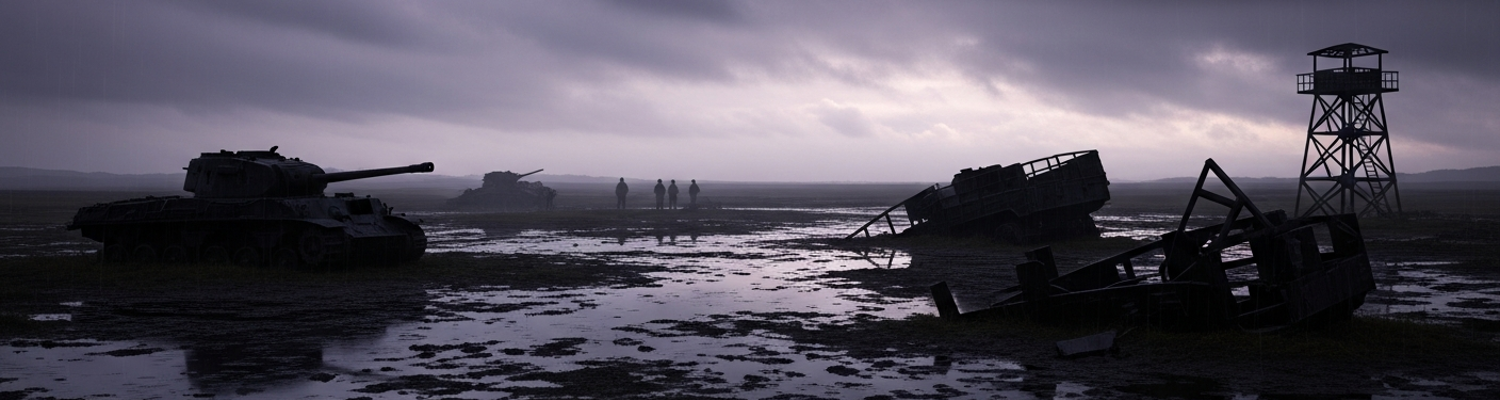

The Deluge at Falaise
The German Seventh Army did not retreat from Normandy. It disintegrated. By the end of August 1944, Allied forces held over 200,000 German prisoners, a direct result of the violent success of Operation Cobra. Supreme Headquarters Allied Expeditionary Force (SHAEF) planners had anticipated a grinding, 90-day advance to the Seine. They forecasted a slow, attritional fight. The reality was a sudden, systemic collapse of the German front.
Between August 12 and August 21, the remnants of Army Group B, comprising the Seventh Army and Fifth Panzer Army, were trapped in the Falaise-Argentan gap. When the pocket was sealed, the scale of the defeat became tangible. Some estimates place German dead at 10,000, but between 40,000 and 50,000 were marched into captivity. After-action reports from General Omar Bradley’s 12th Army Group, operational only since August 1, show American forces processing over 50,000 prisoners in the final days of the battle. The U.S. 90th Infantry Division alone accounted for 13,000 captures.
This was not an orderly surrender. It was a flood.
The influx of prisoners completely overwhelmed the logistical framework of the 12th Army Group. Pre-invasion planning had been based on a much slower advance and a correspondingly smaller, more predictable intake of POWs. The system was designed to handle a stream, not a tidal wave. Archival evidence from QMC (Quartermaster Corps) records shows that the primary logistical concerns during the breakout were fuel and ammunition to maintain the speed of the armored columns. No flexible capacity existed to suddenly transport, house, secure, and feed tens of thousands of captured enemy personnel. Makeshift enclosures, like the one at Nonant-le-Pin, were hastily erected in open fields. There was an immediate and critical shortage of barbed wire, tents, food, water, and medical supplies. Most critically, there was a severe shortfall of trained military police. Combat soldiers, badly needed to continue the pursuit, were pulled from line units and reassigned to guard duty, a task for which they were unprepared and which diluted the strength of the Allied advance.
A One-Way Supply Chain
Operational logs for the Allied advance reveal a system engineered for a singular purpose: forwarding matériel to combat formations. The Red Ball Express, initiated on August 25, 1944, to sustain the rapid breakout, was the ultimate expression of this one-way flow. It was a closed loop designed to push supplies east from Cherbourg and the Normandy beaches to the armies of the 12th Army Group. Two parallel highways were designated exclusively for this traffic. A northern route carried loaded trucks to the front. A southern route was for empties racing back. The entire apparatus was optimized to move fuel, ammunition, and rations.
The workhorse was the GMC CCKW 2½-ton truck, a vehicle designed for cargo, not personnel. Its specifications centered on its 164-inch long-wheelbase cargo bed and a 91-horsepower engine built to haul pallets of artillery shells or stacks of jerricans. It was not built to contain human beings. The system’s driving imperative was speed, with drivers often disregarding the 25-mph speed limit to keep Patton’s tanks fueled. No doctrinal or procedural allowance existed for the organized back-hauling of prisoners. A truck returning empty was simply a resource not yet being used to push more supplies forward.
This intense focus on forward supply meant a complete absence of dedicated infrastructure for handling mass captures. Pre-invasion planning for Operation Overlord had not provisioned for the rapid processing of tens of thousands of prisoners. Consequently, no dedicated POW transport vehicles were staged in the European Theater of Operations. Such vehicles would have required modifications like caged enclosures and seating, deemed an unnecessary use of production capacity. The infrastructure void extended beyond transport. Archival evidence (NARA Record Group 338) shows a critical shortage of basic materials like barbed wire and tents to construct secure enclosures. The temporary cage at Nonant-le-Pin, which struggled to contain a fraction of the prisoners from the Falaise Pocket, was little more than an open field ringed with a handful of guards. No designated railheads were equipped with the platforms, administrative personnel, and security detachments needed to load thousands of men for efficient transfer to rear-area camps. The entire logistical framework for detainee management simply did not exist.
In the absence of a formal system, prisoner movement became a matter of dangerous improvisation. The primary method relied on the ad-hoc use of supply convoys returning from the front. A quartermaster truck company, after delivering its load of Class III petroleum products to a forward depot near Chartres, would be ordered to load its empty cargo beds with hundreds of German captives for the return trip to the coast. These were not secure transports. The trucks, often the long-wheelbase CCKW-353 variant, were open-topped and ill-suited for containing men. The guards were frequently not trained Military Police but infantrymen or artillerymen temporarily pulled from combat duties. Photographic evidence from August 1944 shows these open-topped trucks packed with German soldiers, with only a few American guards perched precariously on the vehicle’s fenders or cab. This reliance on impromptu convoys created massive command and control failures. A division at the front might report the capture of thousands of men, but with no systematic transport, rear-area commanders had no way of knowing when, or even if, these prisoners would arrive.
Processing in Chaos
The deluge of humanity overwhelmed the doctrinal framework for handling prisoners. In the high-tempo environment of the Normandy breakout, the established system for processing captured personnel disintegrated. The immediate, frontline response was the rapid establishment of Division and Corps Collecting Points (DCP/CCP). These temporary enclosures were intended to be the first node in the evacuation chain. Archival records show they were often open fields or horse paddocks, like the cage at Nonant-le-Pin, hastily ringed with a minimal amount of barbed wire. The 90th Infantry Division, which processed over 13,000 prisoners during the final days of the Falaise battle, established its collecting points in whatever suitable terrain it could secure. No pre-planned engineering support or allocation of materials existed for these sites. They were improvised on the spot by combat units whose primary focus remained fixed on the retreating enemy. A review of unit logs shows that the personnel assigned to manage these teeming enclosures were not the trained Military Police (MP) envisioned by doctrine, but infantrymen and combat engineers pulled directly from line companies.
They were wholly unprepared.
The doctrinal procedure called for a systematic search, documentation, and segregation of prisoners at these forward collecting points. This was impossible. Instead of a methodical process, the scene at a typical DCP was one of controlled chaos. A handful of riflemen, often exhausted from the same combat that had produced the prisoners, were suddenly tasked with guarding thousands of German soldiers. Photographic evidence from August 1944 depicts these makeshift stockades packed shoulder-to-shoulder with captured troops. The primary mission of these infantrymen-turned-guards was simply containment. The critical tasks of thorough searching for hidden weapons or intelligence materials were often performed superficially or not at all. The tactical imperative was to get the prisoners away from the front lines as quickly as possible. This often meant that large groups of prisoners were moved rearward with only a cursory check, carrying with them whatever documents or intelligence they had on their persons.
Compounding the problem was a severe deficit of trained intelligence and interrogation personnel at the forward edge of the battle. The G-2 (intelligence) sections of the infantry divisions were small, their personnel focused on tactical intelligence vital for the ongoing fight. Specialized teams from the Military Intelligence Service were a theater-level asset and not organically assigned to every forward collecting point. A review of the order of battle reveals that dedicated MP units with prisoner handling capabilities were stretched thin across the entire front. The 82nd Airborne’s MP platoon, for example, found itself guarding nearly 5,000 prisoners at one point, a task far beyond its intended capacity. The result was a critical intelligence failure at the point of capture. Prisoners who might have possessed vital information about escaping German formations or defensive plans for the Siegfried Line were often evacuated in the undifferentiated mass of captives without ever speaking to a trained interrogator.
Fields of Desperation
With the logistical system oriented entirely toward the front, the physical locations for securing tens of thousands of prisoners were chosen out of immediate, desperate convenience. A close review of operational logs from U.S. First Army divisions in August 1944 shows a consistent pattern. Advancing combat units would designate the nearest defensible area as a temporary collecting point. This was often a French farm complex, its stone walls shattered by the same artillery that had broken the German defenders. These structures, while offering a superficial sense of enclosure, were tactical liabilities. Their walls were frequently breached, offering multiple points of egress. In other cases, the designated enclosures were nothing more than open fields or pastures, like the temporary cage established in a horse racetrack at Nonant-le-Pin. This site, and others like it near Chambois and Trun, held thousands of men in a sea of mud, with no structures of any kind.
These were not camps. They were geographic coordinates.
The defining characteristic of these forward enclosures was the near-total absence of purpose-built security materials. Barbed wire was a low-priority item for the supply services. The Red Ball Express had no capacity for back-hauling engineering supplies like wire spools or fence posts. As a result, archival photographs of sites like Nonant-le-Pin show vast, open-air collections of humanity with no discernible fences. Containment was achieved not through physical barriers but through the liberal use of manpower. Combat soldiers, already exhausted, were repurposed as guards. These men would form a thin human perimeter around the field, often standing just yards apart, their rifles serving as the only deterrent. At some enclosures, guards in jeeps would periodically circle the perimeter, firing their weapons into the air to create the illusion of a more robust security posture. Escape, however, was rare. Most prisoners understood that capture by French Resistance elements outside the American-run enclosures would likely result in summary execution.
Both prisoners and their guards were left utterly exposed to the elements. The weather in Normandy during the latter half of August 1944 turned cool and wet. Without tents or overhead cover, thousands of men were forced to stand or sit in open fields that quickly became quagmires of mud and human waste. There were no organized latrines. Access to clean water and food was sporadic. The American guards, often infantrymen from divisions like the 90th, suffered the same conditions. They had no tents, no special rations, and were subject to the same rain and mud as their captives while performing a duty for which they had no training. This shared misery did not foster sympathy. It bred exhaustion, apathy, and a breakdown of military procedure.
The Guard's War
The assignment to guard duty at a forward collecting point was a sentence to a unique kind of battlefield attrition. The American guards, typically infantrymen pulled from line companies, were subjected to the same squalid conditions as their prisoners. The temporary enclosure at Nonant-le-Pin held tens of thousands of men in open-air conditions. As frequent rains swept through Normandy, the field devolved into a quagmire of mud and excrement. Without organized latrines or sufficient clean water, both guards and captives were exposed to rampant disease. Dysentery became a pervasive affliction. The guards, often from units like the 90th Infantry Division, endured this alongside the men they watched, sleeping in the open and eating the same monotonous rations.
This was not a rear-echelon assignment.
The psychological pressure on these impromptu guards was acute. They were combat soldiers, not trained Military Police, tasked with containing thousands of enemy troops with minimal resources. The lack of barbed wire meant that containment was achieved by forming a human perimeter, with guards standing mere yards apart. This posture required constant hypervigilance. The threat of an escape attempt was a persistent source of stress. More pressing was the fear of enemy reprisal. These enclosures were often within range of German artillery. The fear of being overrun, surrounded by thousands of recently hostile soldiers, was a palpable component of the daily stress.
The sounds of the front line were an ever-present auditory torment. The enclosures at places like Nonant-le-Pin and Chambois were not far behind the shifting front lines. For the guards, there was no psychological distance from the war. The percussive crump of distant artillery barrages and the rattle of machine-gun fire served as a constant, visceral reminder of the violence they had just departed. This unending soundscape prevented any form of mental respite, keeping the soldiers in a heightened state of alert. Every distant explosion could signal a renewed German push. This sensory input blurred the distinction between the front and the supposed safety of the rear, creating a seamless experience of anxiety.
The Medic's Calculus
U.S. Army medical doctrine in the European Theater of Operations followed a stark, mathematical logic. The Battalion Aid Station, the first critical node in the chain of evacuation, was designed to stabilize and sort casualties under extreme pressure. Its resources were finite. A medic or surgeon possessed a limited number of morphine syrettes, a finite supply of blood plasma and sulfa powder, and a fixed quantity of bandages. The prisoner deluge following the collapse of the Falaise Pocket created an ethical crisis. The established triage protocol was ruthless, sorting casualties into categories. The arrival of thousands of wounded German prisoners injected a new variable into this equation. A battalion surgeon, often working in a dimly lit farmhouse cellar, was frequently confronted with two grievously wounded men, one American, one German, but only one unit of life-saving plasma. The Geneva Conventions mandated equal treatment, but operational directives and the unwritten code of the combat soldier demanded preferential care for their own. This forced a terrible calculus.
It was a zero-sum game of survival.
The physical environment of a forward aid station erased any distinction between the front line and the rear. These facilities were often established in recently captured farmhouses or a cleared ditch along a road, well within range of German artillery. Medics and surgeons performed their duties to the constant soundtrack of active combat. A medic applying a Carlisle bandage to a wounded German soldier could often hear the same type of weapon that caused the injury still firing just over the next hedgerow. A surgeon could be in the middle of a delicate procedure on a captured enemy soldier when a nearby shell burst would send dust and debris raining down into the makeshift operating theater. Treating the enemy under these conditions was not a detached, clinical act. It was performed in the same zone of intense violence where the initial wounds were inflicted.
The psychological burden placed on combat medics was immense. A medic who had watched a friend die hours earlier was now expected to use his limited supplies to save the life of a soldier wearing the same uniform as the man who killed him. This forced intimacy with the enemy, cleaning his wounds and offering comfort, went against every instinct for survival and retribution honed by weeks of brutal fighting. Unit logs and psychiatric reports from the period document the rise in combat fatigue among medical personnel. The resentment was palpable. Every bandage wrapped around a German limb was perceived by some as a direct diversion of resources that could have saved an American life. This created a deep, internal conflict between a medic’s sworn duty, the laws of war, and his loyalty to his own soldiers.
Conditions of Collapse
Quartermaster ledgers and after-action reports from August 1944 reveal a system incapable of providing for the basic human needs of the captured. The provision of food, a requirement codified by the Geneva Convention, became an exercise in impossibility. The American K-ration, a wax-coated cardboard box containing three meals, was designed to provide roughly 3,000 calories for a single combat soldier for one day. In the chaos of the forward collecting points, a German prisoner was fortunate to receive a fraction of this. Eyewitness accounts describe single K-ration breakfast units, a four-ounce can of chopped ham and egg and a few biscuits, being divided among several men. More often, the daily sustenance consisted of a handful of dry biscuits and water. This was the direct result of a supply chain built exclusively to push fuel and ammunition east, with no mechanism for distributing food to impromptu prison enclosures.
The ground itself became the primary enemy.
The makeshift enclosures were open fields, completely exposed to the elements. Late August in Normandy brought cool temperatures and drenching rains. With no tents or overhead cover allocated for prisoners, thousands of men were forced to stand, sit, and sleep in the open. The ground churned into a vast quagmire of mud. Blankets were a non-existent luxury. The result was endemic exposure, leading to hypothermia and pneumonia. Compounding this misery was a near-total lack of sanitation infrastructure. There were no latrines. The open fields doubled as mass toilets. With no reliable source of clean water for washing, the enclosures became breeding grounds for bacteria.
This combination of factors created a perfect storm for epidemic disease. Dysentery, a severe intestinal infection causing debilitating diarrhea and dehydration, became rampant. Without access to clean water or basic hygiene, the bacteria spread uncontrollably through the packed enclosures. Prisoners, weakened by hunger and exposure, had no immune defense against the onslaught of pathogens. They drank from muddy puddles contaminated with human waste, perpetuating a deadly cycle of infection. The few Allied medics available were completely overwhelmed, possessing neither the supplies nor the manpower to manage a public health catastrophe on this scale.
The Unraveling
A review of after-action reports from August 1944 reveals that the diversion of frontline troops to guard duty was a severe, unintended consequence of the German collapse. The decision, made by overstretched division and corps commanders, pulled veteran riflemen directly from combat formations like the U.S. 90th Infantry Division and reassigned them to oversee makeshift prisoner enclosures. These were not support personnel. They were experienced infantrymen whose combat skills were desperately needed to maintain the momentum of the Allied pursuit toward the Seine. This act represented a direct dilution of combat power at a tactically decisive moment.
This was not a rear-echelon assignment. It was a sentence.
The new role fostered a deep and corrosive resentment among the infantrymen forced into it. For a soldier conditioned by the extreme violence of the Normandy hedgerows, the task of watching over thousands of defeated German soldiers felt like a profound misuse of their abilities. A palpable bitterness took hold, directed at the prisoners, the miserable conditions, and a command structure that had seemingly relegated them to a non-combat function while their parent units continued the celebrated advance across France. A soldier trained to operate a Browning Automatic Rifle or a 60mm mortar found his skills irrelevant in a role that primarily demanded vigilance.
The psychological strain on these impromptu guards was a unique variant of combat stress. The term used by the military at the time was 'combat fatigue,' a condition that accounted for a high percentage of medical discharges. For the guards, the stress manifested as a state of constant, low-level hypervigilance. This duty, combined with the unending sounds of distant artillery, blurred the line between the front and the rear, preventing any psychological respite. The result was a pervasive emotional numbness, a defense mechanism against the squalor and the sheer human misery of the enclosures. Archival psychiatric reports from the European Theater note a rise in combat fatigue cases among troops in such roles, characterized by withdrawal, irritability, and a vacant emotional state.