
Failure announced itself not with an explosion, but with a grinding protest. A vibration from the port-side Garrett T76 turboprop. The pilot of the OV-10A Bronco, likely from Marine Observation Squadron 2 (VMO-2), felt it travel up the control column. The super-saturated air of the May 1971 Quang Nam Province monsoon was actively degrading engine performance. The intricate system of compressor blades, engineered for optimal airflow, fought against an atmosphere that was more water than air. This reduced combustion efficiency and threatened a flameout. This was not a singular event. It was a symptom of a theater-wide problem for the 3rd Marine Amphibious Brigade (MAB). The very machines meant to provide aerial overwatch were being defeated by the weather.
The environment was the primary antagonist. May in Quang Nam province represented a transitional weather period, an inter-monsoonal phase often characterized by a persistent, low-hanging drizzle and fog called crachin. Historical weather data from the Da Nang area (archived under WBAN 48851) reveals a month defined by oppressive humidity and dramatically reduced visibility. Cloud ceilings frequently dropped below 500 feet, blanketing the rugged western terrain in a thick, impenetrable layer of gray. For ground troops of the 3rd MAB, this meant a constant state of dampness, equipment perpetually slick with moisture, and an inability to see more than a few dozen meters ahead. For aviation assets, the conditions were prohibitive. A close review of operational logs from this period indicates a sharp increase in aborted or canceled flights due to weather exceeding minimum safety parameters. The monsoon did not just bring rain; it brought a persistent, low-level blindness that grounded the most sophisticated observation tools available.
The OV-10 Bronco was the workhorse of aerial observation, but it was acutely susceptible to these specific conditions. Designed for visual flight rules (VFR) operations, its effectiveness depended on the pilot’s ability to physically see the target. The Bronco’s tandem cockpit offered exceptional visibility in clear weather, but its optical and early-generation electronic sensors could not pierce dense cloud cover. As the monsoon intensified, VMO-2 and other observation squadrons faced a daily reality of non-flyable conditions. Decisions to ground the aircraft were not sweeping commands from high command. They were a series of pragmatic, mission-by-mission cancellations made at the airfield level, often at Marble Mountain Air Facility. The Garrett T76 engines, while generally reliable, were known to be sluggish and less responsive in the hot, humid air of Southeast Asia, a problem made worse by the May weather. With a service ceiling far above the cloud layer, the aircraft could theoretically fly. They could not see. This rendered their primary mission of armed reconnaissance and forward air control impossible.
This effective grounding of the aerial reconnaissance fleet created a complete intelligence vacuum. The specific infiltration routes the Broncos were tasked with monitoring, particularly the network of trails branching off the Ho Chi Minh Trail into the mountainous Que Son and Hiep Duc Valleys, were now completely unobserved from the air. Pilots were trained to spot the subtle signs of enemy movement: fresh tracks, disturbed foliage, or the faint smoke from hidden camps. With the Broncos parked on the tarmac, this stream of visual intelligence ceased. North Vietnamese Army (NVA) units, particularly elements of their rear service groups, were afforded an unprecedented freedom of movement. A review of after-action reports from this period shows a distinct drop-off in actionable intelligence regarding enemy troop and supply buildups in the 3rd MAB’s tactical area of responsibility. The NVA could now reposition forces, cache supplies, and prepare for offensive operations with near impunity, shielded by a weather system that had blinded their technologically superior opponents.
Command could not accept the intelligence void. If eyes could not see from the sky, boots would probe on the ground. Throughout May 1971, Marine infantry battalions like the 1st and 7th Marines continued to dispatch squad and platoon-sized patrols from their firebases scattered across Quang Nam Province. These missions were a direct, if perilous, response to the NVA’s newfound freedom of movement. It was an attempt to contest their control of the rugged terrain west of Da Nang, particularly in the notorious Que Son and Hiep Duc Valleys. The operational tempo remained high. Units like the 2nd Battalion, 1st Marines, conducted over 100 small-unit patrols in a single week. This persistent patrolling was the only available method to detect supply caches, locate infiltration routes, and prevent NVA units from massing for attacks on friendly positions.
A patrol moving through the triple-canopy jungle or across flooded rice paddies was isolated. The persistent low cloud ceilings and torrential rain that grounded the OV-10 Broncos also precluded effective on-call close air support from jets or helicopter gunships. A unit ambushed by the NVA could not rely on the swift arrival of air power to suppress enemy fire. Likewise, medical evacuation (MEDEVAC) helicopters were often unable to fly. Wounded Marines might have to be carried for hours or even days through treacherous terrain to a secure landing zone where a break in the weather might permit extraction. This lack of air cover gave NVA ambush parties a significant tactical advantage. They could initiate contact on ground of their own choosing, confident that their targets would be unable to call in immediate, overwhelming firepower. Archival analysis of after-action reports (NARA Record Group 127) from this period points to a spike in casualties from mines, booby traps, and short, violent ambushes, all tactics that exploited the low visibility and the Marines' inability to receive timely support.
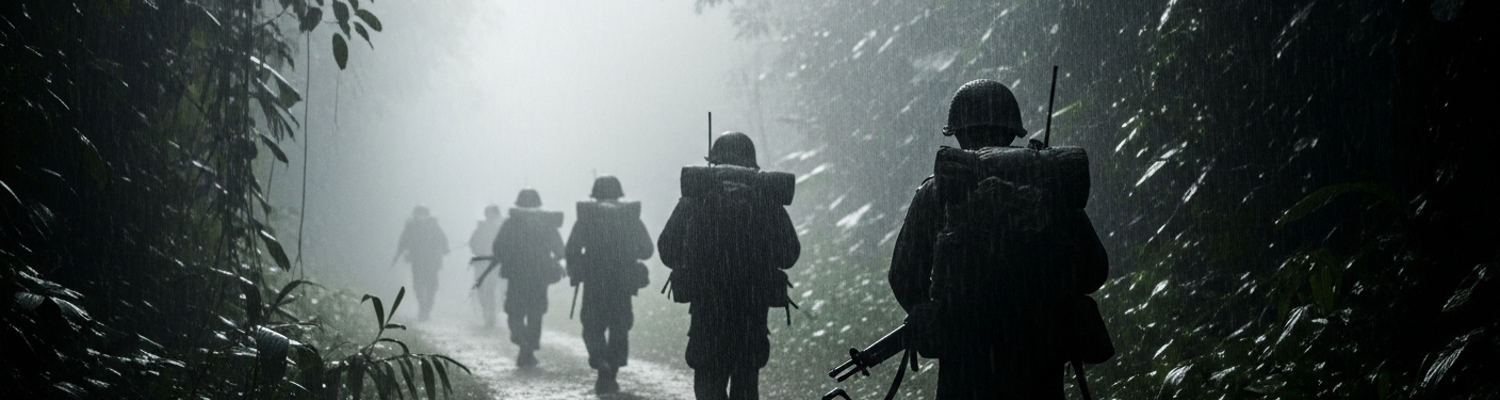
For the enlisted personnel tasked with these patrols, the experience was a nerve-shredding ordeal defined by constant tension and sensory deprivation. A Marine on patrol in the Quang Nam foothills in May 1971 was perpetually soaked. His gear was heavy with moisture. His M16 rifle required constant attention to prevent rust and malfunctions in the damp environment. Visibility was often reduced to mere meters by the thick fog and dripping vegetation. Every step was fraught with uncertainty. The ground itself was hostile, littered with expertly concealed booby traps ranging from simple punji stakes to repurposed American ordnance. The psychological strain was enormous. Every sound, a snapping twig, the call of a bird, could signal the presence of a waiting enemy. The silence between the sounds was often worse. Marines moved with a practiced slowness, scanning their sectors, acutely aware that a hidden NVA force could be watching them from a few feet away, waiting for the perfect moment to spring the trap. This state of high alert, maintained for hours on end, day after day, exacted a heavy mental and physical toll.
North Vietnamese Army tactical doctrine, refined over two decades of conflict, was perfectly adapted to exploit the conditions of the May monsoon. With American aerial observation nullified by the weather, NVA and Viet Cong main force units could move with a freedom not seen in years. A review of NVA tactical manuals and post-war accounts reveals a sophisticated methodology for infiltration and ambush. Units would break down into small, dispersed groups, often moving at night or during the heaviest rainfall, using the roar of the storm to mask the sound of their movement. They traveled light and utilized a network of pre-scouted trails, waypoints, and subterranean caches that were invisible to grounded American reconnaissance planes. This allowed them to pre-position entire companies or battalions within striking distance of American firebases and patrol routes, often for days at a time. The NVA understood that the monsoon had severed the link between Marine ground patrols and their air support. They could initiate combat on their own terms, relying on the classic lure-and-ambush tactic or simply establishing a well-camouflaged, L-shaped kill zone along a predictable route of travel like a trail or stream bed. The goal was to achieve a decisive, violent, and rapid engagement, inflicting maximum casualties before the Marines could organize a coherent defense or before a break in the weather might allow for air intervention.
This was the unseen threat that confronted patrols from the 1st Battalion, 3rd Marines, as they moved through their assigned tactical area of responsibility west of Da Nang. During this period of Vietnamization and redeployment, Marine units were stretched thin, and the necessity of maintaining a presence in the field did not diminish. A typical platoon-sized patrol would leave its firebase for a multi-day mission with the objective of disrupting enemy movement and gathering intelligence. The men were operating in a state of extreme isolation. A Marine on patrol was perpetually soaked, his M16 rifle demanding constant cleaning to fight the pervasive moisture. The jungle terrain, already difficult, became a treacherous landscape of mud-slicked slopes and swollen streams. Visibility in the fog and rain was often reduced to less than 50 meters, creating a claustrophobic sense of dread.
The initial shock of a monsoon ambush was a complete sensory assault. A sudden, violent tear in the fabric of the jungle’s monotonous quiet. For a platoon from 1/3 Marines moving cautiously through the dense, dripping foliage, the first sound would have been the deafeningly sharp crack of AK-47 fire erupting from multiple directions at once. A sound distinctly different from the M16’s report. This was instantly followed by the concussive whump of RPGs and the distinctive, chilling hiss of incoming mortar rounds. Within seconds, the air filled with a maelstrom of noise and flying debris. The snap and buzz of bullets cutting through leaves and branches just overhead. The screams of the wounded. The frantic, shouted commands of squad leaders trying to regain control. The psychological shock was instantaneous. Men who were moments before scanning for tripwires were now thrown into a disorienting reality of extreme violence. The NVA’s strategy was to use a massive, concentrated volume of initial fire to induce panic and break the patrol’s cohesion. This initial burst was the most dangerous moment, where well-rehearsed American battle drills competed with the primal instinct to simply hit the ground and survive the onslaught.
In the kill zone, survival was measured in seconds. The immediate response for a Marine was to return fire in the direction of the muzzle flashes, often unseen, that flickered from behind tree lines or earthen embankments. The air grew thick with the acrid smell of cordite from friendly and enemy weapons, mingling with the metallic scent of blood and the damp odor of the jungle floor. The physical experience was punishing. The shockwaves from RPG explosions and friendly M79 grenade rounds would reverberate through the ground, felt as much as heard. Dirt, leaves, and shrapnel rained down. For those hit, the sensation was often described as a powerful, stunning blow, sometimes not even recognized as a wound until the shock subsided. The tight confines of the jungle meant engagements were fought at brutally close ranges, sometimes only 15 or 20 meters. At this distance, the fighting was intimate and terrifying. There was no front line, only a contested pocket of jungle where NVA soldiers, often camouflaged and deeply entrenched, might be just feet away. The fight devolved from a platoon action into a series of individual struggles for survival as Marines sought cover, attempted to aid the wounded, and tried to lay down a base of fire sufficient to allow for a fighting withdrawal from the kill zone.
Operational logs from May 1971 reveal the direct, cascading consequences of the monsoon’s neutralization of aerial reconnaissance. The inability to gain clear aerial intelligence was not a passive problem but an active enabler of enemy operations. VMO-2, operating its OV-10A Broncos from Marble Mountain, saw its mission effectiveness plummet. These aircraft were the primary tool for visually identifying NVA infiltration along the trails leading from the Ho Chi Minh Trail into the coastal lowlands of Quang Nam Province. The combination of low cloud ceilings and the persistent fog made these flights impossible. This created a complete intelligence blackout over areas like the Que Son and Hiep Duc Valleys, regions historically used by the NVA to stage and supply their forces. The direct result was an increased frequency of high-stress, blind ground encounters as infantry units were ordered to fill the gap. Battalions such as the 1st and 7th Marines were tasked with a relentless tempo of patrols. This was a brutal solution: if the sky was blind, the ground had to be probed. These patrols were deliberate efforts to re-establish a tactical picture, to find the trails and enemy units that the grounded Broncos could no longer locate. The risk was immense. A patrol moving through the triple-canopy jungle was cut off from its technological advantages. The same weather that grounded observation aircraft also prevented on-call close air support and made medical evacuation flights exceptionally hazardous. A small unit, if hit, was on its own. NVA tacticians understood and exploited this vulnerability perfectly, favoring short, violent ambushes in pre-selected kill zones where they could achieve fire superiority and inflict maximum damage before melting back into the jungle.
By May 1971, disillusionment among the junior officer corps of the 3rd Marine Amphibious Brigade had become a significant, if officially unacknowledged, force. A close review of operational patterns from this period reveals a deep fracture between established tactical doctrine and the conditions on the ground. For a young Marine lieutenant leading a platoon out of a firebase in Quang Nam Province, the conflict was stark. The principles learned at The Basic School in Quantico, which emphasized aggressive maneuver warfare built on the concept of “locate, close with, and destroy,” were predicated on a system of robust support. That system had been short-circuited by the monsoon. Doctrine assumed the availability of aerial reconnaissance to find the enemy, close air support to fix them, and helicopter assets for reinforcement and medical evacuation. With the weather grounding most aircraft, these assumptions collapsed. An order to conduct a multi-day reconnaissance patrol was, in effect, an order to walk blind into an environment where the enemy held every advantage. This created a severe crisis of confidence for junior officers, caught between the directives of higher command and the palpable risk to their men. Organizations of disaffected officers, such as the Concerned Officers Movement, gained traction during this period, articulating a widespread opposition to a war strategy that seemed to demand pointless sacrifice.
The erosion of troop morale was not a new phenomenon in 1971, but the specific pressures of the monsoon ordeal accelerated it dramatically. By this late stage of the war, the policy of Vietnamization was in full swing, and troop withdrawals were a constant feature of life in-country. For the individual Marine on patrol, the overarching political context translated into a simple, gnawing question: why should he be the last man to die in a war his own country was visibly trying to exit? This sentiment, pervasive throughout the American forces, was amplified by the seemingly pointless nature of the missions. A patrol that moved for days through torrential rain, unable to see more than a few dozen meters, only to be ambushed without support, felt less like a tactical operation and more like a gamble. This sense of futility contributed to a documented decline in discipline and battleworthiness across U.S. forces in Vietnam. While outright combat refusals were still rare, a more subtle form of resistance, a kind of pragmatic self-preservation, took hold. After-action reports from the period, when cross-referenced with personal accounts, suggest a pattern of patrols taking fewer risks, moving with extreme caution, and prioritizing survival over the aggressive pursuit of contact against a hidden enemy.
Operating in the monsoon-drenched landscape of Quang Nam exacted a severe psychological toll, distinct even from the usual stresses of combat. The environment itself was a relentless antagonist. Marines were perpetually soaked, their skin breaking down in the constant dampness, leading to immersion foot. Their equipment required obsessive maintenance to ward off rust and fungus. The physical misery was compounded by a unique form of sensory warfare. The thick fog and dripping jungle canopy created a claustrophobic world of extremely limited visibility, inducing a state of constant, high-alert paranoia. Silence was not a comfort but a threat, a possible indicator of a nearby ambush. Every sound, a snapping twig, the rustle of leaves, could signal an imminent attack. This state of hypervigilance, maintained for days on end, was mentally exhausting. The knowledge that the weather prevented MEDEVAC helicopters from flying added another layer of dread; a serious wound, survivable under normal conditions, could be fatal if the casualty could not be extracted. This feeling of total isolation, cut off from the technological superiority that was supposed to be the Marine Corps' advantage, fostered a profound sense of abandonment.