
Interwar Naval Intelligence Doctrine
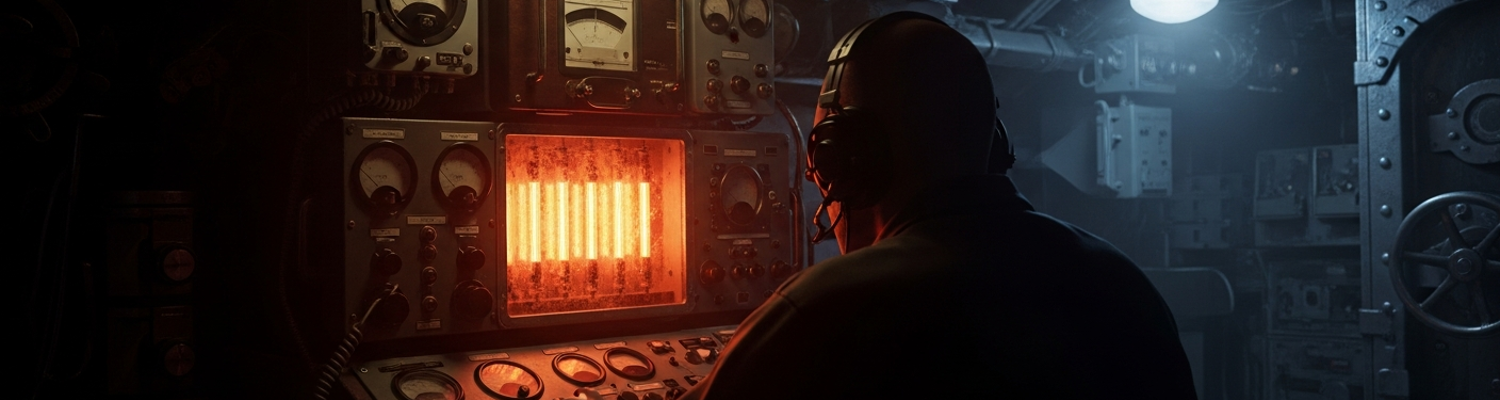
Peacetime doctrine was an exercise in theory. On the flag bridge, carefully arranged timetables and signal books, products of a decade of planning, seemed like relics from a distant, more orderly world. High-frequency direction-finding receivers, expected to provide clear vectors to enemy transmissions, were instead flooded with a chaotic wash of overlapping signals and atmospheric distortion. In the communications room, the air was thick with the smell of hot vacuum tubes. Radiomen, trained to expect neatly coded five-letter groups, struggled to copy messages that were garbled, sent at frantic speeds, and used non-standard encipherment. The plan, so elegant on the chart tables at the Naval War College, had depended on a predictable enemy and perfect communications. At 0200 hours, with the fleet steaming toward coordinates that were hours old and highly suspect, that plan was gone.
A review of operational logs from the period (NARA Record Group 38) reveals a deep institutional faith in the architecture of communication. The interwar doctrine, across both the Royal Navy’s Admiralty and the U.S. Navy’s Office of Naval Intelligence (ONI), was built on a foundation of rigid, hierarchical information flow. Intelligence was to be gathered by distant listening posts, transmitted via robust high-frequency radio or secure undersea cables, processed centrally at hubs like the Admiralty’s Operational Intelligence Centre, and then disseminated to the fleet. The system was predicated on clarity. Radio procedures were standardized, with specific frequencies allocated for command, administrative, and intelligence traffic. Submarines were expected to surface at designated times to receive broadcasts. The mechanical components were impressive for their time, powerful shore-based transmitters and sensitive receivers. This predictability became a systemic weakness. The doctrine did not adequately account for the sheer volume of signal traffic a global conflict would generate, nor the ease with which an adversary could disrupt this orderly system through jamming or deception.
This was a direct result of an overreliance on theoretical training.
The curriculum at institutions like the U.S. Naval War College heavily influenced this mindset. Archival evidence shows that between the wars, naval intelligence training was dominated by textbook scenarios. The U.S. Navy’s annual Fleet Problems were invaluable for testing ship-handling but created a sanitized version of intelligence work. In these games, intelligence injects were clean and timely. An umpire might rule a signal was missed, but there was no genuine simulation of a radioman driven to exhaustion by static, trying to distinguish an enemy report from a commercial broadcast bleeding over from an adjacent frequency. Manuals like the ONI’s publication for Naval Reserve intelligence officers prescribed methodical, academic approaches to collection. They taught officers what to look for, ship silhouettes, armament details, economic data, but the process assumed the information would be accessible. This educational framework created officers who were masters of known procedures but unprepared for the friction of actual wartime intelligence operations.
Pacific Combat Communication Reality
After-action reports from Pacific Theater operations reveal a communication environment defined by near-constant failure. The physics of the region was the first antagonist. High-frequency radio signals, the foundation of long-range command, were profoundly affected by the tropical atmosphere. High humidity and frequent electrical storms generated a persistent, crackling static that could overwhelm all but the strongest transmissions. For units like the 1st Marine Division on Guadalcanal, this meant that high-frequency signals connecting them to naval support were often lost in a sea of white noise. The Earth’s magnetic field in the South Pacific further complicated HF radio, creating interference so severe that pilots sometimes removed their radio sets, considering them useless weight.
Signals were actively absorbed by the terrain. The dense, triple-canopy jungle, saturated with moisture, acted as a massive signal sink. A man-portable SCR-300 walkie-talkie, which had a reliable range of three to five miles in open terrain, saw its effective broadcast distance shrink to a few hundred yards. A platoon could vanish from the radio net before it was out of sight.
The natural obstacles were compounded by deliberate enemy action. Imperial Japanese forces practiced a doctrine of communication disruption that proved tactically effective. Analysis of signal logs shows Japanese signal regiments were equipped with units specifically for jamming. Their methods included transmitting a fluctuating continuous wave carrier to interfere with Allied radiotelephone conversations, a technique designed to sow chaos on command nets during an attack. They would also transmit dummy messages on Allied frequencies to create confusion. A more sophisticated form of disruption was radio deception. A study of Japanese naval communications before the attack on Pearl Harbor shows a mastery of this craft. Key radio operators from the main carrier strike force were left ashore to transmit routine traffic from land-based stations, creating the illusion that the fleet was still in home waters. This created a false intelligence picture that American analysts accepted. While Allied forces struggled to hear anything through the static, Japanese intelligence was actively listening.
Beyond the invisible battles in the ether, the physical hardware was losing a war against the environment. The near-100 percent humidity and salt spray of the Pacific islands were a relentlessly corrosive agent. A thin film of moisture settled on every piece of equipment, creating conductive paths that caused short circuits on circuit boards. Battery terminals on sets like the SCR-536 Handie-Talkie would corrode, preventing a reliable connection. The very materials of the radios broke down. Bakelite knobs on tuning dials would seize, forcing operators to use pliers, which often shattered the knob and locked the radio to a single frequency. An even more insidious threat was fungal growth. Spores found a fertile breeding ground on the organic materials used inside the radios, thriving in the heat and humidity. This military mould would grow over insulation and within electronic components, causing further shorts and equipment failure. During the Battle of Tarawa, entire lots of the TBX portable radios were rendered inoperable after being soaked with saltwater, while EE-8 field telephones were completely ruined. This systematic equipment failure had direct tactical consequences, severing the link between forward observers and artillery and leaving patrols completely isolated.
Isolated Forward Intercept Operations
A close review of operational logs from the South West Pacific Area reveals the gulf between doctrinal theory and the conditions faced by forward intelligence operatives. The Allied Intelligence Bureau’s coastwatcher network, codenamed Operation Ferdinand, depended on placing small teams in positions of extreme physical vulnerability. These were not fortified bases. On islands like Bougainville and New Georgia, coastwatchers established observation posts on high ridges overlooking strategic channels, but their physical presence was often nothing more than a concealed lean-to. Their primary tool, the AWA Teleradio 3BZ, was robust for its time, but it was not a modern field radio. The complete set, including the transmitter, receiver, car batteries, and the 30kg petrol charging engine, could weigh over 100 kilograms. Relocating a single post required a team of 12 to 16 local islander carriers. This hardware defined their existence, rooting them to a location while making them a detectable target. Other missions relied on the US Navy’s Patrol Torpedo boats, not for combat, but as fragile taxis, inserting operatives and their equipment onto hostile coastlines under the cover of darkness.
These men were never safe.
The threat from enemy patrols was constant. Analysis of Japanese operations in the Solomon Islands shows a concerted effort to hunt the coastwatchers, who were seen as a dire threat to operational security. On Bougainville, Japanese patrols used tracker dogs and radio direction-finding equipment to methodically pinpoint the locations of observers like Paul Mason and Jack Read. The coastwatchers lived with the daily knowledge that the faint hum of their charging generator could bring an enemy platoon to their position. For the coastwatchers, capture was not a survivable event. After the capture and execution of several civilian operatives, the men were given nominal ranks in the Royal Australian Navy Volunteer Reserve, a bureaucratic measure the Japanese frequently ignored. For the PT boats tasked with insertion, the danger came from the sea. A 78-foot plywood boat was no match for a patrolling Imperial Japanese Navy destroyer. Their operational logs are filled with near-misses and high-speed escapes into darkness, their primary mission overriding any instinct to engage.
Archival records underscore the profound isolation of these forward posts. The same communication failures that plagued the wider Pacific campaign left these small units utterly alone. A coastwatcher on Guadalcanal, like Captain Martin Clemens, could provide critical early warnings of incoming air raids from Rabaul, giving Henderson Field’s fighters the margin to scramble, but he could not expect a destroyer to be diverted for his own protection. This was the central calculation of the intelligence war. Support was a fiction. Submarines and PT boats delivered supplies when and if they could, on schedules dictated by enemy patrol activity and lunar cycles, not by the needs of the men ashore. If a radio failed, spare parts were not forthcoming. If a man contracted a tropical disease, medical evacuation was a distant hope. These operatives were expendable assets, their survival secondary to the information they could provide before their inevitable discovery.
Intelligence Operator Survival Risks
An examination of Japanese counter-intelligence methods in the Solomon Islands campaign shows that every radio transmission was a potential death sentence. The operators of the AWA Teleradio 3BZ sets were not simply hiding; they were being actively hunted. Japanese search teams were specifically tasked with locating and eliminating the Allied coastwatchers. These units employed portable radio direction-finding equipment, methodically sweeping the jungle for the faint electronic pulse of a coastwatcher’s report. Their tactics reveal a patient, triangulating approach, where multiple listening posts would coordinate to narrow down a signal’s origin, after which infantry patrols with tracker dogs would be dispatched. After-action reports confirm that the nominal rank of Royal Australian Navy Volunteer Reserve offered no protection. Captured personnel were not treated as prisoners of war. The historical record is unambiguous: men like Percy Good on Buka Island or the seventeen New Zealanders captured in the Gilbert Islands were interrogated and then executed as spies.
For an intelligence operative, there was no such thing as being taken prisoner.
Survival became a game of chance where skill was only one factor. An operator’s life did not just depend on his fieldcraft but on a failing vacuum tube, a corroded battery terminal, or a sudden tropical fever. Resupply and extraction were not guaranteed assets but infrequent possibilities. A man could do everything right and still be discovered by a Japanese patrol that happened to stumble upon his concealed position. He could be betrayed by local islanders tempted by Japanese rewards. A review of medical logs from the period shows that disease was as effective a killer as the enemy; malaria, dysentery, and infected wounds incapacitated men for whom there was no hospital. Survival hinged on a long chain of improbabilities: that the petrol for the charging engine would not be fouled by humidity, that the local chief would remain loyal, and that a friendly signal would be heard through the atmospheric static before an enemy RDF unit heard you.
The only possible response to this overwhelming risk was a state of constant, exhausting vigilance. Operational standing orders for the coastwatchers, under the codename Ferdinand, emphasized a doctrine of absolute stealth. The name itself was a direct command: their job was to observe, not to engage. This translated into a grueling routine of silent, rotating watches where one man would strain to hear the faint snap of a twig in the jungle while his partner manned the radio. Transmissions were kept brutally short to minimize the chance of detection by Japanese direction finders. Every aspect of life was governed by the need to leave no trace, no cooking fires, carefully buried waste, and conversation conducted only in whispers. This was not the sharp stress of combat, but a continuous, grinding psychological pressure, a mandated paranoia that became the operator’s most essential professional skill.
Fragmented Signals Intelligence Assembly
A review of Allied intelligence operations shows that the raw data arriving at decryption centers like Station HYPO in Hawaii or the joint US-Australian Central Bureau in Brisbane was not coherent information. It was a chaotic stream of partial transmissions cut off by atmospheric changes, direction-finding bearings with wide margins of error, and the distinctive rhythmic patterns of individual Japanese radio operators, known as their fist. Each of these fragments was treated as a discrete piece of a continental-sized puzzle. A single five-letter code group, even if unreadable, was logged, indexed, and cross-referenced against all previous intercepts. The objective was to find patterns in the noise. Analysts looked for recurring message preambles that might identify a specific command authority, or changes in call signs that could signal the movement of a naval squadron.
This was not a war of brilliant deductions.
The work itself was a slow process of industrial-scale data analysis, performed in windowless basements crammed with card catalogs and the clatter of IBM tabulating machines. At centers like FRUMEL in Melbourne and HYPO at Pearl Harbor, teams of analysts, many of them women from the WAVES (Women Accepted for Volunteer Emergency Service), spent thousands of hours on traffic analysis. This field of study often ignored the content of the messages. Instead, it focused on the metadata: who was transmitting, who they were talking to, the volume of messages, and from what location. By mapping these communication nets, analysts could construct a detailed order of battle for the Japanese military without reading a single decrypted word. They could identify the headquarters of an army air force unit by the sheer number of messages it sent. The departure of a fleet was often first detected not by a decoded plan, but by the sudden radio silence of its ships, whose traffic was now being handled by shore stations to maintain deception.
No single intercept provided a grand revelation. The intelligence picture that reached fleet commanders like Admiral Nimitz was an assessment, a mosaic built over weeks from thousands of tiny, often contradictory data points. A sudden increase in radio traffic from the Marshall Islands might suggest a pending operation, but it could also be a feint. The warning before the Battle of Midway, for instance, did not come from one decoded message that laid out the Japanese plan. It was the culmination of weeks of painstaking work, including the analysis of increased traffic, the identification of carrier call signs, and the ruse of having the Midway garrison broadcast a false message about a water shortage to confirm that the Japanese code designator AF referred to Midway. This confirmed a piece of the puzzle, but it was just one piece among many, an analytical judgment built from an ocean of fragmented and misleading enemy signals.
Strategic Naval Intelligence Impact
An analysis of Allied naval operations shows that the fragmented intercepts gathered by forward operators were the raw material for an intelligence machine that altered the strategic course of the war. Its most significant effect was the prevention of strategic surprise. The work done at decryption centers like Station HYPO, despite dealing with only partial decryptions of the Japanese naval code JN-25B, consistently provided enough warning to negate the Imperial Japanese Navy’s intended shock value. In late April 1942, analysts pieced together enough coded references to identify Operation MO, a planned amphibious invasion of Port Moresby, New Guinea. While the full operational order was not readable, the identification of the objective and the carrier forces assigned was enough. This intelligence allowed Admiral Nimitz to dispatch Task Force 17, with the carriers USS Yorktown and USS Lexington, to the Coral Sea. For the first time in naval history, a major engagement was fought entirely by aircraft, with the opposing surface fleets never sighting one another. The intelligence was not a guarantee of victory; the USS Lexington was lost. It was, however, a guarantee that the US Navy would be present for the fight, transforming a surprise conquest into a head-on collision that blunted Japanese expansion.
This was the new calculus of naval warfare.
This predictive capability directly shaped Allied fleet movements and enabled high-risk tactical decisions. The Battle of Midway in June 1942 stands as the definitive example. Faced with conflicting intelligence estimates, Admiral Nimitz made the decision to trust the analysis of Commander Joseph Rochefort’s team at Station HYPO. Rochefort’s unit was convinced the Japanese target, designated AF, was Midway Atoll. To confirm this, they directed the Midway garrison to send an unencrypted plain-text message reporting a failure of their water distillation plant. Days later, HYPO intercepted a Japanese message noting that AF was short on fresh water. This confirmation gave Nimitz the confidence to commit his entire available carrier force, the USS Enterprise, USS Hornet, and the hastily repaired USS Yorktown, to an ambush. He positioned Task Force 16 and Task Force 17 to the northeast of Midway, a location derived directly from the intelligence-informed timeline of the Japanese approach. The resulting battle destroyed four of Japan’s first-line aircraft carriers and shifted the naval balance of power. The impact of such precise intelligence extended to targeted assassinations. On April 14, 1943, a decrypted message revealed the exact flight itinerary for Admiral Isoroku Yamamoto, specifying his route, arrival times, and the composition of his transport and escort aircraft. Acting on this, P-38 Lightning fighters from the 339th Fighter Squadron were dispatched to intercept, shooting down his G4M bomber over Bougainville and killing the commander of the Combined Fleet.
Beyond singular engagements, a review of US submarine command logs reveals a third, and perhaps more profound, strategic impact: a cumulative attrition of Japan’s war-making capacity. The massive codebreaking and traffic analysis effort provided the US Navy’s submarine force with a near-constant stream of information on the movement of Japanese merchant shipping. Submarine commanders, operating on high-level intelligence, were not hunting blind. They were given specific convoy routes, timetables, and destinations. This transformed the submarine service into a systematic instrument for severing Japan’s resource arteries. The flow of oil, rubber, and iron from Southeast Asia to the home islands was throttled, not in large-scale battles, but through the daily sinking of tankers and transports reported in secret dispatches. At the same time, traffic analysis maintained a detailed order of battle and location plot for most major warships of the Imperial Japanese Navy. The Japanese high command became increasingly aware that their fleet could rarely leave major bases like Truk Lagoon or Kure without its movements being detected, creating an operational paralysis that limited their ability to mount further offensive actions.