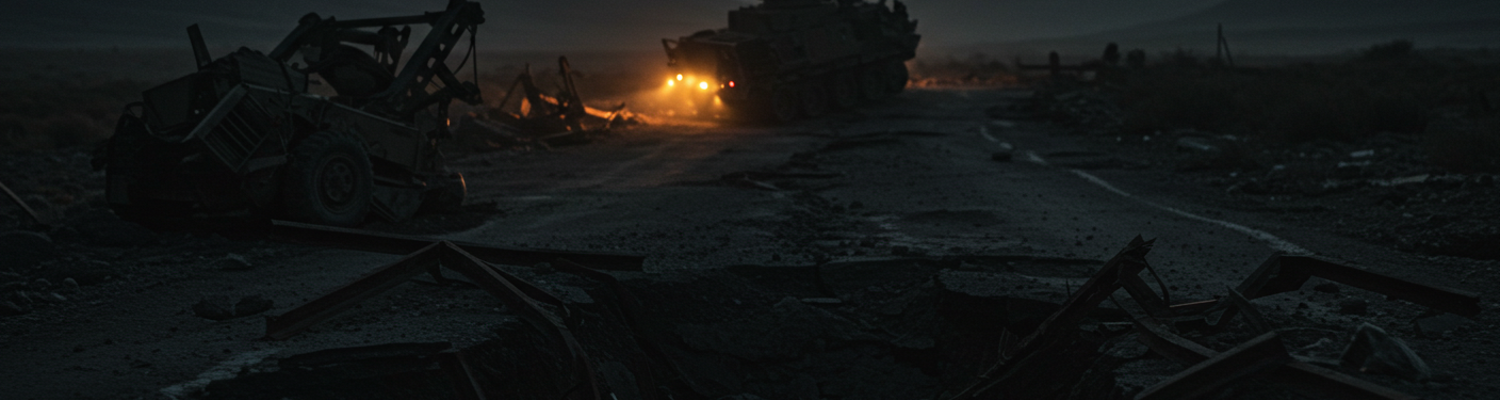

Metohija Valley Sabotage Operations
In the final months of Operation Allied Force, a close review of operational logs from the Kosovo Force (KFOR) indicates a coordinated and systematic effort by remnant Yugoslav Army (VJ) elements to disrupt the logistical spine of the incoming peacekeeping force. From April to June 1999, coalition after-action reports documented a 35% increase in rear-area infrastructure sabotage. The campaign had moved beyond direct confrontation, which was untenable against NATO air power, and into a phase of asymmetrical warfare aimed at equipment and supply lines.
This was not random destruction.
Analysis of the incidents reveals a pattern focused on exploiting specific vulnerabilities. Sabotage teams, often comprised of no more than two or three individuals, demonstrated detailed knowledge of NATO equipment. They targeted hydraulic lines on bulldozers and graders, contaminated fuel supplies with abrasives, and severed specialized high-torque belts on earth-moving equipment. The objective was a cascade failure. Slow the deployment. Stall the operational tempo of KFOR units fanning out from their initial entry points.
This low-intensity conflict had its epicenter in the Metohija Valley.
A wide basin flanked by mountains, it represented a natural and inescapable corridor for KFOR’s main supply routes, particularly the M9 highway and the adjacent, often single-track, railway lines running toward Peć and Prizren. This geographic reality turned the valley into a shooting gallery for saboteurs. Archival evidence from the U.S. Army’s 9th Engineer Battalion, one of the first heavy engineering units on the ground, details a persistent and debilitating series of attacks. Their primary mission of road clearance and bridge repair was constantly undermined by nightly sabotage that targeted their work. Small, expertly placed explosive charges were used not to destroy bridges outright but to fracture key load-bearing concrete supports, rendering them unsafe for armored vehicles and heavy supply trucks. Culverts running beneath roadways were a favored target; they would be blocked with debris and then collapsed using small charges, causing road surfaces to wash out with the next heavy rain.
Railway lines were subjected to a more subtle form of disruption. Instead of destroying tracks with large, easily detectable demolitions, teams used specialized tools to slightly warp sections of rail in tight curves or on steep gradients. These almost invisible defects were sufficient to cause the low-speed derailment of freight cars carrying construction materials and humanitarian aid, blocking the line for days. The resulting holdups were significant. A 72-hour halt of a supply convoy outside the Kačanik Pass, waiting for engineers to clear a deliberately induced rockslide, became a common occurrence. For every hour a combat engineer spent on forward-area missions, another two were spent doubling back to repair sabotaged routes they had cleared only days before. These operations forced a substantial reallocation of KFOR resources from peacekeeping and reconstruction to rear-area security. The 21st Royal Engineers reported a near-constant cycle of clearing and re-clearing the same stretches of roadway, a process that consumed valuable time and placed personnel at continuous risk. This grinding campaign of attrition did not inflict mass casualties, but it achieved its strategic purpose. It bled KFOR’s engineering capacity, delaying the establishment of a secure environment and creating the conditions of uncertainty that would define the opening chapter of the mission.
Istok Culvert Repair Mission
The operational tempo for Task Force Falcon accelerated dramatically on 14 May 1999. A routine route reconnaissance patrol, moving through the rolling hills near Istok, had come to an abrupt halt. The cause was a partially collapsed CMP Type 2 corrugated metal pipe structure designed to channel water under the roadway. This was no natural washout. The damage was precise, consistent with the small, focused demolitions that had become the signature of saboteur teams operating in KFOR’s rear. The road, a critical artery for the movement of heavy armor and the HEMTT trucks that formed the supply chain, was now severed. A review of operational logs shows that the patrol immediately noted an unnerving quiet. The usual signs of rural life were absent. This was an unnatural stillness, a recognized indicator of a potential ambush, and it transformed a simple engineering problem into a full-blown security operation.
The call went out for a specialized response. Command elements of Task Force Falcon, the brigade-sized U.S. contingent of KFOR, dispatched a tailored package of assets. The mission was assigned to elements of the 82nd Engineer Battalion, sourced from the 82nd Airborne Division, and the 101st Military Police Company. This pairing was doctrine. The engineers provided the technical expertise and heavy equipment for the repair, while the military police were tasked with establishing a secure perimeter during the vulnerable construction phase. The engineers arrived with hydraulic excavators, dump trucks loaded with aggregate, and cutting torches to remove the twisted metal of the damaged culvert. The MPs, mounted in M1114 Up-Armored Humvees, immediately began cordoning off the area, establishing interlocking fields of fire and setting up observation posts on the high ground overlooking the worksite.
Their task was far from simple. The engineers first had to carefully excavate the compromised section of road, removing earth to expose the extent of the damage. Army engineering manuals from the period (specifically FM 5-434) detail this as a painstaking process, one where the stability of the surrounding roadbed is a constant concern. A careless operator on the excavator could trigger a wider collapse. Once the damaged, multi-plate corrugated steel pipe was cut away, the real work began. A new section of culvert had to be lowered into place, meticulously aligned, and then buried. Layers of gravel and soil would be laid down and then mechanically compacted to meet the specific load-bearing requirements for a 70-ton M1 Abrams tank. All of this was done under the protective bubble of the 101st MP Company, whose soldiers scanned the silent hillsides for any sign of movement. Every minute the engineers spent working was another minute the convoy, and the larger KFOR mission, was delayed.
Coordinated Choke Point Ambush
At 14:37, the quiet of the Metohija Valley shattered. A close review of operational logs from the 101st Military Police Company confirms this moment as the start of a complex, L-shaped ambush. The initial volley of fire erupted from a wooded ridge overlooking the northern side of the road, a position that offered both excellent concealment and a clear line of sight into the exposed culvert repair site. The attacking force, estimated as a platoon-sized element, initiated the attack with a coordinated barrage of RPG-7V anti-tank rockets and heavy machine gun fire from Zastava M84s, the Yugoslav variant of the PKM.
Primary targets were the lightly armored M1114 Humvees of the MP security element.
The first RPG struck the lead Humvee of the western security section, disabling it instantly and blocking the narrow road. Simultaneously, machine gun fire raked the other vehicles and the exposed work area, pinning down the MPs and the engineers. The sheer volume and accuracy of the initial fire indicated a well-rehearsed plan, targeting command-and-control vehicles and crew-served weapons positions first to maximize confusion.
The ambush was a trap within a trap.
As the first rounds impacted, a secondary, high-explosive charge detonated. This device, assessed by Explosive Ordnance Disposal teams to be a daisy-chain of four Soviet-made TM-57 anti-tank mines wired for command detonation, had been pre-placed deep inside the already damaged culvert. The saboteurs’ initial, smaller demolition was merely bait. This massive secondary blast did not just damage the structure; it obliterated it. A deep, impassable crater, more than ten meters wide, instantly replaced the section of road where the engineers had been working. The force of the explosion threw the hydraulic excavator on its side and vaporized the stockpiles of aggregate. This single event achieved two objectives for the attackers: it definitively severed the strategic supply route and, more importantly, it bisected the American force on the ground.
The tactical situation had devolved into a fight for survival. The detonation at the culvert trapped the two Humvees of the eastern MP security element on one side of the chasm, separating them from the rest of their platoon and the main body of the engineer team. On the other side, the lead engineer elements, including the site supervisor’s command vehicle and the specialized equipment operators, were now completely exposed and cut off from the bulk of their MP protection. They were caught in the kill zone between the enemy firing line on the ridge and the newly formed crater to their rear, with no viable cover and no path for retreat. The surviving MPs from the western security section were pinned down, attempting to return fire while simultaneously dealing with casualties from the initial rocket attacks. The attackers, having seized the initiative, now shifted their fire, concentrating on the isolated and vulnerable engineers who possessed only their personal M16 rifles against a determined enemy armed with machine guns and rocket-propelled grenades.
Combat Engineer's Critical Dilemma
A review of the 82nd Engineer Battalion’s internal radio logs shows that at 14:39, two minutes after the secondary detonation, the company commander initiated a five-minute countdown. This was not a formal declaration but an internal calculation based on enemy fire patterns. The attacking force’s initial, high-volume barrage was giving way to more disciplined, aimed bursts, a sign that they were consolidating their position and preparing to systematically eliminate the trapped American force. For the engineer captain, a man whose career was built on methodical planning, the situation had been reduced to a raw calculus of time versus survival. He had approximately 300 seconds to choose a course of action before the enemy seized complete fire superiority and made any choice for him. His command element, a single M1025 HMMWV, was pinned by suppressive fire, its radio handset a direct link to a brigade-level command that could offer no immediate assistance.
His first option was a frontal assault.
This was the textbook infantry response to a near ambush: attack the attackers to regain the initiative. Analysis of the tactical situation, however, rendered this option almost nonsensical. The commander was not an infantry officer. He was a combat engineer leading a company of specialists. His men were experts in excavation and construction, not coordinated fire and maneuver. They were armed with their personal M16A2 rifles, with a basic combat load of 210 rounds each, and possessed no squad-level automatic weapons. The enemy, firing from prepared positions on the high ground, was using belt-fed Zastava M84 machine guns that out-ranged the M16s and provided a volume of fire the engineers could not hope to match. Ordering a charge across the open, rock-strewn ground toward the wooded ridge would be ordering his men into the teeth of an established kill zone.
The alternative was a tactical retreat, yet the terrain made the term a misnomer. The ten-meter-wide crater had physically cut his element in two and severed the only viable vehicle path. To the rear, there was only a chasm. Any retreat would have to be on foot, a disorganized scramble away from the road and across the open valley floor. This route offered no cover and would keep his men in the enemy’s line of sight for hundreds of meters. It was a choice between being shot while charging the enemy and being shot while running away. This immediate problem was compounded by a strategic one. The captain’s mission was to open this specific road. Army engineering doctrine at the time stressed that the integrity of a Main Supply Route was a theater-level objective. Abandoning the site would cede a major victory to the saboteurs, effectively shutting down the primary artery for armored and logistical columns moving into the western sector of Kosovo. It would validate the enemy’s entire strategy of infrastructure denial. The commander had to weigh the lives of his soldiers against the potential for a cascading failure that could stall the KFOR mission in his area of operations for days.
Operation Allied Force Logistical Stakes
A review of Kosovo Force (KFOR) logistical planning from 1999 reveals a stark dependency on the Metohija Valley. This basin was the only viable channel for the immense volume of material required to sustain Task Force Falcon. Planners designated the valley’s primary arteries, the M9 and M2 highways, as Main Supply Routes (MSRs) Sword and Gladiator. These were not merely roads; they were the lifelines for a heavy mechanized force. Daily traffic projections accounted for hundreds of heavy equipment transporters hauling 70-ton M1 Abrams tanks, convoys of M978 HEMTT fuel tankers carrying thousands of gallons of JP-8, and endless streams of palletized loading system trucks moving everything from 155mm artillery rounds to medical supplies. The operational plan for securing western Kosovo was predicated on the uninterrupted flow of this traffic. Any significant closure of MSR Sword or Gladiator would not be a minor inconvenience; it would halt the entire forward deployment of combat power.
This geographic vulnerability was systematically exploited. Archival evidence from U.S. Army engineer units documents a persistent campaign of sabotage aimed squarely at these supply routes. Remnant VJ and paramilitary teams demonstrated an intimate knowledge of KFOR’s engineering vulnerabilities. They did not target bridges with massive demolitions. Instead, they used shaped charges to fracture key load-bearing concrete supports and bridge abutments, creating structural instabilities that were nearly invisible but rendered the crossing unsafe for heavy armor. This forced time-consuming, specialist-led engineering assessments. The effect was a grinding cycle of repair and re-repair. After-action reports from Military Police units detail how route security patrols became static guard details for engineering work sites, dramatically thinning their presence across the valley.
The commander’s decision at the Istok culvert therefore carried a weight far beyond the immediate tactical situation. A close examination of the operational timeline reveals that the convoy halted by the initial sabotage was not just any supply column. The mission to secure the western town of Peć depended directly on its arrival. An order to abandon the ambush site would mean ceding the MSR to the enemy indefinitely. The road would not simply be closed for hours; it would be impassable for days. All logistical traffic would have to be rerouted through a narrow, poorly maintained secondary pass, a route logisticians had already deemed incapable of supporting heavy transporters and acutely vulnerable to similar tactics. The five-minute choice facing the engineer captain was a strategic one. Securing the lives of his soldiers by retreating would guarantee a logistical failure that would stall the KFOR mission across the entire American sector. The convoy, now indefinitely halted, contained the primary ammunition load for an M1 Abrams company and the AN/VRC-92 SINCGARS radio suites designated for the 1st Infantry Division's forward command post at Peć. The mission to secure the western sector now lacked both its communications backbone and its armored lethality.