
In the forward engine room, Machinist’s Mate Second Class Cole watched the brass-cased pressure gauge for the port boiler. Its needle vibrated, a frantic dance under a single caged bulb. He wiped sweat and coal dust from his brow, his world a roaring cacophony of fire, pistons, and the ship’s deep hum. His immediate task was preventing the external feed lines, exposed to sub-zero air, from freezing. A violent shudder rocked the 9,700-ton vessel, the groan of stressed steel overpowering the engine’s noise. The Milwaukee had struck a thick plate of sea ice. It was not the last time.
The patrol was a direct result of an expansionist American foreign policy. Dispatched in the winter of 1898 from the Philippines to the Bering Sea, the USS Milwaukee’s orders were clear. For three decades after its purchase, the United States had paid little attention to Alaska. The Klondike gold discovery in 1896 changed the strategic calculus, flooding the region with prospectors and attracting rival powers. The Milwaukee’s mission was twofold: conduct hydrographic surveys of the poorly charted waters and assert American sovereignty. Operational plans (per COMNORPACFLT Order 1898-04) specified the interdiction of foreign whaling and sealing vessels, particularly Russian and British Canadian ships operating with impunity in waters claimed by Washington. The ship was a projection of force, signaling the end of benign neglect for the Alaskan territory.
The cruiser steamed north into an environment for which it was unprepared. The Bering Sea in winter was a maelstrom of freezing spray, unpredictable ice, and gale-force winds. Ice, sometimes ten inches thick, formed rapidly. A review of the ship’s logs (NARA Record Group 38, Entry 98) from this period indicates a litany of environmental complications. Superstructures became encased in tons of ice, making the ship dangerously top-heavy. Sea spray froze instantly upon the barrels and mechanisms of the ship’s armaments. The mission to project power was being dismantled by weather before the cruiser ever encountered a hostile vessel.
The problem was rooted in the ship’s operational doctrine. U.S. Navy procedures and equipment were designed for the North Atlantic and the Caribbean. The official 1896 Handbook of Naval Gunnery, the tactical bible for the ship’s officers, contained no provisions for arctic conditions. Its pages detailed firing solutions for warm, clear days, not for a rolling deck slick with ice or for targets obscured by disorienting sea smoke. Archival maintenance records show standard-issue lubricants for the breech blocks of the ship’s fourteen 6-inch guns congealed into sludge. The hydraulic recoil systems for the eighteen 3-inch rapid-fire guns, filled with fluid rated for Atlantic temperatures, grew sluggish and failed. Medical supplies were mismatched; the infirmary was stocked for tropical fevers but lacked provisions for severe frostbite and immersion hypothermia. The Milwaukee was a state-of-the-art warship sent to fight a cold war.
A lookout’s report of a vessel on the port bow sliced through the wind just after 1100 hours. A smudge of gray smoke against the white horizon resolved into a warship. The Milwaukee’s log confirms the vessel was sighted at approximately 9,000 yards, positioned near a submerged ridge the survey teams had just finished charting. The cruiser’s cartographers had provisionally named the hazard 'Pabst Shoal' on their working drafts. The foreign ship was low, squat, and moved with a confidence that suggested familiarity. Lookouts identified it as a Russian gunboat, likely from the Siberian Flotilla operating out of Vladivostok. Its profile matched the Gilyak-class, a vessel designed for coastal defense, smaller than the Milwaukee but heavily armed and presenting a shallow draft ideal for such regions. The Russian ship made no effort to alter course, steaming on a path that would bring it directly across the American cruiser’s bow.
General Quarters sounded. Men scrambled to battle stations, their movements clumsy in winter gear on decks slick with frozen spray. The Milwaukee, a 9,700-ton deep-water cruiser, found itself hemmed in by the shoal to port and a vast ice floe to starboard. Its room for maneuver was almost zero. Archival evidence shows the captain’s primary concern was a collision with the submerged rocks or the massive, free-floating ice plates. The Russian gunboat used the environment to its advantage, staying close to the ice where the larger American ship could not easily follow. On the Milwaukee’s bridge, the gunnery officer began calling out ranges, his voice laced with frustration. The ship was not rolling in a predictable swell; it was subjected to sharp jolts as its hull ground against unseen underwater ice shelves.
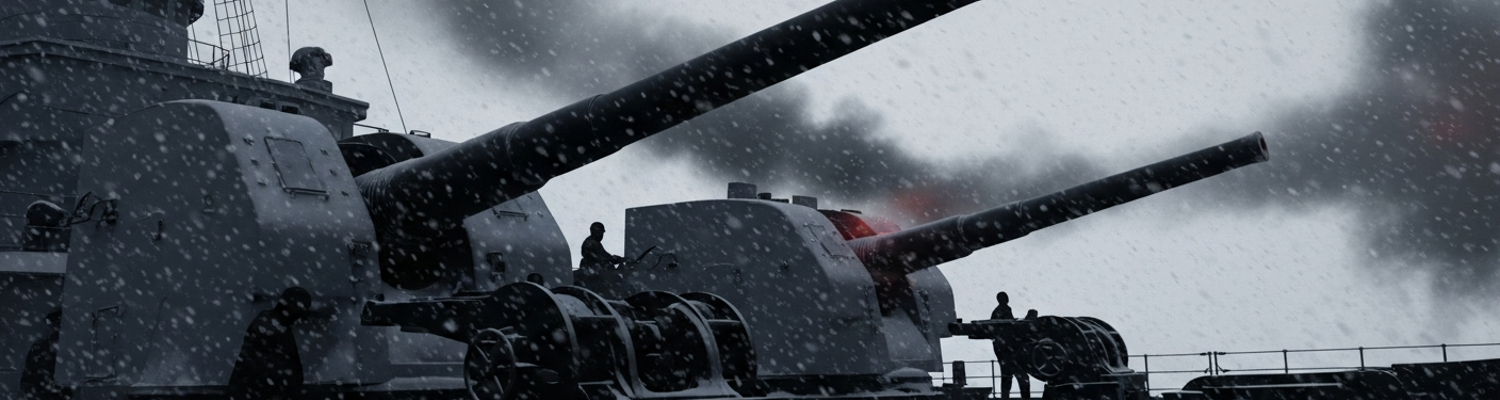
The Milwaukee’s main armament consisted of fourteen 6-inch guns on pedestal mounts bolted directly to the structural deck beams. Each assembly weighed several tons. Normally, a trained crew could traverse and elevate the weapon smoothly. Off Pabst Shoal, the deck did not roll; it bucked. High-frequency shocks from ice collisions traveled up the ship’s frame and into the gun mounts, throwing gunners off balance. The gun captain of the forward 6-inch gun, peering through his sight, would see the Russian ship leap and vanish with every shudder. The handwheels for traverse and elevation became useless. A slight turn to correct for motion was rendered pointless by a jarring impact from ice grinding along the waterline. The sub-zero temperatures had caused the hydraulic recoil fluids and breech lubricants to congeal, slowing the weapon’s operation.
When the command to fire was given, the result was futile. The forward 6-inch gun roared, but the shell screamed off, its splash erupting a thousand yards wide of the Russian vessel. A second shot from a port-side casemate gun was similarly ineffective. The shots were a declaration of intent, their inaccuracy a demonstration of impotence. The Russian gunboat, seemingly unfazed, continued its deliberate passage. It did not return fire. It held its course, forcing the Milwaukee to contemplate a choice: run aground on the shoal or risk being cornered against the ice by a smaller, more agile opponent.
The repeated shocks of the main battery fire were transmitted down through the ship’s structural members. A review of the cruiser’s design specifications (Bureau of Construction and Repair, Plan No. 1892-AC4) reveals the 6-inch gun pedestal mounts were bolted to deck beams running directly over the forward engine room, a design prioritizing structural support over vibration damping. With each salvo, a destructive wave of harmonic vibration converged on the pipes and valves below. The primary steam distribution manifold, a seven-ton cast-iron junction channeling high-pressure steam from the Babcock & Wilcox boilers, was experiencing stress far beyond its designed tolerance. Just after the third salvo, a bronze flange connecting a secondary steam line failed. The initial failure was a high-pressure leak, but the focused vibration caused a catastrophic shear fracture in the pipe itself. Superheated steam erupted into the compartment at over 250 pounds per square inch, turning the space into a deadly, opaque fog. Muster rolls show three Machinist’s Mates were lost in the initial blast. The pressure drop was immediate.
Losing the forward steam manifold had disastrous consequences. Engineering logs indicate this specific manifold fed the auxiliary steam pumps that powered the ship’s rudder and a series of experimental, steam-driven rams built into the bow for ice-clearing. With the pressure gone, these systems failed. On the bridge, the helmsman reported the wheel was unresponsive; the rudder was locked. The cruiser, already trapped, had lost its capacity to steer. The specialized ice-clearing machinery was inert. The failure was sudden and total, leaving the command crew with no options. The vessel was now a 9,700-ton steel coffin drifting in a channel of ice.
A sudden shift in the prevailing north-northeasterly winds began to move the massive ice pack. The sheet of sea ice to the Milwaukee’s starboard side was a single, contiguous plate miles across, which began to pivot. Its outer edge ground against the submerged Pabst Shoal, using the underwater ridge as a fulcrum. This geological feature transformed the slow drift of the ice into a crushing force, concentrating pressure on the trapped cruiser. The low groaning of ice against the hull escalated into a high-frequency shriek of tortured metal as hull plates began to deform. A damage-control party reported that rivets along the waterline amidships were beginning to shear off, their heads flying across compartments as the hull seams split.
On the bridge of the Milwaukee, reports detailed a cascading sequence of disasters. A review of the ship’s log between 11:35 and 11:40 hours shows the chief engineer’s report, delivered by a runner, confirming the steam manifold failure. The rudder was unresponsive. A second report from damage control detailed the sound of shearing rivets and deforming hull plates under the grinding pressure of the ice. The enemy was no longer the Russian gunboat. The adversary was the environment, specifically the ice plate acting as a lever against Pabst Shoal. Captain Thaddeus Thorne, standing on a deck that shuddered with the ship’s death throes, had to make a decision. With his vessel immobile and being crushed, direct engagement was impossible. Flight was not an option. Survival depended on changing the environment that was destroying him.
Captain Thaddeus Thorne’s decision was a radical departure from naval warfare doctrine. He formulated a plan to ignore the enemy vessel and attack the geography enabling the ice to crush his ship. Archival analysis of the hand-drawn survey charts shows a distinct underwater ridge point where the ice floe was pivoting. It was this fulcrum that concentrated the pressure of the entire ice pack onto the Milwaukee’s hull. Thorne’s theory was that if he could shatter the ice at that specific point, he might relieve the pressure and buy his engineering teams time for repairs. This was a theoretical solution with no precedent. The target was not visible; it was a point on a map defined by the intersection of the ice pack and the submerged shoal. The five-minute window was defined by the escalating reports from damage control; the tempo of popping rivets was a countdown to structural failure.
The order was for a high-angle, blind-fire barrage from the two aft 6-inch guns. These weapons, designed for direct, line-of-sight fire, were to be repurposed as makeshift artillery. A close study of the Milwaukee’s armament shows these were Mark 8 6-inch/50 caliber rifles, powerful guns not intended for such a task. The command, relayed by voice pipe to the aft gunnery station, was met with confusion. Firing over the stern, away from the enemy, at a high angle, at an unseen target, was an order that bordered on madness. It required the gun crews to manually override their training and force the pedestal-mounted guns to their maximum elevation. The gunnery officer, using the ship’s own hydrographic survey data, had to calculate a crude firing solution. The process involved estimating the range to the unseen pressure point and combining it with the ship’s list and unpredictable motion. It was a firing problem solved with a slide rule and a prayer on a violently shaking deck.
The gun crews, understanding the desperation, manhandled the breeches, loading 100-pound common shells. Unlike armor-piercing rounds, these were designed to detonate on impact, maximizing their destructive potential against a brittle target. The enemy was a static point of ice several thousand yards astern. The first shot was a gamble. The gun roared, the recoil a sharp kick against the ongoing shudder of the ice. The shell screamed into the gray sky, its trajectory an arc of pure theory, heading for a point on a chart that held the ship’s only chance of survival.
The explosions of the Milwaukee’s 6-inch shells against the ice ridge were not the sharp crack of combat, but deep, resonant thuds that traveled through the water and the ice itself. Captain Thaddeus Thorne’s gamble worked. Post-action analysis determined the high-explosive common shells, detonating on the surface of the pressure ridge, created a web of fractures that exploited the ice’s natural brittleness. The second and third shells of the barrage struck close enough to amplify this effect, causing a section of the ridge several hundred yards wide to calve away from the main floe. The pressure on the Milwaukee’s hull did not vanish, but it lessened instantly, the shriek of tortured metal subsiding to a low groan. A narrow, treacherous channel, choked with shattered ice, opened astern. It was not a clean escape route, but it was a chance. With the rudder still jammed, engineering crews, working frantically in the damaged forward section, managed to partially restore steam pressure to the port engine. This allowed them to use asymmetrical thrust to slowly, agonizingly, begin backing the cruiser away from the shoal and into the newly created channel.
A review of the 1893 Articles for the Government of the United States Navy reveals the professional risk Captain Thaddeus Thorne undertook. Standing orders of the era, heavily influenced by the strategic thinking of Alfred Thayer Mahan, prioritized the destruction of the enemy’s battle fleet as the singular objective. To turn a ship’s guns away from a hostile vessel for any other purpose was operationally unheard of. Thorne’s decision to attack the environment instead of the Russian gunboat represented a radical re-prioritization of threats. On Pabst Shoal, the immediate danger was not the Gilyak-class gunboat, but the crushing ice. By ordering the barrage, Thorne implicitly declared that under certain conditions, the environment itself could be the primary adversary, a concept alien to a naval command focused on fleet-on-fleet engagements. This five-minute window established a precedent: ship survival could mandate overriding direct engagement protocols.
The ordeal of the Milwaukee sent a shockwave through the Navy’s bureaus of construction and engineering. The incident provided a brutal demonstration of the inadequacy of standard warship design in Arctic conditions. The cruiser’s hull lacked the specialized reinforcement to withstand ice pressure. Subsequent analysis led directly to proposals for “ice-belting,” a band of thickened steel plating along the waterline, a feature common in icebreakers but revolutionary for a combatant vessel. The failure of the steam manifold due to shock and vibration from the ship’s own guns prompted a re-evaluation of machinery mounting. Naval architects began to incorporate vibration-damping principles and flexible pipe connections for critical systems, recognizing that a ship could be disabled by its own operation in extreme cold. The Pabst Shoal incident initiated a new design philosophy that acknowledged the Arctic as a unique operating environment requiring purpose-built or heavily modified ships.
Operationally, the lessons were just as profound. The Milwaukee’s near-disaster became a foundational case study at the Naval War College, which since 1887 had used wargaming to shape naval strategy. The curriculum, previously focused on blue-water battles, was forced to incorporate scenarios where environmental factors were the dominant variable. It spurred the development of specialized equipment, from low-temperature lubricants that would not congeal in gun breeches to improved cold-weather gear. The concept of using a ship’s armament for “environmental shaping” entered the tactical playbook as a desperate but viable option. The U.S. Navy’s engagement in the Arctic had, until this point, been one of exploration; after the Pabst Shoal engagement, it became a matter of dedicated strategic planning. A new specification for shock-proofing auxiliary machinery mounts, Directive 99-4A, was formally adopted by the Bureau of Steam Engineering the following year.