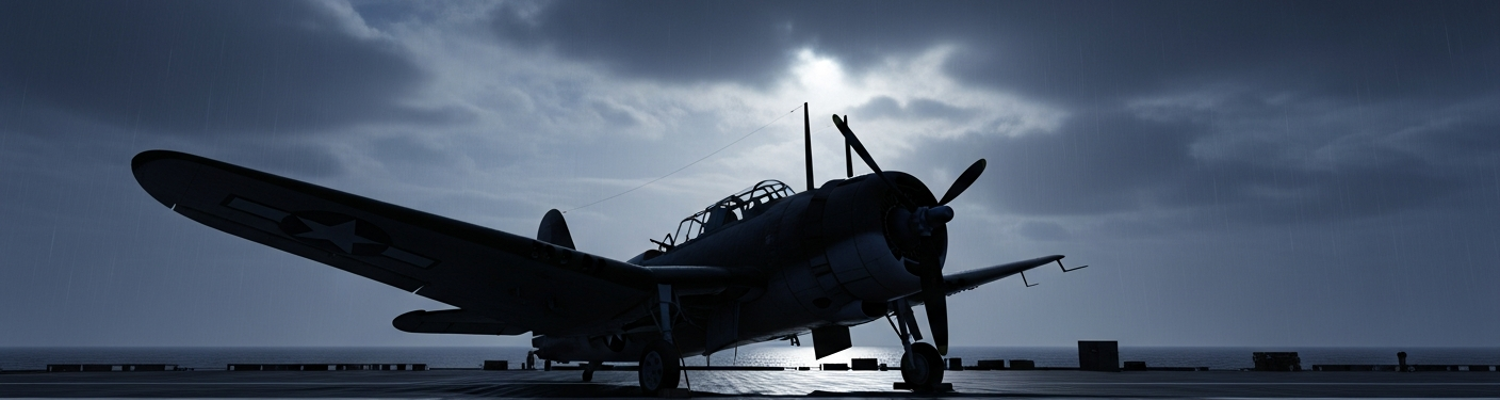

TBD Devastator Design Origins
A close review of operational logs shows the conceptual framework for the TBD Devastator began to solidify in the early 1930s. The United States Navy’s Bureau of Aeronautics (BuAer) issued a design competition in 1934 for a new carrier-based torpedo bomber. This request (BuAer Req. SD-114-T) was driven by the commissioning of the new aircraft carrier USS Ranger and the general expansion of the carrier fleet. At this moment in military aviation, naval air power was a ferment of technological transition. The biplane, with its open cockpits and fixed landing gear, was still the dominant configuration on carrier decks, but designers and naval planners alike saw the potential of the all-metal monoplane. The Navy's 1934 request was part of a larger push for modernization that also sought new scout bombers and fighters, resulting in aircraft like the Northrop BT-1, the precursor to the SBD Dauntless. Douglas Aircraft Company, alongside Great Lakes Aircraft Corporation and Hall Aluminum Aircraft Corporation, submitted proposals. The Great Lakes entry, the XTBG-1, was a biplane, representing the last of its kind procured by the Navy for the torpedo-bomber role. The Douglas design was a radical departure.
The Douglas prototype, designated XTBD-1, was the U.S. Navy’s first carrier-based monoplane and its first all-metal naval aircraft. It introduced a host of features that were, for the mid-1930s, advanced. The design featured a fully enclosed cockpit for its three-man crew: a pilot, a navigator/bombardier, and a radioman/gunner. This was a significant change from the wind-blasted open cockpits of its predecessors. Perhaps most striking were the hydraulically actuated folding wings, a system designed to maximize storage space on the crowded hangar decks of aircraft carriers. According to deck logs, when the first TBD demonstrated this capability while taxiing, a startled sailor triggered the crash alarm, mistaking the upward-folding wings for a sign of catastrophic structural failure. The landing gear was semi-retractable, with the wheels designed to protrude slightly below the wing even when raised. This was an intentional safety feature, meant to reduce damage to the airframe during a wheels-up belly landing. The prototype first flew on April 15, 1935. After passing acceptance trials, it was assigned to the USS Lexington for carrier certification.
The Navy’s pre-war optimism for its air arm was palpable, and the TBD Devastator was seen as the physical embodiment of this new potential. Deliveries to the fleet began in 1937, with Torpedo Squadron 3 (VT-3) being the first unit to receive the aircraft. Upon its introduction, the Devastator was arguably the most advanced carrier aircraft in the world. Naval doctrine at the time envisioned coordinated attacks, with torpedo bombers making low-level runs against enemy warships while dive bombers attacked from high altitude and fighters provided cover. The TBD was designed specifically for this role, intended to be the fleet’s primary ship-killer. It could carry a single 1,200-pound Bliss-Leavitt Mark 13 aerial torpedo or a variety of bomb loads, including a single 1,000-pound bomb. For the bombing role, the bombardier would move to a prone position, looking through a window in the bottom of the fuselage to aim with a Norden Bombsight. The production TBD-1 models were powered by a 900-horsepower Pratt & Whitney R-1830-64 Twin Wasp radial engine, giving the 10,000-pound aircraft a maximum speed of just over 200 miles per hour.
This was not enough.
Defensively, the aircraft was equipped with a single forward-firing .30 or .50-caliber machine gun and a rear-facing .30-caliber gun for the gunner. By the time the first production order for 110 aircraft was placed in February 1936, the largest peacetime aircraft order the Navy had ever made, the TBD represented a massive leap in capability over the biplanes it was replacing. The aircraft, with its polished aluminum fuselage and yellow wings, became a symbol of American naval aviation’s modern cutting edge. It equipped the torpedo squadrons of every U.S. carrier in the fleet by the time of the Pearl Harbor attack, including those on the Saratoga, Lexington, Yorktown, Enterprise, and Hornet. The rapid pace of aviation development, however, meant that an aircraft considered revolutionary in 1937 would be perilously out-of-date just five years later.
Early Pacific Deployment Challenges
Operational logs from late 1941 and early 1942 reveal a series of failures that crippled the TBD Devastator before it ever reached a target. The logistical network required to sustain this mechanically advanced, yet fragile, aircraft was stretched to its breaking point across the vast Pacific. At remote island airfields and on the decks of carriers operating far from the naval yards of the West Coast, the Devastator’s sophisticated systems became liabilities. The hydraulic mechanisms for the folding wings and semi-retractable landing gear were a constant source of maintenance headaches. Seals rated for temperate climates failed in the tropical humidity. Specialized hydraulic fluid and replacement parts were often thousands of miles away, sitting on the docks in Pearl Harbor or San Diego. The Pratt & Whitney R-1830 Twin Wasp engines, while robust, demanded a steady diet of specific tools, spark plugs, and filters that were in critically short supply. This logistical strain meant that ground crews were forced to cannibalize already worn-out aircraft to keep a fraction of the squadron flight-worthy, a practice that only accelerated the decline of the fleet. The problem was most acute for the aircraft’s primary weapon system. The Mark 13 aerial torpedo was a complex and delicate piece of machinery, and the handful of technicians trained to service its gyroscopes and exploders were a finite resource.
This logistical decay fed directly into doctrinal gaps. Pre-war naval aviation theory was built on the concept of the coordinated strike: high-flying fighters would sweep the skies of enemy aircraft, dive bombers would suppress anti-aircraft fire from enemy warships, and then, in the ensuing chaos, the torpedo bombers would make their low-level runs. The plan was nearly impossible to execute in combat. The Devastator’s extremely slow attack speed, it had to decelerate to under 115 mph to safely drop the Mark 13 torpedo, meant it could never keep pace with the faster fighters and dive bombers. A coordinated launch did not guarantee a coordinated arrival. Squadrons would become separated over the vast distances of the open ocean, leaving the TBDs to arrive at the target alone. The Japanese-developed "anvil attack," a tactic where two torpedo squadrons would approach a ship from different vectors to bracket it, was known to U.S. planners but required a level of command, control, and pilot proficiency that did not exist in the early carrier battles. The weapon itself was the core of the failure. The Mark 13 torpedo was notoriously unreliable. It had a tendency to run deeper than its set depth, passing harmlessly under targets. Its contact exploder frequently failed to detonate even on a direct hit. To give the weapon even a chance of working, pilots had to fly a long, straight, and perfectly level approach at a perilously low altitude. This made them predictable targets for enemy fighters and anti-aircraft gunners.
The result was a collapse in operational readiness across the fleet's torpedo squadrons. The men of Torpedo Squadron 8 (VT-8) aboard the USS Hornet, Torpedo Squadron 6 (VT-6) on the USS Enterprise, and Torpedo Squadron 3 (VT-3) from the USS Yorktown were sent into the pivotal Battle of Midway with aircraft that were poorly maintained, armed with a faulty weapon, and committed to a flawed tactical doctrine. Archival evidence shows that training was dangerously inadequate. Due to the scarcity and expense of the Mark 13, many pilots, including a large number of newly commissioned ensigns in VT-8, had never dropped a live torpedo before entering combat. Some had never even taken off from a carrier with one. The squadrons themselves were often composites of veteran pilots and inexperienced newcomers who had not had time to cohere as a fighting unit. The early carrier raids of 1942, while strategically important, had worn down the limited number of available TBD airframes, leading to metal fatigue and engine trouble that the strained logistical chain could not fix. By June 1942, the Devastator squadrons were facing Japan’s elite, combat-hardened carrier pilots in machines that were, by every measurable standard, obsolete. The Navy knew this. The TBD’s replacement, the Grumman TBF Avenger, was already entering service, but not in time to fully equip the carriers heading to Midway. A handful of Avengers did operate from Midway Island, but the carrier-based squadrons were left with the Devastator.
Devastator Fundamental Design Flaws
An examination of the TBD Devastator's engineering specifications reveals an aircraft caught disastrously between two distinct eras of aviation technology. The fundamental flaws were not isolated component failures but a systemic vulnerability woven into the airframe’s very concept. Chief among these was a lack of speed. The 900-horsepower Pratt & Whitney R-1830 radial engine was tasked with pulling a 10,000-pound aircraft through the sky, a job it performed poorly. In a clean configuration, the TBD could theoretically reach 206 miles per hour at an optimal altitude of 8,000 feet. Combat operations required it to be laden with its primary weapon, a single Mark 13 torpedo. This external payload generated enormous drag, reducing the aircraft’s effective top speed to a crawl. The situation worsened dramatically during the attack run. To have any chance of a successful drop, naval doctrine and the torpedo’s own delicate mechanics required the pilot to slow to under 115 mph and descend to a perilously low altitude. This created a predictable, non-evasive attack profile. For the pilots of Torpedo Squadrons like VT-8 and VT-6 at Midway, this meant flying straight and level for minutes at a time, a horrifyingly long duration when facing enemy defenses.
This vulnerability was magnified by the TBD’s inadequate defensive armament. A close review of operational logs shows that TBD crews were sent into combat with weapons that offered psychological comfort but little actual protection. The primary defensive weapon was a single, flexible .30-caliber machine gun operated by the rear gunner. While some efforts were made late in its service life to upgrade to a twin-mount, the vast majority of Devastators at the outset of the war carried this single gun. This weapon was outmatched by the standard Japanese naval fighter, the Mitsubishi A6M Zero. The Zero, capable of speeds well over 300 mph, could choose its angle and timing of attack with impunity, often targeting the slow TBDs from below or from angles where the single rear gun could not traverse. The Zero was armed with a pair of powerful 20mm cannons in addition to its machine guns. The .30-caliber rounds from the Devastator’s gun lacked the mass and energy to penetrate the Zero’s airframe or inflict meaningful damage, while a single hit from a 20mm cannon shell could shred the TBD’s unarmored fuselage and control surfaces. The pilot had a single forward-firing .30-caliber machine gun, but this was useless for defense once an attack run commenced and fighters were on its tail.
The aircraft was effectively defenseless.
Compounding these issues was the Devastator’s severely limited payload capacity, which undermined its entire strategic purpose. The aircraft was designed around a single weapon system: one Bliss-Leavitt Mark 13 aerial torpedo, weighing approximately 2,216 pounds. It could not carry anything else. Alternatively, it could be configured as a level bomber, carrying a single 1,000-pound bomb or a small number of 500-pound bombs, but it could not mix these loads or carry both bombs and a torpedo. This lack of flexibility meant that mission planners had to make a hard choice on the carrier deck, a choice that could not be altered once the aircraft was in the air. The reliance on a single torpedo for its anti-ship role was a critical weakness. A successful torpedo attack against a maneuvering warship often required multiple hits from different angles, a tactic known as an "anvil attack." Because each TBD carried only one weapon, this required a large number of aircraft to execute, exposing more three-man crews to enemy fire for each attempted strike. The performance at the Battle of Midway, where 41 Devastators failed to score a single torpedo hit while suffering near-total losses, stands as the ultimate indictment of this design limitation.
Mark 13 Torpedo Operational Malfunctions
Operational logs and after-action reports from the first year of the Pacific War reveal the Mark 13 torpedo was not merely a flawed weapon; it was a cascade of interlocking failures. The most persistent of these was its inability to maintain a set depth. The torpedo’s Mark 6 hydrostatic pistol, a device designed at the Naval Torpedo Station in Newport, Rhode Island, used a combination of a water pressure-sensitive bellows and a pendulum to keep the weapon at a pre-set running depth. These mechanisms were calibrated and tested in the cold, fresh, and calm waters of a New England test range. The warm, dense, and turbulent salt water of the Pacific Ocean was a completely different environment. Reports from combat pilots consistently described perfect attack runs, flying low and slow directly into enemy anti-aircraft fire, only to see their torpedoes pass harmlessly underneath the target. The hydrostatic valve, when subjected to the higher ambient pressure of warmer seawater, consistently guided the torpedo to run approximately 10 to 15 feet deeper than its setting. For a torpedo set to strike a destroyer’s keel just a few feet below the waterline, this was a fatal error. The weapon simply vanished beneath the ship.
The weapon was a dud.
Even when a Mark 13 managed to run at the correct depth and strike a target, it was highly unlikely to explode. This second critical failure resided in the contact detonator mechanism, a fragile assembly. The design required the torpedo to strike the target hull at a near-perfect 90-degree angle to function. Anything less, a common occurrence against a maneuvering warship, would cause the firing pin mechanism to deform or shatter on impact without striking the detonator cap. A direct, perpendicular hit often proved just as useless. The force of the impact against a solid steel hull was so great that the guide pins for the firing pin would buckle, jamming the mechanism completely before it could function. Submarine crews using the related Mark 14 torpedo reported seeing their weapons hit enemy ships with a loud clang and break in half, the warhead sinking inertly. Aviators of squadrons like VT-6 and VT-8 at the Battle of Midway were sent to their deaths carrying a weapon that, according to post-war analysis, had a dud rate approaching or exceeding 70 percent on contact hits. The Bureau of Ordnance, which had conducted almost no live-fire testing before the war due to budget constraints, initially refused to believe the reports from the fleet, blaming the failures on poor pilot skill.
These mechanical defects were compounded by the operating environment of the Pacific theater. A torpedo is a complex machine, and the Mark 13 was exceptionally delicate. On the hot, humid, and salt-sprayed decks of aircraft carriers, the conditions for proper maintenance were nonexistent. Internal components, meticulously assembled in stateside factories, were susceptible to corrosion from the salt air. The gyroscopes that governed the torpedo’s direction could be thrown off by temperature fluctuations and rough handling during loading. The compressed air propulsion system could lose pressure in the tropical heat, causing the torpedo to run at inconsistent speeds, which further complicated its already poor depth-keeping. The fins and propellers were easily damaged if the torpedo entered the water at anything other than a precise angle, a problem made worse by the TBD’s slow speed, which forced a flat, jarring entry into the water. Each of these environmental factors amplified the weapon’s inherent unreliability, creating a system where every component seemed poised for failure long before it was ever dropped from the belly of a Devastator.
Devastator Losses Battle of Midway
Operational logs from the morning of June 4, 1942, detail a one-sided aerial engagement. The TBD Devastator squadrons, launched from the carriers USS Hornet, USS Enterprise, and USS Yorktown, were systematically annihilated. The first to make contact was Torpedo Squadron 8 (VT-8) from the Hornet. Due to poor launch coordination and the Devastator’s slow speed, VT-8 became separated from its intended fighter escort. Its commander, Lieutenant Commander John C. Waldron, made the fateful decision to break from the main strike group’s heading, gambling on his own navigation to find the Japanese fleet. He found it. Descending to attack altitude without any F4F Wildcat protection, his 15 aircraft were met by a massive combat air patrol of Mitsubishi A6M Zero fighters. The Zeros, with a speed advantage of over 100 miles per hour, swarmed the slow-moving TBDs. The Devastators were forced to fly a long, straight, and level approach to have any chance of launching their Mark 13 torpedoes, making them predictable targets. The Japanese fighters conducted multiple firing passes, tearing apart the unarmored American planes.
Every single one of the 15 TBDs of Torpedo Squadron 8 was shot down.
Of the 30 men in the squadron, only a single pilot, Ensign George Gay, survived the attack. He was shot down after releasing his torpedo, which missed, and spent the rest of the battle floating in the ocean amidst the wreckage. Shortly after the destruction of VT-8, Torpedo Squadron 6 (VT-6) from the USS Enterprise, led by Lieutenant Commander Eugene E. Lindsey, found the Japanese carriers. Like VT-8, they arrived without fighter escort and pressed their attack. The Japanese CAP, already at low altitude from finishing off Waldron’s squadron, immediately engaged. Lindsey’s squadron was savaged. Ten of the 14 TBDs were shot down, including Lindsey’s own aircraft. The final carrier-based TBD attack came from Torpedo Squadron 3 (VT-3), launched from the USS Yorktown. Commanded by Lieutenant Commander Lance E. Massey, VT-3 was escorted by six F4F Wildcats, but this small force was overwhelmed by the dozens of Zeros defending the fleet. The Wildcats were drawn into dogfights, leaving the torpedo bombers exposed. Ten of VT-3’s 12 Devastators were destroyed.
Across the three squadrons, 41 TBD Devastators were dispatched from the American carriers. A total of 35 were shot down. The torpedo attacks failed to score a single confirmed hit on any of the Japanese carriers. The losses underscore the complete inability of the unescorted, slow-moving TBDs to penetrate the Japanese air defenses. The Japanese combat air patrol, flying the world-class A6M Zero, operated with brutal efficiency. The American doctrine of a coordinated strike had completely broken down, leaving the torpedo bombers to arrive piecemeal, guaranteeing their destruction. The sacrifice, however, was not entirely in vain. The successive, suicidal attacks drew the Japanese fighters down to sea level and forced the Japanese carriers into evasive maneuvers, preventing them from launching their own counterstrike. This left the skies above the Japanese fleet undefended at the precise moment American SBD Dauntless dive bombers arrived, changing the course of the battle in a matter of minutes.
War Correspondents Expose Devastator Flaws
Newsreels and still photography from the Pacific Fleet in 1942 show the first, brutal exposure of the Devastator’s weaknesses. Combat photographers, many of them enlisted Navy men, were tasked with documenting carrier operations, and their footage provided an unvarnished look at the machine’s failures. These were not just for public consumption; they were a component of after-action analysis. Pre-war photography from magazines like LIFE captured the TBD in vibrant color, an icon of "Golden Wings" naval aviation. By mid-1942, the images were grainy, black-and-white, and chaotic. Film from the deck of the USS Hornet captured the takeoff sequence of Torpedo Squadron 8 before their attack at Midway. The images show the fifteen heavily laden aircraft struggling to get airborne, a visual confirmation of their underpowered engines.
Of the 41 Devastators launched from American carriers on June 4, only a handful returned. Photographers who had filmed their departure waited for hours, their cameras aimed at an empty sky. The absence of returning aircraft was a silent, powerful indictment of the plane’s inability to survive. The sole survivor of VT-8, Ensign George Gay, was rescued after spending hours in the water; his personal account, once declassified, provided a harrowing narrative that no camera could capture. The few photographs that did emerge from the battle, such as images of a damaged TBD being jettisoned from the USS Yorktown, became symbols of the aircraft’s obsolescence. These pictures, stripped of heroic context, showed a failed machine being discarded, a story of mechanical weakness, not just battlefield loss.
The initial press reports following the Battle of Midway were a carefully constructed narrative of overwhelming victory, but the sheer scale of the TBD’s destruction could not be entirely suppressed. Dispatches from war correspondents embedded with the fleet were subject to heavy censorship, with operational details and equipment deficiencies systematically removed. The public story was one of heroic sacrifice, framing the loss of the torpedo squadrons as a courageous charge that, while costly, enabled the decisive victory by the dive bombers. This narrative deliberately obscured the fact that the pilots were sent into combat with catastrophically flawed equipment. Some publications began to hint at the deeper problems. The Chicago Tribune, in a controversial article published just days after the battle, focused on the fact that the Navy had broken Japanese codes. This story caused a firestorm in Washington, but buried within the coverage were casualty lists that pointed to a lopsided outcome for specific squadrons, allowing astute readers to infer that the torpedo bombers had faced a unique level of destruction.
As more information trickled back from the Pacific, the discrepancy between the performance of the SBD Dauntless dive bombers and the TBD Devastators became impossible to ignore. Analysis printed in aviation journals and newspapers began to openly question the torpedo bomber doctrine. They detailed the TBD’s slow speed and the stringent, predictable attack profile required by its Mark 13 torpedo. While direct criticism of the Navy was muted, the technical specifications and reported combat results spoke for themselves. The press began referring to the aircraft as obsolete, a stark contrast to the pre-war articles that had hailed it as the world’s most advanced naval aircraft. This shift in public perception, from technological marvel to deathtrap, was a direct result of the losses at Midway.
The official reaction in Washington was swift. Declassified naval records indicate that the after-action reports from the carrier commanders at Midway were a brutal assessment of the TBD and its torpedo. The commanders did not mince words, detailing the near-total annihilation of their torpedo squadrons for zero effective results. These internal reports triggered an immediate response from the Bureau of Aeronautics. The Devastator was withdrawn from all frontline combat units almost immediately. The disaster also forced the Bureau of Ordnance to finally confront the long-standing and disastrous flaws of the Mark 13 torpedo, which pilots had been complaining about for months. The failure rate at Midway, where dozens of crews died without scoring a single hit, provided undeniable proof that the weapon was a dud, prompting intense investigation and redesign efforts at Caltech. The losses also fed into broader inquiries, such as those conducted by the Truman Committee, which was investigating deficiencies in war production and military procurement. The public exposure and internal condemnation of the Devastator’s performance directly accelerated the deployment of its replacement, the Grumman TBF Avenger, ensuring that the Navy would not enter another major battle with such a fatally compromised weapon system.
TBD Devastator Rapid Obsolescence
The after-action reports from the commanders at Midway constituted an undeniable indictment. The U.S. Navy immediately withdrew the 39 remaining TBD Devastators from frontline units. It was not a phased retirement but a purge, executed with a speed that reflected the scale of the disaster. The surviving aircraft were banished from the Pacific theater, reassigned to training squadrons operating in the relative safety of the Atlantic or stateside. Many were used to train pilots and mechanics. Others were expended as instructional airframes for firefighting practice. By the end of 1944, not a single TBD was left in the Navy’s inventory; the last operational aircraft was scrapped in November of that year.
Its combat career was over.
The Devastator’s swift replacement was the Grumman TBF Avenger, an aircraft that represented a complete generational leap in technology and design philosophy. A small detachment of six new Avengers had actually fought at Midway, flying from the island itself. Five were lost, but the one that returned, riddled with over 200 bullet holes, with its hydraulics shot out and one crewman dead, demonstrated a level of structural integrity the TBD could never approach. The Avenger was everything the Devastator was not. Its 1,900-horsepower Wright R-2600 engine provided nearly double the power of the TBD’s powerplant, allowing a top speed of over 275 mph. The Avenger featured an internal bomb bay, which allowed it to carry a Mark 13 torpedo or 2,000 pounds of bombs without the massive aerodynamic drag that crippled the TBD’s performance. For defense, it mounted a power-operated dorsal turret with a .50-caliber machine gun, a ventral .30-caliber gun, and wing-mounted .50-caliber machine guns, a world away from the Devastator’s single, manually operated rear gun. The Avenger was a product of the "Grumman Iron Works" philosophy. It was rugged, armored, and equipped with self-sealing fuel tanks, designed from the outset to absorb punishment and bring its crew home. Squadrons that had been annihilated at Midway, like Torpedo Squadron 8, were reconstituted and equipped with the Avenger, returning to the fight for the Guadalcanal campaign.
The Devastator was a relic.
A review of Bureau of Aeronautics procurement documents following Midway reveals a fundamental shift in design requirements. The TBD disaster served as a violent lesson on the accelerated pace of wartime aviation development. An aircraft considered revolutionary in 1937 was a death trap just five years later, proving that a technological lead was fleeting. The Devastator’s vulnerability forced BuAer to make crew survivability a non-negotiable design principle. Armor plating for the cockpit, self-sealing fuel tanks, and effective defensive armament became standard requirements for all future naval aircraft, from the Grumman F6F Hellcat to the Curtiss SB2C Helldiver. The concept of sending unarmored aircraft into combat was abandoned overnight.
Crews had to be able to survive contact with the enemy.
The debacle also forced a long-overdue reckoning with the Navy’s broken weapons development process. The failure of the Mark 13 torpedo, which BuAer had ignored for months despite reports from the fleet, could no longer be denied. The loss of dozens of aircrews for zero hits provided the grim proof needed to force the Bureau of Ordnance into action, initiating a crash program at Caltech that finally fixed the torpedo’s depth-keeping and detonator flaws. The lesson was clear: an aircraft was only as good as the weapon it carried, and airframes and ordnance had to be developed and tested as an integrated system. Future procurement processes moved away from designing an aircraft around a single, unproven weapon. This led to more versatile, multi-role aircraft like the Avenger and, later, the AD Skyraider, which could carry a wide array of bombs, rockets, and torpedoes, ensuring that a failure in one weapon system would not render the entire aircraft useless.