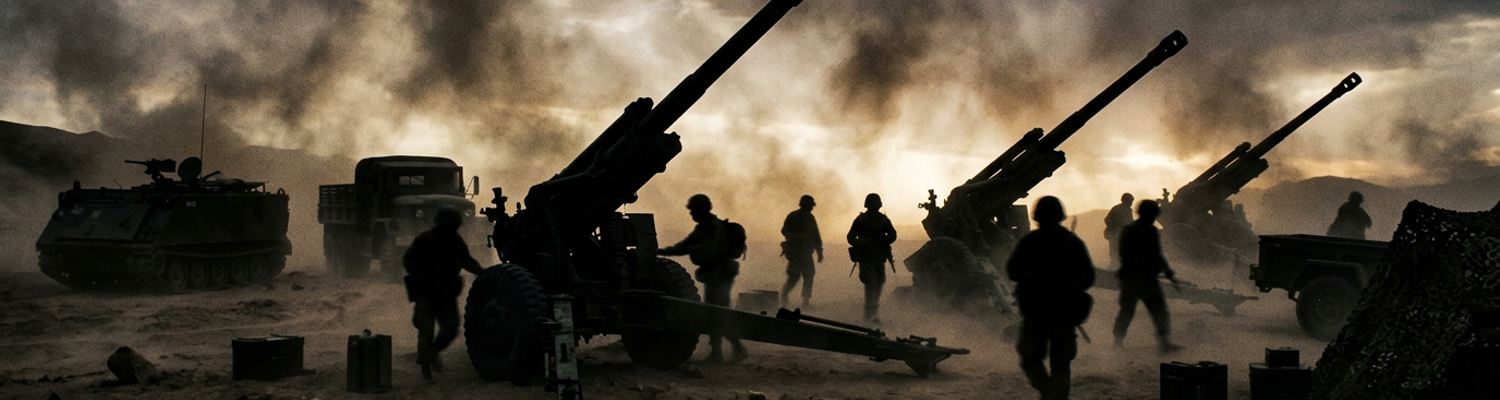

Shot Apple-2 and Artillery Deployment Objectives
Across the alkali flat of Area 1 at Yucca Flat, 0515 hours brought a dead freeze. Zero hour for Shot Apple-2 was minutes away. Wind across the dry basin dropped to zero knots. Thousands of yards of dry lake bed sat silent under the steel skeletal frame of the five-hundred-foot shot tower. Test personnel from the 53rd Field Artillery Battalion huddled in forward trenches four thousand yards south. They listened to metallic static crackling through field telephone wire. No engines turned over. Men gripped the edges of timber revetments. They waited for twenty-nine kilotons of nuclear fission to detonate.
Nobody expected the desert dust to stay settled.
Archival evidence shows that Army Field Artillery Board test teams from Fort Sill hauled battery elements of towed 155mm M114 howitzers into the Yucca basin during the first week of May 1955. Operation Teapot had already pummeled the surrounding terrain with thirteen prior detonations. Deep silt and fragmented caliche choked the carburetors of the heavy six-by-six M39 transport trucks. Battery positions were surveyed along predetermined azimuths. Each five-ton artillery piece sat in open firing pits without sandbag revetments. Every M114 tube pointed across the dry basin directly toward the shot coordinates. Standard GAA grease on the split-trail locking pins attracted airborne particulate within hours of emplacement. This jammed the elevation gears. Crews used hand-cranked breaker bars just to seat the recoil mechanisms.
Field Artillery Board officers documented that movement of the twenty-three-foot-long howitzers through the desert scrub required double-tree winching. The soft-sand flats swallowed the carriage tires down to the wheel hubs. The documentation lists specific serial numbers for the forward guns (NARA Record Group 338, Box 412). Howitzer serial number 44-12998 required three separate winch pulls just to clear the initial staging area. The carriage weight exceeded eleven thousand pounds. The standard prime mover was the M4 high-speed tractor. The M4 tracks dug deep ruts into the caliche. This forced the crews to manually shovel the displaced dirt away from the trail spades before the guns could be hooked up. The physical labor exhausted the men before the test even began.
The timeline took priority over weapon preservation.
When examining the historical record, the test doctrine behind the deployment centered on quantifying weapon displacement rates inside an active fallout footprint. Pentagon planners needed exact chronological milestones. They wanted to know how many minutes it took an artillery section to hook the M114 lunette ring to a prime mover. They measured the time required to pull trail spades from compacted soil and clear a designated radiation vector while debris was still dropping from the nuclear cloud. Stopwatches governed the field trials. Field artillery detachments ran their displacement drills across ground contaminated with high levels of fresh fission isotopes. Measurement posts logged each fraction of an hour spent freeing pinned spades. They tracked the time spent securing traveling locks and rolling out of the drop zone along predetermined secondary trails. Field reports showed that every minute of mechanical delay inside the fallout deposition zone multiplied crew exposure rates beyond peacetime limits.
Armored protection was deliberately withheld from the forward crews.
A close review of operational logs indicates that the gunners performed every stage of displacement without mechanized armor. They lacked tracked recovery vehicles or filtered cabin enclosures. Artillerymen operated in standard two-piece herringbone twill fatigue uniforms and canvas combat boots. Standard M9A1 protective field masks quickly clogged with radioactive alkali dust. Soldiers dismounted into hot fallout. They muscle-hauled the heavy spades out of the dirt using picks and pry-bars. They handled bare metal carriage components that registered elevated milliroentgens per hour. Transport consisted of open-bed cargo trucks with canvas side-panels. These offered zero attenuation against direct gamma radiation or falling beta-emitting particles. Officers stood on open running boards with mechanical radiac meters. They noted how the physical exertion of heavy lifting accelerated the respiration rates of troops wearing rubber gas masks in ninety-degree heat. Displacement orders required these unshielded crews to push through the dusty radial contamination lanes. They had to establish secondary firing lines five miles south before the fallout pattern shifted across the primary supply route.
Radiological Contamination and Equipment Degradation
Archival evidence shows that within ninety seconds of the detonation, rapid barometric shifts across the Yucca basin generated violent thermal squalls. Surface winds accelerated across the caliche pan. The winds scooped up tons of dry lakebed sediment pulverized by the twenty-nine-kiloton blast. Thermal squalls across the desert terrain whipped caustic alkaline dust and irradiated particulate directly into open M114 howitzer breech mechanisms. Battery positions of the Army Field Artillery Board sat facing down-range with their screw-type breeches swung open for pre-firing checks. Airborne fallout slammed into the bare steel interrupted threads of the breech rings. This fallout was saturated with short-lived radioisotopes and calcium-rich alkaline salts. Heavy multi-purpose grease instantly bound with the dry dust. Technical manuals specified this grease for dampening desert heat. This chemical mixture transformed into a viscous abrasive paste. Crews attempting to close the breech blocks found the stepped threads fouled down to their roots.
The breeches stayed welded open by dirt.
Thread tolerances on the 155mm tubes tolerated less than five-thousandths of an inch of clearance. Even fractional dust buildup prevented the carrier arms from swinging flush into battery. Gunners scrubbed the threads with wire brushes and gasoline-soaked rags. Wiping the metal pushed the hot particulate deeper into the microscopic pores of the carbon steel. A close review of operational logs indicates that the degradation spread immediately into the traverse and sighting subsystems. Abrasive radioactive grit jammed gun elevation gears and traverse gearboxes. This rapidly immobilized manual aiming controls. Dust carried by the low-altitude thermal currents settled directly inside the unsealed gear housings. Open-cut spur gears and worm-drive assemblies turned manual traverse inputs into mechanical resistance. Artillerymen stationed at the Yucca test revetments leaned their full body weight onto the dual manual handwheels. The internal teeth seized after less than two quarter-turns. Fine quartz grains fractured under the mechanical pressure. This bound the bronze traversing worms against the steel carriage rings.
No artillery piece could acquire a target.
When crews applied breaker bars to force the manual aiming controls past the obstruction, the bronze teeth stripped outright. Panoramic telescopes and elevation quadrants registered erratic readings. Fine grit packed between the mounting brackets and the trunnion pins. This threw off battery deflection angles by several mils. Radiac survey meters positioned against the traverse housings read forty-five roentgens per hour. Gunners were absorbing heavy local gamma dosages while struggling with completely static hand cranks. When examining the historical record, carriage structural components failed just as rapidly as the fire-control optics. The combination of heat and particulate contamination created severe mechanical binding within gun carriage friction surfaces. Intense thermal radiation from the burst heated the exterior metal surfaces of the M114 carriages to over one hundred and forty degrees Fahrenheit before the arrival of the shockwave. Thermal expansion widened the external split-trail sleeves. This simultaneously drew fine alkaline dust into the ungreased pivot pins and walking-beam suspensions.
Once the metal began cooling in the subsequent down-drafts, the steel contracted directly over the layer of trapped grit. Equilibrator spring cylinders locked up. These cylinders were responsible for balancing the twenty-three-foot tube during elevation. Fine desert grit cut through the oil-scraper rings and contaminated the hydraulic fluid. The suspension lock-out wedges became seized in their slides. Field Artillery Board crews attempted to raise the trail legs to hook the guns to their prime movers. The trail hinge pins refused to budge without direct sledgehammer impacts. Ordnance technicians recorded severe friction galling across every unpainted pivot face on the M114 carriages. Decontamination wash-racks twenty miles south recovered three guns with their trail legs bent from tractor winches attempting to break the seized friction pins.
The M114 used a hydro-pneumatic recoil mechanism. This system relied on a precise mixture of nitrogen gas and hydraulic fluid. The technical manual designated the fluid as OHA (Oil, Hydraulic, Artillery). The dust penetrated the floating piston seals. The nitrogen pressure bled out into the atmosphere. The recoil cylinders lost their buffering capacity. Firing the weapon in this condition would tear the carriage apart. The test directors noted this in their post-action reports. The guns were mechanically blind and structurally compromised.
Optical Sight Failures and Environmental Fouling
Archival evidence shows that the thermal pulse and trailing shockwave compromised every rubberized barrier across the artillery park within seconds. On the M114 howitzers of the Army Field Artillery Board, the primary fire-control instrument was the periscopic M12A7 panoramic telescope. Factory-installed neoprene housing gaskets shrank away from their mating surfaces. Ambient desert heat and blast thermal flux baked them brittle. Fine radioactive silt breached housing gaskets on periscopic panoramic sights. This blinded optics required for indirect fire. This sub-micron particulate blew past the degraded perimeter seals and gathered inside the sealed internal optical tubes. Thirty-knot post-shot winds propelled the dust across Yucca Flat. Heavy deposits coated the penta-prisms and objective lenses with an opaque abrasive film. Gunners peered through the rubber eyeguards only to find the mil-scale reticles obliterated by internal shadow.
Target grids vanished behind fouled glass.
Disassembly in the field was prohibited under standard operating procedures. Opening the sight assemblies outside an ordnance depot broke internal nitrogen purging and introduced further contaminants. Battery commanders were left without any reliable optical baseline to establish firing deflections. A close review of operational logs indicates that observation equipment deployed to forward observation posts suffered catastrophic surface abrasion. Forward observers situated three thousand yards south of Ground Zero relied on M65 battery commander periscopes. They used M2 aiming circles and binocular assemblies to track impact patterns and survey secondary firing points. Windblown quartz fragments blasted into suspension from the dry lakebed. This transformed the ambient air into an abrasive sanding stream. Airborne dust scratched sight reticles and clouded optical prisms across front-line observation gear.
Observers attempted to clear the caked silt using camel-hair brushes or standard lens tissue. Sharp caliche crystals cut deep grooves into the magnesium fluoride anti-reflective coatings. Prisms inside the periscope heads turned milky. Microscopic pits diffused ambient sunlight and generated blinding internal glare. Within ninety minutes of the shot, forward observer teams could no longer resolve distant aiming stakes. They could not distinguish terrain features beyond eight hundred yards. Optical maintenance kits contained nothing capable of polishing damaged flint glass back to tolerance. When examining the historical record, this physical degradation broke the battery-wide laying process along the contaminated perimeter. Standard doctrine required gun crews to execute reciprocal laying. This involved using the battery commander aiming circle to orient each howitzer panoramic telescope along a common deflection azimuth.
Artillery crews lost standard optical alignment capabilities within hours of exposure to the fallout perimeter. Red-and-white striped M1A1 aiming posts disappeared into the dusty irradiated haze. These posts were planted fifty and one hundred yards from each gun pit to serve as reference deflection markers. Radiation readings near the gun trunnions exceeded twenty roentgens per hour. Crews rushed sighting procedures while struggling to read scratched micrometer drums and clouded level vials. Parallax errors between the scarred sights and obscured reference points multiplied deflection errors up to forty mils. By noon on the day of the test, every howitzer section in Area 1 had completely abandoned standard indirect sighting drills. The weapons were incapable of achieving registered battery fire. Field Artillery Board inspectors sent nineteen M12A7 panoramic sights to the base ordnance shop at Camp Desert Rock. They attached inspection tags marking them totally unserviceable.
The M12A7 telescope weighed exactly four and a half pounds. It was a precision instrument. It was not designed for a nuclear battlefield. The glass was sourced from the Bausch and Lomb optical company. The reticle illumination relied on a small tritium vial. The dust blocked the tritium glow. The night-firing capabilities were completely neutralized. The forward observers reported the failure via field telephone. The command post logged the transmission at 0714 hours. The entire battery was functionally blind.
Breakdown of Forward Decontamination Logistics
Archival evidence shows that Chemical Corps forward supply lines running from the primary support depot at Camp Desert Rock along Mercury Highway broke down before midday. Mandated power-driven decontaminating apparatus and specialized chemical neutralizing solvents failed to reach the Yucca Flat test grid. Quartermaster supply convoys transporting skid-mounted M3A1 high-pressure wash units stalled. They carried drums of non-corrosive clearing solvent. Transport engines developed vapor lock along the unpaved bypass tracks west of Yucca Pass. Division chemical staff officers had scheduled four motorized wash-trucks to flush the 155mm howitzer positions immediately following radiation survey clearances. None of the vehicles cleared the intermediate checkpoints. Movement control officers halted all soft-skinned supply trucks ten miles south of Area 1. Radiation safety teams had not cleared the access roads for unshielded transport. Drivers dumped full pallets of solvent canisters onto open dirt pads alongside the road.
The forward supply conduit stopped cold in the desert sand.
The field batteries positioned inside the fallout footprint received no liquid decontamination agents. A close review of operational logs indicates that artillery crews were left with nothing more than hand-held M2 decontamination kits. These kits contained stiff tampico-fiber brushes. Caliche dust embedded across the outer surfaces of the M114 howitzers acted as an industrial abrasive against the equipment. Within twenty minutes of manual scrub-downs, alkaline grit sheared the bristle bundles down to the bare wooden brush blocks. Coarse calcium carbonate grains ground through the natural fibers. This tore the bristle tufts away from their internal wire staples. Gunners scouring the irradiated trunnion housings discovered that the brushes quickly choked on an abrasive paste of dry fallout and heavy lubricating grease. Rubbing this mixture across the metal smeared the fission products deeper into the carriage steel rather than removing them. Frustrated artillerymen hurled the bald splintered wooden brush blocks into dry drainage gullies behind the gun pits.
Every gun crew ran out of scrubbing tools.
Company supply sergeants logged that field batteries had exhausted their entire baseline issue of replacement brushes before one in the afternoon. When examining the historical record, this collapse of forward chemical logistics forced artillery personnel to operate without functional cleaning supplies inside high-exposure zones. Radiac survey meters held against the gun tubes registered radiation fields exceeding twenty-five roentgens per hour. The rear echelons delivered no secondary cleaning solutions. They sent no soap concentrates or replacement decontamination barrels. Soldiers attempted to strip radioactive dirt out of breech mechanisms and elevation gear teeth using dry canvas scraps. They used uniform sleeves and dirty canteen water. This dry rubbing failed to lower gamma and beta emission levels across the exposed metal surfaces. Chemical Corps observers watched gunners absorb climbing radiation doses. The men repeatedly touched hot equilibrator cylinders and traverse handwheels during displacement drills.
Field Artillery Board inspection sheets recorded that eight men were pulled from the battery positions by late afternoon. Their personal pocket dosimeters pegged past thirty roentgens. Camp Desert Rock medical officers impounded the dosimeters. Battery work details spent the remaining daylight hours scraping contaminated axle housings with dry bayonets and scrap metal strips found in the vehicle tracks. Forward commanders submitted three urgent emergency supply requisitions to the Chemical Corps depot for pressurized water tankers and solvent drums. Not a single supply truck cleared the Area 1 checkpoint before nightfall.
The M3A1 wash units required a steady supply of fresh water. The desert offered none. The water tankers were stuck behind the checkpoint. The solvent was designated as DS2 (Decontaminating Solution 2). It was highly toxic. It required careful handling. The drivers left it in the sun. The heat expanded the metal drums. Several drums ruptured. The solvent soaked into the sand. The logistical failure was absolute. The artillerymen were entirely on their own.
Field Maintenance Workarounds and Diesel Washouts
Archival evidence shows that fine alkaline caliche from the Yucca lakebed penetrated past the external wiper seals of the 155mm howitzers. It settled directly into the hydropneumatic recoil mechanisms. The M114 recoil cylinders jammed when calcium salts bound to the bronze packing rings. These cylinders were charged with nitrogen gas and hydraulic oil at pressures exceeding one thousand pounds per square inch. Internal floating pistons seized in place. Abrasive dust cut across the polished cylinder sleeves during initial test firing cycles. Recoil piston rods refused to return to battery. This threatened to crack the recuperator cylinder walls if the pieces were towed over the rutted desert floor. Battery mechanics from the Army Field Artillery Board bypassed depot maintenance doctrine. They siphoned heavy diesel fuel directly from the fuel tanks of nearby M39 cargo trucks into five-gallon jerrycans. Gunners fitted flexible copper tubes and hand-cranked grease guns to the recoil cylinder flushing ports.
Diesel became the only cleaning agent left in the forward pits.
They forced raw diesel through the internal fluid channels under manual pressure. This hydrocarbon pressure wash dissolved the hardened paste of dust and oxidized grease. Grey particulate-laden sludge spewed out through the bottom drain valves onto the test apron. A close review of operational logs indicates that blast heat and caustic fallout fused the unpainted carriage hardware within two hours of the detonation. Traveling locks locked solid as ambient ground temperatures climbed above ninety degrees Fahrenheit. Split-trail hinge sleeves and lunette pintle latches suffered the same fate. Gunnery sergeants tore long strips of cotton fabric from vehicle seat cushions and spare undershirts. They soaked the material in a thick mixture of drained crankcase motor oil and diesel fuel. Artillerymen wrapped these dripping rags around the frozen locking pins. They left the petroleum blend to seep into the friction interfaces of the steel latches. Capillary action pulled the fuel blend deep into the seized hinge sleeves. This broke the bond formed by the calcium carbonate scale.
Crews waited twenty minutes for the fluid to soften the crust. They drove the pins out using twelve-pound sledgehammers and brass drift punches. Soldiers cracked the corroded latches open one by one. They scraped the scored metal surfaces with pocket knives before applying fresh motor oil to prevent re-seizure. Every unjammed latch cost skin and dosimeter counts. When examining the historical record, displacement timetables set by Exercise Desert Rock VI planners required each battery to haul the guns five miles south toward secondary rally points. They had to move before shifting fallout plumes drifted across Mercury Highway. Hauling the five-ton pieces demanded free-rolling wheel hubs and functional suspension locks. Caliche grit had locked the internal brake shoes and wheel bearings to tolerances under four-thousandths of an inch. Section chiefs severed empty fifty-five-gallon steel fuel drums with cold chisels. They constructed crude immersion troughs directly behind the howitzer spade pits.
Soldiers filled these containers with an improvised cocktail of dry-cleaning mineral spirits and high-octane gasoline scavenged from field generators. They established emergency solvent baths beside the guns. Detachment personnel stripped the outer hub assemblies. They dunked Timken tapered roller bearings into the solvent. Brake shoe return springs and traversing gears went into the bath to strip away radioactive grit down to bare steel. Washing the components in solvent restored the three-thousandths-of-an-inch operational clearances. This allowed the wheels to turn freely on their spindles without seizing under tow. The howitzers rolled out of Area 1 with fuel dripping from their wheel hubs.
The M39 cargo trucks used a Continental R6602 engine. The mechanics drained the oil directly from the oil pans. They used standard issue steel helmets to catch the fluid. The mixture of diesel and used motor oil was highly flammable. The men worked with cigarettes hanging from their mouths. The safety protocols were completely ignored. The mission required movement. The guns had to move. The radiation levels were climbing. The dosimeters were maxing out. The convoy crossed the checkpoint at 1630 hours. The dosimeters registered forty roentgens.