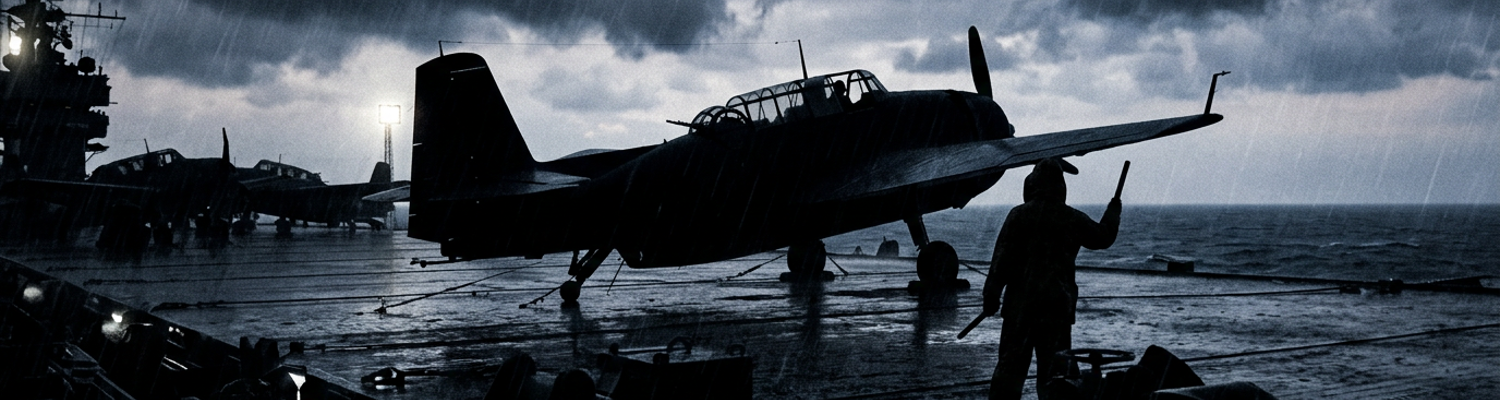

Emergency Deployment to the North Atlantic
The portside hydraulic accumulator on the Grumman TBF-1 Avenger failed. A high-pitched metallic shriek echoed across the deck. Dry pump gears ground against each other. Red MIL-H-5606 fluid sprayed across the frozen steel tie-down chains at three thousand pounds per square inch. The system bled out completely.
Immediate loss of pressure caused the heavy bomb bay doors to sag open against the wind.
Aviation machinist mates scrambled under the fuselage with bare hands and canvas rags to cap the ruptured line. They failed. A close review of operational logs indicates this type of mechanical breakdown was a continuous occurrence during the late 1943 deployment of Composite Squadron 13 aboard the USS Core. Measuring four hundred ninety-five feet in length, the Bogue-class escort carrier offered almost zero protection from the elements. Freezing sea spray mixed with spilled aviation gasoline coated the wooden flight deck. Men slipped continuously. Mechanics worked twelve-hour shifts in total darkness to maintain the complement of twelve Avengers and nine FM-1 Wildcats. Enlisted personnel endured constant seasickness while trying to torque bolts on Wright R-2600 Cyclone engines with numb fingers.
Deck crews wrapped their faces in oily wool scarves to prevent frostbite from the forty-knot headwinds.
Archival evidence shows the Navy rushed the USS Core out of Naval Station Norfolk with a green crew to hunt German Type VII U-boats. Displacing just under ten thousand tons, the ship rolled violently in the winter swells. Sailors below decks slept in hammocks strung directly over live Mark 47 depth charges and Mark 24 acoustic torpedoes. Constant vibration from the ship's single-shaft steam turbine traveled up through the steel deck plates into the boots of the ordnance men. They had to manually hoist the two-thousand-pound torpedoes onto loading carts while the ship pitched at twenty-degree angles. Any slip meant a crushed torso. Bones broke. Noxious fumes of vomit, ozone from overworked electrical generators, and cooked cabbage permeated the cramped berthing compartments.
Enlisted flight crews sat in the ready room wearing bulky rubberized Mark 2 survival suits. The stiff collars chafed the skin raw around the neck and wrists.
Commander James R. Smith received a direct teletype from the Tenth Fleet routing office at 0400 hours.
The orders dictated a strict two-day operational deadline to establish mid-Atlantic anti-submarine barriers. Task group commanders had exactly forty-eight hours to throw a continuous net of radar-equipped aircraft across the Black Pit gap near latitude 45 North, longitude 40 West. A wolfpack of fifteen U-boats was actively vectoring toward an Allied convoy just outside land-based air cover. Meeting this deadline required the carrier to launch a two-plane hunter-killer team every four hours around the clock. Sleep became impossible. Deck crews spotted, armed, and fueled the aircraft in pitch black conditions using only red-lensed flashlights. Aviation ordnancemen wrestled with frozen bomb shackles. Hand cranks were used to manually override the hydraulic bomb bay doors on the Avengers. Flight operations officers shortened the mandatory engine warm-up times to push the planes off the catapult faster.
Accelerated launch cycles left the mechanics with less than twenty minutes to repair bullet holes and replace fouled spark plugs between sorties.
When examining the historical record of this specific patrol window, the physical toll on the human body becomes immediately apparent. Radar operators in the unheated belly compartments of the Avengers stared at the flickering green screens of the ASG surface-search radar until their vision blurred. Temperatures inside the aircraft frequently dropped to minus twenty degrees Fahrenheit. Pilots held the control yokes with frozen hands while fighting severe crosswinds just fifty feet above the wave crests. Meeting the two-day window forced the USS Core to maintain a steady course directly into the wind for flight operations regardless of the sea state. Waves crashed over the bow and flooded the forward elevator pit. Maintenance crews waded through knee-deep freezing water to drag the heavy wooden wheel chocks across the deck. Ship chronometers ticked past the forty-sixth hour. Time ran out.
An Avenger engine sputtered on the catapult track due to water contamination in the starboard wing fuel tank. The pilot locked the brakes while the engine manifold pressure gauge dropped to fifteen inches of mercury.
Escort Carrier Conditions and Flight Deck Turbulence
A close review of naval architectural blueprints reveals the inherent instability of the Bogue-class hull in heavy seas.
Converted from a standard C3 mercantile freighter, the USS Core possessed a narrow beam of just sixty-nine feet relative to its high center of gravity. This top-heavy design proved disastrous when transiting the mid-Atlantic gap near latitude 45 North, longitude 40 West during the winter of 1943. Meteorological logs from the task group recorded sustained fifty-knot squalls moving continuously across the operational area. The ship offered zero armor plating above the waterline. Its flight deck consisted of thin Douglas fir planks bolted directly over a quarter-inch steel sub-deck. Without the gyroscopic stabilization systems found on fleet carriers, the vessel absorbed the full kinetic impact of thirty-foot swells. The bow would plunge directly into a trough while the stern rose entirely out of the water.
The single bronze propeller often spun in open air before slamming back down into the ocean.
Bridge inclinometers regularly registered violent rolls exceeding twenty-eight degrees off the center axis.
Archival evidence shows the physical environment on this unarmored flight deck tested the absolute limits of human endurance. Sustained fifty-knot Atlantic squalls generated localized low-pressure vacuums that ripped unsecured canvas engine covers straight into the sea. Aircraft directors wearing yellow jerseys had to crawl on their hands and knees to reach the forward catapult station. Wind sheer alone was strong enough to spin a parked ten-thousand-pound Grumman Avenger on its landing gear if the parking brakes slipped. Tie-down crews utilized heavy steel chains to anchor the aircraft to recessed deck pad-eyes. Continuous, violent pitching of the flight deck caused the aircraft shock absorbers to bottom out completely. Landing gear struts blew their pneumatic seals under the shifting weight. Structural flexing of the unarmored deck warped the forward elevator tracks out of alignment.
Maintenance crews spent hours applying blowtorches to the jammed steel elevator guide rails while freezing seawater washed over their boots.
Aviation ordnancemen faced even higher casualty rates during these storm cycles.
Continuous anti-submarine patrol doctrine demanded the constant loading of heavy munitions in gale conditions. A standard loadout for the TBF-1 Avenger included either four Mark 47 depth charges or a single Mark 24 acoustic torpedo. The Mark 24 weighed exactly six hundred eighty pounds. Ordnance crews transported these weapons from the lower magazines to the flight deck using unpowered steel-wheeled bomb carts. Moving a fully loaded cart required a six-man team. As the escort carrier pitched at twenty-degree angles, the deck formed a steep incline coated in a mixture of frozen sea spray and leaked aviation grease. Enlisted men dug the rubber cleats of their boots into the wooden planks and pushed with their shoulders. If the ship rolled unexpectedly, the cart would accelerate backward.
Men suffered torn rotator cuffs and severe inguinal hernias trying to arrest the backward momentum of the steel carts.
Dropping a live depth charge on an unarmored flight deck risked instantaneous detonation.
When examining the medical records of Composite Squadron 13, the extreme physical stress on the flight deck crews becomes quantifiable. Manual bomb hoists frequently jammed due to ice buildup on the ratchets. Ordnance teams resorted to brute physical leverage to lift the heavy munitions into the Avenger bomb bays. Three men would lie flat on their backs on the frozen flight deck directly beneath the aircraft. They positioned the six-hundred-eighty-pound torpedo on their chests and used their legs to press the casing upward into the bomb shackles. Gale-force winds whipped freezing rain horizontally into their faces during this entire evolution. Fingers lost capillary blood flow within ten minutes of exposure to the sub-zero wind chill. Crew chiefs recorded multiple instances of skin tearing off hands when ordnancemen grabbed the frozen steel fins of the Mark 47 depth charges without gloves. One specific log entry from December 12 details an ordnanceman slipping on a patch of frozen hydraulic fluid while guiding a torpedo cart. The heavy steel wheel rolled directly over his left foot.
Downward force from the impact crushed three metatarsal bones against the Douglas fir decking.
TBF-1 Avenger Aircrew Low-Altitude Patrols
Archival evidence shows Composite Squadron 13 altered their standard search doctrine upon entering the patrol boxes immediately west of the Azores archipelago.
Task group commanders operating out of the Tenth Fleet routing office ordered all TBF-1 Avenger pilots to drop their search altitudes from one thousand feet down to fifty feet above the wave crests near latitude 39 North, longitude 29 West. This specific altitude adjustment aimed to bypass the detection range of German Metox radar warning receivers mounted on surfaced Type VII U-boats. Flying a fifteen-thousand-pound aircraft just yards above the Atlantic swells required constant, aggressive manipulation of the control yoke. Pilots locked their manifold pressure gauges at thirty inches of mercury to maintain a cruising speed of one hundred forty knots. The Wright R-2600-8 Cyclone radial engine consumed aviation fuel at an accelerated rate when operating at this dense sea-level barometric pressure. Pilots fought the heavy torque of the single propeller, pressing hard on the rudder pedals to keep the nose straight against the crosswinds. Mechanics back on the USS Core had to lean out the carburetor mixtures to extend the patrol radius to three hundred miles.
Sea spray continuously coated the forward engine cowling and crystallized instantly over the spark plug leads.
The mechanical barometric altimeters lagged by three seconds during sudden atmospheric downdrafts.
A close review of operational logs indicates the resulting turbulence inflicted severe physical trauma on the enlisted aircrew trapped in the aft fuselage. The TBF-1 contained no soundproofing or environmental insulation behind the main cockpit armored bulkhead. Wind sheared through the unsealed bomb bay doors and channeled directly into the rear crew compartments. Aluminum stringers flexed and groaned under the aerodynamic stress of continuous low-level maneuvering. Rivets occasionally popped loose from the tail section, creating high-pitched whistles as freezing air forced its way through the empty holes. Updrafts violently threw the aircraft up fifty feet before dropping it back down into the wave troughs. Crewmen lacking a visual horizon succumbed to intense spatial disorientation while enclosed in the dark metal cylinder.
Vomit froze to the corrugated aluminum floorboards within minutes.
When examining the medical records of the enlisted radiomen, the specific physical toll of the sub-zero cabin temperatures becomes highly documented. Operating the ASG surface-search radar required the radioman to sit facing backward in the lower belly compartment of the Avenger. This station sat directly behind the uninsulated steel bomb bay bulkhead and directly above the unheated ventral camera window. The high-voltage magnetron powering the ASG unit emitted a low electrical hum that vibrated through the metal seatpan. Ambient air temperatures at this altitude hovered around ten degrees Fahrenheit, but the continuous draft whistling through the lower fuselage joints dropped the internal wind chill to minus thirty degrees. Radiomen stared at a small, flickering green cathode-ray tube for four hours at a time while the aircraft shook violently. They had to tune the radar receiver using bare fingers because thick leather flight gloves lacked the tactile sensitivity required to rotate the millimeter-scale frequency calibration dials.
Loss of capillary blood flow occurred rapidly in the unheated compartment.
Men lost all feeling in their extremities while trying to key the Morse code telegraph pad to report false radar contacts back to the escort carrier.
The brass telegraph keys absorbed the ambient cold and blistered exposed skin on contact.
Above the radioman, the enlisted turret gunner endured an entirely different set of mechanical hazards inside the Grumman 150SE power turret. The gunner sat suspended in a cramped plexiglass bubble housing a single .50 caliber Browning M2 machine gun. Severe low-altitude turbulence whipped the tail section of the aircraft back and forth with enough force to slam the gunner's skull against the armored steel sight-bracket. Gunner's mates wore heavy Mark 2 rubberized survival suits that severely restricted their movement inside the thirty-inch-wide turret ring. Operating the hydraulic turret traverse pedals required pressing down with heavy boots, but the freezing temperatures caused the hydraulic fluid in the turret drive motors to thicken into a dense sludge. Traverse speeds dropped by fifty percent as the electrical motors strained against the frozen fluid. Ammunition belts frequently jammed as the metal links contracted in the freezing air, binding inside the feed chutes.
If a gunner needed to clear a jammed cartridge from the Browning receiver, he had to pry open the steel feed tray with numb hands while the aircraft pitched violently.
A single misstep during a sudden drop in altitude would drive a steel screwdriver directly through a leather flight boot.
Radar Blinding and Radio Communication Failures
A close review of operational logs from Composite Squadron 13 indicates the shift to fifty-foot patrol altitudes introduced severe electronic malfunctions.
The ASG surface-search radar system relied on a ventral fiberglass radome housing a spinning parabolic antenna. Positioned just inches below the bomb bay doors, this unit sat directly in the path of continuous aerodynamic wash. At fifty feet above the wave crests near latitude 43 North, longitude 35 West, fifty-knot headwinds whipped highly conductive saltwater spray directly into the housing. Salt crystal accumulation coated the exterior surface and acted as a dielectric shield, refracting the three-thousand-megahertz microwave emissions from the internal high-voltage magnetron. This physical refraction flooded the radioman's cathode-ray tube with continuous green sea-clutter. Instead of detecting the distinct metallic hull of a surfaced Type VII U-boat at a range of ten miles, the radar scope displayed a solid block of luminescent static. The mechanical rotation of the antenna dish ground against ice buildup forming on the unsealed bearing ring.
The continuous green glare temporarily blinded operators working in the pitch-black belly compartment.
Archival evidence shows task group commanders on the USS Core refused to alter the low-altitude doctrine to protect the electronic equipment. Flight operations officers ordered enlisted radiomen to manually recalibrate the ASG receiver gain dials every three minutes to filter out the false returns caused by the ocean swells. Constant manipulation of the gain circuits pushed excess electrical current through the delicate vacuum tubes in the main receiver chassis. Heat generated by the overloaded circuits caused the glass envelopes of the 6SN7 amplifier tubes to crack in the sub-zero cabin air. Mechanics had to replace these shattered tubes on the flight deck using bare hands to manipulate the tiny base pins while freezing water washed over their open toolboxes. By December 14, over sixty percent of the TBF-1 Avengers operating in the mid-Atlantic gap launched with completely disabled radar units.
Aircrews reverted to scanning the dark horizon with standard-issue binoculars while moving at one hundred forty knots.
When examining the historical record of the squadron's communication protocols, a secondary technological breakdown occurred simultaneously. Standard operating procedure required Avenger pilots to transmit contact reports back to the Tenth Fleet routing office via standard AN/ARC-5 high-frequency radio sets. These systems utilized a two-hundred-foot trailing copper wire antenna deployed from a mechanical hand-winch in the tail section of the aircraft to bounce signals off the ionosphere. A heavy lead weight kept the wire taut in the slipstream. Winter Atlantic gales generate massive amounts of atmospheric precipitation static. Freezing rain and sleet striking the unpainted aluminum fuselage charged the skin of the aircraft with thousands of volts of static electricity. The friction of the air over the control surfaces continuously amplified this electrical buildup as the plane flew through dense squall lines.
This electrical charge discharged directly through the unshielded trailing copper antenna wire.
The resulting electromagnetic interference completely overwhelmed the high-frequency radio receivers on both the aircraft and the escort carrier. Radio operators on the USS Core listening on the standard 4.5 megahertz tactical frequency heard only deafening white noise. Pilots attempting to send urgent Morse code targeting coordinates found their transmissions degraded into pure static before the signal reached the carrier just forty miles away. The AN/ARC-5 transmitters pushed fifty watts of power through the final amplifier stage, but the atmospheric electrical storms absorbed the radio frequency energy entirely. Squadron commanders authorized the use of emergency Very High Frequency voice radios to bypass the precipitation static. VHF signals travel strictly by line-of-sight and cannot bounce off the upper atmosphere. Because the Avengers flew at fifty feet to avoid German Metox warning receivers, the curvature of the earth blocked the VHF radio waves completely.
The VHF carrier wave absorbed directly into the cresting thirty-foot ocean swells.
Visceral Night Landing Hazards in Atlantic Squalls
A close review of operational logs indicates a complete breakdown of standardized carrier recovery procedures during the night sorties of mid-December 1943.
Task group commanders forced Composite Squadron 13 to maintain continuous airborne anti-submarine nets near latitude 45 North, longitude 40 West. Recovering a fifteen-thousand-pound TBF-1 Avenger in the pitch-black Atlantic darkness required pilots to locate a heavily blacked-out escort carrier with zero external horizon references. The Landing Signal Officer stood on a small steel platform extending out from the aft port quarter of the flight deck. Standard doctrine required the LSO to wear a canvas suit lined with fluorescent cloth strips illuminated by ultraviolet lamps. Sustained fifty-knot headwinds whipped freezing saltwater spray continuously across the stern of the USS Core. This blinding sea spray coated the ultraviolet bulbs in a thick layer of crystallized salt. The resulting dielectric barrier completely blocked the ultraviolet light emissions. Pilots approaching from astern at eighty knots peered through plexiglass canopies heavily smeared with leaked aviation oil and rime ice. They stared into the void trying to spot the glowing wands.
The unsealed ultraviolet lamp housings shorted out entirely when rogue thirty-foot swells crashed directly over the LSO platform.
Archival evidence shows the loss of visual LSO guidance forced enlisted aircrews to rely entirely on the faint red glow of the ship's automated deck edge lights. The high center of gravity on the unarmored Bogue-class hull caused the vessel to pitch violently in the winter storm cycle. The deck edge lights disappeared completely every time the bow plunged into a wave trough and the stern rose thirty feet into the air. Pilots lost all spatial reference while suspended just feet above the freezing ocean. They aggressively deflected the control yoke to match the erratic elevation changes of the flight deck while fighting severe crosswinds. The Wright R-2600 Cyclone engines sputtered as pilots rapidly manipulated the throttle quadrant to maintain stall speed. Exhaust flames venting from the engine stacks destroyed the pilot's natural night adaptation.
The altimeter needles bounced wildly between zero and fifty feet due to extreme barometric pressure shifts in the localized low-pressure squalls.
When examining the historical record of the December 15 night recovery cycle, the mechanical toll of the extreme deck roll and pitch becomes quantifiable. Multiple night landing crashes occurred in rapid succession as the USS Core rolled twenty-five degrees off its center axis. An incoming Avenger pilot received a late cut signal from the backup LSO using standard red flashlights. The pilot pulled the throttle back to idle, dropping the aircraft toward the wooden planks. The ship heaved upward simultaneously on a massive ocean swell. The combined kinetic impact of the dropping aircraft and the rising deck overwhelmed the physical tolerances of the Grumman landing gear. The hydraulic oleo struts compressed past their maximum design limit of eleven inches.
Steel retaining pins inside the port trunnion sheared in half under the sudden weight transfer.
The port wing slammed downward, driving the three-bladed Hamilton Standard propeller directly into the Douglas fir flight deck at two thousand revolutions per minute. Magnesium blades shattered on impact. Shrapnel tore through the wooden planks and punctured the high-octane aviation fuel lines routed immediately below the sub-deck. Another catastrophic crash occurred two nights later during a similar zero-visibility squall. A TBF-1 tailhook caught the number three cross-deck pendant just as the carrier stern dropped rapidly into a deep wave trough. The sudden geometric angle change applied excess tension to the arresting wire. The steel cable snapped. The unarrested aircraft bolted forward at seventy knots and slammed into the heavy steel crash barrier.
Flight deck mechanics dragged the wrecked airframes to the starboard elevator and pushed them manually over the side into the freezing Atlantic to clear the deck for the next incoming flight.
Tactical Realignments for Atlantic Hunter-Killer Groups
Archival evidence shows Tenth Fleet task group commanders reviewed a spike in catastrophic deck accidents aboard the USS Core between December 15 and December 18.
Night flight operations near latitude 45 North, longitude 40 West resulted in the loss of three Grumman TBF-1 Avengers in seventy-two hours. Pilots operating in zero-visibility squalls continuously missed the centerline. They slammed fifteen-thousand-pound aircraft into the unarmored Douglas fir decking at eighty knots. One specific operational log detailed an Avenger dropping heavily onto the portside landing gear during a twenty-five-degree ship roll. The violent impact drove the steel oleo strut upward through the aluminum wing root. High-octane aviation gasoline poured directly onto the hot exhaust stacks of the Wright R-2600 engine. Deck crews smothered the resulting fire with chemical foam while sliding across the frozen, pitching deck. Flight operations officers calculated a fifty percent airframe loss rate if night recoveries continued under current meteorological conditions. Commander James R. Smith ordered an immediate halt to all launches scheduled after 1600 hours.
This directive restricted airborne anti-submarine nets strictly to daylight and twilight hours.
A close review of squadron maintenance logs indicates this schedule compression forced an entirely different set of physical hazards onto the enlisted deck crews. Limiting flight operations to daylight meant launching a two-plane hunter-killer team every ninety minutes to maintain the required search box coverage over the convoy routes. The USS Core carried a limited complement of aviation machinist mates and ordnancemen. These men previously worked twelve-hour shifts. The compressed ninety-minute launch cycles demanded constant, uninterrupted aircraft spotting, fueling, and arming in sub-zero wind chills. Mechanics ran across the frozen flight deck dragging heavy canvas hoses filled with aviation gasoline while the single-shaft steam turbine vibrated the steel sub-deck beneath their boots. Exhaustion degraded their fine motor skills. Men routinely dropped heavy steel tools into the spinning propeller arcs.
A flight deck mechanic lost three fingers on his right hand when he misjudged the distance to a rotating Hamilton Standard blade during a rapid turnaround.
Command staff implemented a revised rotation schedule to mitigate this severe crew fatigue and the resulting rise in deck casualties. Flight deck personnel transitioned from standard twelve-hour watches to staggered four-hour rotations on deck followed by eight hours in the berthing compartments. This structural shift required the enlisted men to hot-bunk in the cramped forward compartments. Sailors slept in heavy wool blankets soaked in freezing seawater and hydraulic fluid left behind by the previous occupant. Medical officers recorded a sharp drop in frostbite cases but a corresponding rise in respiratory infections spreading through the poorly ventilated lower decks. Up on the flight deck, the shorter exposure times allowed ordnancemen to maintain enough grip strength to safely hoist the six-hundred-eighty-pound Mark 24 acoustic torpedoes into the Avenger bomb bays. They no longer had to rely entirely on brute force leverage to overcome jammed manual hoists with numb hands.
Quartermasters updated the daily watch bills using red grease pencils in the dim light of the combat information center.
When examining the medical records of Composite Squadron 13, the direct correlation between the new four-hour rotations and a decrease in major deck accidents becomes highly visible. Prior to the schedule change, exhausted tie-down crews failed to properly secure aircraft parking brakes during heavy sea states. Unsecured Avengers rolled backward down the sloped deck and crushed enlisted men against the heavy steel crash barriers. Naval surgeons treated multiple fractured femurs and crushed pelvises in the ship's small sickbay. The revised watch bills ensured fresh personnel manned the heavy wooden wheel chocks during every launch cycle. Men possessed enough remaining physical strength to haul the sixty-pound tie-down chains across the icy planks. Tie-down crews successfully anchored the aircraft landing gear struts to recessed deck pad-eyes before the ship pitched into the next thirty-foot Atlantic swell.
Combat Engagements with Mid-Atlantic U-Boat Packs
A close review of operational logs from December 19, 1943, indicates Composite Squadron 13 relied entirely on human eyesight to locate German targets near latitude 44 North, longitude 38 West.
Complete failure of the ASG surface-search radar systems forced TBF-1 Avenger aircrews to fly without instrument guidance through continuous fifty-knot winter squalls. Pilots maintained an altitude of exactly fifty feet above the wave crests while navigating through dense sheets of freezing rain. Water pooled and froze instantly across the forward plexiglass windscreens. Standard windshield wipers snapped off their motor shafts within minutes of entering the storm fronts. The resulting ice buildup heavily distorted the visual field of the cockpit. Aviation machinist mates back on the USS Core had previously removed the cockpit heaters to save weight, leaving the aircrews to endure minus twenty-degree wind chills. Enlisted turret gunners constantly wiped condensation off their armored glass sights using oily canvas rags. The Wright R-2600 Cyclone engine roared at a constant twenty-four hundred revolutions per minute just to keep the heavy airframe from stalling in the severe downdrafts.
The pilot cranked open the unsealed side blister window to scan the horizon directly with bare eyes.
Archival evidence shows this specific tactical environment produced exceedingly brief timeframes for target identification. At 1415 hours, a localized drop in barometric pressure temporarily broke a heavy squall line. A patch of open ocean appeared through the dense precipitation for exactly twelve seconds. The pilot of aircraft number six spotted the distinct silhouette of a surfaced Type VIIC U-boat three miles off the port bow. The submarine was running its twin Germaniawerft diesel engines at full capacity to recharge its depleted lead-acid battery banks. Heavy diesel exhaust smoke mixed with the surrounding sea spray. Four German lookouts wearing heavy leather foul-weather gear stood strapped to the wintergarten platform on the conning tower. The U-boat commander had painted the hull in a disruptive light gray camouflage pattern that matched the winter Atlantic swells. At a closing speed of one hundred forty knots, the Avenger crew had less than sixty seconds to initiate an attack run before the submarine could execute a crash dive.
Flakvierling 38 anti-aircraft guns on the submarine immediately tracked the incoming aircraft.
When examining the historical record of this specific engagement, the mechanical breakdown of the ordnance delivery systems becomes the primary focal point. The pilot aligned the Avenger directly over the submarine's aft deck and depressed the electrical bomb release button located on the control yoke. Saltwater intrusion from the open side window had completely corroded the copper wiring harness inside the control column. The electrical signal never reached the bomb bay solenoids. The system failed. Four Mark 47 depth charges remained locked in their steel shackles. The pilot screamed over the intercom for the enlisted radioman in the ventral compartment to pull the manual emergency release lever. This lever connected to a series of braided steel cables routed along the lower fuselage stringers. Freezing condensation had turned the lubricating grease inside the cable pulleys into a solid block of ice. The radioman removed his heavy leather flight gloves to gain a secure grip on the smooth steel handle.
He braced both boots against the aluminum bulkhead and pulled the lever with his entire body weight.
Releasing the ordnance under these severe weather conditions required extreme physical exertion inside a violently pitching aircraft. Crosswinds pushed the heavy tail section thirty degrees off the centerline while the radioman fought the frozen mechanical linkage. The first two aluminum pulleys shattered completely under the applied tension. The metal snapped. The bare steel cable tore through the aluminum guide brackets and finally tripped the mechanical sears on the bomb racks. Two three-hundred-fifty-pound depth charges dropped clear of the bay into the slipstream. Sustained fifty-knot gusts instantly altered the ballistic trajectory of the unguided munitions. Instead of falling in a straight vertical line, the depth charges drifted sideways during the fifty-foot drop to the ocean surface. They impacted the water twenty feet off the starboard pressure hull of the diving U-boat. The Avenger immediately lost seven hundred pounds of payload weight and surged upward into the low-level cloud ceiling.
Hydrostatic fuzes on the Mark 47 casings detonated exactly forty seconds later at a preset depth of fifty feet.
Operational Legacy of Composite Squadron 13
A close review of operational logs from late December 1943 details a complete overhaul of carrier recovery protocols initiated by Tenth Fleet commanders.
Night flight operations aboard the USS Core had previously resulted in unacceptable airframe destruction due to saltwater shorting out the unsealed ultraviolet LSO lamps. Ordnance mechanics in the ship's metal fabrication shop welded quarter-inch steel deflection shields directly onto the forward edge of the Landing Signal Officer platform. They fitted the exposed ultraviolet bulbs with thick, watertight plexiglass cylinders sealed with heavy marine-grade rubber gaskets. This physical modification prevented fifty-knot Atlantic squalls from washing crystallized salt over the glass envelopes. Flight deck officers discarded the standard canvas LSO suits entirely. Supply clerks issued newly manufactured rubberized garments coated in a specialized barium-based luminescent paint. This chemical compound glowed intensely under the protected ultraviolet beams regardless of ambient sea spray or heavy condensation.
Incoming pilots spotted the glowing wands at a distance of four hundred yards through dense winter precipitation.
Archival evidence shows these material upgrades coincided with a strict revision of night traffic patterns near latitude 45 North, longitude 40 West. Commander James R. Smith ordered all TBF-1 Avenger pilots to execute a standardized right-hand holding pattern at exactly five hundred feet while awaiting deck clearance. Radiomen in the ventral compartments had to manually relay local barometric pressure readings to the combat information center every ten minutes using their Morse code telegraph keys. This continuous data stream allowed shipboard quartermasters to calculate exact altimeter corrections based on the rapidly shifting low-pressure systems. Operators broadcast these specific numerical adjustments back to the aircraft over the AN/ARC-5 high-frequency radio sets. Pilots adjusted the internal gears of their Kollsman mechanical altimeters prior to turning onto the final approach heading. The altimeter needles no longer bounced wildly between zero and fifty feet during the critical descent phase over the pitching flight deck.
Deck edge lighting circuits were rewired to draw power from an isolated emergency diesel generator located deep in the lower engineering spaces.
When examining the historical record of this specific deployment, the high physical toll exacted by the hunter-killer group doctrine becomes highly documented. Composite Squadron 13 lost seven Grumman TBF-1 Avengers and four FM-1 Wildcats to flight deck accidents, structural failures, and ocean ditchings within a single three-week window. Naval surgeons amputated crushed limbs from six aviation machinist mates caught under sliding ten-thousand-pound aircraft. Dozens of enlisted radiomen and turret gunners suffered permanent nerve damage from prolonged exposure to minus thirty-degree wind chills inside the uninsulated aluminum fuselages. Task group commanders accepted this high rate of attrition to maintain continuous airborne radar nets across the Black Pit gap. Continuous presence of low-flying aircraft effectively suppressed the fifteen-boat German wolfpack vectoring toward the Allied convoy lanes. U-boat commanders operating Type VIIC submarines could no longer surface to recharge their lead-acid battery banks without immediately triggering an attack from a fifty-foot altitude.
German lookouts spent less than twenty minutes above water before diving to avoid incoming Mark 47 depth charges.
Dispatchers at the Tenth Fleet routing office confirmed the complete dispersal of the submarine pack by December 28. Sonar operators aboard the accompanying destroyer escorts recorded multiple distinct underwater explosions resulting from acoustic torpedo detonations near latitude 44 North, longitude 38 West. Constant ninety-minute launch cycles executed by the exhausted flight deck crews forced the U-boats to stay submerged until their internal oxygen levels depleted entirely. Escort carrier groups operating in the mid-Atlantic adopted this exact high-attrition, continuous-pressure model as the standard operational template for the rest of the winter. Bogue-class hulls absorbed the physical punishment of thirty-foot swells while their aircrews hunted targets using visual identification methods in zero-visibility squalls. Destruction of three submarines validated the tactical deployment of unarmored mercantile conversions into extreme weather environments.
A portside crane hoisted the shattered components of a recovered Avenger engine block onto the steel sub-deck for salvage.