
### Post-Collapse Court-Martial Analysis
A review of archival records from the U.S. Army Judge Advocate General Corps (NARA Record Group 153) confirms the formal initiation of court-martial proceedings on October 22, 1946. The date was not arbitrary. It marked the conclusion of a frantic preliminary investigation following the complete command breakdown at Camp Esperanza in southern Mindanao. The convening authority, under pressure from both the Philippine Commonwealth government and the War Department, fast-tracked the legal process. The primary objective was to assign accountability for a disaster resulting in hundreds of detainee deaths and the effective dissolution of an entire camp administration. The initial phase focused on collecting physical evidence and sworn statements. This task was complicated by the chaotic state of the camp, where records had been destroyed in riots or lost to mismanagement. Investigators from the Criminal Investigation Division, dispatched from Clark Field, were tasked with reconstructing a timeline from patrol logs, supply requisitions, and the grim evidence left at the site.
Their findings pointed toward a systemic decay of procedure.
The investigation’s focus narrowed onto the leadership of the 51st Military Police Detachment. This unit, comprised largely of veterans from the European theater, was reassigned to occupation duties and ill-prepared for its mission. The 51st was organized with a command element and three platoons, intended to provide a 24-hour guard rotation for the camp's three detainee compounds. A close review of operational logs indicates the unit was consistently understrength by at least twenty percent. This fact was repeatedly noted in weekly reports by the detachment’s commander, Captain Robert Egan, but never rectified by area command. The inquiry centered on Egan and his two senior lieutenants, who were responsible for day-to-day operations. Investigators scrutinized the 51st’s failure to maintain basic security. Guard towers were often undermanned. Perimeter patrols became infrequent. Physical searches of detainees and their quarters ceased almost entirely in the weeks leading up to the incident.
The formal charges leveled against the 51st’s command were direct. Gross negligence. Catastrophic detainee management failure. The negligence charge was substantiated by evidence of procedural decay. The camp’s primary water purification system, a diesel-powered pump, had been reported as malfunctioning for weeks. Instead of escalating the repair request, leadership authorized the use of untreated water from a nearby stream, leading to a massive outbreak of dysentery. Testimony from junior NCOs revealed that ammunition inventories for guard posts were not regularly inspected. Some posts had less than half their basic loadout. The charge of management failure stemmed directly from these acts. Sickness weakened the detainee population and fueled desperation. A forensic analysis of the camp’s layout showed the 51st had failed to segregate different detainee factions. Former Japanese collaborators, Hukbalahap insurgents, and common criminals were all housed in proximity. This decision created a volatile social environment, allowing an internal command structure to form among the insurgents.
Camp Esperanza Security Deterioration
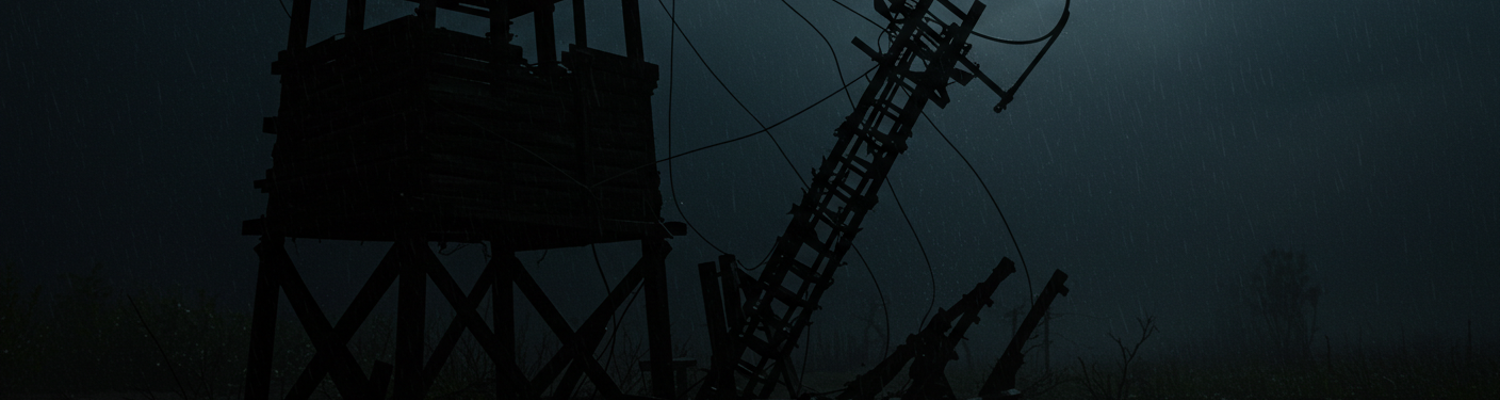
A forensic review of after-action reports reveals the security apparatus of Camp Esperanza did not fail instantaneously. It was bled out over a 72-hour period. The catalyst was the seasonal southwest monsoon, which made landfall with unexpected ferocity. Within 24 hours, torrential rains and high winds began to dismantle the camp’s outer defenses. The perimeter was a three-tiered system of barbed wire, trenches, and eight wooden guard towers. The unrelenting downpour turned the trenches into impassable canals of mud, rendering them useless. Two of the eight guard towers, specifically Towers 3 and 7 on the camp’s exposed western flank, collapsed from soil erosion around their foundations. The electrical system, already a patchwork of repairs, failed when the main diesel generator’s fuel line became contaminated with water.
The camp went dark.
This physical decay was compounded by a loss of command control. For the next 48 hours, the 51st Military Police Detachment operated under the assumption of an isolated equipment failure. Patrol logs show attempts to run the backup generator were futile; its own fuel supply was also compromised. Lacking power for spotlights and the electric fences, security devolved into a series of disconnected efforts. Guard rotations, normally conducted by truck, were forced to proceed on foot through knee-deep mud. This drastically increased travel time between posts and left large sections of the perimeter unobserved for hours. Investigators believe it was during this period that initial perimeter breaches occurred, not by detainees, but by external guerrilla forces testing the weakened defenses.
The direct link between the security breakdown and the severing of communications is undeniable. Camp Esperanza’s sole link to area command was a single hard-wired telegraph line running over thirty miles through dense jungle. Captain Egan had previously noted this vulnerability in his reports. The secondary system, a low-power SCR-300 backpack radio, was ineffective due to the monsoon’s atmospheric interference and the exhausted state of its batteries. Approximately 52 hours into the crisis, the telegraph went silent. A patrol dispatched to locate the break in the line never returned. Its members were listed as the first casualties. This act, later determined to be deliberate sabotage by Hukbalahap elements, left Captain Egan completely isolated. He possessed no ability to request reinforcements, report the deteriorating conditions, or receive intelligence that a sizable guerrilla force was massing just beyond the camp’s degraded perimeter.
The final event was a study in coordinated, asymmetrical warfare. The guerrilla assault began not with a direct charge, but with a precise barrage of mortar fire from a captured Japanese Type 97 infantry mortar. The rounds were not aimed at the command post. They were aimed at the remaining functional guard towers and the detainee compounds to sow chaos. Simultaneously, guerrilla fire teams exploited the previously scouted breaches in the perimeter fence. Their objective was not to seize the camp but to facilitate the mass escape of detainees, among whom were key Hukbalahap leaders. Aided by collaborators inside the wire, compound gates were forced open. The ensuing event was a deluge. Hundreds of detainees poured out into the night, overwhelming the thinned-out MP details. The 51st was forced into a fighting withdrawal, abandoning the compounds to establish a defensive circle around their own barracks. By sunrise, the guerrillas had melted back into the jungle, along with over 1,200 escaped detainees.
SCR-300 Radio Network Failure
A forensic analysis of communication logs from Mindanao Area Command (File Ref: SIG-77B-46) reveals the precise moment Camp Esperanza fell silent. On October 18, 1946, at 1400 hours local time, the camp’s primary AN/VRC-3 radio set failed to conduct its scheduled hourly check-in. The breakdown was absolute. The network was designed for layered communication; the vehicle-mounted AN/VRC-3 linked the camp to regional headquarters in Zamboanga, while individual SCR-300 backpack radios provided tactical communication for patrols. Suddenly, all of it ceased. Post-incident technical reviews pointed to a combination of factors endemic to the Philippine climate and post-war logistical shortfalls. The SCR-300, a vacuum tube-based FM radio, was notoriously susceptible to moisture. The humidity of the Mindanao jungle regularly caused condensation inside the radio chassis, leading to short circuits and premature failure of the delicate vacuum tubes.
The system was dying long before the final silence.
Maintenance records from the 51st MP Detachment show a constant struggle to keep the radios operational. The primary power source for the backpack units, the BA-70 dry cell battery, had a functional life of only about 20 hours under ideal conditions. In the heat and damp of the jungle, this lifespan was often cut in half. Requisitions for replacement batteries and spare vacuum tube kits were repeatedly filed but went largely unfulfilled by a supply chain still struggling with demobilization. Investigators later found that by October 18, the camp’s radio operators were cannibalizing parts from multiple non-functional units just to keep one or two radios online. The total network failure was the culmination of weeks of attrition on the fragile equipment.
The silence on the airwaves had a paralyzing effect. Area Command in Zamboanga was accustomed to constant radio traffic from Camp Esperanza. When the 1400 hours check-in was missed on October 18, it was logged as a routine equipment malfunction. A note in the Area Command signal log at 1600 hours reads: “Esperanza set likely down for maintenance; monsoon interference.” No immediate action was taken. This inaction, born of familiarity with the SCR-300’s temperamental nature, created a fatal information vacuum. For the next 24 hours, Captain Egan was completely severed from his superiors. He was unable to report the internal chaos or request fire support. Area Command, for its part, operated under the assumption of normalcy. Their tactical maps still showed Camp Esperanza as a secure outpost.
This electronic isolation occurred as the external threat level peaked. Archival intelligence summaries from the period confirm that Hukbalahap guerrilla units had become exceptionally active in the Zamboanga Peninsula through September and October 1946. Their operational doctrine emphasized intelligence gathering and the exploitation of isolated outposts. Huk teams were known to monitor military radio frequencies. While they may not have had the capability to decipher encrypted messages, they were adept at analyzing traffic patterns. The abrupt cessation of all radio chatter from the direction of Camp Esperanza would have been a significant intelligence indicator. The communication failure did not just blind the 51st MP Detachment; it broadcast a signal of opportunity to a waiting enemy.
Hukbalahap Insurgency Escalation
A review of declassified U.S. Army intelligence summaries from 1946 reveals a sharp escalation of Hukbalahap guerrilla activity far south of their traditional Central Luzon stronghold. Huk leadership initiated a strategic expansion into the southern islands, seeking to exploit post-war administrative chaos. The Zamboanga Peninsula on Mindanao, with its dense jungles and limited government presence, was identified in Huk strategic documents as a prime theater for this expansion. American area command assessments consistently underestimated this threat, viewing the Huks as a localized Luzon problem and treating incidents in Mindanao as isolated banditry. This analytical failure resulted in a gross misallocation of security resources, leaving remote installations like Camp Esperanza exposed. By mid-1946, Huk cadres were successfully embedding within local communities, building a formidable intelligence and support network.
Their operational doctrine, refined during years of fighting the Japanese, was one of asymmetrical warfare. A typical operation against an isolated outpost would begin days in advance with intensive reconnaissance by local sympathizers. This was followed by the insertion of specialized sabotage teams whose sole objective was to sever all lines of communication. The severing of Camp Esperanza’s telegraph line was a classic application of this tactic. Only after the target was confirmed to be electronically isolated would the main assault force move into position. They often utilized captured high-trajectory weapons like Japanese Type 97 mortars to sow chaos and suppress defensive positions from a distance. The final phase involved multiple, synchronized attacks by small fire teams on the weakest points of a perimeter. Their actions were designed to achieve specific objectives, like seizing arms or liberating prisoners, before melting back into the jungle.
U.S. military installations became the insurgency’s primary targets for strategic reasons. Each isolated camp and depot was viewed by Huk command as a source of supply. Raids were planned to acquire weapons, ammunition, medical supplies, and communications equipment. A secondary objective was the liberation of captured Huk fighters. An installation like Camp Esperanza, designated as a holding center for high-value detainees, was a strategic prize. Intelligence reports from the weeks preceding the catastrophe confirm that Area Command had received information from captured guerrillas. The information indicated that Huk leadership in Mindanao had specifically identified the liberation of commanders held within Camp Esperanza as a primary operational goal for the monsoon season. The warning was filed, not acted upon.
Detainee Management Protocol Breaches
Post-incident investigative records expose that protocols for detainee management at Camp Esperanza were structurally unsound from the outset. The camp’s paper-based records system was in shambles, making accurate headcounts nearly impossible even under normal conditions. The 51st Military Police Detachment was fundamentally unequipped for its assignment. Repeated requests from Captain Robert Egan for personnel to bring his unit up to its authorized strength were ignored, leaving him with a consistent twenty percent manpower deficit. This shortage directly translated into a degraded security posture.
It was a powder keg of internal factions.
The failure to properly segregate the detainee population was a significant administrative error. Post-collapse analysis of camp rosters showed that hardened Hukbalahap insurgents were housed in proximity to common criminals and former Japanese collaborators. This created a volatile internal social structure where organized Huk prisoners could intimidate, recruit, and establish a covert command hierarchy. This internal threat was compounded by external intelligence that was not acted upon. Area Command was aware that Huk leadership in Mindanao had made the liberation of their comrades in Camp Esperanza a primary goal. Despite this known external threat, no specific directives were issued to harden the camp’s internal security or to re-segregate the high-risk Huk detainees into a more secure compound. The 51st was left to manage a simmering insurgency within their own wire, using procedures designed for a low-threat facility.
The lack of any viable emergency communication contingency plan ensured that when the crisis began, it could not be contained. The camp's connection to the outside world depended entirely on a single, vulnerable hard-wired telegraph line. The backup system, a set of SCR-300 radios, was known to be unreliable. Supply chain failures meant replacement tubes and batteries were almost nonexistent. When the telegraph line was deliberately severed by Huk sabotage teams, Captain Egan was rendered electronically deaf. There was no tertiary plan. No pre-arranged schedule for runner contact. No signal flare protocols. No designated emergency frequency that Area Command was mandated to monitor. The dispatch of a single patrol to find the break in the line was the beginning and end of the contingency plan. When that patrol failed to return, Egan had no further options. His isolation was total, preventing him from reporting the deteriorating security, the massing of guerrilla forces, or the impending riot within the compounds.