
A Clemson-class destroyer was a tool for fleet action. Its armament confirmed this. Four 4-inch guns. A single 3-inch anti-aircraft gun. A battery of twelve 21-inch torpedo tubes. Depth charge racks completed a payload designed for open-ocean combat against submarines and surface vessels. This destructive potential was entirely unsuited for the mission that awaited Squadron 40-T. The ships were not sent to fight. Their primary weapon was their mere presence in a foreign port.
The squadron's deployment to Spanish waters was a long-term vigil. Activated in September 1936, the temporary squadron would remain on station until October 1939, nearly the entire duration of the Spanish Civil War. It grew from the initial emergency dispatch of the Spanish Service Squadron, which included vessels like the cruiser USS Quincy and the Coast Guard Cutter USS Cayuga. A close review of operational logs indicates Squadron 40-T, often designated Squadron Forty-Tare, typically consisted of a light cruiser flagship like the USS Raleigh and a rotating pair of destroyers. Many of these ships were aging World War I-era "flush-deckers" of the Wickes and Clemson classes. They cycled through the theater from bases in French ports like St. Jean de Luz and Villefranche, maintaining a constant American naval footprint in tense Spanish ports like Bilbao, Barcelona, Valencia, and Malaga. This was not a short-term crisis response. It was a sustained, three-year operation in a multi-sided conflict zone where German, Italian, and British naval forces were also active.
Its core function was humanitarian.
The squadron’s primary objective was the protection of United States citizens and interests. This translated directly into non-combatant evacuation operations. The civil war threatened thousands of foreign nationals, and the US Navy was dispatched to extract American citizens from the increasingly dangerous war zones. Archival evidence shows this was a multinational effort. American ships often coordinated with British, German, and other navies to share information and even evacuate each other’s nationals. The process was methodical. Consular officials on the ground identified and gathered American citizens and other designated foreign nationals. A destroyer, such as the USS Kane, would then enter a port under a fragile truce, embark the refugees, and transport them to the safety of a neutral French port like Marseilles. The US Navy evacuated over 1,500 people, though only 633 of them were American citizens. These operations were conducted in harbors that could become active battlegrounds with little warning. In November 1936, the USS Raleigh evacuated 24 refugees from Valencia, and the USS Kane performed similar missions in Bilbao and Santander.
Every action was governed by a strict mandate of non-interference. Operating under the tight restrictions of the US Neutrality Acts of the 1930s, Squadron 40-T was forbidden from intervening in the conflict. The laws explicitly prohibited the export of arms to belligerents. For commanders on the scene, this translated into rules of engagement that demanded absolute impartiality. They could not supply either the Republican government or Franco’s Nationalist forces. They could not engage their warships. They could not take any action that could be construed as taking a side. This created a high-tension environment where armed American destroyers had to stand by as passive observers as the war raged around them. Their ships were ordered to display additional colors to avoid misidentification. The danger was constant. The attempted bombing of the USS Kane on August 30, 1936, was a stark reminder of the risks. The squadron’s role was to be a visible symbol of American interest and a lifeline for its citizens, all while navigating the treacherous diplomatic waters of a European conflict that Germany and Italy were actively fueling.
Valencia Operational Environment
A warship entering Valencia’s harbor in 1937 sailed into a thicket of overlapping legal and military constraints. The entire Spanish coast was subject to the Non-Intervention Agreement, a multi-national pact designed to prevent the civil war from escalating. The United States unofficially supported this agreement through its own Neutrality Acts. The pact established a complex system of naval patrol zones. The coast of Republican Spain, including Valencia, was assigned to the German and Italian navies for monitoring. These were the very powers actively supporting the Nationalist forces under Franco. This placed any neutral vessel, like an American destroyer, in a precarious position. The rules were a study in contradiction. They were intended to stop the flow of arms, yet Germany and Italy consistently violated the agreement to supply their proxy. For a U.S. ship commander, this meant navigating a patrol zone controlled by nations whose military objectives were hostile to the port they were visiting. Unidentified submarines, later confirmed to be Italian, conducted attacks on merchant shipping bound for Republican ports, adding a layer of lethal ambiguity to every voyage.
Valencia itself was a pressure cooker of revolutionary fervor and internecine conflict. It had become the capital of the Spanish Republic in November 1936. The city was a magnet for a dizzying array of political and military factions. A close review of the historical record shows the Republican government’s authority was heavily contested on its own streets. Anarchist militias of the CNT-FAI, which had collectivized much of the region’s industry and agriculture, operated with significant autonomy. They frequently clashed with the Soviet-backed Communists (PCE) who were gaining power within the government and military police. Archival evidence describes a city plastered with propaganda posters, where public squares and theaters became political battlegrounds. This internal conflict could turn deadly. Street fighting between libertarian militias and communist groups erupted over issues like arms distribution. For an American sailor stepping off a launch, the city was a minefield. The political uniform of one group could make him a target for another. Legitimate authority was impossible to discern amidst the alphabet soup of armed factions. Adding another layer of danger was the presence of a clandestine "Fifth Column" of Nationalist sympathizers engaged in sabotage and espionage within the city.
Every action was a potential international incident. The absolute mandate of non-intervention dictated that a U.S. warship was to be an impartial observer, present only to protect and evacuate American citizens. This created a tactical straitjacket. A ship commander had to accept the declared authority of the port, even if that authority was a local anarchist committee with no formal standing. The ship’s log and operational plans from this period would have been dominated by risk mitigation. Every shore leave party required extensive briefings on factional tensions. Any interaction with locals, even for the procurement of fresh water or food, was fraught with the danger of being seen as favoring one group over another. The physical act of entering the port was a calculated gamble. Nationalist bombers, often flown by Italian crews from bases in the Balearic Islands, were methodically targeting Valencia’s port to choke off the Republic’s supply lines. A neutral warship, despite flying oversized flags, could be misidentified in the heat of an air raid. The rules of engagement were defensively rigid. A ship could defend itself if directly attacked but could not intervene in fighting it observed. The vessel was a sovereign American territory of a few thousand tons, armed to the teeth while committed to total passivity.
USS Cayuga Shore Party Assignment
The unit tasked with going ashore was a hybrid, reflecting the Coast Guard’s place in the naval task force. A review of landing party doctrine from the period shows a typical Navy destroyer would field a platoon of sailors, sometimes augmented by a small Marine detachment. The USS Cayuga, a Coast Guard cutter operating under Navy command, had a crew conditioned by law enforcement and port security missions. Its landing party was composed entirely of Coast Guardsmen, a force of approximately 30 men led by a junior officer and senior petty officers. Their training was distinct. Navy landing parties regularly drilled in infantry tactics. The Cayuga’s men brought a different skillset. They were experts in small boat handling, crowd control, and interfacing with civilian authorities. Their armory reflected this dual role. They carried M1903 Springfield rifles and M1911 pistols, standard military issue, but their operational mindset was shaped by the Coast Guard’s constabulary function. They were trained to de-escalate and to act with judgment suited for a sensitive mission, a quality noted in after-action reports from an earlier evacuation in San Sebastian.
This was not an invasion force.
Their mission in Valencia was precise and perilous. Secure the American Consular Agency and establish it as the primary evacuation point for designated non-combatants. The consulate itself was located at Calle del Doctor Romagosa, 1, deep within the urban core of the Republican capital. Operational planning documents from similar evacuations reveal a multi-stage process. First, the landing party had to transit from the ship to the docks via motor surfboat. They then had to move through a city teeming with armed, politically opposed militias. The shore party’s objective was to reach the consulate, establish a defensive perimeter, and coordinate with the skeleton staff inside. This meant securing entry points, designating rally points for arriving evacuees, and establishing a reliable line of communication back to the Cayuga. The entire operation was conducted under strict rules of engagement that forbade any action that could be perceived as interference.
An incident in early 1937 demonstrated the knife-edge tension of these operations. As the Cayuga’s shore party moved to establish its position, it was confronted by a patrol of Assault Guards, the paramilitary police loyal to the Republican government. A review of logs from other ships in the squadron indicates such encounters were frequent. The American presence, armed and in uniform, was an anomaly in a city on a war footing. The Assault Guard commander, operating under the authority of the Valencia Defense Council, challenged the legal standing of the American force to operate on Spanish soil. The junior officer leading the Coast Guard detachment was forced into a tense negotiation on a crowded street, surrounded by suspicious militia members. Using a combination of pre-approved diplomatic letters and the sheer audacity of their presence, the officer had to justify his mission without escalating the situation. Records show the successful evacuation of diplomatic staff and sixty-one refugees from San Sebastian by the Cayuga in July 1936 was accomplished under similarly trying conditions. In the Valencia incident, the standoff was resolved only when a consular official arrived to vouch for the party’s non-combatant and humanitarian purpose. The patrol allowed them to pass, but the event delayed the securing of the evacuation point by a critical 45 minutes.
Radio Silence Valencia Coast
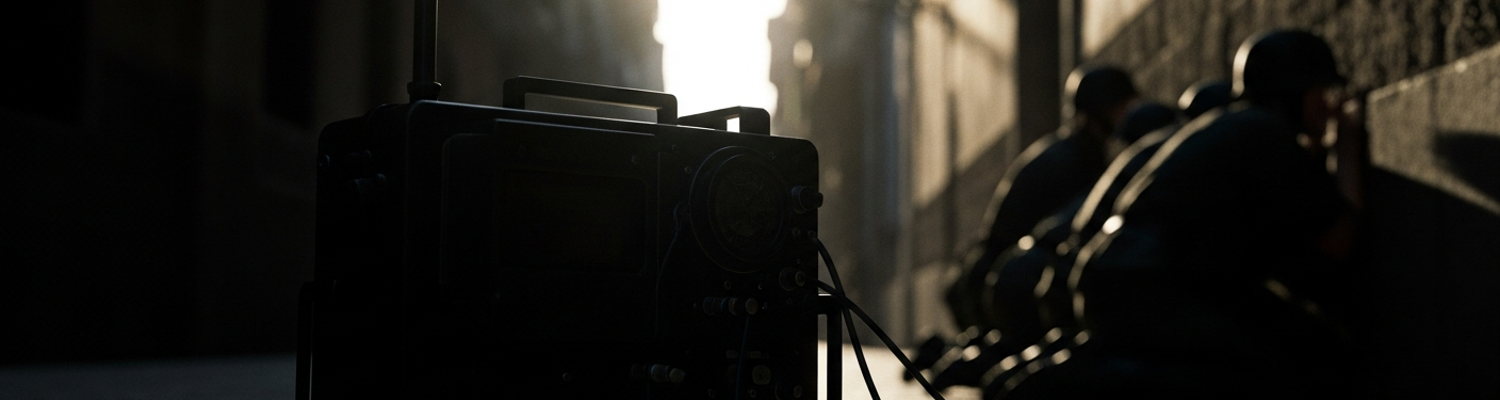
The connection to the USS Cayuga was a fragile construct of metal, wire, and atmospheric physics. A close review of standard landing party equipment for the period indicates the shore party relied on a portable radio set. This was a bulky apparatus requiring at least two men to operate. One man carried the transceiver, a wooden or metal box weighing upwards of 30 pounds, containing delicate vacuum tubes and tuning coils. A second man carried the power source: a hand-cranked generator, the GN-35, which produced a distinct, low whine during operation. From the transceiver, a thin copper wire snaked upwards, tossed into a tree or strung across an alleyway to serve as a long-wire antenna. For the first hour ashore, the radioman could hear the low-frequency hiss of the carrier wave from the Cayuga. In his headphones, the background static was punctuated by rhythmic clicks of scheduled check-ins. Then, at approximately 14:40 local time, the hiss vanished. It was not a fade. It was a sudden, surgical amputation of sound. The familiar static was replaced by an unnerving, absolute dead air. The radioman instinctively checked the connections and slapped the side of the transceiver case, a common fix for loose vacuum tubes. He signaled his partner to crank the generator faster. Nothing. The ether was silent.
The link was dead.
This was not equipment failure. The radioman confirmed it after minutes of frantic troubleshooting. His report to the junior officer commanding the shore party was bleak. He had twisted the tuning dial across the entire frequency band allocated for their operation, likely a narrow slice of the HF spectrum between 2 and 4 MHz. The clear frequencies they had confirmed before landing were gone. In their place, the headphones screamed. A powerful, unmodulated carrier wave. Brute-force jamming. It was not a sophisticated attack, but a loud, persistent roar broadcast from a powerful transmitter, designed to overwhelm the weak signal of the landing party’s portable set. The sound was a harsh, grating buzz, occupying a wide swath of the radio spectrum. This indicated it was not accidental interference from civilian broadcasts. This was a deliberate, hostile act. Intelligence assessments from Squadron 40-T consistently warned of German and Italian assets operating in the area. The jamming signal could have originated from a Nationalist-controlled trawler disguised as a fishing vessel miles offshore, or from a clandestine transmitter operated by a Fifth Column element from a high-rise apartment building deep within Valencia itself.
This act of electronic aggression instantly and completely isolated the 30-man Coast Guard detachment. They were a tactical island, adrift in a city of warring factions, more than two miles from the port. The umbilical cord to the Cayuga, their source of orders, intelligence updates, and fire support, was severed. The junior officer in charge, a man likely in his mid-twenties, now bore the full weight of command. His mission parameters to secure the consulate and await further instructions were now subordinate to a more primitive directive: survival. The carefully constructed timetable for the operation was rendered meaningless. Every decision, from the posting of sentries to the rationing of water, now had to be made in a vacuum.
The psychological impact on the men was immediate. A review of after-action reports from similar situations shows that the loss of communications transforms a unit’s mindset. They were no longer a projection of naval power. They were ground troops, alone and exposed. The officer’s pre-planned contingencies for communication loss, likely involving a runner attempting the hazardous journey back to the docks, were now pitted against the high probability of that runner being intercepted or shot by any one of the city’s paranoid patrols. The American consulate, their objective, now presented a tactical dilemma. Moving forward meant pushing deeper into the city. Retreating to the port meant abandoning the mission and the consular staff they were sent to protect. The sounds of the city, once just background noise, now took on a menacing quality.
Refugee Influx Security Challenge
The trickle began just after 15:00. At first, it was manageable. A family of four with American passports, followed by a handful of consular staff designated for extraction. The Coast Guardsmen of the Cayuga’s shore party processed them through a hasty checkpoint at the consulate’s main gate on Calle del Doctor Romagosa. But a close review of after-action reports from similar operations reveals how quickly such order can disintegrate. Within minutes, the trickle became a flood. Word of the American evacuation had spread through the surrounding blocks. The narrow street filled with a desperate mass of humanity, a mix of Spanish civilians and foreign nationals, all pressing toward the consulate. The sound changed from individual pleas to a sustained, anxious roar that echoed off the stone facades. The thirty-man detachment was now faced with a classic crowd control problem in a hostile city, completely cut off from the ship. Their designated rally points were swamped. The physical pressure of the crowd began to test the hinges of the wrought iron gates.
This was not a uniform mass of civilians.
As petty officers scanned the faces in the crush, their training in identifying threats kicked in. Archival evidence shows Valencia was a hotbed of armed political factions, and their presence now bled into the evacuation. A Coast Guard lookout on the consulate’s second-floor balcony noted small groups of men moving with a coordinated purpose that belied the general panic. They did not have the haunted look of refugees. They had the focused intensity of soldiers. One man, pushed near the gate, had a conspicuous bulge under his jacket consistent with an Astra 400 pistol. Another group of three men wore the red-and-black neckerchiefs of a CNT-FAI anarchist militia, their hands kept inside their coats. These were not non-combatants. The landing party's rules of engagement presented the junior officer with an impossible choice. Attempting to disarm these men could trigger a firefight in the middle of a dense crowd. Allowing them through would compromise the neutrality of the evacuation and endanger every legitimate refugee. The officer made a hand signal. Two of his men, rifles held at a low ready, moved to block the gate.
The situation was deteriorating. The pressure of hundreds of bodies, combined with the uncertainty of the unidentified armed men, created an explosive mixture. The shore party was blind, their world shrunk to the confines of the street and the incessant buzz of the jamming signal in their radioman’s headphones. Without contact with the Cayuga, they could not confirm identities or receive intelligence. A rumor cut through the crowd: a Nationalist air raid was imminent. Panic intensified the surge. The Coast Guardsmen, using their bodies and rifle butts, struggled to prevent the gates from being breached. Their crowd control training was failing. The junior officer in command, isolated and relying on the 1934 "Tentative Manual for Landing Operations," had to make a decision. He gave a sharp command. In response, his men, spaced along the perimeter wall, fixed their bayonets. It was not a preparation to attack. It was a final, desperate measure to assert control.
Critical Five-Minute Decision Point
The five-minute window that altered the operation opened at precisely 14:45 local time. For the preceding five minutes, since the radio link had been severed, the junior officer had been consumed by two problems: the failing security at the consulate gate and the absolute impossibility of contacting the USS Cayuga. The pressure of the crowd was threatening to buckle the gate hinges. The armed men spotted within the mass of refugees presented an insoluble tactical dilemma. His attention was fixed on the chaos at street level. It was a lookout, a Seaman posted on the second-floor balcony with a pair of Navy-issue field glasses, who saw the new axis of threat. His frantic hand signals drew the officer’s eye away from the gate. He was pointing across the street, to a third-story window in the apartment building opposite. Archival reconstruction of the incident confirms the lookout’s sighting. Two individuals were moving a machine gun, likely a Spanish-made Hotchkiss M1914, onto a tripod positioned in the window frame. The weapon was not aimed at the American consulate. It was being angled downwards, to command a devastating field of fire directly into the densest part of the crowd.
The choice belonged to the junior officer alone.
A close analysis of the tactical situation reveals the terrifying logic of the threat. Firing into the crowd would trigger a catastrophic stampede. The panicked mob would surge forward with unstoppable force, overwhelming the 30-man detachment, breaching the consulate, and trampling dozens to death. It would simultaneously create a scene of public carnage that Republican propaganda could blame on any of its enemies. The officer, an Ensign with perhaps three years of service, was completely isolated. The electronic buzz in his radioman’s headset was the only answer from the outside world. He had no way to ask for orders. He had no way to confirm the identity of the gun team. His rules of engagement were explicit: do not interfere, do not fire unless directly fired upon. Firing on a Spanish faction on Spanish soil was the single action most guaranteed to create an international incident. Inaction would lead to a massacre at his feet and the almost certain destruction of his command. His decision process was compressed into less than thirty seconds. A horrifying calculus. He gave a hand signal, designating his best marksman, a Chief Petty Officer armed with an M1903 Springfield rifle. He pointed to the third-story window. The order was not shouted. It was a sharp, direct command passed with a look. Authorization to take a single, precise shot. This was a direct violation of standing orders. It was also the only way to prevent a massacre.
A review of the 1934 "Tentative Manual for Landing Operations," the guiding document for the Ensign’s training, reveals a complete absence of procedure for this specific confluence of events. The manual provided guidance for amphibious assault, riot control, and defense of an embassy against a direct, identifiable attacker. It contained chapters on establishing communications, with contingencies for equipment failure that presumed an environment where a runner could be dispatched. The doctrine had no answer for deliberate, hostile electronic warfare that created a total information blackout. It had no answer for a multi-sided urban conflict where the landing party itself becomes a pawn. The established response to losing communications was to adhere to the last received order and await reconnection. For the Ensign, that meant holding his position and doing nothing. The machine gun across the street had made that choice untenable. He was operating in a doctrinal void, forced to weigh the certainty of an international incident against the certainty of a massacre. His decision was not based on any written contingency plan. It was a judgment call made under extreme duress, where the bedrock principles of non-intervention and self-preservation were in direct, irreconcilable conflict.
Belligerent Interdiction Outcome
The single report of the M1903 Springfield rifle was a sharp, distinct crack, audibly different from the miscellaneous small arms fire common in Valencia. From the second-story balcony of the American consulate, the Chief Petty Officer had braced against a stone baluster. A close analysis of the shot’s trajectory indicates an engagement distance of less than eighty yards. The marksman did not aim at the Hotchkiss machine gun itself. He aimed at the gunner. The 150-grain .30-06 projectile struck the man in the upper torso. He collapsed backwards, out of sight. The second individual in the window vanished instantly into the darkened room. For a full second, the machine gun, weighing over fifty pounds, remained balanced on its tripod, its muzzle pointed down at the crowd. Then, it tilted forward, its barrel snagging on the windowsill before the entire apparatus fell from view inside the apartment.
The order was an unambiguous violation of the rules of engagement.
This single, deliberate shot was a tactical gambit that prevented a far greater strategic disaster. Had the machine gun opened fire, its placement would have allowed it to enfilade the dense mass of people packed into the narrow Calle del Doctor Romagosa. A burst of fire would have initiated a catastrophic human stampede. A review of the crowd’s composition and the geography of the street shows the only escape route was forward, directly into the thirty-man Coast Guard detachment. The detachment would have been overrun in seconds. The Ensign’s choice would have been to order his men to open fire on the panicked civilians to keep them from breaching the perimeter, or be trampled under the surge. Either outcome would have resulted in a massacre. By neutralizing the machine gunner before he could fire, the junior officer aborted this entire sequence. The illegal shot prevented a public bloodbath, the destruction of his unit, and an international incident that would have irrevocably compromised American neutrality.
On the street, the effect was immediate and paradoxical. The sharp crack of the high-powered rifle, originating from the consulate itself, did not incite more panic. It lanced the bubble of imminent, chaotic fear. The collective roar of the crowd faltered. The physical pressure against the gates lessened as people instinctively turned their heads toward the source of the shot and the third-story window opposite. The immediate threat, which the crowd had not even been aware of, was gone. This momentary confusion gave the Coast Guardsmen the critical window they needed to re-establish control. The junior officer, his pistol still holstered, began issuing sharp, clear commands. His men, who had fixed bayonets moments before, used the butts of their rifles to create space, their movements firm but non-lethal. The armed men who had been spotted filtering through the crowd now faced a new calculation. The Americans were not passive observers. They were capable of delivering precise, lethal force without warning. The acute crisis had passed, replaced by a tense but manageable standoff. The Chief Petty Officer on the balcony worked the bolt of his rifle, ejecting the spent cartridge casing, which spun end over end before clattering onto the stone floor.
Unit Psychological Strain Aftermath
The return to the USS Cayuga did not bring relief. A review of medical logs from similar high-stress deployments indicates the men of the shore party would have exhibited clear signs of what was then termed "operational exhaustion." They had been cut off, hunted, and forced to witness a violation of their own rules of engagement. This created an immediate and lasting hypervigilance. The ordinary sounds of the ship could trigger an involuntary flinch. Sleep offered little escape, with many men likely experiencing intrusive thoughts replaying the events on Calle del Doctor Romagosa. There was a documented disconnection from their surroundings, a state later identified as the "thousand-yard stare," as the men struggled to reconcile their recent experience with the routine of shipboard life. They were physically safe, yet psychologically, they remained in the jammed, hostile streets of Valencia. This internal state was isolating. They could not share the specifics of their ordeal with the rest of the crew, who had only experienced the crisis as a loss of radio contact. This created a silent, invisible barrier, turning the 30-man detachment into a self-contained pocket of trauma.
The junior officer was now a keeper of a profound secret. His single command had been a direct contravention of the Neutrality Act's spirit and the squadron's explicit orders, yet it had saved his men and the mission. This act placed him in a state of extreme moral ambiguity. An official report detailing the shot would have triggered a court-martial and a diplomatic firestorm. An honest, informal report to his captain would place that senior officer in an untenable position of complicity. Consequently, the Ensign was forced to carry the burden of his decision alone. This experience would have fundamentally altered his understanding of command. His training had prepared him for clear-cut problems of navigation and gunnery, not for morally gray choices where violating orders was the only path to success. He was now acutely aware that the regulations in his field manuals were insufficient for the chaotic reality of ground-level operations. He had learned the hard lesson that ultimate responsibility meant sometimes standing outside the rules.
Over time, the shared secret of the illegal shot would have acted as both a corrosive and a binding agent on the unit. For the 30 men of the landing party, and especially for the Ensign and the Chief Petty Officer who took the shot, the event created a powerful, unspoken bond. They had faced a crisis that no one else on the ship could understand and had survived through a shared, illicit act. This experience forged an intense level of in-group loyalty. However, this same secret carried the seeds of long-term psychological distress. A review of post-combat disorders shows that actions transgressing deeply held moral beliefs, even when necessary, can lead to what is now understood as moral injury. The men were trained to be neutral peacekeepers, yet they had deliberately taken a life outside the established rules of engagement. No formal debriefing for post-traumatic stress existed in that era. The event on Calle del Doctor Romagosa would be processed in silence, a collective secret held by thirty men, absent from any official log or after-action report.