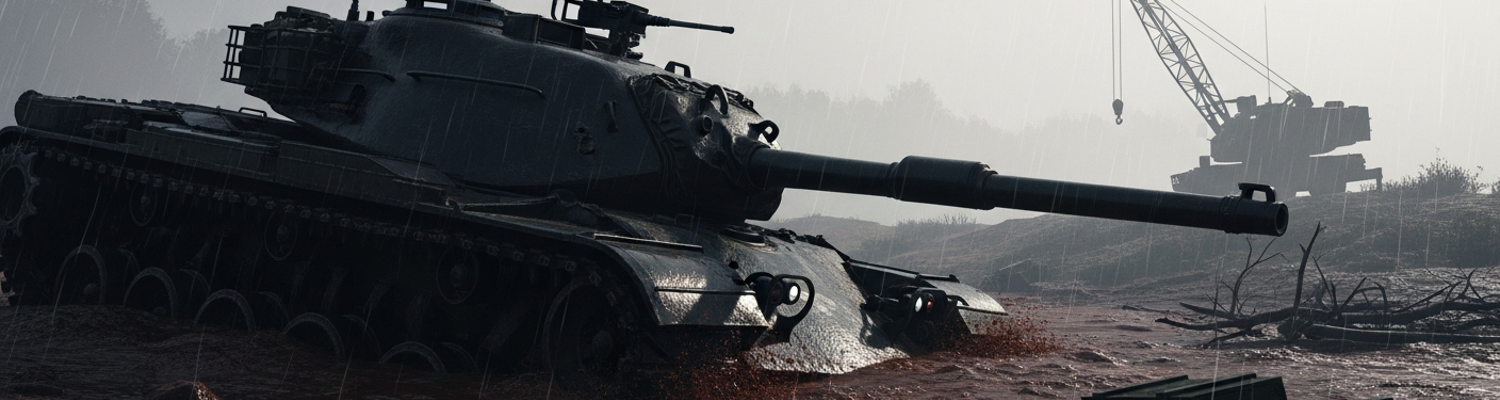

M88 Recovery Vehicle Catastrophe
September 17, 1965. An M48 Patton tank from the 3rd Tank Battalion was the objective. The 49-ton vehicle was deeply mired in the coastal plains of Quang Tri Province, a common occurrence during the monsoon season. The terrain, a mixture of clay and mud, could swallow heavy armor. In response, an M88 Armored Recovery Vehicle was dispatched. The M88, a 50-ton tracked vehicle based on the M48 chassis, was the standard heavy-duty recovery platform for American armored units, designed specifically for extricating tanks under battlefield conditions.
Its crew connected the main winch, a system with a rated pull capacity exceeding 40 tons, to the stricken Patton. As the M88’s engine strained and the winch cable grew taut, the attempt failed. The core of the M88’s recovery gear, its powerful hydraulic pump, experienced a catastrophic failure. Subjected to the immense load of pulling a nearly 50-ton tank from the sucking mud, the system gave way. The winch and hoisting boom were rendered useless.
Now two vehicles were trapped.
The failure of the M88’s hydraulic system created a far more dangerous situation. Not only was the M48 Patton still stuck, but its designated rescuer was also a casualty. The two vehicles represented a significant concentration of combat power. They sat inert near Quang Tri. Archival evidence shows this area was a known corridor for Viet Cong movement. The terrain offered ideal concealment for enemy forces. The immobilized American armor was located in a slight depression, limiting its fields of fire and making it an exceptionally vulnerable target. The loss of a single M48 tank was serious, but the neutralization of an M88 ARV was a larger operational problem. These recovery vehicles were a finite and essential resource, necessary for keeping an armored force functioning in Vietnam’s punishing environment. Without a functioning recovery vehicle, any future armored operations in the vicinity would be undertaken with substantially increased risk. Any tank that broke down or became stuck could be lost.
This tactical predicament was amplified by intelligence identifying the specific location as a suspected ambush zone. The area was a curated kill zone. Marine intelligence (G-2) had noted consistent enemy activity along this route, viewing it as a likely staging point for attacks on U.S. and ARVN forces. Standard Viet Cong doctrine involved observing American patrols and logistical movements, identifying patterns, and striking at points of maximum vulnerability. An M48 and M88, bogged down and stationary, presented a perfect target. It was not a question of if the enemy knew the vehicles were there, but when they would choose to act. The crews of the two vehicles established a hasty defense, using the limited capabilities of their immobilized platforms while command elements scrambled to formulate a response to a situation spiraling from a mechanical issue into a major tactical crisis.
Quang Tri Cholera Epidemic 1965
The seventh pandemic of Vibrio cholerae, El Tor biotype, had entered South Vietnam in 1964. By the autumn of 1965, it erupted across Quang Tri Province, creating a silent second front for the 3rd Marine Division. A close review of medical intelligence reports (MAW-MED-65-09) reveals the region was already flagged as a perennial cholera hotspot. The disease had been a recurring scourge in Vietnam for over a century. The specific conditions of late 1965 created a perfect storm for a large-scale outbreak that directly threatened military operations. The monsoon season’s flooding overwhelmed rudimentary local sanitation systems. This environmental shift facilitated the contamination of the very water sources that both the local population and deployed Marine units relied upon. The disease, which can kill through severe dehydration within hours, spread rapidly through the civilian population, creating a pervasive and invisible threat that respected no battle lines.
For the Marines of the 3rd Medical Battalion, who had established facilities in Quang Tri, the epidemic represented a significant drain on resources.
The designation of Quang Tri as a high-risk zone was not a post-incident assessment but a matter of established medical fact. Naval and Army medical research units had long identified Southeast Asia as a breeding ground for diseases that could cripple military forces far more effectively than conventional weapons. Cholera was the subject of intense study due to its rapid transmission and high mortality rate if left untreated. Intelligence assessments noted that the central coastal areas of Vietnam were historically the most affected regions, a pattern holding true since French colonial soldiers experienced outbreaks with up to 50% mortality in the 1880s. The 1964 arrival of the El Tor strain was a well-documented event with over 20,000 recorded cases and hundreds of deaths in its first year in South Vietnam alone. This data formed the backbone of the military’s preventive medicine programs, which were stretched thin by the rapid buildup of forces and the realities of field conditions in 1965.
The contagion vectors for Marine personnel were numerous and deeply embedded in the operational environment. The nature of dismounted patrols in the Vietnamese countryside forced Marines into direct contact with contaminated sources. A primary vector was water. In the field, Marines often had to refill canteens from available sources like streams, wells, and even rice paddy water. While purification tablets were standard issue, their effectiveness could be compromised by heavy sediment, and under the pressure of combat, proper water discipline could falter. Interaction with local villages for civic action programs or during search operations created another pathway for the bacterium. Handling local food, using local eating utensils, or simply coming into contact with surfaces contaminated by sick individuals could transmit the disease. The bacterium thrives in conditions of poor sanitation, and the field environment offered little respite. This constant exposure created a host of other health issues like fungal infections and skin diseases, weakening the body’s overall resistance and making a cholera infection even more dangerous.
Manpower Crisis and Recovery Impasse
The problem was manpower. The operational paralysis gripping the 3rd Marine Division’s recovery effort stemmed from a catastrophic collapse of available personnel, a crisis inflicted by the rampant cholera epidemic. A conventional recovery of the mired M48 and its M88 rescuer was, by doctrine, a labor-intensive process. It required concentric rings of security, engineering support, and a significant logistical footprint. The unfolding public health disaster systematically dismantled this capability. The first blow was the near-total incapacitation of the local indigenous workforce. A review of operational logs (3rdFSR-LOG-65-117) reveals these laborers were essential for non-technical, physically demanding tasks. They performed support functions such as digging drainage channels, clearing vegetation, laying corduroy roads to improve vehicle access, and hauling equipment. The cholera outbreak ripped through these labor pools with devastating speed.
A 40% incapacitation rate was not a static figure. On any given day, it meant nearly half of the hired workforce was either actively suffering from the disease’s acute, dehydrating effects or attending to sick family members. With a mortality rate that could be as high as 50% without rehydration therapy, the local community was in a state of crisis. Organized labor became an impossibility. For the 3rd Marine Division, this translated into a sudden and almost complete loss of the manual labor upon which expeditionary military operations depend.
The manpower deficit was compounded by sickness ravaging allied South Vietnamese military units. The local Army of the Republic of Vietnam (ARVN) and Popular Forces (PF) units, integral to the security architecture of Quang Tri Province, were themselves reeling from the epidemic. A 15% incapacitation rate among these local forces represented a critical degradation of the outer security cordon. These were the units tasked with patrolling the wider area, interdicting Viet Cong movement, and providing early warnings. With one in six soldiers unfit for duty, ARVN and PF company commanders were forced to consolidate their forces and shrink their patrol zones. Joint patrols with Marine units were curtailed. The result was a tactical void. The eyes and ears of the allied forces in the countryside went dim, allowing Viet Cong units greater freedom of movement precisely when a high-value target lay exposed.
The evaporation of the civilian labor pool and the degradation of ARVN/PF security elements created a complete operational impasse. A textbook recovery operation was now impossible. The standard procedure would have involved deploying a security element of at least company size to establish a hard perimeter. Within this perimeter, combat engineers, assisted by a large contingent of laborers, would have worked to stabilize the ground. This could involve building a temporary causeway or digging out tons of mud. All of this required a large number of men working in the open for an extended period. With the cholera epidemic effectively removing both the labor force and a significant portion of the security force, any attempt to execute a conventional recovery would mean pulling Marine infantry from frontline positions. This would dangerously weaken the division’s overall combat posture to address a single tactical problem. The command was forced into a corner, with two high-value armored vehicles stranded in a known enemy kill zone and no conventional means to extract them.
Major Jones's Strategic Dilemma
The crisis landed on the desk of Major T.J. "Tracker" Jones. Command chronologies for the 3rd Force Service Regiment (3rd FSR) show this unit was the logistical and maintenance backbone for the entire 3rd Marine Division. Jones, a field-grade officer within the regiment’s maintenance battalion, was directly in the chain of command responsible for the recovery of high-value hardware. The decision confronting him was not merely technical but deeply strategic. Standard operating procedure was no longer an option. The cholera-driven manpower crisis meant he lacked the allied soldiers and local laborers to secure and prepare the site for a conventional retrieval. Every available Marine was already stretched thin across the Quang Tri sector.
Pulling a company of infantry off the line to guard a recovery effort would create a dangerous gap elsewhere, inviting an attack.
The hardware in jeopardy represented a significant loss to the division’s combat power. The M48 Patton was the principle main battle tank available to the Marines in 1965, a 49-ton platform armed with a 90mm cannon that provided indispensable fire support. The M88 Armored Recovery Vehicle, built on the same chassis, was arguably even more valuable in the context of operations in Vietnam. These 50-ton workhorses were the only vehicles in theater capable of extricating a mired tank from the monsoon mud. Their powerful winches and cranes were the key to keeping the armored battalions functional. Losing one M88 crippled the 3rd Marine Division’s ability to conduct aggressive armored operations across a wide swath of territory. The two vehicles, inert and helpless, represented a combined 100 tons of advanced American military technology. Leaving them for the enemy was unthinkable. They would be stripped for intelligence, used for global propaganda, and their destruction would be hailed as a major victory for the Viet Cong. The only alternative, destroying them in place with demolition charges, meant accepting the permanent loss of irreplaceable assets and publicly conceding defeat.
Intelligence reports flowing into the 3rd Marine Division headquarters painted an increasingly grim picture. The location was a known infiltration route and a suspected ambush zone for local Viet Cong main force units. Enemy forces were adept at using the terrain for concealment, allowing them to approach American positions undetected. Viet Cong doctrine prioritized attacks on isolated or stationary targets, and a pair of immobilized armored vehicles presented an irresistible opportunity. Reconnaissance patrols reported signs of increased enemy activity, suggesting that VC commanders were aware of the prize and were likely observing the site. They employed “hugging” tactics, getting so close to American forces that air and artillery support became too dangerous to use. Any conventional recovery attempt, with its large security detail and noisy engineering work, would be a magnet for a well-planned ambush. Major Jones was caught between the certainty of losing the tanks if he did nothing and the high probability of walking his men into a slaughter if he attempted a textbook rescue.
Unconventional Salvage Protocol Authorization
With conventional options exhausted, Major Jones authorized a plan that departed radically from established military doctrine. A review of 3rd Force Service Regiment operational planning from this period reveals the formal authorization of an exceptionally risky 72-hour "rapid extraction" protocol. This timeline was not arbitrary. It was a stark acknowledgment of the window of opportunity before Viet Cong forces could reasonably be expected to organize a decisive, large-scale attack. A standard, deliberate recovery would have taken weeks. The 72-hour directive stripped the operation to its bare essentials. There would be no time to build a causeway or systematically drain the mud. The recovery would be a snatch and grab, reliant on speed, mechanical expertise, and luck.
The protocol accepted the near certainty of direct enemy engagement and aimed to conclude the operation before the Viet Cong could bring superior numbers to bear. The entire concept was an exercise in calculated risk.
Executing this high-stakes mission required a unique type of unit. Command logs show the diversion of a specialized but critically undermanned recovery team designated "Team Delta-3." Delta-3 was not a standard line unit; it was a small, hand-picked group of expert mechanics and recovery specialists from within the 3rd FSR’s maintenance battalion. These were Marines who possessed an intimate, hands-on knowledge of the M88’s complex winch systems and the Continental AVDS-1790 series diesel engine. Their specialization was in performing complex repairs under battlefield conditions. The team was dangerously undermanned. The same cholera epidemic that had incapacitated the local labor force had also swept through rear-echelon support formations. Delta-3 was meant to operate with a twelve-man element, but at the time of the authorization, only seven members were fit for duty. This reduction in manpower meant the team had no redundancy. The loss or incapacitation of even one man could cause the entire mission to fail. Their diversion to this single task also created a significant gap in the 3rd Marine Division’s maintenance capabilities elsewhere in Quang Tri Province.
The most controversial element of Major Jones’s plan was the decision to launch the operation without full quarantine pre-staging. Standard medical procedure for any unit operating in a designated cholera hot zone was rigid. It involved isolating the unit, ensuring untainted water supplies, administering prophylactic treatments, and conducting extensive briefings on sanitation discipline. The 72-hour window made these precautions impossible. A review of the operational order shows a complete waiver of these protocols. Team Delta-3 would go in “dirty,” with full knowledge that they would be exposed to the Vibrio cholerae bacterium. They would be moving through contaminated mud and water, and the physical exertion of the recovery task would make perfect water and sanitation discipline difficult. This decision placed the seven-man team at extreme biological risk, adding the invisible threat of a fatal disease to the overt danger of enemy ambush.
Team Delta-3 Deployment Risks
The operational order dictated that Team Delta-3 would insert into a zone where Viet Cong main force units were actively preparing an attack. Intelligence summaries from the period confirm the area was a curated kill zone. Viet Cong doctrine prioritized the isolation and annihilation of stationary, high-value targets. The two immobilized American vehicles were precisely such a target. The local terrain gave enemy forces extensive concealed avenues of approach. They could observe the American position and stage their forces for an assault with little chance of detection. Intelligence had specifically warned of “hugging” tactics, a method where Viet Cong soldiers would deliberately close the distance with an American unit. By engaging at extremely close quarters, they could effectively neutralize the power of American air and artillery support. For a seven-man team like Delta-3, this was a lethal proposition. They lacked the manpower to establish a meaningful 360-degree security perimeter while simultaneously conducting the arduous mechanical work.
This was a mission with no margin for error.
The team was a skeleton crew. A full-scale M88 recovery element was designed for twelve men, a number that provided redundancy, security, and the raw manpower for heavy armor repair. A reduction to seven Marines created a cascade of intersecting risks. There was no longer a dedicated security component. Every mechanic would have to split his attention between the complex repair and watching a sector of the perimeter. The labor itself was a problem of physics. The main winch cable on an M88, a thick steel rope weighing several pounds per foot, was a task for a full team, not a handful of exhausted men. M88s were designed for on-site repairs of components like engines and powerpacks, tasks that required lifting heavy parts and precise alignment. With only seven men, work cycles would be longer, fatigue would set in faster, and the potential for a critical mistake or injury would increase exponentially. The loss of a single Marine would likely make the primary objective impossible.
Compounding the tactical and personnel risks was the threat of the cholera bacterium. Major Jones’s authorization explicitly waived the standard pre-deployment quarantine and sanitation protocols. This decision put Delta-3 in extreme biological danger. The recovery site was a pit of contaminated mud and stagnant water, a perfect breeding ground for Vibrio cholerae. The men would be immersed in this environment. Cholera is a rapid disease; it can incapacitate a healthy man in a matter of hours and, without immediate intravenous rehydration, lead to death. A U.S. Navy medical research unit had already demonstrated that aggressive fluid replacement was the only effective treatment, a capability utterly unavailable to a small team in the field. An outbreak within the team would be a mission-ending catastrophe. A single Marine struck down by the disease would require the attention of at least one other, instantly crippling the workforce and bringing the complex repair to a halt.
Calculated Risk Probability Assessment
A review of the unclassified planning documents (3rdFSR-OPORD-65-44) for the salvage operation reveals the mathematical foundation of Major Jones’s decision. The assigned probability of successfully recovering both the M48 and the disabled M88 was set at sixty percent. This figure was not a guess. It was the output of a rapid analysis based on the known variables. The calculation factored in the specific expertise of Team Delta-3, whose members were among the few mechanics in-country with extensive experience repairing the M88’s hydraulic winch assembly under field conditions. The planners assumed a best-case scenario where Delta-3’s own M88 could establish a secure position, allowing the team to first repair the disabled ARV’s hydraulic pump before attempting a tandem pull on the deeply mired M48 tank. The forty percent failure probability accounted for a host of negative variables. These included the high likelihood of enemy interference, the possibility of an unrepairable secondary mechanical failure, or the reality that the monsoon-softened ground might not support the anchor position needed for a two-vehicle pull.
The operational order contained a pragmatic medical assessment. Planners formally attached an estimated thirty-five percent personnel infection rate for Team Delta-3. This number was derived directly from 3rd Medical Battalion data tracking cholera incidence among units that had operated for extended periods in the Quang Tri hot zone with compromised water discipline. The waiver of standard quarantine protocols meant the seven-man team was being sent directly into a known biological hazard area. The mission profile required them to work for up to seventy-two hours while physically immersed in contaminated mud and water.
The operational plan proceeded with the assumption of two to three casualties from disease before mission completion.
The justification for accepting such a high probability of personnel casualties for a non-combat mission rested on a cost-benefit analysis of the alternative. The two vehicles represented a combined 100 tons of American military hardware. Archival evidence shows the M88 ARV, in particular, was considered a non-expendable asset in I Corps operations. Its loss would functionally ground the 3rd Tank Battalion, as no other vehicle in the inventory could recover a 49-ton tank from the region’s mud. This would have a cascading effect, limiting the scope of all future infantry operations that depended on armored support. Destroying the vehicles in place meant permanently writing off irreplaceable equipment and conceding a tactical defeat. More importantly, it risked an intelligence catastrophe. An M88 captured intact would provide Soviet and Chinese military intelligence with a direct look at American heavy vehicle recovery systems. The propaganda value of displaying captured US armor would be a global embarrassment. Weighed against this outcome, the potential loss of several skilled mechanics to a treatable disease was deemed the strategically necessary price.
Cold War Salvage Operation Legacy
The after-action reports from the 1965 Cholera Salvage Operation sent a shockwave through the 3rd Marine Division and III Marine Amphibious Force. A review of operational planning documents from the period shows a rigid adherence to doctrine for both asset recovery and preventive medicine. The recovery of a disabled vehicle was codified as a deliberate, methodical process requiring overwhelming security and extensive engineering preparation. Simultaneously, Navy and Marine Corps medical directives mandated strict quarantine and sanitation protocols for any unit operating in a known epidemic zone. The authorization of the Delta-3 mission deliberately violated both sets of doctrine. It substituted speed and risk for security and methodical planning, creating a precedent that was both celebrated for its success and scrutinized for its recklessness. The operation became an internal, classified case study in command-level risk acceptance, forcing a formal re-evaluation of the line between operational necessity and the commander’s responsibility to preserve the force.
The ethical considerations of the gamble were as stark as the mathematical probabilities. While Marine Corps doctrine has always acknowledged risk, it is framed within the context of achieving a mission objective against a thinking enemy. The Cholera Salvage Operation introduced a different calculus. The thirty-five percent estimated infection rate for Team Delta-3 was not a probability of a random combat event; it was a statistically predicted outcome of a command decision to waive established medical procedure. This transformed the concept of “acceptable losses” from a battlefield contingency to a pre-planned medical certainty for a logistical task. A review of subsequent analyses from the Judge Advocate General’s office and the Navy Bureau of Medicine and Surgery shows a deep internal debate over the decision. The core conflict was between the unquestionable value of the armored assets and the commander’s fundamental duty of care. The loss of the M88 ARV would have crippled the operational capacity of the entire 3rd Tank Battalion. Set against this was the deliberate exposure of seven Marines to a disease that could kill within hours, far from any advanced medical care. Major Jones’s decision was ultimatelyupheld as a valid command judgment under extreme duress, but it established an uncomfortable ethical benchmark for future operations.
The operation’s most tangible legacy was its direct influence on future Marine Corps recovery and medical protocols. The success of the mission, paired with its human cost, spurred the development of new doctrine designed to bridge the gap between logistics and expeditionary medicine. A review of training manuals from the late 1960s and early 1970s shows the emergence of protocols for what became known as “Contaminated Asset Recovery.” These new procedures acknowledged that high-value equipment could be stranded in biologically or chemically hazardous environments. They formalized the risk assessment process, requiring a direct sign-off from both the operational commander and a designated preventive medicine officer. New, specialized units were proposed, cross-trained in both advanced mechanical skills and hazardous environment survival. The operation also highlighted equipment shortfalls, leading to the development of man-portable, rapid water testing kits and individual protective gear designed specifically for mechanics working in contaminated conditions. The direct result was the fast-tracked development of the M2 Individual Water Purification Kit, issued division-wide by 1967.