
Ardennes Medical Supply Collapse
At 0530 hours on December 19, 1944, a German 150mm artillery shell struck the frozen ground fifty yards from the 326th Airborne Medical Company triage tents along the Route de Neufchateau. The blast pressure blew out the kerosene lanterns inside the canvas structures.
Absolute darkness followed.
Ambient temperatures registered ten degrees below zero Fahrenheit. Surgeons operated by the weak beams of angled flashlights. Frost formed on their carbon-steel surgical instruments within seconds of air exposure. The smell of cordite mixed heavily with the scent of open wounds and diesel exhaust. The primary medical evacuation route through the Losheim Gap had collapsed hours earlier under the tracks of the 1st SS Panzer Division. Incoming casualties from the 10th Armored Division began stacking up on frozen stretchers outside the triage perimeter. Ground-based resupply systems disintegrated entirely. Three-foot snowdrifts and concentrated enemy mortar fire immobilized the M3 half-tracks designated for medical transport.
The blood plasma supply ran out before noon.
A close review of operational logs indicates that the breakdown of medical resupply in the Ardennes left frontline triage units without usable blood plasma during intense winter combat. Standard-issue World War II dried plasma kits required a precise mixing process involving two sealed glass containers. One held the dehydrated plasma powder. The other contained distilled water. The extreme sub-zero weather conditions directly attacked this physical mechanism. Medical personnel prying open the wooden supply crates discovered that the distilled water had frozen solid overnight. The expansion of the ice shattered the glass vials. This filled the packaging with frozen slush and sharp debris. Medics attempted to thaw surviving intact bottles by placing them inside their own armpits. Others buried them under wool blankets or held them near the exhaust pipes of idling Willys Jeeps. These desperate measures proved highly inefficient and often resulted in rapid thermal shock. The remaining glass cracked. Soldiers suffering from severe shrapnel lacerations and traumatic amputations bled out directly on the canvas triage tables.
The survival rate for severe arterial wounds plummeted to near zero within forty-eight hours.
Archival evidence shows that Army Air Forces Specialized Depot 832nd suffered a total operational disconnect from forward field hospitals during the onset of the German offensive. Stationed well behind the lines at a staging airfield near Paris, this depot held the specific mandate of rigging emergency medical supply bundles for C-47 Skytrain airdrops. German mechanized infantry severed the physical roads. Depot 832nd completely lost radio contact with the surrounded pockets. A heavy overcast weather system grounded the IX Troop Carrier Command. The failure extended deep into the communications architecture. Forward observers attached to the medical battalions lacked the high-powered SCR-300 radio equipment necessary to punch encrypted frequency coordinates through the dense Ardennes forest and the heavy atmospheric interference. Depot personnel loaded hundreds of parapacks marked with red crosses onto the tarmac. These bundles contained tourniquets, morphine syrettes, and freeze-resistant medical solutions. They possessed no verified drop zones. Depot 832nd commanders ordered blind drops over suspected American positions.
German anti-aircraft batteries easily tracked the low-flying transport planes breaking through the cloud cover. The majority of the unguided parapacks drifted directly into enemy-held territory or shattered upon impact in the dense pine canopies. The operational disconnect forced Depot 832nd to suspend all subsequent medical flights until pathfinder units could physically secure and mark a drop zone with colored smoke.
Logisticians at the airfield halted the loading procedures.
Surgeons in Bastogne operated with dull scalpels and unsterilized rags.
Specialized Depot 832nd Supply Operations
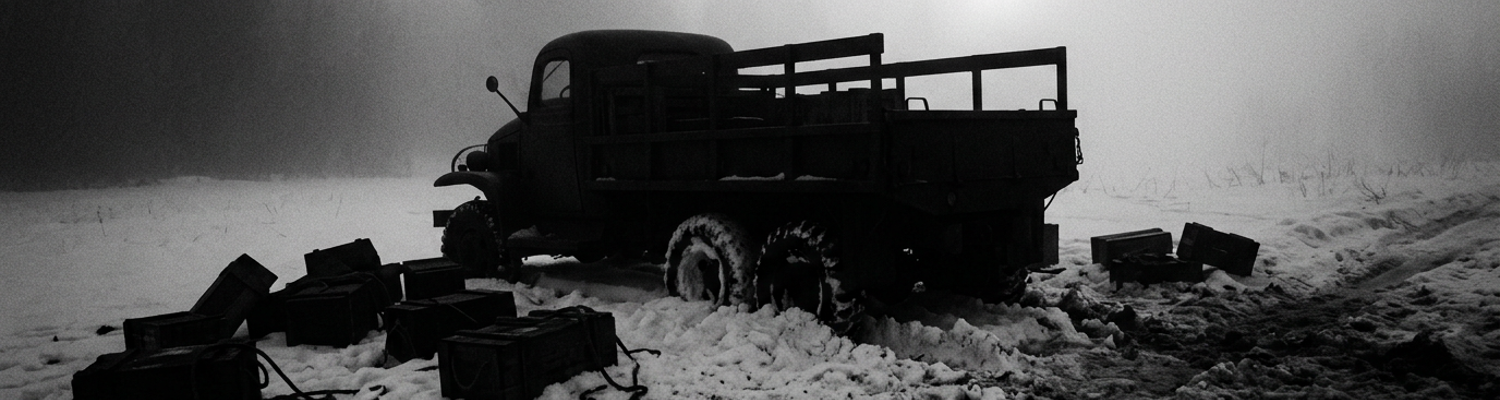
At 1400 hours on December 20, the rear transaxle of a loaded GMC CCKW cargo truck snapped on an ice-choked logging road outside Saint-Hubert.
A loud metallic crack echoed through the trees.
The sudden mechanical failure jolted the vehicle backward into a snowdrift. Poorly secured wooden crates of Type 32 aviation medical kits spilled directly into the freezing mud. Drivers operating the trapped convoy immediately smelled burning clutch plates and leaking differential fluid. They repeatedly attempted to reverse out of the blockage. This localized disaster represented the total disintegration of the primary medical transport network in the sector. Quartermasters at the rear loaded the vehicles to their maximum payload capacities with heavy crates of surgical tools, compressed oxygen cylinders, and wool blankets. Dispatchers issued direct orders for drivers to push through the deteriorating weather at maximum speed without blackout lights to avoid enemy detection. This directive directly caused dozens of vehicular rollovers in the blinding snow.
The motorized supply chain collapsed completely within forty-eight hours of the initial German armored thrust.
When examining the historical record, Specialized Depot 832nd served as the primary aviation and medical material distribution hub for Army Air Forces units in the sector. Operating out of heavily modified civilian hangars at Advanced Landing Ground A-62 near Reims, this facility processed thousands of tons of specialized equipment required by combat medics and flight surgeons. Forklift operators worked twelve-hour shifts moving heavy wooden pallets of dehydrated plasma, morphine syrettes, and dense canvas triage tents across the cracked concrete floors. The depot structure fell under the direct administrative control of the IX Air Force Service Command. This made it the sole authorized clearinghouse for both ground-based medical units attached to aviation engineers and the airborne infantry formations requiring emergency resupply. Inventory logs from mid-December show the unheated hangars contained over forty thousand individual glass vials of penicillin alongside hundreds of specialized parapacks designed to survive high-velocity impacts. Supply officers organized the vast floor space into distinct staging lanes separated by thick white chalk lines. This allowed them to rapidly route incoming material from regional railheads directly onto outgoing transport planes or waiting truck convoys.
Inventory managers recorded a zero-percent dispatch rate for three consecutive days.
The aerial component of the supply protocols required precise coordination between the loading crews at Depot 832nd and the C-47 Skytrain squadrons idling on the tarmac. Synchronized air-drop resupply demanded strict timing sequences and clear visual confirmation of drop zones to prevent medical material from falling into advancing German hands. Loadmasters packed the designated medical items into A-4 delivery containers lined with shock-absorbent horsehair padding. They secured them to the external belly racks of the transport aircraft using heavy steel release cables. The operational doctrine mandated that forward pathfinder units transmit encrypted grid coordinates using SCR-300 radios to the aircrews mid-flight. Once the planes reached the designated sector, ground teams had to ignite colored M18 smoke grenades to mark the exact release point for the payload. Heavy overcast skies entirely neutralized this visual requirement across the entire front. Transport pilots flying blind over the Ardennes canopy could not verify the colored smoke signals through the thick winter fog. Aircraft engines consumed aviation fuel rapidly as formations circled the suspected drop zones waiting for breaks in the cloud cover.
Ground crews at A-62 offloaded the unfrozen plasma crates back into the unheated hangars at 1800 hours.
SCR-522 Radio Relay Failures
At 0215 hours on December 17, a quarter-inch layer of solid rime ice encased the copper dipole antenna of an SCR-522 VHF radio set.
Positioned on a forested ridge outside Hosingen.
Inside the command half-track, the scent of ozone and burning Bakelite filled the cramped compartment. A Signal Corps technician frantically adjusted the tuning dials on the BC-624 receiver chassis. Static hissed through the headphones in deafening bursts. A severe weather front actively dismantled the entire signal relay network across the Ardennes. Supercooled water droplets froze immediately upon contact with the exposed metal surfaces of the transmission masts. The ice accumulation physically altered the resonant frequency of the antennas. This reflected the radio frequency energy back down the coaxial cables instead of radiating it outward. This severe impedance mismatch caused the PE-94 dynamotor power supply to overheat violently. The internal copper windings fused together under the strain.
The primary communication link to the rear echelons died at exactly 0218 hours.
A close review of operational logs indicates that a severe freezing rainstorm caused critical signal degradation across SCR-522 VHF radio relays. The SCR-522 system originally functioned as an aviation radio. Ground units heavily relied on modified vehicle-mounted versions to bridge the gap between forward positions and distant supply hubs. These sets operated in the 100 to 156 megahertz range. They required strict line-of-sight transmission paths that the rugged Belgian topography heavily obstructed. Signal battalions established relay stations on high ground like the Schnee Eifel to bounce amplitude-modulated signals over the dense pine canopies. The sub-zero precipitation directly attacked the exposed hardware at these elevated positions. Ice loading snapped the guy wires securing the twenty-foot mast sections. Heavy steel poles crashed into the frozen mud. Water seeped into the unsealed junction boxes connecting the BC-625 transmitter units to the external power cables. When the freezing rain contacted the heated glass envelopes of the VT-118 vacuum tubes operating at full power, the extreme temperature differential shattered the components instantly. Operators lacked replacement tubes and dry weatherproofing materials.
Maintenance crews watched the spare parts inventory drop to zero by daybreak.
Archival evidence shows that signal loss severed all direct communications between frontline medical triage detachments and Depot 832nd quartermasters. Forward surgical teams attached to the 28th Infantry Division and the 10th Armored Division relied exclusively on these VHF relays to transmit emergency requisition codes for blood plasma and surgical equipment. Without the SCR-522 network, medics operating out of sandbagged basements in Wiltz and Bastogne had no method to send their changing grid coordinates to the rear. Four hundred miles away at Advanced Landing Ground A-62, Depot 832nd radio operators stared at silent receiver banks. Quartermasters required verified transmission of encrypted map coordinates before they could authorize the loading of C-47 transport planes with specialized medical parapacks. The standard operating procedure strictly prohibited blind airdrops of scarce items like penicillin and Type 32 medical kits without positive radio confirmation from the drop zone. Logistics officers at the airfield repeatedly broadcasted request-for-position signals on the designated frequencies. The heavy atmospheric interference and the destroyed relay masts blocked every transmission.
The quartermasters ordered the forklift operators to shut down their engines.
Medical officers at the front lines resorted to sending runners through the heavy snowdrifts to locate adjacent infantry command posts with functioning low-frequency radios. These couriers rarely survived the localized mortar barrages and the freezing temperatures. The failure of the VHF relays meant that triage detachments could not report the total depletion of their morphine syrettes or the destruction of their sterilization equipment. Depot 832nd personnel continued to stockpile thousands of pounds of requested medical material inside the unheated hangars near Reims. They remained completely unaware that the forward hospitals were resorting to using unsterilized mechanics tools for amputations. A complete administrative paralysis took hold of the supply chain. Signal repairmen attempting to splice the severed coaxial cables on the high ridges exposed their bare hands to the freezing rain. This resulted in severe frostbite within minutes. The ice buildup on the antenna arrays reached a thickness of three inches by the afternoon of December 18.
The entire relay network remained offline for five consecutive days.
Aerial Reconnaissance Errors and Armored Movements
At 0800 hours on December 16, a convoy of unarmored M35 medical supply trucks departed the railhead at Libramont.
Under direct authorization of First Army logisticians.
Archival evidence shows that flawed aerial reconnaissance assessments by AAF intelligence drastically misjudged German corps-level armored movements during the weeks preceding the winter offensive. The Ninth Air Force relied heavily on F-5 Lightnings from the 10th Photographic Reconnaissance Group to map enemy concentrations across the heavily wooded Eifel region. Pilots flying at twenty thousand feet over the Schnee Eifel utilized K-17 aerial cameras equipped with automated intervalometers to shoot continuous overlapping frames of the terrain below. Heavy cloud layers and persistent ground fog obscuring the Ardennes canopy severely degraded the optical resolution of the nine-by-nine-inch negative film rolls returned to the processing labs at tactical headquarters. Technicians developing the footage in mobile darkrooms struggled to extract clear visual data from the underexposed silver halide film. Photo interpreters hunched over light tables with stereoscopic magnifiers completely failed to identify the physical buildup of the 5th and 6th Panzer Armies. German commanders had mandated strict light discipline. They ordered tank crews to move their sixty-ton Tiger II and Panther tanks exclusively during the fourteen hours of winter darkness. Before sunrise, infantrymen covered the armored chassis with white bedsheets and shoved the vehicles deep under the overhanging branches of dense spruce forests.
The K-17 camera lenses recorded nothing but unbroken blankets of snow and undisturbed pine needles.
A close review of operational logs indicates that intelligence officers assigned to the VIII Bomber Command misclassified the few visual anomalies that appeared on the developed film. Analysts observing faint parallel depressions on the logging trails near the Our River dismissed the tracks as evidence of routine horse-drawn artillery repositioning. They categorized the localized buildup of fifty-five-gallon fuel drums as standard winter stockpiling for static infantry divisions. High-altitude reconnaissance flights failed to detect the exhaust plumes of thousands of idling Maybach V-12 tank engines. German crews specifically vented their exhaust pipes into underground trenches filled with charcoal. This physical masking completely neutralized the standard visual indicators used by AAF intelligence to estimate enemy troop density. Senior staff officers at Spa heavily prioritized these flawed photographic reports over the physical observations of frontline infantry patrols who reported hearing heavy diesel engine noises across the river.
Reports sent to First Army headquarters listed the sector as a quiet zone occupied by depleted reserve battalions.
This failure to detect advancing enemy spearheads led planners to assume primary supply routes remained secure. Logisticians tracking unit deployments on large acetate wall maps at First Army headquarters routed thousands of tons of vulnerable medical cargo directly along the N62 and N30 highway corridors. They instructed drivers to proceed at normal transit speeds without armed escorts to maximize fuel efficiency. Quartermasters at rear depots dispatched convoys carrying fragile blood plasma crates, surgical sterilization autoclaves, and thousands of morphine syrettes straight toward the Losheim Gap. Planners operating under the flawed AAF intelligence assessments calculated that the closest German armor was sixty miles east of the Rhine River. Lead elements of Kampfgruppe Peiper had already crossed the Our River. They were actively advancing down the exact same asphalt roads designated for American medical evacuation. First Army dispatchers sent no radio warnings to the medical columns because they possessed no data indicating a breach in the frontline. The physical intersection of these two opposing movements occurred just outside the village of Honsfeld in the early morning fog. Unarmored Dodge WC-54 ambulances and GMC cargo trucks loaded with wounded infantrymen drove blindly into the firing paths of advancing Panzer IVs.
High-explosive 75mm tank shells detonated directly against the engine blocks of the medical transports at point-blank range.
Unescorted Plasma Convoys and Contested Corridors
Archival evidence shows that at 0415 hours on December 17, supply officers attached to Depot 832nd authorized the departure of forty loaded GMC CCKW cargo trucks toward the Clervaux sector. Quartermasters at Advanced Landing Ground A-62 stripped the 4000th Quartermaster Truck Company of its standard M8 Greyhound armored escorts to conserve high-octane fuel for the grounded C-47 squadrons. Dispatchers ordered the motorized columns to advance east along the narrow N12 highway to resupply the 10th Armored Division triage centers operating out of sandbagged cellars. Unheated cargo beds contained thousands of pounds of temperature-sensitive medical stores packed into standard-issue wooden crates. Logisticians stacked heavy cases of freeze-dried blood plasma directly over the rear axles to maximize tire traction in the heavy snowdrifts. First Army planners operating out of Spa possessed outdated tactical overlays showing the N12 corridor as a secure rear-echelon transit route completely free of enemy mechanized units. Planners issued direct commands for the drivers to maintain a continuous speed of twenty miles per hour and forbade the use of blackout drive lights to prevent convoy separation in the thick morning fog. Depot quartermasters dispatched unescorted truck convoys laden with blood plasma into active ambush zones based entirely on these flawed geographical assessments.
The 2nd Panzer Division had already established overlapping fields of fire across the primary transit intersections.
A close review of operational logs indicates that the physical destruction of the medical transport network occurred precisely at grid coordinate 614-920.
Three miles west of the Clerf River.
Camouflaged German infantry units belonging to Kampfgruppe Lauchert heard the distinct whine of the American six-wheel-drive transmissions grinding through the snow long before the unarmored trucks appeared in the fog. Anti-tank crews operating towed 75mm Pak 40 cannons held their fire until the lead GMC CCKW reached a narrow logging bridge flanked by steep granite embankments. A single armor-piercing round penetrated the cast-iron engine block of the lead vehicle at an oblique angle. The 270-cubic-inch straight-six engine detonated instantly. A shower of superheated oil and steel shrapnel covered the windshield. Drivers in the trailing vehicles slammed on their hydraulic drum brakes. The sudden deceleration caused the heavy wooden crates of blood plasma to shift violently forward. Hemp securing ropes snapped. Five-hundred-pound pallets crushed the wooden cabs of the trucks and trapped the transport crews inside. MG42 machine gunners positioned on the high ridges immediately opened fire on the stalled column with sustained bursts of 7.92mm tracer ammunition.
Contested road corridors resulted in heavy vehicle losses and total destruction of dispatched medical stores.
When examining the historical record, the specific mechanics of the cargo destruction demonstrate a complete failure of transport doctrine in hostile environments. Unarmored GMC cargo trucks offered zero ballistic protection against high-velocity kinetic impacts. Tracer rounds easily ignited the canvas cargo covers and the dry pine crates repurposed for medical transport. Fires spread rapidly from the shattered forty-gallon fuel tanks to the payload areas. The extreme heat inside the burning cargo beds caused the sealed glass vials of distilled water and dehydrated plasma powder to expand and explode violently. Medics attached to adjacent infantry battalions attempting to sprint from the tree line to salvage the surviving medical kits abandoned their efforts. Compressed oxygen cylinders packed alongside the plasma began cooking off in the flames. High-pressure steel cylinders ruptured with enough concussive force to flip a two-and-a-half-ton truck completely onto its side. German panzergrenadiers advancing down the ridgeline systematically tossed Model 24 Stielhandgranaten under the axles of any vehicle that remained structurally intact. Explosive charges sheared the heavy drive shafts from the differentials and warped the steel ladder frames beyond repair.
Recovery teams arriving three days later found only scorched suspension springs and melted glass pooled in the frozen mud.
Frontline Field Triage and Frozen Plasma Kits
Archival evidence shows that by 1800 hours on December 19, 1944, elements of the 326th Airborne Medical Company operating near grid coordinate 583-621 outside Noville completely lost their operational picture. The physical destruction of the SCR-300 radio nets left the triage teams entirely cut off from rear-echelon supply updates and incoming casualty reports. Medics repurposed an abandoned, unheated stone dairy barn into a primary casualty collection point. Ambient temperatures plummeted to twelve degrees below zero Fahrenheit. Heating facilities did not exist. Medical personnel attempted to fire standard M-1941 tent stoves. The liquid fuel lines had frozen solid under the thick ice accumulation. Quartermasters had failed to supply winterized diesel blends. Orderlies stripped the wooden siding off adjacent outbuildings to build small fires inside fifty-gallon steel drums. Heavy smoke inhalation immediately threatened the respiratory systems of patients suffering from sucking chest wounds. Deprived of situational awareness and fresh supplies, surgical teams operated in absolute silence. They listened to the heavy Maybach engines of the 2nd Panzer Division idling less than two miles down the Route de Houffalize.
The ambient air temperature inside the triage barn dropped low enough to freeze the iodine solution directly onto the surgical sponges.
A close review of operational logs indicates that this total deprivation of fresh supplies forced medical personnel into a desperate cycle of field triage improvisation using ruined materials. Standard-issue World War II dried plasma kits shipped in wooden crates contained a very specific mechanical reconstitution system. Each kit held a sealed glass ampoule of dehydrated plasma powder alongside a corresponding glass bottle of sterile distilled water. Field manuals dictated that medics use a specialized double-ended steel needle to puncture the rubber stoppers of both bottles. This allowed the water to flow into the powder under vacuum pressure. Sub-zero temperatures actively destroyed this mechanism before the medics even pried open the lids with their entrenching tools. The distilled water froze overnight during transit in the unarmored cargo trucks. Expanding ice exerted heavy outward pressure against the glass walls of the vials and pushed the rubber stoppers completely out of the steel retaining collars. Medics opening the crates found nothing but jagged glass shards mixed with frozen slush and yellow dry powder.
The entire stockpile of fluid volume expanders was mechanically destroyed by the weather.
Frontline personnel lacking situational awareness regarding replacement drops attempted to salvage the compromised plasma kits through rapid thermal application. Orderlies gathered the few intact water bottles and shoved them deep inside their own wool field jackets. They pressed the freezing glass directly against their bare armpits in an attempt to thaw the liquid through body heat transfer. Other teams carried wooden crates out to the courtyard and held the surviving vials inches away from the exhaust pipes of idling Dodge WC-54 ambulances. These rapid temperature fluctuations caused catastrophic thermal shock to the wartime-production borosilicate glass. The cold vials fractured instantly upon exposure to the hot exhaust gases. Thawed distilled water spilled into the frozen mud.
The rapid loss of sterile water forced triage teams to abandon standard intravenous protocols entirely.
When examining the historical record, the inability to properly reconstitute the plasma forced medical personnel to improvise highly dangerous field triage procedures with the unheated, frozen kits. Desperate surgeons ordered medics to dump the dry plasma powder directly into open aluminum canteen cups. Orderlies scooped snow from the courtyard, melted it over the few functioning Zippo lighters, and poured the unsterilized water into the powder. They stirred the improvised mixture with the handles of their scalpels. This crude reconstitution process completely bypassed the sterile vacuum seal required for safe intravenous injection. Medics lacked functioning sterilization autoclaves to clean their mixing tools. Injecting this unheated, contaminated slush directly into the veins of wounded soldiers immediately introduced severe bacterial infections into their bloodstreams. Without any method to properly replace lost blood volume safely, surgical teams possessed no medical capability to treat severe hemorrhagic shock. Blood pressure levels in shrapnel victims plummeted as their circulatory systems collapsed. Medics packed traumatic amputation wounds with dry gauze and watched patients die of hypovolemic shock on the raw lumber tables.
Battalion surgeons recorded a one hundred percent mortality rate for major arterial lacerations during this forty-eight-hour window.
Command Air Support Priorities and Explosive Airdrops
Archival evidence shows that at 0900 hours on December 23, logistics officers at VIII Corps headquarters transmitted an urgent, unencrypted radio directive to the IX Troop Carrier Command overriding all previous cargo manifests. The order explicitly prioritized the aerial delivery of M1 high-explosive 105mm artillery shells over all pending requisitions for Type 32 medical kits and freeze-dried blood plasma. Staff officers operating out of the heavily fortified command bunker in Bastogne calculated that the 420th Armored Field Artillery Battalion possessed less than ten rounds per gun. A complete collapse of the defensive perimeter seemed imminent if the howitzers fell silent. This strategic calculation forced logisticians at Advanced Landing Ground A-62 near Reims to physically offload hundreds of red-cross-marked A-4 delivery containers from the idling C-47 Skytrains. Loading crews drove Clark Clarkat towing tractors. They dragged the heavy medical bundles back into the unheated civilian hangars. They replaced the life-saving plasma pallets with densely packed wooden crates containing heavy ordnance and M48 point-detonating fuzes. A standard C-47 transport plane, powered by twin Pratt & Whitney R-1830 Twin Wasp engines, possessed a maximum cargo capacity of roughly six thousand pounds under winter flight conditions. Loading exactly one hundred and eighty 33-pound artillery shells reached this structural weight limit instantly. This left absolutely zero payload margin for the fifty-pound medical supply bundles. Flight engineers bolted the heavy ordnance directly to the floor tie-downs using heavy steel chains.
The entire airlift capacity of the 440th Troop Carrier Group shifted exclusively to lethal munitions within forty-five minutes.
A close review of operational logs indicates that this deliberate command decision to fill the cargo bays with high-explosive ordnance immediately triggered a secondary medical failure inside the surrounded triage centers. Planners at First Army headquarters understood the C-47 squadrons could only exploit a narrow four-hour window of clear weather before a Siberian high-pressure system brought heavy cloud cover back over the Ardennes. They chose to allocate one hundred percent of the available 241 transport aircraft to the ammunition resupply effort. Medical officers attached to the 326th Airborne Medical Company received no advance warning of this manifest alteration due to the severed ground radio networks. Medics operating out of sandbagged cellars near grid coordinate 542-589 watched the sky as the first wave of sixty transport planes released hundreds of parapacks over Drop Zone Marc just west of the Bastogne perimeter. Red, yellow, and green parachutes deployed in the freezing air. These colors marked the different cargo types according to AAF doctrine. Transport pilots flying at eight hundred feet pushed the cargo bundles out the open jump doors. Ground crews sprinting through knee-deep snowdrifts under sporadic 81mm German mortar fire reached the smoking drop zones expecting to recover shock-absorbent horsehair pads filled with morphine syrettes and sterile distilled water. They sliced open the heavy canvas bundles with trench knives and found only cold steel casings.
Surgeons inside the unheated basements continued to pack traumatic amputation wounds with dirty rags.
When examining the historical record, the strategic focus on artillery shells exacerbated the medical supply collapse by physically denying forward hospitals the fluid volume expanders required to treat hemorrhagic shock. The decision left the triage teams completely isolated during the most intense phase of the German armored assaults. Frontline casualty collection points reported an influx of over three hundred severe shrapnel lacerations and crush injuries between December 23 and December 24. Without the displaced A-4 medical containers, orderlies possessed zero units of usable blood plasma to replace massive blood loss. The lack of incoming penicillin vials meant severe streptococcal infections spread unchecked through the crowded cellar wards. Medical personnel attempted to extract jagged steel shrapnel fragments from shattered femurs without the aid of sodium pentothal anesthesia. They relied entirely on heavy leather restraint straps to hold the conscious patients down. The prioritization of 105mm shells allowed the field artillery batteries to successfully bombard the 2nd Panzer Division armor massing along the Neufchateau highway. That same tactical choice condemned dozens of wounded infantrymen to bleed out directly on the raw lumber operating tables from injuries that standard intravenous protocols would have stabilized.
Quartermasters at the Reims airfield recorded an inventory of forty thousand unshipped penicillin doses sitting on the cracked concrete floor.