
The Cold War in the Pacific Ocean was not a prelude to combat. It was the combat itself. This contest was one of ghosts and whispers, fought with parabolic antennas and magnetic tape. U.S. Navy and Naval Security Group cryptologic personnel waged a constant, clandestine war of information against the Soviet Union. It was a conflict of electronic cat and mouse, where victory was measured in the successful interception of a stray radar emission or the characterization of a new submarine’s unique electronic signature. The core of this effort was Electronic Intelligence, or ELINT, a discipline dedicated to deriving intelligence from foreign, non-communicative electromagnetic radiations. Instead of listening to what an enemy was saying, ELINT specialists focused on the machines they used, their radars, their missile guidance systems, their navigational aids.
The front line was an invisible, shifting boundary in the ocean.
A review of operational logs shows a significant concentration of these intelligence-gathering activities in the waters off the California coast. This was no coincidence. Southern California was a nexus of American naval power and aerospace innovation, home to bases in San Diego and Long Beach, extensive testing ranges, and the heart of the nation’s defense industry. This concentration of high-value assets acted as a magnet for Soviet intelligence. Specially equipped Soviet Auxiliary General Intelligence ships, or AGIs, often disguised as fishing trawlers, loitered perpetually just outside the 12-mile territorial limit. Balzam-class spy ships became a common sight, their decks bristling with antennas and collection domes, starkly out of place on a supposed fishing vessel. From this vantage point, they methodically vacuumed up any and all electronic signals, from military satellite communications to the radar patterns of aircraft taking off from coastal bases. In response, U.S. Navy destroyers and specialized platforms, including converted cargo ships designated AGERs like the USS Pueblo, were tasked with shadowing these Soviet vessels and conducting their own covert collection patrols.
The primary mission was the exhaustive collection of ELINT. This task fell to a small cadre of highly trained specialists, often working in cramped, windowless compartments deep within the ship. Surrounded by racks of sensitive receivers and analysis equipment, their world was a landscape of green phosphor screens and the constant hum of electronics. The workhorse of this era was the AN/WLR-1 countermeasures receiver, a system capable of detecting a vast range of radar frequencies from 50 MHz to over 10,000 MHz. An operator at a WLR-1 station would spend hours methodically sweeping the spectrum, hunting for a signal. The discovery of a new, unidentified emission triggered a tense, meticulous process of analysis. Using oscilloscopes and frequency counters, the operator had to determine the signal’s characteristics: its frequency, pulse repetition rate, pulse duration, and antenna scan rate. This data was compared against a library of known threats. A correct identification could provide a fleet commander with critical warning time. A misidentification could have disastrous consequences. This data was often paired with other systems, like the AN/ULQ-6 deception jammer, which could theoretically be used to confuse enemy systems once they were identified.
Archival evidence shows that by the late 1980s, Soviet AGI ships were present off the California and Hawaii coasts for approximately 250 ship-days each year, a dramatic increase from earlier in the decade. For the U.S. Navy crews tasked with monitoring them, this meant long, tense patrols. A typical mission involved locating a Soviet trawler and maintaining a constant, shadowing presence, all while collecting every possible emission from the target vessel. The work was a high-stakes technical investigation where the laboratory was a warship rolling in the Pacific swells and the subject of study was an active, and potentially hostile, intelligence-gathering platform of a rival superpower.
To meet the persistent Soviet intelligence threat off the California coast, the U.S. Navy, from the late 1960s through the early 1980s, turned to a doctrine of expediency. They modified existing hulls for the highly specialized role of electronic intelligence gathering. Naval registers from this period reveal a reliance on converted World War II-era destroyer escorts. These ships, originally designed for mass production to protect convoys, were becoming obsolete in their primary anti-submarine role. Their availability and endurance made them suitable candidates for conversion. The process involved stripping out significant portions of their anti-submarine warfare equipment, such as depth charge racks and torpedo tubes, to free up space and topside weight for the installation of a dense array of antennas, radomes, and the ELINT collection suites below decks. The USS Glover (AGDE-1), originally a Garcia-class frigate, was purpose-built as a research escort to test new sonar systems, but its operational history involved extensive electronic surveillance missions. Inside these converted vessels, former munitions magazines or crew berthing spaces were transformed into cramped, windowless Sensitive Compartmented Information Facilities (SCIFs). Here, Communications Technicians would operate systems like the AN/WLR-1, spending countless hours scanning the electromagnetic spectrum for Soviet radar and telemetry signals. The disconnect between the ship’s original design and its new mission was palpable; a warship built for speed and combat was now tasked with loitering at slow speeds for weeks on end, a task that placed immense strain on its aging propulsion and power generation systems.
A different, more clandestine approach involved specialized surveillance trawlers, a direct response to the Soviet tactic of using their own fishing fleet as a cover for intelligence operations. The U.S. Navy’s Auxiliary General Environmental Research (AGER) program was the embodiment of this strategy. These ships were deliberately designed to be innocuous, leveraging their unassuming appearance. The Banner-class ships, including the USS Banner (AGER-1), USS Pueblo (AGER-2), and USS Palm Beach (AGER-3), were converted from small, World War II-era U.S. Army cargo ships. Publicly, their mission was oceanographic research, providing a plausible cover for their true purpose of signals intelligence collection. The conversion at shipyards like the Puget Sound Naval Shipyard involved installing sophisticated ELINT equipment within the hull while maintaining a mundane exterior. The capture of the USS Pueblo by North Korean forces on January 23, 1968, starkly illustrated the immense risks of this approach. The incident sent a shockwave through the intelligence community and led to the AGER program’s discontinuation, but the underlying concept of using low-profile vessels did not disappear. The crews on these platforms lived with a unique psychological burden: they were on the front lines of the Cold War, operating a high-value intelligence asset, yet they were on ships that were slow, lightly armed, and deliberately vulnerable to maintain their cover.
A more robust, though still disguised, effort was the Technical Research Ship (AGTR) program. These ships were significantly larger than the AGER trawlers, typically converted from World War II-era Liberty and Victory-class cargo ships. Vessels like the USS Jamestown (AGTR-3) and USS Georgetown (AGTR-2) were packed with advanced electronic surveillance equipment and staffed by a large contingent of Naval Security Group specialists and National Security Agency personnel. Their cover story was less about being a simple trawler and more about conducting atmospheric research. These ships carried a vast array of antennas for intercepting a wide spectrum of wireless communications, their true mission a closely guarded secret. To transmit their collected intelligence back to the United States, some of these ships were fitted with the Technical Research Ship Special Communications (TRSSCOM) system, which used a large, 16-foot parabolic antenna to bounce signals off the moon to a receiving station in Maryland. This provided a secure, if cumbersome, means of communication.
Operational logs from the period show a primary, grinding mission objective for California-based ELINT patrols: the comprehensive targeting of Soviet Pacific Fleet communications. This was not a passive act of listening but an aggressive hunt for command-and-control signals, tactical ship-to-ship transmissions, and the low-level administrative chatter that could betray larger intentions. Onboard converted destroyers and specialized platforms like the AGTRs, Communications Technicians (CTs) worked in secure compartments, their world dominated by the glow of receiver dials and the constant hiss of the radio frequency spectrum. Their primary tools were high-frequency direction-finding (HF/DF) antenna arrays and banks of R-390A receivers, manually tuned through bands known to be favored by Soviet naval forces. The task demanded an almost inhuman level of patience. Hours upon hours were spent trying to isolate a faint signal from the oceanic background noise. A successful acquisition meant locking onto a broadcast, determining its bearing, and recording the encrypted Morse code or voice transmission to magnetic tape. These tapes were the raw currency of intelligence, each one cataloged with precise time, frequency, and bearing before being sent for shore-based analysis. The operational challenge was constant; Soviet communication officers were disciplined adversaries, employing frequency-hopping techniques, short burst transmissions, and continually updated encryption methods designed specifically to defeat this kind of collection.
Every signal was a piece of a puzzle.
The collection of non-communicative signals centered on the interception of Soviet radar emissions. For the ELINT specialists aboard these patrols, this was a technical discipline of the highest order. The workhorse AN/WLR-1 and later AN/SLR-12 systems allowed an operator to methodically scan frequency bands used by Soviet air search, surface search, and fire-control radars. The sudden appearance of a series of pulses on an oscilloscope triggered an immediate and intense analytical sequence. The operator had to characterize the signal before it disappeared. Using the pulse analyzer, they would measure its core characteristics: the Pulse Repetition Frequency (PRF), the Pulse Width (PW), and the antenna’s scan rate. This electronic fingerprint was then compared against a constantly updated library of known Soviet systems. An emission with a long pulse width and slow scan rate might indicate the presence of a Top Sail 3-D air search radar from a Kresta-class cruiser hundreds of miles away. A different set of parameters, characterized by a very narrow beam and rapid scan, could betray the brief activation of a Big Bulge fire-control radar, a far more threatening signal. Each new or modified signal was designated with a temporary identifier, its characteristics meticulously logged, and its recording rushed for analysis. Capturing these emissions allowed U.S. naval intelligence to build a detailed electronic order of battle of the Soviet Pacific Fleet without ever making visual contact.
Archival evidence indicates that the most strategically significant collection missions involved the targeting of telemetry from Soviet missile tests. When the Soviet Union conducted tests of new submarine-launched ballistic missiles (SLBMs) or intercontinental ballistic missiles (ICBMs), the terminal phase and splashdown often occurred in designated impact zones in the vast, empty stretches of the Eastern Pacific. Soviet range instrumentation ships and intelligence-gathering trawlers would be on station to record the missile’s performance data, transmitted from the missile back to the ships via a telemetry data stream. U.S. Navy ELINT ships were tasked with a high-stakes form of electronic eavesdropping: getting close enough to the impact zone to intercept this telemetry without provoking the Soviet assets already there. This required specialized equipment, including large, steerable parabolic antennas mounted on the decks of ships like the USS Georgetown (AGTR-2). The collection window was incredibly brief, lasting only the final few minutes of the missile’s flight. Operators had to lock onto the weak signal, often just by capturing the sidelobes of the main transmission beam, and record the wideband data stream on high-speed magnetic tape recorders. A successful intercept provided American analysts with a treasure trove of raw data on the performance of new Soviet strategic weapons.
ELINT patrols off California subjected their crews to a unique and wearing combination of prolonged isolation and intense, minute-by-minute pressure. A typical shadowing mission could last for weeks, sometimes over a month, with the ship remaining at sea for the entire duration. These ELINT platforms often operated on a model of endurance, loitering for extended periods in their designated patrol boxes. The psychological impact of this was twofold. First was the sheer monotony and confinement. Sailors, particularly the ELINT specialists, spent the majority of their time enclosed within the ship’s hull, with life becoming a repeating cycle of watch shifts, meals, and attempts at sleep, all while rolling in the Pacific swells. The second factor was the constant, low-grade tension of proximity to a Soviet AGI or warship. This was not active combat, but it was an unending, non-kinetic confrontation where the adversary was always present, always watching, and always collecting their own intelligence. The strain was especially pronounced on the older, converted destroyer escorts whose aging power plants and systems were not designed for such long, slow, loitering missions.
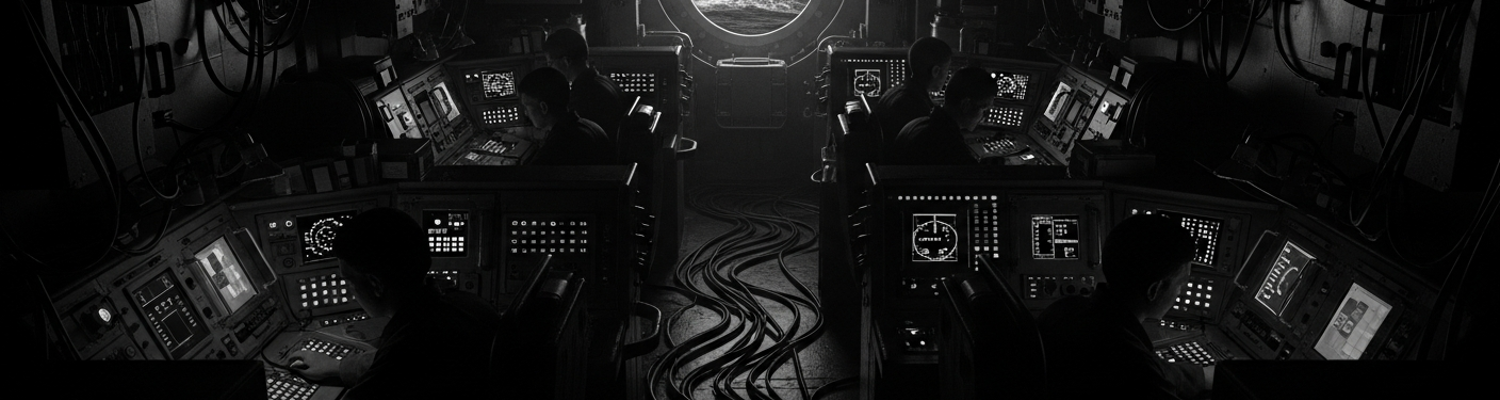
The world for a Naval Security Group technician shrank to the dimensions of a steel, windowless box. These Sensitive Compartmented Information Facilities, or SCIFs, were built deep within the ship to be electromagnetically and acoustically sealed from the outside world. Access was strictly controlled. Personal electronics were forbidden. Inside, multiple operators would work shoulder-to-shoulder in extremely cramped quarters, surrounded by humming racks of equipment that generated considerable heat. The space was dominated by the operator consoles for systems like the AN/WLR-1 countermeasures receiver, each with its associated Cartesian display screen, analysis oscilloscopes, and magnetic tape recorders. The environment was an assault on the senses. The constant low hum of power supplies and cooling fans, the smell of hot vacuum tubes and ozone, and the glow of green and amber phosphor screens. This compartment was an electromagnetically dense space, flooded with the very energy the operators were trying to analyze, requiring extensive shielding to prevent the ship’s own emissions from contaminating the collected signals. The physical confinement and sensory overload, maintained for watch shifts that could last twelve hours, compounded the stress of the mission itself.
The core of the ELINT operator’s job was a high-stakes analytical race against time. The manual process for using a system like the AN/WLR-1 required an operator to be on the right frequency band at the right moment to catch a brief transmission. An ephemeral series of lines appearing on the display screen triggered an immediate, high-pressure sequence. The operator had to manually switch the receiver to an analysis mode and, before the signal disappeared, determine its exact frequency, pulse repetition rate, and other defining parameters. This data was then checked against threat libraries. The problem was that the electromagnetic spectrum was a chaotic environment, filled with atmospheric noise, commercial signals, and deliberate Soviet attempts to deceive. An analyst might spend hours tracking what they believed to be a new Soviet radar only to find it was a harmonic from a commercial fishing vessel’s navigation set. Conversely, a signal dismissed as noise could be the brief activation of a missile guidance radar. This ambiguity was the central, unresolved challenge of the job. The speed of data acquisition was limited not by the equipment, but by the operator’s own decision time. Every intercept was a judgment call made under pressure.
Declassified medical logs and post-tour debriefings from California-based ELINT patrol units (NARA Record Group 38) reveal a consistent pattern of severe anxiety among the Naval Security Group technicians. This was not the generalized stress of naval service, but a specific, job-related affliction rooted in the demands of their work. The anxiety stemmed from the intense pressure to correctly interpret ambiguous signals under punishing time constraints. An operator at an AN/WLR-1 station spent hours staring at a screen, hunting for brief pulses in a sea of electromagnetic noise. The system’s own documentation noted that the speed of analysis was limited not by the equipment, but by the operator’s own decision time. This placed the entire burden of success or failure squarely on the individual technician. A single, momentary lapse of concentration could mean missing the brief transmission of a Soviet missile guidance radar, while misinterpreting a commercial fishing radar could trigger a false alert. This constant analytical pressure, compounded by sleep deprivation and the physical confinement of the SCIF, led to documented cases of chronic fatigue, inability to concentrate, and what one debriefing termed persistent mental agitation.
Instances of morale collapse within the small, isolated ELINT teams were a direct consequence of this high-pressure, low-reward environment. Morale was not a constant but a fragile commodity, easily eroded by equipment failure, mission futility, and interpersonal friction within the cramped SCIF. A patrol on a converted destroyer escort shadowing a Soviet AGI off the San Clemente Island training ranges could become an exercise in extreme frustration. The logs of one such mission from the early 1980s describe a twelve-hour watch cycle where the primary AN/WLR-1 collection system was plagued by a faulty power supply, causing intermittent failures. During one of these outages, a high-gain Soviet antenna was observed being uncovered and activated, a clear sign of a significant transmission, but the American vessel’s collection system was offline. The subsequent report from the senior Communications Technician noted a total collapse of team spirit, with operators becoming sullen, argumentative, and deliberately slow in performing even routine maintenance. The feeling that their specialized training was being wasted by unreliable equipment on a mission with no tangible metric for success created a powerful sense of futility that directly impacted operational readiness.
The perpetual fear of detection or misinterpretation formed the psychological bedrock of every ELINT patrol. All naval personnel on these missions lived with the low-grade tension of the Cold War standoff. The ELINT technicians experienced a unique and amplified version of this fear. Their very job was to listen, to be the invisible ears of the fleet. This created a heightened awareness of their own vulnerability. They were acutely conscious that while they were trying to intercept Soviet signals, Soviet ELINT specialists were undoubtedly attempting the same. Every transmission from their own ship, no matter how brief, was a potential beacon giving away their position and mission. This fear was magnified by the nature of the platforms themselves; slow, lightly-armed converted destroyers or AGERs were not frontline combatants. The specter of the USS Pueblo’s capture was a constant, unspoken presence. Beyond the fear of detection was the more insidious fear of misinterpretation. A technician analyzing a complex signal faced a difficult choice: was this the air search radar of a distant Bear bomber on a routine patrol, or was it the terminal guidance radar of an anti-ship missile just seconds from impact? The doctrine demanded passive collection, but the human mind raced with kinetic possibilities. Every unexpected signal, every sudden maneuver by the shadowed Soviet vessel, created a spike of adrenaline-fueled dread, turning the abstract puzzle of signal analysis into a visceral, personal threat.
Naval Security Group training doctrine from the Cold War period shows a curriculum built on a foundation of clean-room certainty. In classrooms at locations like Corry Station, prospective ELINT technicians learned their craft in a controlled environment. They practiced identifying threat emitters using pre-recorded, high-quality signals piped directly into their training consoles. The manuals for systems like the AN/WLR-1 detailed a precise, step-by-step methodology for signal acquisition and analysis. The process was depicted as a scientific procedure: detect a signal, isolate it, measure its parameters against a known library, and log the result. This idealized workflow promised clarity and certitude, training a generation of technicians to expect a logical puzzle where every piece had a place. It prepared them for a version of electronic warfare that was methodical and predictable.
This was a fiction.
The actual electromagnetic environment encountered during a patrol off the California coast was a chaotic, saturated mess. Instead of the single, clean signals from training, an operator’s console was flooded with a cacophony of overlapping transmissions. Commercial fishing fleets with their own powerful radars, civilian air traffic control, terrestrial radio and television broadcasts, and even atmospheric phenomena created a dense wall of electromagnetic noise. Soviet intelligence-gathering ships compounded this chaos deliberately. Archival analyses of Soviet tactics show a consistent use of electronic deception, activating multiple emitters at once or using decoy signals to mask a significant transmission. An operator at an AN/WLR-1 station, manually tuning through frequency bands, had to attempt to pick out the faint, intermittent pulse train of a Soviet Top Sail air search radar from this background roar. It was less a scientific procedure and more an act of auditory and visual triage under extreme pressure. The very technology of the era, often based on 1970s hardware, struggled with parts obsolescence and was susceptible to interference from the patrol ship’s own systems, further degrading any hope of a clean collection.
This transformed the operator’s task from analysis to a high-stakes guessing game. The sanitized scenarios of the training school were useless. There, a technician might be tested on their ability to differentiate between two known Soviet fire-control radars. On patrol, they had to decide if a fleeting, garbled signal was a Soviet Bear-D bomber probing coastal defenses, a Japanese commercial airliner on approach to LAX, or a harmonic anomaly generated by their own ship’s overloaded power grid. A technical manual for the AN/WLR-1 itself noted that the speed of analysis and data storage would be limited not by the equipment, but by operator decision time. This single sentence in a dry engineering document defined the entire psychological burden of the mission. Every decision rested entirely on one individual’s interpretation of ambiguous data, made in seconds, with the potential consequences of a mistake weighing on every single choice.
Operational logs reveal a constant, escalating technical battle against novel Soviet electronic warfare tactics. Soviet doctrine, known as Radio-Electronic Combat, integrated electronic deception directly into their operational posture. On station off the California coast, this translated into a deliberate effort to confuse and overwhelm the collection capabilities of U.S. Navy vessels. Soviet AGIs did not just passively collect intelligence; they actively manipulated the electromagnetic spectrum. Analysis of archived signal recordings shows Soviet operators using techniques like frequency-agile radars, which rapidly shift their operating frequency to evade detection and make tracking difficult. They would also employ high-power barrage jamming to raise the noise floor across entire frequency bands or use spot jamming to target specific frequencies being monitored by a U.S. ship. This created a working environment for American ELINT technicians that was nothing like the clean signals of their training manuals. The standard AN/WLR-1 receiver, while sensitive, depended heavily on an operator manually tuning to the correct frequency band at the right time to catch a signal. Faced with an adversary that was actively working to deny collection, the standard-issue equipment was often insufficient.
This equipment gap forced extraordinary acts of improvisation from the enlisted technicians and chief petty officers within the shipboard SCIFs. When a Soviet vessel began transmitting a complex, frequency-hopping signal that defied easy characterization, or when multiple signals were used to mask a primary emission, the standard omnidirectional antennas on the American ship proved too blunt an instrument. After-action reports describe a recurring need for more specialized, directional antennas to isolate a single signal from the surrounding electronic noise. Unable to request new gear through official channels in the middle of a tense shadowing mission, crews turned to what was on hand. They began to construct their own antennas. Using lengths of coaxial cable, scrap metal plates from the machine shop, and sometimes even cannibalized parts from backup systems, they would construct crude but effective directional antennas. A common ad-hoc solution was a form of Yagi-Uda antenna, where a simple dipole element was enhanced with a reflector element made of scrap metal and one or more director elements fashioned from copper wire or tubing, all mounted on a wooden boom. This allowed the technicians to create a highly directional antenna that could be pointed directly at the Soviet ship, physically filtering out interfering signals from other directions and focusing the receiver’s sensitivity on the specific target emitter they needed to analyze.
These ad-hoc solutions were a direct response to the appearance of uncataloged signal patterns. The existing threat libraries aboard the ELINT ships were built on known Soviet radar and communication systems, but the Soviets were constantly testing and deploying new hardware. An operator at an AN/WLR-1 station might suddenly detect a signal with a pulse repetition frequency or scan pattern that matched nothing in the catalog. This was a moment of high tension and high stakes. It was in these situations that the jury-rigged directional antennas became essential. By connecting their handmade antenna to a receiver, a team of technicians could work on deck, physically rotating the antenna to find the precise bearing of the unknown signal and to maximize its strength. This improved signal-to-noise ratio was often the difference between getting a clean-enough intercept to analyze and losing the signal in the static. The data gathered, a more accurate pulse width, a clearer picture of the frequency-hopping pattern, or the polarization of the signal, was meticulously recorded on magnetic tape. This new data, captured by a non-standard antenna built from scrap, was the first step in identifying a new piece of the Soviet electronic order of battle.
Established signal analysis doctrine failed rapidly. The official procedure taught for the AN/WLR-1 system was a linear, methodical process suited for a laboratory, not a contested electromagnetic environment. It assumed a technician would be hunting for single, clear emitters. The reality off the California coast was a dense, layered chaos of overlapping signals. Soviet Radio-Electronic Combat doctrine was not passive; it was an aggressive effort to deny collection by using jamming, deception, and frequency-agile emitters designed specifically to defeat manual tuning and analysis. The standard operating procedure of manually scanning frequency bands was too slow and too easily overwhelmed. An operator could spend an entire watch chasing ghosts.
This forced the development of entirely new, non-doctrinal analysis protocols in real-time, deep within the confines of the shipboard SCIF. Ingenuity replaced rigid procedure. Archival evidence describes the emergence of collaborative, team-based collection methods that were never written into any training manual. Onboard platforms shadowing Soviet AGIs, ELINT teams began to operate in a hunter-killer configuration. One operator, the hunter, would use a receiver with a wide bandwidth setting, not to analyze, but simply to detect. His job was to stare at the raw, unprocessed display, looking for any flicker of energy, any pulse that seemed out of place or fleeting. The moment he spotted a potential signal, he would not waste seconds trying to tune and analyze it himself; he would call out the frequency and bearing to a second operator, the killer. This second technician would already have a separate receiver slaved and pre-set to a narrow bandwidth, ready to pounce on that specific frequency range. This allowed the team to capture and record the critical first few seconds of a novel or frequency-hopping signal before it vanished, a task nearly impossible for a single operator following standard procedure.
This was an invention born of necessity.
This ad-hoc system was essential for maintaining any collection capability under the intense pressure of Soviet electronic countermeasures. The process evolved beyond simple detection. Veteran technicians, through hundreds of hours of watch-standing, developed an almost preternatural feel for the electromagnetic environment. They learned to recognize the specific audio signature of different radar types when the receiver’s output was patched to a speaker, a subjective skill that was impossible to teach in a classroom but was highly effective. A senior chief petty officer could often identify the class of a Soviet warship, or even distinguish between two ships of the same class, just by the unique sound of its air-search radar’s pulse train and the particular hum of its power supply. This expertise, passed down from seasoned operators to new arrivals during grueling twelve-hour watches, formed a body of informal, highly effective operational knowledge. This unwritten doctrine allowed crews to perform a sort of predictive analysis, anticipating when a Soviet AGI might activate a high-interest system based on its previous patterns of electronic behavior. This informal, experience-based analysis, completely outside official channels, became the true method for maintaining intelligence collection in the face of an active and deceptive adversary.