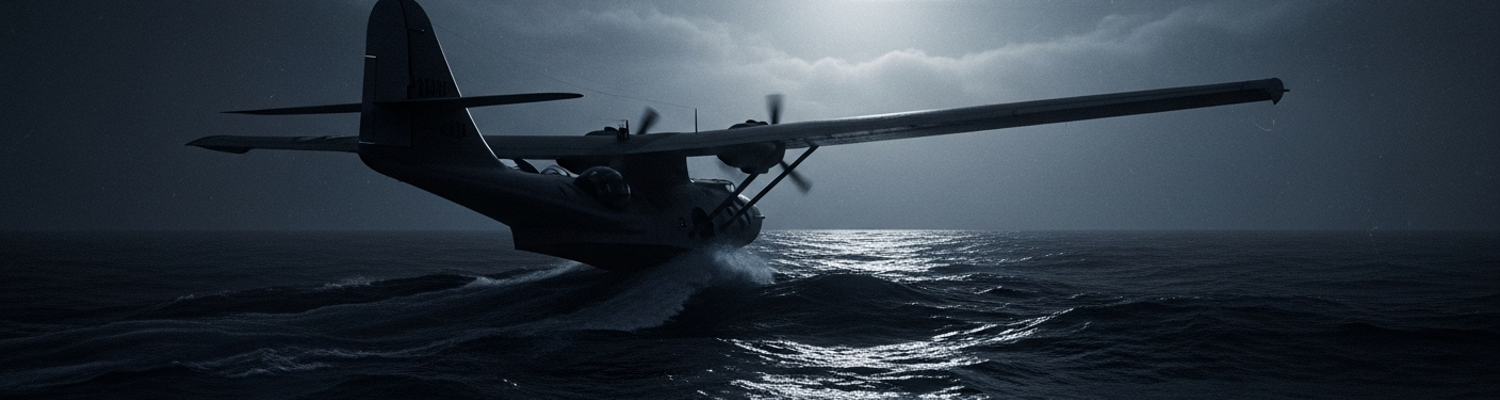

From Eyes of the Fleet to Atlantic Hunters
In the years wedged between two world wars, United States Navy doctrine remained tethered to the battleship. Naval aviation, championed by visionaries like Rear Admiral William A. Moffett, existed primarily to serve the great gun clubs. Its aircraft were conceived as scouts flung from cruisers and battleships to find an opposing battle line. The concept of long-range, independent air operations over vast oceanic tracts was a theoretical indulgence, not a funded priority. The Washington Naval Treaty and its successors placed strict limits on aircraft carrier tonnage, which inadvertently forced the Navy to seek other means of projecting air power over water. Congressional mandates following the 1920 Naval Appropriations Act severely limited the number of land-based air stations, effectively pushing the Bureau of Aeronautics down the path of the flying boat for any hope of extended maritime patrol. The dominant operational question was not how to hunt a submarine in the mid-Atlantic, but how to extend the fleet’s vision just beyond the horizon.
This thinking permeated the Navy’s annual Fleet Problems, large-scale exercises that shaped its tactical mind. In Fleet Problem IX in 1929, the carrier USS Saratoga conducted a successful mock raid on the Panama Canal, demonstrating aviation's potential. Yet the key takeaway for many was the need for better scouting to prevent such a surprise. Early aviation assets were adjuncts, their performance measured by their utility to the surface combatants. The idea of an aircraft as a dominant offensive weapon system, particularly in an anti-submarine warfare (ASW) capacity, was undeveloped. Doctrine evolved slowly, focused on reconnaissance and spotting for naval gunfire. The physical reality of the Pacific and Atlantic oceans demanded aircraft that could stay aloft for punishing durations. This fundamental need for endurance, long before the U-boat threat became a crisis, drove a quiet but persistent technical evolution. The engineers at companies like Consolidated and Martin were not just building planes; they were wrestling with the elemental problems of time, distance, and the unforgiving nature of the sea.
Designing for Extended Oceanic Reach
The central engineering challenge of the interwar period was building a machine that could carry a meaningful payload over thousands of miles of open water, remain on station for nearly a full day, and survive the landing. Consolidated Aircraft Corporation’s PBY Catalina, which first flew in prototype form in March 1935, represented a landmark solution. Its defining feature was the massive, internally braced parasol wing. This design elevated the engines high above the corrosive salt spray and allowed for a relatively shallow, efficient hull. The most ingenious element was Isaac M. Laddon’s design for retractable wingtip floats. These floats folded upward to form streamlined wingtips, drastically reducing drag compared to the fixed floats on earlier flying boats. The aircraft’s skin was made of Alclad, a composite aluminum sheet with a pure aluminum coating, which offered superior resistance to saltwater corrosion. Its immense range came from large integral fuel tanks built directly into the wing structure, a design that maximized volume without adding the weight of separate bladder tanks.
Power came from two Pratt & Whitney R-1830 Twin Wasp 14-cylinder radial engines. Each R-1830-92 variant could produce 1,200 horsepower for takeoff, but crews operated them for hours at lean cruise power settings, nursing fuel consumption to achieve the Catalina’s typical endurance of 15 to 20 hours. The engine itself was a marvel of 1930s technology, but for the flight engineers who managed them over endless stretches of ocean, they were a constant source of attention. A rough-running engine, an oil pressure fluctuation, or a sudden drop in RPM was a serious crisis hundreds of miles from any friendly base. The Glenn L. Martin Company took a different approach with its PBM Mariner, designed in 1937. The Mariner featured a deep, robust hull with two steps, which improved hydrodynamic performance on takeoff, and a distinctive gull wing to keep its more powerful engines clear of spray. This made it a superior aircraft in rough seas but also more complex. The first PBM-1s entered service with Patrol Squadron Fifty-Five (VP-55) on September 1, 1940. Both the Catalina and Mariner were true flying boats, often operating for weeks from tenders anchored in remote lagoons. This self-sufficiency was a core design requirement, but it placed immense strain on the crews. Navy veteran Cash Barber, a flight engineer on PBYs, recalled carrying a box of small wooden plugs to hammer into rivet holes that would pop open during rough water landings to keep the aircraft from sinking.
Inside these aircraft, the human element was pushed to its limits. The flight deck was cramped, noisy, and subject to extreme temperature swings. Behind the pilots, the navigator worked at a small table with charts and sextant, while the radio operator managed communications with temperamental high-frequency sets. Further aft, bunks allowed for a rudimentary form of hot-racking, where crew members would take turns sleeping on long patrols. A small galley provided hot coffee and warmed cans of food. For hours on end, gunners stood watch in the exposed waist blisters, their eyes scanning the waves, battered by wind and spray. The constant, deafening roar of the radial engines was a physical presence, a vibration that seeped into the bones and made conversation impossible without the intercom. It was a test of mental and physical stamina.
A New Doctrine Forged in Crisis
The attack on Pearl Harbor on December 7, 1941, shattered the Navy's battleship-centric doctrine. In the Atlantic, the eruption of Operation Drumbeat (Paukenschlag) in early 1942, when German U-boats began devastating Allied shipping along the American East Coast, created an immediate and desperate need for an effective ASW capability. In the first six months, Karl Dönitz’s submarines sank hundreds of vessels in waters supposedly controlled by the US Navy. The existing patrol aircraft, designed for scouting, were thrown into the fight. Their crews, trained for reconnaissance, were now hunters. The doctrinal shift was not a deliberate, scholarly process; it was a frantic, life-or-death adaptation driven by operational necessity.
The initial focus on finding enemy fleets gave way to the monotonous, draining work of convoy escort and barrier patrols. A typical ASW patrol involved flying precise search patterns, like the 'creeping line ahead' or 'expanding square', for 12, 15, or even more hours. This new form of warfare required entirely new equipment and tactics. Early airborne Air-to-Surface Vessel (ASV) radar could detect a surfaced submarine, but the signal was lost in the sea clutter at close range, leaving the crew blind in the final moments of a night attack. The British-developed Leigh Light, a powerful 22-million candela searchlight, solved this problem. Switched on just as the radar contact was lost, it would illuminate the U-boat, giving the crew no time to dive. US Navy PBYs were fitted with this device, turning them into lethal night hunters. Later, aircraft were equipped with Magnetic Anomaly Detector (MAD) gear, a long boom extending from the tail that could detect the metallic mass of a submerged submarine. This required flying at perilously low altitudes, often less than 100 feet above the waves, to get a signal. The combination of long-endurance aircraft, ASV radar, the Leigh Light, and MAD gear, coordinated through the newly formed 10th Fleet under Admiral Ernest J. King, allowed Allied forces to close the mid-Atlantic 'air gap' and relentlessly harry the U-boats.
The Flying Boats Go to War
The PBY Catalina proved its worth from the first hours of the war. A PBY on patrol near Pearl Harbor detected and dropped depth charges on a Japanese midget submarine an hour before the main aerial assault began. At the Battle of Midway in June 1942, it was a PBY from VP-44, piloted by Ensign Jack Reid, that first located the approaching Japanese fleet on June 3rd, providing the critical intelligence that led to the American victory. But it was in the grinding, attritional campaigns that the flying boats made their most significant contribution. In the Battle of the Atlantic, PBYs and the newer PBM Mariners became the scourge of the U-boat fleet, operating from austere bases in Reykjavik, Iceland, and Natal, Brazil. On June 30, 1942, a PBM from Patrol Squadron Seventy-Four (VP-74), commanded by Lieutenant R. E. Schreder, achieved the type’s first U-boat kill, sinking U-158 off Bermuda. The attack was a classic example of the new tactics: a radar contact from above the clouds, a swift descent, and a surprise attack that left the submarine no time to react. Over the course of the war, Mariners would be credited with sinking ten U-boats.
In the vastness of the Pacific, patrol squadrons found a new role in nocturnal interdiction. As American forces gained air superiority, the Japanese military relied on nighttime resupply runs, dubbed the 'Tokyo Express,' to sustain their isolated island garrisons. In response, several PBY squadrons, starting with VP-12, painted their aircraft matte black and began flying night-attack missions. These 'Black Cats' became a feared force. Flying low and slow in the darkness, they used their early AN/APS-15 radars to find Japanese barges, transports, and destroyers. A typical mission for a crew from a squadron like VP-54 in the Solomon Islands involved taking off at dusk and flying a patrol sector for hours. Upon getting a radar contact, the pilot would descend to just a few hundred feet, using the dark landmass of an island to mask his approach. The final run was a high-stress affair, flying a slow aircraft directly into enemy defensive fire to release bombs or torpedoes. From late 1942 through early 1945, the Black Cat squadrons sank or damaged a huge volume of enemy shipping, disrupting logistics and proving that with the right doctrine and immense crew fortitude, even a lumbering flying boat could become a deadly predator of the night.