
In the last days of January 1969, the 3rd Marine Division faced a complex threat in South Vietnam’s I Corps. Allied intelligence estimated nearly 89,000 enemy soldiers, including 42,700 North Vietnamese Army regulars, operated within the corps tactical zone and its border areas. NVA units like the 320th and 324B Divisions were well-trained, disciplined, and positioned to contest the Demilitarized Zone. As the 9th Marine Regiment prepared to launch an offensive into the Da Krong and A Shau Valleys for Operation Dewey Canyon, they confronted an adversary with substantial numerical strength and an intimate knowledge of the terrain.
The operational concept for Dewey Canyon was ambitious. It depended on a series of leap-frogging fire support bases to create an umbrella of artillery protection for the mobile infantry. The success of this high-mobility strategy rested entirely on perfect communication between forward observers, rifle companies, and the gun batteries positioned miles away. The NVA, entrenched in fortified positions and supplied from their logistical hub in the A Shau, was prepared to fight for every inch of ground.
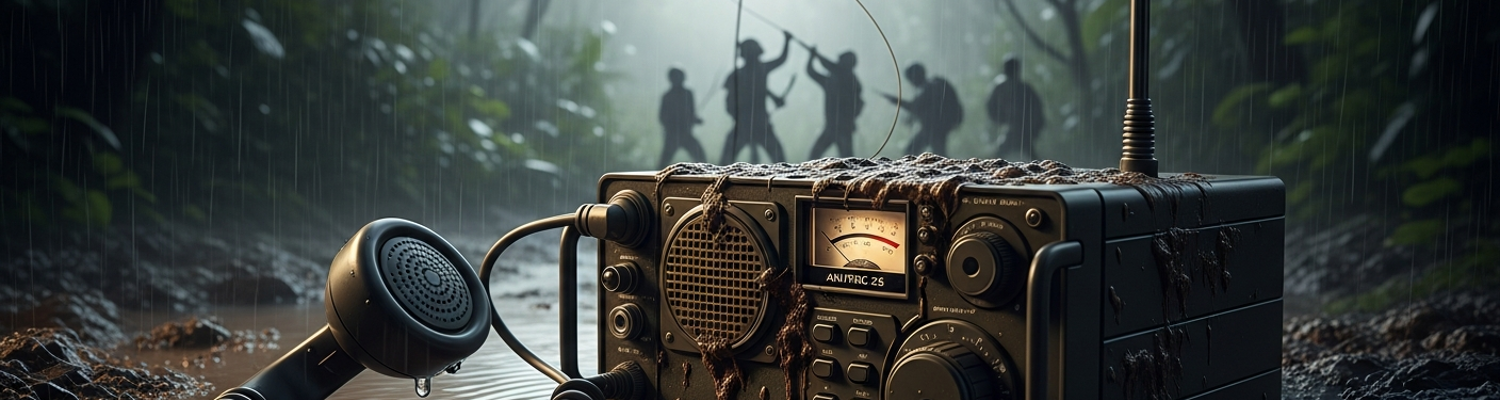
Between January 29 and 31, the seasonal monsoon arrived over Quang Tri Province with force. The extreme humidity and driving rain became a direct assault on the communication equipment of the 3rd Marine Division. The workhorse of tactical radio, the AN/PRC-25, was officially rated as water-resistant, but the conditions in the Da Krong Valley pushed the hardware far beyond its design limits. A close review of operational logs from the period (archived under NARA Record Group 127) indicates the radios failed in multiple, compounding ways. The primary point of failure was moisture penetrating the H-189/GR handset. While the main transceiver was a sealed metal case, the push-to-talk handset was notoriously susceptible to water intrusion. Liquid would seep into the switch mechanism, causing it to short out or fail to make a connection. Radio operators began wrapping their handsets in the plastic bags from battery packaging, a crude but necessary field improvisation.
Beyond the handset, the oppressive dampness attacked the battery terminals. Green blooms of copper-oxide corrosion would form on the contacts of the CY-2562/PRC-25 battery box, interrupting the flow of power and rendering the 25-pound radio set inert. The air itself, thick with moisture and choked by a triple-canopy jungle, attenuated the FM signals, drastically reducing a broadcast range already compromised by the mountainous topography.
The tactical consequences of this technological breakdown were immediate. As Operation Dewey Canyon began, infantry companies of the 9th Marines advanced deep into enemy territory, frequently moving beyond the line of sight of their supporting firebases like Cunningham and Razor. When the radios went dead, these units were not just out of touch; they were functionally isolated. A rifle platoon pinned down by an NVA machine gun bunker could not transmit coordinates for a fire mission. A company commander observing a large enemy force maneuvering on his flank had no way to report the intelligence to battalion headquarters or request reinforcements.
Silence on the command nets left leadership at the regimental command post on Firebase Cunningham staring at maps, unable to track the progress or status of their forward elements. For the men on the ground, the isolation was absolute. Radio operators, already prized targets for enemy snipers, would frantically try to get a signal out. They climbed to higher ground in the open, scraped battery contacts clean with their P-38 can openers, and cycled through every frequency in a search for a friendly voice. For several days, resupply and medical evacuation by helicopter were impossible due to the thick, low cloud cover, compounding the isolation of units that were now low on ammunition and sustaining casualties.
This widespread environmental degradation of equipment was systematically exploited by the North Vietnamese Army. NVA and Viet Cong forces in I Corps demonstrated a sophisticated understanding of American communication vulnerabilities. Their intelligence units often used captured or commercially available receivers, such as Sony or Panasonic radios modified to tune into the U.S. tactical frequency band, to monitor Marine nets. Since the primary American manpack radios of the era, the AN/PRC-25 and its successor, the AN/PRC-77, were fielded without effective encryption, all traffic was sent in the clear. NVA units could pinpoint the locations of command posts and forward units by using radio direction-finding equipment on the consistent chatter. They specifically targeted Radio Telephone Operators (RTOs), who were easily identified by the radio’s bulk and its three-foot “tape measure” antenna, understanding that killing the radioman could decapitate an entire platoon.
When the monsoon’s intensity peaked, NVA commanders knew Marine units might be cut off. They would wait for the radio silence, then initiate ambushes or assaults, confident that the isolated Marines could not effectively coordinate a defense or call for the artillery and air support that so often shifted the balance of a fight.
The unceasing, makeshift repairs performed by Marine communicators represented a triumph of ingenuity over systemic hardware failure. With the AN/PRC-25 radio as the center of their problems, RTOs became battlefield technicians. Their toolkits consisted of whatever they could carry or find. The most common points of failure were the H-189/GR handset and the battery box connections. Under the duress of the monsoon, water would foul the handset’s push-to-talk switch, creating an open circuit. The standard field fix involved prying the plastic casing apart, often with a P-38 can opener or the tip of a Ka-Bar knife, and physically drying the internal contacts. RTOs would then wrap the entire handset in the plastic bag that new BA-4386 batteries were packaged in, sealing it with rubber bands scavenged from ration kits. The battery terminals were another persistent issue, quickly developing a film of green oxidization that severed the power connection. Marines would scrape these contacts clean with any available abrasive, a process that had to be repeated constantly in the near-100% humidity. These were not glamorous repairs; they were repetitive acts of maintenance performed in the mud, often under fire, by teenagers who understood that a silent radio was a danger to their entire platoon.
Survival depended on a signal.
To overcome the signal-absorbing combination of mountainous terrain and triple-canopy jungle, jury-rigging antennas became standard operating procedure. While the PRC-25 was issued with a three-foot tape-style antenna and a longer, ten-foot whip antenna, neither was consistently effective in the deep valleys of Quang Tri Province. RTOs and their assistants resorted to creating their own antenna systems. A common practice involved using communications wire, or even splicing several issued antennas together, to create a long-wire antenna. They would then throw the weighted end over the highest accessible tree branch, hoisting the improvised antenna dozens of feet into the air to break free of the densest foliage. This was a high-risk action. Climbing a tree or even just standing in the open to arrange the wire drew the immediate attention of NVA snipers who actively hunted radiomen. Where direct line-of-sight was impossible, units established ad-hoc relay points. This often involved dispatching a fireteam to an exposed hilltop for the sole purpose of having their RTO act as a human repeater, receiving transmissions from the company in the valley and rebroadcasting them to the command post on a nearby firebase. This practice, born of necessity, placed small groups of Marines in isolated, static positions that were highly vulnerable to being targeted and overrun.
The battle to maintain command links extended beyond the platoon level, engaging specialized engineers in a constant struggle. While infantry RTOs wrestled with their PRC-25s, communications personnel at the battalion and regimental command posts on firebases like Cunningham and Razor fought to keep the larger network operational. Higher-echelon communications relied on more powerful, but equally vulnerable, systems like the vehicle-mounted AN/VRC-46 and the heavy AN/GRC-106 HF radio sets. These units, often housed in canvas-sided bunkers or tents, were just as susceptible to the monsoon’s corrosive dampness, which attacked their more complex tube and solid-state circuitry. A critical component of the command infrastructure was the simple field telephone, connected by miles of WD-1/TT telephone wire. Wire teams from the 3rd Marine Division’s communications battalions would spend their days spooling out this “slash wire” through the jungle, linking the firebases and command posts. A review of operational logs shows this was a near-futile effort. The wire was constantly being cut by NVA patrols, shredded by friendly and enemy artillery, or simply shorting out from moisture. Engineers would spend hours locating and painstakingly splicing breaks in the line, only for it to be cut again moments later, forcing the entire command structure to fall back on the already over-burdened and unreliable radio frequencies.
Archival materials from the 3rd Marine Division’s deployment in I Corps confirm the extensive presence of combat photographers and correspondents. Men from the 1st Combat Camera Group, as well as photojournalists from major news services, were embedded with units of the 9th and 4th Marine Regiments during operations like Dewey Canyon. Their mandate was to document the American military effort. The resulting photographic record, shot on professional-grade 35mm cameras like the Nikon F, is a visceral depiction of kinetic warfare. Images capture Marines charging up hillsides, helicopters descending into smoky landing zones, and the work of corpsmen treating casualties. This visual archive, intended for both internal historical records and public dissemination, overwhelmingly prioritized depictions of valor, action, and human drama. An analysis of these images reveals a consistent focus on the infantryman and his rifle. The technical specialists, the radio operators and wiremen, appear primarily as background figures, their struggles subsumed by the larger narrative of combat.
There are no dramatic photographs of a Radio Telephone Operator meticulously scraping the green corrosion from a BA-4386 battery terminal with his P-38 can opener. The official visual history does not contain a sequence showing a Marine wrapping his H-189/GR handset in a plastic bag to keep the push-to-talk switch dry during a monsoon downpour. The photographers captured the fight, but the technical war, the constant, grinding battle against equipment failure, remained almost entirely unseen.
This visual oversight was compounded by a breakdown in administrative reporting regarding equipment deficiencies. The extreme focus on immediate combat survival and tactical maneuverability meant that the granular details of communication failures were never formally documented. A platoon commander, pinned down by NVA machine-gun fire from a fortified bunker in the A Shau Valley, would not pause his report of enemy contact to dictate a supplementary memo on the poor performance of his RTO’s antenna in the dense, wet foliage. After-action reports, the primary tool for gathering battlefield data, were structured to capture tactical information: enemy strength, friendly and enemy casualties, ammunition and resupply levels, and a chronological summary of the engagement. A section detailing a communications blackout would often contain the terse, unspecific entry “lost comms.” This entry provided no actionable data for the logisticians and technicians at the regimental or divisional level. It did not explain that the failure was due to moisture penetrating the handset, signal attenuation from the triple-canopy jungle, or corroded battery contacts. The very structure of wartime reporting, combined with the life-or-death priorities of frontline leaders, created a system where widespread, systemic equipment failures went completely unrecorded. The crisis was everywhere, but in the official paperwork that drove institutional change, it was nowhere.
The efforts of communicators were consequently rendered invisible to the wider command structure and to later historical analysis. The quiet, unglamorous work of keeping the network alive was simply considered part of the job, an expected and unrecorded aspect of daily survival. An RTO with the 9th Marines who spent two hours on an exposed ridge, manipulating a jury-rigged long-wire antenna thrown over a tree to finally make contact with Firebase Cunningham, performed an action essential to his platoon’s survival. Yet, this act of technical improvisation and personal courage would never appear in a citation. His success was measured by the brief moment the command net crackled back to life, not by the ingenuity he displayed. This lack of documentation had profound long-term effects. With no official record detailing the constant field modifications and desperate repairs, there was no impetus for the Marine Corps Systems Command to demand fundamental design changes from the manufacturers of the AN/PRC-25 and its successors. The resourcefulness of the individual Marine in the field effectively masked the inadequacies of the equipment he was issued, creating a closed loop of failure. The lessons learned in the mud of the Da Krong Valley were never institutionalized; they were simply relearned, at great cost, by the next unit to move into the jungle.