
North African Theater Supply Challenges
Before the first shots at Kasserine Pass, American soldiers of the II Corps were already fighting a losing battle. The advance into Tunisia after the November 1942 Operation TORCH landings had stalled. A review of operational logs (NARA Record Group 407) shows units stretched over hundreds of miles from the primary Allied ports of Casablanca, Oran, and Algiers. This distance was serviced by a decrepit infrastructure.
A single-track, French-built railway system was the main artery. It was a logistical nightmare, plagued by differing gauges between Algeria and Tunisia that forced constant unloading and reloading. The road network was worse, consisting largely of dirt tracks. When unanticipated winter rains began in late 1942, these roads dissolved into impassable rivers of mud, bringing vehicle convoys to a standstill for days. Troops at the front, particularly elements of the 1st Armored Division, were physically debilitated, short on rations, and low on fuel before ever engaging the enemy.
The supply chain was not broken. It was never truly built.
Initial planning for Operation TORCH had prioritized combat troops over logistical support personnel. This decision had immediate and severe consequences. Archival evidence shows a shortage of the unglamorous units that make a modern army function: port battalions to unload ships, engineer companies to repair roads, and truck companies to move materiel forward. The port of Algiers, the most vital logistical hub, became a choke point. Ships waited for days to be unloaded while under constant threat of Axis air attack. A dire lack of spare parts for American vehicles meant that routine mechanical failures became terminal. Breakdowns of trucks and tanks were rampant. With no replacements available, cannibalization of other vehicles became standard practice, steadily eroding the combat power of frontline units. The distance from the ports to the front lines near the Tunisian border was simply too great for the fragile and under-resourced logistics network to sustain.
Protection was a matter of sand, steel scrap, and hope.
This failure to supply extended to armor protection. American-made M3 Lee and the newer M4 Sherman tanks arrived with armor plating that was dangerously inadequate against high-velocity German anti-tank guns. There were no official up-armor kits available from army depots. In response, individual tank crews resorted to desperate measures. Photographs from late 1942 show tanks of the 1st Armored Regiment laden with sandbags, a technique crews hoped would dissipate the blast from a shaped-charge warhead. This addition, however, added immense weight, severely straining engines and suspensions. Crews welded scavenged plates of steel from destroyed vehicles onto their hulls and turrets. Others bolted on sections of railroad track or even poured concrete into makeshift frames. This was not a centralized program but a frantic, unit-by-unit effort to survive.
These logistical hurdles cascaded directly into a crisis of combat readiness. The constant cannibalization of vehicles for parts meant that by February 1943, many tank battalions could only field a fraction of their authorized strength. The 168th Infantry Regiment received 450 new troops just days before the battle at Sidi Bou Zid. Many had not completed basic training and lacked personal rifles. Fuel and ammunition shortages frequently halted offensive plans and left units dangerously exposed. The improvised armor, while a sign of ingenuity, increased fuel consumption and the rate of mechanical failure. As Rommel prepared his offensive, American forces were not only inexperienced and poorly led, they were exhausted, under-equipped, and struggling to simply keep their machines running.
Improvised Vehicle Armor Degradation
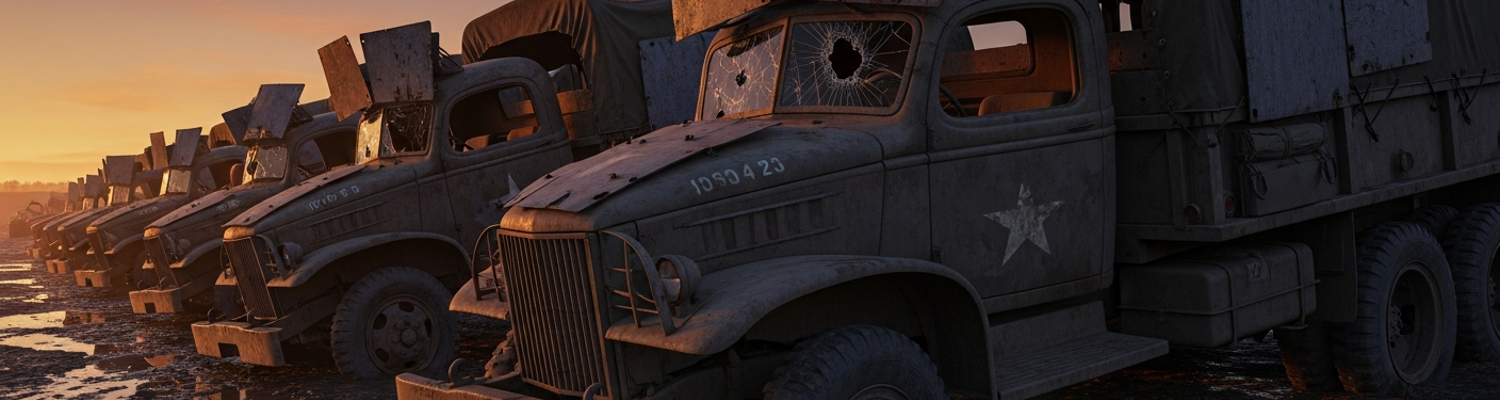
A review of II Corps operational logs from early 1943 reveals a field-level campaign to harden soft-skinned vehicles. With no official up-armoring kits available, ordnance and maintenance crews resorted to extreme improvisation. The primary material was boilerplate steel, essentially thick, unhardened metal plates, sometimes salvaged from local shipyards or scavenged from destroyed French and Italian rolling stock. Period photographs show GMC CCKW and Dodge WC-series trucks with crude steel plates welded or bolted to their doors, radiator grilles, and cab walls. These were not engineered solutions. They were frantic efforts to provide some measure of protection for drivers hauling fuel and ammunition toward Faïd Pass. The application was inconsistent, varying wildly from one truck to the next, dictated entirely by the availability of scrap metal and the limited capacity of field welding equipment.
This ad-hoc armoring was a direct consequence of a systemic supply failure. A May 1942 order from the U.S. War Production Board had severely restricted the use of steel for most non-combat production. While military needs had priority, shipping tonnage to North Africa was ruthlessly triaged. Ammunition, fuel, and replacement combat vehicles took precedence. The raw steel plate required for factory-produced armor kits was not a priority for shipment. Ordnance planners were aware of the vulnerability of supply convoys, but their requests for armor kits were stymied by the larger shipping problem. There was not enough ship capacity to transport both the essentials for combat and the materials for vehicle protection. The decision was made thousands of miles away, leaving drivers and mechanics in Tunisia to fend for themselves.
Protection came at a steep mechanical price.
The standard GMC CCKW 2½-ton truck, the workhorse of the supply lines, had a chassis weight of roughly 8,500 pounds. Its engine and suspension were engineered for that load. Adding hundreds, and in some cases thousands, of pounds of boilerplate steel catastrophically overstressed these components. The constant abrasion from sand and dust already wore down parts at an accelerated rate. The additional weight multiplied this effect. Leaf springs, not designed for the constant overload, would flatten and crack, immobilizing a truck and blocking narrow mountain roads. Transmissions and clutches, particularly on the steep gradients of the Tunisian mountains, burned out with alarming frequency. Engines overheated as they strained to move the excess mass, leading to thrown rods and cracked blocks. This wave of non-combat vehicle losses created a negative feedback loop. The attempt to protect trucks from enemy fire made them more likely to break down, which in turn slowed the delivery of the spare parts needed to fix them. A single truck, disabled by a failed axle bearing, could halt an entire convoy for hours, creating a stationary target for German Stuka attacks.
Axis Intelligence Decryption Failures
Cryptanalytic records from early 1943 reveal a significant intelligence failure preceding the German offensive at Sidi Bou Zid. The central problem was an almost total lack of signals to intercept. Field Marshal Erwin Rommel, keenly aware of Allied success in decoding Axis communications, implemented a strict policy of radio silence for the initial stages of Operation Spring Breeze, or Unternehmen Frühlingswind. The veteran 10th and 21st Panzer Divisions, which formed the two main attack columns, received their final orders via landline and courier. Their assembly in forward positions and the movement of German pioneers to clear minefields went undetected by Allied listening posts. The codebreakers at Bletchley Park, who had provided game-changing information by decrypting Luftwaffe Enigma traffic, were faced with a void. There were no messages detailing ambush points or operational start times to decode. The entire Allied intelligence apparatus, increasingly reliant on ULTRA intercepts, was rendered deaf and blind by an enemy who refused to speak on the air.
This electronic vacuum was compounded by a near-total lack of tactical intelligence. Without signals to intercept, Allied command depended on physical reconnaissance, which failed completely. On the morning of February 14th, a fierce sandstorm swept across the plains, cloaking the westward advance of over 140 German tanks from Faïd and Maizila passes. The first indication of the attack for many American officers of the 1st Armored Division was the sound of gunfire as German tanks swarmed their positions. U.S. forces, particularly Combat Command A, were fragmented and spread thinly across a wide front, a disposition based on flawed high-level assessments. Lacking reconnaissance, American counterattacks were launched directly into prepared German kill zones. A classic German ruse involved a feigned retreat, luring American M4 Sherman tanks into a pursuit, where they were then engaged by concealed screens of high-velocity 88mm anti-tank guns. This tactic was repeated with devastating effect.
A warning that arrives too late is not a warning.
Even if actionable intelligence had existed, the Allied command structure in Tunisia was so fractured that its timely dissemination was practically impossible. The American II Corps, British First Army, and French XIX Corps operated with poor coordination and conflicting objectives. The II Corps commander, Major General Lloyd Fredendall, directed the battle from a heavily fortified command bunker complex built by engineers 70 miles behind the front. He communicated with his divisions via unreliable radio links and couriers. Intelligence that did trickle in from French patrols was often dismissed or misinterpreted. A warning from II Corps' own intelligence officer about a likely German thrust through Faïd was ignored by the British First Army’s commander, who was convinced the attack would fall elsewhere. For a convoy commander on the dusty tracks around Sidi Bou Zid, this meant there was no flow of information. Orders were cryptic or non-existent, leaving isolated units to fight and die based on what they could see in the immediate sand and smoke in front of them.
Internal Communications Misdirection
Operational logs from the American II Corps in February 1943 reveal a communications system on the verge of collapse. The technical backbone, primarily the SCR-193 and vehicle-borne SCR-284 radio sets, was unsuited for the Tunisian terrain. These radios saw their effective range drastically reduced by the canyons and ridges of the Eastern Dorsal mountains. This left vast dead zones where units were completely cut off. Compounding the physical limitations was a command-level failure in signal doctrine. Major General Lloyd Fredendall directed the battle from his elaborate bunker complex near a place called Speedy Valley, a full 70 miles behind the front. His orders were often transmitted over these unreliable radio links using a self-invented slang. He referred to infantry as walking boys and artillery as popguns. The unfortunate side effect was that his own subordinate commanders were frequently just as baffled as the enemy, leading to delays as they struggled to decipher what they were being ordered to do.
This was not a system suffering from friction. It was actively broken.
The result was a cascade of routing errors that sent American supply convoys directly into the path of the German offensive. On February 14, as the 10th and 21st Panzer Divisions surged through the Faïd and Maizila passes, American logistical columns were still operating on outdated movement orders. A truck convoy carrying fuel for Combat Command A, believing its route to be secure, would proceed along a designated road only to find itself driving headlong into a German armored spearhead that had passed through hours earlier. These were not isolated incidents. German battle plans were predicated on a rapid, two-pronged envelopment of American forces around Sidi Bou Zid. The northern pincer from 10th Panzer and the southern one from 21st Panzer were designed to meet and trap the American defenders. Convoys rerouted by II Corps headquarters, based on faulty and delayed information, were often sent down the very roads the Germans were using for their advance.
American supplies were, in effect, delivered directly to the enemy's guns.
The systemic breakdown of communication had a paralyzing effect. Convoy commanders, unable to get reliable updates, were forced to operate in a total information vacuum. The decision to proceed down a road or to hold position became a gamble. Halting a convoy for clarification that might never arrive made the collected vehicles a concentrated target for the Luftwaffe, which maintained air superiority. Pushing forward risked blundering into a prepared German anti-tank screen of 88mm guns, a fate that befell numerous American armored units. This operational paralysis extended to rescue efforts. Units cut off and surrounded, like elements of the 168th Infantry Regiment on Djebel Lessouda, could not be effectively relieved because the command structure lacked a clear, real-time picture of the battlefield. A counterattack by Combat Command C toward Sidi Bou Zid on February 15 was launched with poor intelligence, resulting in the loss of 46 tanks as it drove straight into a German ambush. The communication failures emanating from Fredendall's distant headquarters ensured that tactical decisions were being made based on a situation that no longer existed.
Kasserine Medical Evacuation Crisis
II Corps medical after-action reports from February 1943 reveal a doctrinal system of casualty evacuation completely severed from the conditions on the ground. The plan was methodical: wounded men were to be stabilized at battalion aid stations, then moved by litter bearers and ambulances to larger collecting stations, and finally to clearing stations for surgery before evacuation to hospitals in the rear. This process was contingent on a stable front and secure lines of communication. At Sidi Bou Zid and Kasserine Pass, the speed of the panzer attacks rendered this system instantly obsolete. Forward aid stations of the 1st Armored and 34th Infantry Divisions were overrun in the opening hours. Medics, surgeons, and their equipment were captured or destroyed. Records from the 47th Armored Medical Battalion show its companies were forced into a series of hasty withdrawals, displacing further and further north from Kasserine Pass, attempting to stay ahead of the advancing German columns.
The entire system collapsed.
The result was a significant delay in medical response for the hundreds of American soldiers wounded in the initial ambushes. For infantrymen of the 168th Infantry Regiment, surrounded on the hills of Djebel Lessouda, or for the tank crews of Combat Command A, whose vehicles were destroyed by hidden 88mm guns, there was no evacuation. Wounded men lay in the open desert or in shallow slit trenches for hours, and sometimes days. German control of the roads and the continued combat made it impossible for American ambulances or medics to reach the isolated pockets of survivors. A grievous wound that might have been survivable with prompt surgical care became a death sentence. The number of American troops listed as missing in action, a figure that eventually rose to over 3,000, includes an unknown quantity of men who were wounded and subsequently died from exposure or lack of medical attention.
This paralysis was a direct extension of the battle's core communication failures. Medical units, like their combat counterparts, were operating in an information vacuum. The same mountain ridges that created radio dead zones for tank commanders also prevented ambulance dispatchers from receiving coherent requests for casualty extraction. An examination of II Corps signal logs shows that even when messages did get through, the chaotic command structure and Major General Fredendall's physical and operational distance from the front meant that medical assets could not be safely routed. A collecting company, ready with surgeons and plasma, would be held in place for lack of reliable information about which roads were clear of German armor. Ambulances sent forward based on outdated intelligence were driven directly into enemy kill zones or were forced to turn back. For a wounded soldier waiting in the cold Tunisian rain, the silence of the radio was as dangerous as the enemy.