
A Region on Fire
The summer of 1958 found the Middle East balanced on a razor's edge. The currents of pan-Arab nationalism, championed by Egypt's Gamal Abdel Nasser, surged across the region. Nasser's vision had recently produced the United Arab Republic, a political union of Egypt and Syria that many Arab nationalists saw as the nucleus of a future superpower. For the United States, engaged in the global Cold War, the Middle East was a critical theater of operations. Washington watched with deep concern as Soviet influence grew in Cairo and Damascus. Lebanon, a fragile republic built on a delicate confessional system of power sharing, became a flashpoint in this wider geopolitical struggle. Its pro-Western president, Camille Chamoun, a Maronite Christian, had openly embraced the 1957 Eisenhower Doctrine. This policy pledged American military and economic aid to Middle Eastern nations resisting armed aggression from any nation controlled by international communism. Chamoun's alignment with Washington, along with his controversial effort to amend the constitution to seek a second term, alienated large segments of Lebanon's population, particularly Sunni Muslims drawn to Nasser's ideology. Prominent opposition leaders like Saeb Salam and Rashid Karami galvanized this dissent.
By May 1958, political tensions erupted into a low-grade civil war. Armed rebels, receiving support and arms from Syria, clashed with government forces in Beirut, Tripoli, and the Chouf mountains. The Lebanese Army, under its commander General Fuad Chehab, walked a tightrope. Chehab, a respected figure, sought to contain the violence without shattering the military's own multi-confessional structure, a move he knew would lead to the country's complete disintegration. President Chamoun made repeated, urgent appeals for American help. The decisive moment came on July 14, 1958. A violent military coup in Iraq, led by Brigadier Abd al-Karim Qasim, swept away the pro-Western Hashemite monarchy. King Faisal II and his prime minister, the staunchly anti-communist Nuri al-Said, were brutally killed. The event sent shockwaves through Washington and London. The fear was that Lebanon would be next, followed by Jordan, creating a domino effect that would hand the entire oil-rich region to Nasser and his Soviet patrons.
Eisenhower's Decisive Order
President Dwight D. Eisenhower, a leader forged in the crucible of supreme command during World War II, recognized the gravity of the situation. The Iraqi coup was a direct challenge to American interests and regional stability. He immediately convened his national security team. Secretary of State John Foster Dulles and his brother, CIA Director Allen Dulles, argued forcefully for intervention. They believed that failing to act would be perceived as a sign of American weakness, inviting further aggression. Chairman of the Joint Chiefs of Staff, General Nathan Twining, confirmed that U.S. forces were ready. Acting on the authority of the Eisenhower Doctrine and President Chamoun’s formal request, Eisenhower made a swift choice. On July 15, 1958, he authorized Operation Blue Bat, a direct American military intervention to secure Lebanon.
The directive was twofold. First, to protect the thousands of American citizens in Lebanon and secure evacuation routes if necessary. Second, to demonstrate unwavering support for the legitimate, pro-Western government of Lebanon. The presence of American military power was intended to deter further external aggression and prevent the state's collapse. It was a calculated projection of force, intended to send an unmistakable message to both regional agitators and their sponsors in Moscow. The order set in motion a massive logistical undertaking. It called upon the forces of the U.S. Sixth Fleet, commanded by Admiral James L. Holloway Jr., which had been on high alert in the eastern Mediterranean for weeks. The fleet's carrier air power and amphibious capabilities were the key to executing Eisenhower's directive at speed.
The Landing at Khalde Beach
The spearhead of Operation Blue Bat was the 2nd Provisional Marine Force, a self-contained Marine Air-Ground Task Force. Its core ground combat element was Battalion Landing Team 2/2, the Second Battalion, Second Marines. The force, under the command of Brigadier General Sidney S. Wade, was embarked with Admiral Holloway’s Sixth Fleet. The plan, conceived and refined amidst the escalating crisis, called for an amphibious assault to seize and secure the Beirut International Airport, located south of the capital at Khalde. This would provide a secure lodgment for follow-on forces and control a key entry point into the country. At 3:00 PM local time on July 15, the landing began. The scene was surreal. As amphibious tracked vehicles (LVTP-5s) and landing craft churned through the surf and hit the sand, they were met not by enemy fire, but by curious sunbathers and local entrepreneurs selling soft drinks.
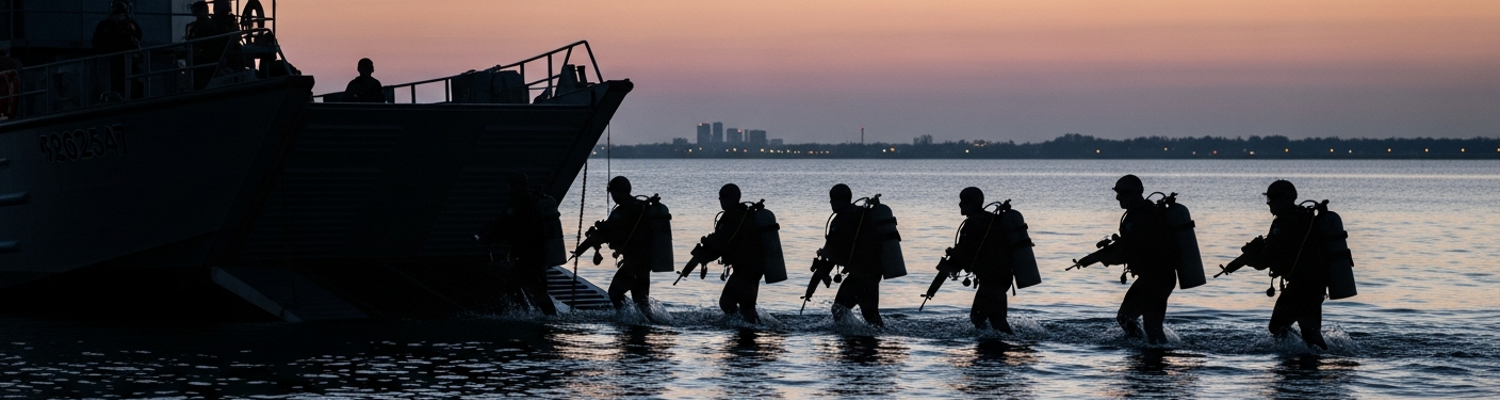
Fully armed Marines in combat gear, carrying M1 Garand rifles and weighing down with equipment, splashed ashore into the warm Mediterranean waters. They pushed across the sand of Red Beach, their immediate objective the airport perimeter. Overhead, F8U Crusader jets from the carriers USS Saratoga, USS Essex, and USS Wasp provided air cover, their sonic booms echoing over the city. Despite the peaceful, almost carnival-like atmosphere on the beach, the operation was fraught with tension. The landing force had been supplied with outdated French maps and had a limited understanding of the complex political terrain. More critically, the commander of the Lebanese Army, General Chehab, had not been given advance notice. He initially opposed the landing, fearing it would shatter his army's neutrality and plunge the country into total war. A tense standoff occurred when a Marine column heading north from the airport was halted by Lebanese Army Sherman tanks. A direct, face-to-face negotiation on the road between U.S. Ambassador Robert McClintock and General Chehab, with Admiral Holloway present, averted a confrontation. They hammered out the rules of engagement that would define the U.S. presence, establishing zones of responsibility and ensuring no conflict between the two armed forces.
An Armed Occupation
With the airport secured by Lieutenant Colonel Harry A. Hadd’s BLT 2/2, the mission expanded. The force’s immediate task was to establish a firm perimeter and prepare for the arrival of additional troops. Over the following days, the American presence swelled dramatically. The 2nd Battalion, 8th Marines and the 3rd Battalion, 6th Marines arrived by sea, bolstering the Marine contingent. They were soon joined by U.S. Army Task Force 201, an airborne component built around the 1st Airborne Battle Group, 187th Infantry, airlifted from West Germany. Ultimately, more than 14,000 American soldiers and Marines were deployed to Lebanon, supported by a flotilla of 70 ships and 40,000 sailors of the Sixth Fleet. The Marines and soldiers established checkpoints, patrolled the city’s approaches, and secured the vital Port of Beirut. Their mission was not to engage in combat but to be an overwhelming and stabilizing presence. They conducted constant patrols and established a visible deterrent, their M48 Patton tanks and heavy equipment a tangible symbol of American resolve. The operation was largely bloodless, although there were a few casualties. One American soldier, Sergeant First Class Pasquale F. Varco, was killed by a rebel sniper, and three other deaths resulted from accidents.
The military presence created a shield behind which diplomacy could work. Eisenhower dispatched veteran diplomat Robert D. Murphy as his personal representative. His task was to navigate the labyrinth of Lebanese politics and broker a solution. The presence of thousands of American troops provided him with significant leverage. He engaged with leaders from all factions, including President Chamoun and rebel chieftains like Saeb Salam. He skillfully managed the delicate process of finding a political resolution that would be acceptable to the warring parties and restore stability.
A Blueprint for Deterrence
The intervention achieved its strategic objectives with remarkable efficiency. The robust military presence stabilized the security situation, discouraged outside interference from Syria, and allowed the Lebanese political process to function. The Soviet Union, faced with a decisive American action, confined its response to loud but empty diplomatic protests. Under Murphy's guidance, a compromise was reached. President Chamoun agreed to step down at the end of his term. On July 31, the Lebanese Parliament elected the respected and neutral General Fuad Chehab as the new president, a choice acceptable to most factions. With a new consensus government in place, the crisis abated. The phased withdrawal of American forces began in August and was tied to the successful implementation of the political agreement. By October 25, 1958, all American forces had withdrawn from Lebanon. Operation Blue Bat was over.
It stood as a clear demonstration of America's ability to project power globally and to execute a complex joint-service amphibious and airborne operation on short notice. The intervention successfully protected American lives, prevented the collapse of a friendly government, and averted a wider regional conflict that could have drawn in the superpowers. Operation Blue Bat became a case study in the effective use of military force as an instrument of national policy. It showcased how decisive leadership, when coupled with the swift deployment of credible military power, could create the conditions for a diplomatic resolution. In a critical Cold War flashpoint, Eisenhower's directive and the professional execution by the U.S. Marines and Army had successfully defended American interests and restored stability without firing a major shot.