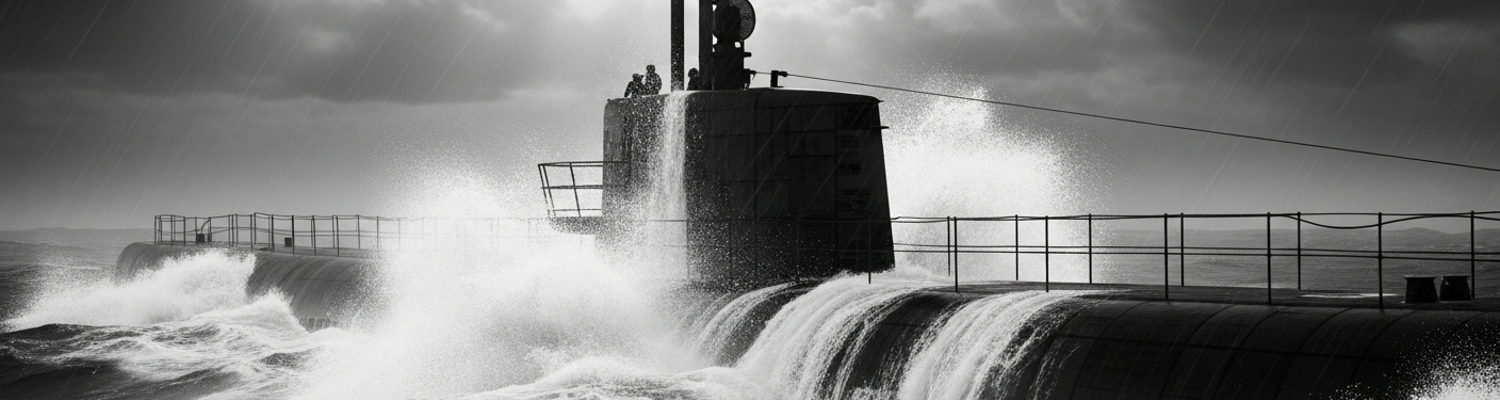

Passage into the Kill Zone
Operational records (NARA Record Group 38) document the departure of USS Besugo (SS-321) from Fremantle, Australia, on December 24, 1944. This was the submarine’s third war patrol. Her destination was the South China Sea, a transit that required navigating the Lombok Strait. Separating the islands of Lombok and Bali, the strait was a geographic chokepoint, a necessary gateway to the hunting grounds north. It was also a known kill zone. Treacherous currents, running up to five knots, made submerged passage a high-risk gamble, capable of forcing a boat to the surface without warning. Japanese shore batteries were positioned to exploit this vulnerability, creating a deadly crossfire for any submarine caught in the unpredictable waters.
Besugo made the passage submerged. Late on December 30, she cleared the strait and entered the Celebes Sea, continuing north. Her designated operational area off the coast of French Indochina was the primary artery for Japan’s war economy. Oil and raw materials flowed from the Dutch East Indies and Southeast Asia through these sea lanes to the home islands. By this stage of the war, the Imperial Japanese Navy had concentrated its remaining anti-submarine warfare assets along these routes. The threat was no longer aging destroyers. It was the Kaibōkan, purpose-built coastal defense ships. These 1,000-ton escorts were diesel or steam-powered, capable of 20 knots, and carried a heavy load of depth charges. Some later variants carried as many as 120. Their construction, initiated in 1943, meant that by mid-1944, the South China Sea was saturated with hundreds of dedicated sub-hunters.
The Fragility of Technical Advantage
The American technological edge was embodied by the SJ surface-search radar. This system allowed a fleet submarine to operate with lethal effectiveness at night. It could detect a merchant ship from over the horizon, sometimes at ranges approaching 17,000 yards, allowing the submarine to track targets and press home an attack on the surface where its 20-knot speed gave it a distinct advantage over most convoys. The SJ radar, however, was a complex assembly of vacuum tubes and sensitive electronics. Patrol reports from the period show these systems were highly susceptible to the punishing heat and humidity of tropical waters. A failure of the SJ radar rendered a submarine effectively blind at night. Its tactical advantage was gone. Detection ranges collapsed from miles to the few thousand yards offered by a periscope or visual lookout. This vulnerability was compounded by the fact that Japanese escorts were slowly being fitted with their own primitive radar and detection gear, making a surfaced American boat an increasingly detectable target. Any equipment failure could instantly erase the American advantage, reducing a sophisticated hunter to a defensive posture, fighting only for its own survival.
Constant Aerial Surveillance
The sky over the South China Sea was not empty. Japanese naval air power created a lethal gantlet for any submarine. Patrols were systemic and constant. The Japanese military pressed a wide variety of aircraft into service for this duty. Long-range Mitsubishi G4M “Betty” bombers, Kawanishi H8K “Emily” flying boats, and even the common Aichi E13A “Jake” floatplane flew predictable patterns along known shipping lanes at staggered times. Their presence forced any submarine in the area to remain submerged or risk immediate attack. This dictated the entire rhythm of the patrol. Submerged, a fleet boat’s speed dropped to a sluggish 8.75 knots, making offensive maneuvers against a convoy almost impossible. The boat became a slow-moving target. Daylight hours were spent deep beneath the surface. This created a cascade of problems. The boat’s 126-cell battery banks, its lifeblood when submerged, required lengthy recharging cycles on the surface using the diesel engines. Denied the freedom to surface, the crew lived with the constant anxiety of a low battery, a condition that severely limited their tactical options and their ability to escape if detected. Ventilation was another issue. The air inside the steel hull grew foul with carbon dioxide, diesel fumes, and human sweat, degrading crew efficiency and morale. Every command decision was weighed against the probability of a lookout spotting the distant silhouette of a Japanese aircraft.
Sudden, violent encounters were a constant feature. The patrol log documents the need for repeated evasive action. On December 31, 1944, just after entering the Celebes Sea, Besugo sighted a small merchant vessel. A spread of three torpedoes missed. The target likely radioed a contact report. The consequence was immediate. Japanese aircraft appeared, forcing Besugo to crash dive four separate times to evade detection. This pattern was common. An attack that revealed the submarine’s presence, even for a moment, would bring an aerial hunt down upon it. The standard evasion was a frantic, all-hands evolution to get the boat below the thermal layer, a temperature boundary in the water that could disrupt active sonar, before an aircraft could line up a bombing run. These were not gentle procedures. They were controlled falls that threw men and equipment about the compartments. The drone of an unseen engine became the most feared sound in the South China Sea.
The Isolation of Command
The high-frequency radio was a submarine’s connection to the wider war. For Besugo, this system was both a lifeline and a point of failure. The standard TBL model transmitter was a large piece of equipment. It required the boat to be on the surface or at periscope depth with a whip antenna exposed to send or receive messages. This act alone made the submarine a target. In the turbulent atmospheric conditions of the South China Sea, signal propagation was notoriously unreliable. Scheduled fleet broadcasts from Pearl Harbor or Australia, containing encrypted operational orders and intelligence, could be completely missed. A submarine could be left in electronic isolation for days. Patrol logs from the period are filled with notations of failed attempts to raise command or of receiving only garbled transmissions. A failure of the primary radio gear would force a reliance on lower-powered backups, drastically shrinking the communication range and leaving the boat effectively deaf.
This electronic isolation created an intelligence vacuum.
The decisive advantage for American submarines was “Ultra” intelligence, derived from the decryption of Japanese naval communications. These messages provided time-sensitive details on the composition, course, and speed of enemy convoys. An Ultra update could turn a blind search into a calculated ambush. The system, however, was plagued by delays. An intelligence report was worthless if it arrived twelve hours after the target had passed. On January 6, 1945, Besugo’s lookouts sighted the large tanker Nichei Maru, escorted by a destroyer and two coastal defense vessels. There is no indication in available records that this contact was preceded by an intelligence warning. The submarine was operating on its own reconnaissance. After sinking the tanker, Besugo joined a patrol line with USS Hardhead and USS Cobia. They spent the next two weeks fruitlessly searching for targets. This long period of inactivity suggests a lack of actionable intelligence, forcing the submarines to rely solely on what their own radar and lookouts could find.
The direct result of this fragmented communication was that immense operational weight fell upon the captain. Commander Herman E. Miller was forced to make high-stakes decisions under extreme duress, cut off from the strategic picture. The attack on the Nichei Maru is a case in point. With no intelligence to suggest a more valuable target was pending, Miller made a calculated gamble. He closed on the tanker and its three escorts, firing a spread of six torpedoes to ensure a kill against the 10,020-ton vessel. This single decision expended a significant portion of his torpedo load on a target of opportunity. Each engagement was a self-contained tactical problem to be solved with incomplete information. Every choice was made in an information void.
The War Against Faulty Ordnance
Besugo’s primary weapon, the Mark 14 torpedo, was a deeply flawed instrument. This was not a problem unique to this boat; the weapon was notorious throughout the Pacific fleet for multiple, distinct failures. Its magnetic exploder, designed to detonate beneath a ship’s keel, was so sensitive to fluctuations in the Earth’s magnetic field that it often triggered prematurely. The backup contact exploder used a fragile firing pin that could shatter on impact with a hull instead of detonating the warhead. The torpedo also had a tendency to run approximately eleven feet deeper than its set depth. Every attack was a gamble not just against the enemy, but against their own ordnance.
A statistical necessity.
The attack on the Nichei Maru on January 6 was a textbook case of overcoming the weapon’s deficiencies through sheer volume. Commander Miller, facing a high-value target protected by three escorts, ordered a spread of six torpedoes. This was not tactical extravagance. It was an admission that a significant percentage were likely to fail. On this occasion, three torpedoes struck home. The tanker was destroyed. Less than a month later, on January 24, Besugo engaged another tanker, the Sarawak Maru. After being driven off by escorts, the submarine fired another full spread of six torpedoes at the damaged vessel. The patrol report records the sound of the torpedo tracks. Post-war analysis confirmed no sinking. The expenditure of a dozen torpedoes for one confirmed kill illustrates the crippling unreliability that defined submarine combat.
The Strain of Constant Operation
The boat’s four Fairbanks-Morse 38D8-1/8 opposed-piston diesel engines were the heart of the vessel. They provided propulsion on the surface and generated the electricity required to charge the batteries for submerged operations. These engines were powerful, but they were not immune to the stresses of a war patrol. The constant cycle of crash diving, running at flank speed, and long periods of submerged operation placed an enormous strain on every mechanical component. A common failure point was the pistons themselves, which could lead to cylinder liner damage under high thermal stress. While Besugo’s logs from this patrol do not detail a catastrophic engine failure, war damage reports from sister ships like USS Bergall show how vulnerable these systems were. A nearby underwater detonation could shear studs, knock reduction gears out of alignment, and trip the engines offline. The boat would be left dead in the water, deafened by the noise of its own damaged machinery.
Every piece of equipment was pushed to its breaking point. Repairs had to be improvised thousands of miles from the nearest friendly port. A ruptured hydraulic line or a failed pump, a mundane issue in a naval shipyard, became a life-threatening emergency. The crew, particularly the enlisted specialists, were the only thing standing between a minor malfunction and total mission failure. Electricians, machinist’s mates, and torpedomen were forced to perform delicate and complex repairs within the cramped, foul-smelling confines of the hull. Often this work was done while the threat of Japanese depth charges enforced a deadly silence.
The Weight of Unnatural Stillness
The long stretches of silent, submerged operation were not periods of rest. They were exhausting vigils defined by a constant, nerve-shredding tension. The order for silent running plunged the boat into an unnatural quiet, a state required to evade detection by Japanese hydrophones. All unnecessary machinery was secured. Movement was restricted. Men spoke only in whispers. In this state, every sound became magnified. The groan of the hull plates contracting under deep-water pressure, the drip of condensation, a dropped tool. Any one of these could seem as loud as a gunshot, a potential betrayal of their position to the unseen hunters above. The crew was suspended in a state of hyper-alertness for hours, sometimes days, on end. This was not boredom. It was the sustained activation of the body’s fight-or-flight response in a situation where neither action was possible, a condition known to cause severe mental and physical fatigue.
Prolonged submersion created an environment of profound sensory deprivation. For the eighty or so men packed into the steel tube, the world shrank to the confines of the hull. They were denied sunlight and fresh air, disrupting sleep cycles and distorting their sense of time. The air itself became a source of misery. It grew thick with the smell of diesel fuel, unwashed bodies, and cooking odors. As the oxygen content decreased, even lighting a cigarette became difficult. The temperature inside the boat, especially after diving to escape the tropical heat, would rise dramatically from the heat of the machinery and the men themselves. Privacy was nonexistent. Men hot-bunked in shifts, living in constant, unavoidable proximity to one another.
The Violence of the Counterattack
The moments after the successful torpedoing of the Nichei Maru on January 6 were not silent. As Besugo cleared the area, the tanker’s escorts began their counterattack. The response was recorded as seven depth charges dropped in a disorganized pattern. For the men inside the hull, even an ineffective attack was a violent physical event. The pressure wave from each distant explosion struck the boat like a massive steel hammer, a dull, bone-jarring concussion that vibrated through the deck plates. Light fixtures would flicker. Dust and cork insulation would shake loose from the overhead. Every man knew what the sound meant. They had been detected.
The next confrontation was far more intense.
On January 24, Besugo received a contact report from USS Blackfin and moved to engage a convoy that included the tanker Sarawak Maru and the destroyer Shigure. As Besugo closed, the Japanese escorts spotted it and opened fire, forcing the submarine to dive. Twenty minutes later, Commander Miller attempted a second approach. This time, the response was a concerted depth charge attack. The command to rig for silent running echoed through the boat. The diving officer and his planesmen worked to take the submarine deep, seeking a thermal layer to make them invisible to sonar. Above, the crew heard the chilling sound of the escort’s propellers, a rhythmic thump that grew louder as it passed overhead, followed by the splash of the charges entering the water.
A close-proximity detonation was a fundamentally different experience. The patrol logs confirm Besugo endured a close depth-charge attack, with one report detailing a total of twenty-two charges dropped in the initial barrage. A nearby explosion was not a dull boom but a sharp, deafening crack. The entire pressure hull flexed violently, groaning and popping as if it were being crushed. Unsecured gear and men were thrown across compartments. Glass gauge faces shattered. Light bulbs exploded, plunging sections of the boat into darkness lit only by the faint blue glow of emergency battle lanterns. The air filled with the acrid smell of ozone from electrical shorts. The crew was completely blind, relying on their sonar operator to interpret the sounds of the hunt. They could only wait in enforced silence as the shockwaves hit, each one a reminder that the next could rupture the hull. Later that same afternoon, the Japanese escorts dropped another thirty-two depth charges, prolonging the state of extreme tension for hours. The patrol's end was dictated not by a calendar, but by the emptying of the torpedo racks and fuel tanks.