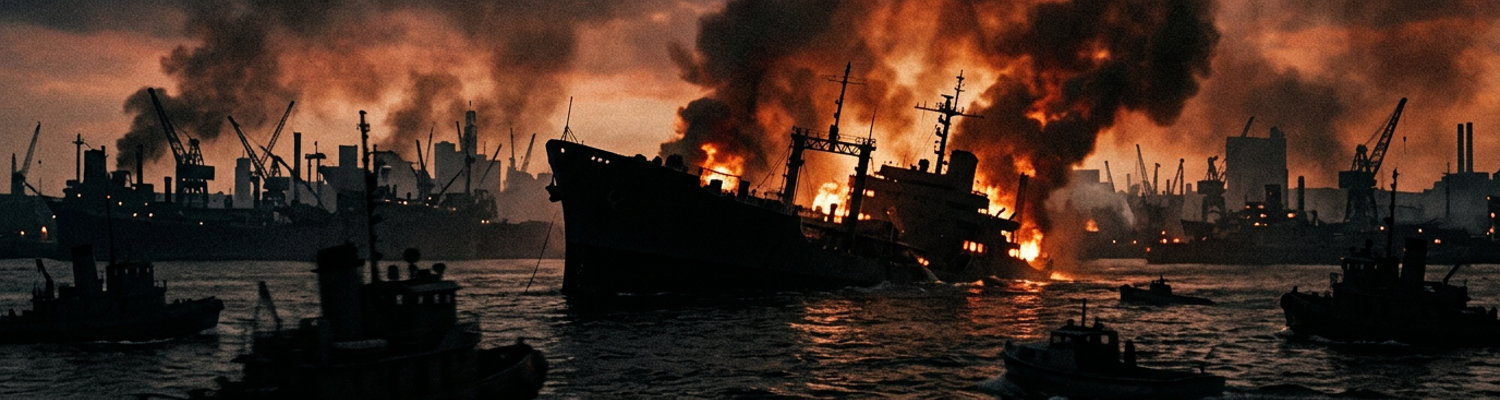

Burning Slicks Across Berth Murder Thirteen
Radio traffic intercepted on the harbor common circuit at 0547 cracked with panic. Berth Murder Thirteen reported a heavy explosion. The fleet oiler Mississinewa was blazing forward. All craft received immediate orders to stand clear.
A close review of operational logs indicates the blast was not an internal accident. Fleet assessors initially presumed a vapor ignition inside the forward cargo spaces. It was a successful strike by an Imperial Japanese Navy Kaiten human torpedo. Submarine I-47 deployed the weapon.
Lieutenant Commander Zenji Orita directed I-47 four and a half nautical miles off the southern rim of Ulithi Atoll. Technicians unbolted the upper clamps. They released four piloted Type 1 craft into the sea. Sub-Lieutenant Sekio Nishina navigated through the open Mugai Channel. The modified oxygen-driven Type 93 torpedo carried a 3,417-pound warhead. Mechanics packed it with Type 97 explosive. Running several feet below the surface, the weapon rammed the starboard bow of USS Mississinewa (AO-59) at 0547 hours on November 20, 1944.
The contact exploder functioned instantly.
It impacted the forward cargo spaces directly. The detonation shattered the steel hull plating between frames twenty and forty. Bulkheads collapsed into adjacent compartments. Thousands of gallons of incoming seawater churned against ruptured internal piping. Lookouts on nearby auxiliaries had spotted a periscope wake moments prior. The anchored fleet oiler lacked forward headway to execute an evasive turn.
Ruptured forward fuel cells ignited across the entire bow section within three minutes.
Archival evidence shows the Kaiten warhead struck directly into tanks holding approximately 404,000 gallons of high-octane aviation gasoline and 90,000 barrels of heavy fuel oil. Mississinewa had filled these reservoirs to peak capacity four days earlier. The fuel supported fast carrier strikes against Luzon. The 100-octane aviation gasoline loaded in centerline tanks two and three atomized upon impact. Internal voids filled with dense volatile fumes. Secondary sparks reached this vaporized mixture. A violent internal concussive blast blew the forward weather deck upward. The explosion ripped through transverse framing. Burning gasoline rushed through open deck vents.
The liquid acted as an incendiary accelerant.
It enveloped the thicker Navy Special Fuel Oil stored aft of the bridge structure. Firemain pressure failed completely. Electrical generators tripped off the board. Damage control parties lost seawater pressure to fight the advancing flames. Heavy petroleum leaked from ruptured hull seams. The crude poured out onto the lagoon waters at Berth Murder Thirteen. It caught fire in wide expanding sheets. The ship began listing heavily to starboard. Uncontrolled thermal energy cooked off small-arms lockers and ammunition handling rooms beneath the forward gun tubs.
Captain Philip G. Beck ordered the crew to abandon ship.
Flames engulfed the boat deck. When examining the historical record of the rescue operation, casualty counts confirmed sixty-three officers and enlisted men lost. Burning petroleum blanketed the surrounding water. Men hurled themselves over the rails. They surfaced inside thick floating pools of ignited Navy Special Fuel Oil. The slick spread hundreds of yards across the anchorage. Swimming beneath the surface offered temporary protection. Sailors had to surface through sheets of burning oil for air. This resulted in lethal inhalation trauma and third-degree thermal injuries.
Responders from Service Squadron 10 braved the heat.
Crews aboard the harbor tugs Chickasaw and Munsee pulled survivors onto motor launches and whaleboats. Fleet doctors treated severe respiratory burns. Administrative officers aboard repair ships frantically tallied missing crew rosters. At 0928, the capsized oiler rolled bottom-up. It sank into thirty fathoms of water. Black soot settled over the quiet lagoon. Fleet staff immediately logged urgent defensive deficiencies. Ulithi lacked anti-torpedo netting at outer channels. Lookouts possessed no doctrine for spotting submerged suicide crafts. Forward fuel oilers remained concentrated targets inside designated berths.
Perimeter Penetration of the Mugai Channel
Archival evidence shows the penetration began in the early morning darkness of November 20. The launch occurred four nautical miles east of Falalop Island. Mother submarines I-36 and I-47 trimmed ballast along the outer ocean drop-off. The hulls pitched heavily in the western Pacific swells.
Commander Zenji Orita sent four Kaitens away from I-47 between 0415 and 0430.
He aimed each craft directly toward the eastern rim of the atoll. Running on magnetic headings set just before release, the craft steered straight toward Mugai Channel. This was the sole deep-water throat carving through the barrier reef between Sorlen Island and the northern tip of Falalop. The passage spanned barely one thousand yards across. Deep bottom contours dropped past twenty fathoms. This depth permitted the passage of heavy fleet units.
Pilots steered by crude internal gyroscopes.
Brief periscope exposures in the dark provided visual fixes. The operators trimmed their buoyancy tanks down. Their conning towers cleared the surface by mere inches. Incoming ocean tides sweeping over the submerged reef flats carried the forty-eight-foot weapons straight into the harbor entrance.
Fleet defenses registered nothing.
A close review of operational logs indicates the underwater sound defenses guarding Mugai Channel were completely neutralized. Local acoustic conditions blinded the sensors. Shore-based hydrophone arrays connected to the Harbor Entrance Control Post on Sorlen Island picked up only static. Heavy ocean breakers crashed against the shallow coral shelves along the atoll rim. This generated continuous acoustic interference. The noise drowned out the higher-frequency hum of the twin counter-rotating screws.
The mechanical design of the Kaiten bypassed the Allied detection baseline.
Driven by a modified Type 93 torpedo engine, the weapon burned kerosene and pressurized pure oxygen. The combustion chamber produced almost no gaseous exhaust bubbles. Active sonar pings had nothing to reflect. Operating at low engine revolutions conserved fuel during the ingress. The machines generated minimal mechanical cavitation. Outside the channel mouth, patrol craft PC-463 swept back and forth along designated picket lines. Accompanying screening vessels maintained their stations. Their active echo-ranging sonar transducers were tilted downward. Operators expected to locate large fleet hulls resting in deep water. They did not scan for shallow targets running twelve feet below the chop.
The acoustic perimeter had failed entirely.
When examining the historical record, the vulnerability stemmed from severe structural blind spots across the naval base at Ulithi. Fleet command assumed the jagged coral reef and scattered patrol vessels were sufficient. Mugai Channel sat completely unobstructed by permanent anti-torpedo baffle netting. Third Fleet commanders demanded unhindered passage for carrier groups and supply convoys clearing the lagoon at all hours. Net tenders maintained open gate sections overnight. This left an exposed maritime gap over three-quarters of a mile wide.
Inside the perimeter, anchorages were systematically grouped by ship type.
Volatile auxiliaries like Service Squadron 10 tankers sat in static clusters. Zero defensive baffles separated them. Anti-submarine doctrine focused almost exclusively on countering standard fleet submarines. Planners expected long-range torpedo strikes from open sea. Visual lookouts and radar teams received no training to detect a steerable weapon measuring three feet across.
Detection came only after the threshold was crossed.
At 0538, destroyer USS Case was screening heavy cruisers out of Mugai Channel. Lookouts spotted a wake breaking water eight hundred yards off the starboard bow. Case rang up twenty-two knots. The destroyer altered course to intercept. The ship rammed a Kaiten directly in the channel throat. The impact tore the midget submarine apart. It crushed the forward hull against the keel. A secondary depth-charge attack by USS Cummings blew remaining debris to the surface. This confirmed the presence of enemy submersible craft.
The destruction outside the channel did not close the breach.
Sekio Nishina had already steered his modified torpedo past the outer reefs more than twenty minutes earlier. He entered the placid interior lagoon without drawing a single shot. By 0545, Nishina had clear line of sight on the high profiles of Service Squadron 10. He aligned his crosshairs directly on the fully loaded tanks of Mississinewa.
Emergency Salvage and Harbor Fire Suppression
A close review of operational logs indicates harbor tugs rushed directly alongside fleet tenders. YTB-384 engaged the expanding inferno. Repair ships from Service Squadron 10 brought high-capacity foam generators to bear against the ruptured forward tanks. Crews pumped thousands of gallons of aerated foam solution through mechanical monitors.
Firefighting parties rigged six-inch lines.
They drove liquid chemical foam directly into the jagged openings between frames twenty and forty. Severe radiant heat defeated these measures almost instantly. The intense thermal up-draft vaporized the foam crust. It failed to create an airtight seal over the boiling aviation gasoline. Burning petroleum cascaded down the hull seams. The liquid ignited the surrounding water. Hose crews operated behind makeshift water fog shields. Their rubber discharge lines scorched and cracked under blistering temperatures. Mechanical proportioning pumps overheated. Seawater booster lines struggled to maintain continuous line pressure against the billowing flames.
Water and foam failed to halt the internal combustion.
Archival evidence shows harbor rescue craft converged amidst rising smoke. They recovered 278 surviving crew members from fuel-choked waters. Motor whaleboats pushed directly into drifting slicks of burning Navy Special Fuel Oil. Utility launches and LCVPs from neighboring auxiliaries followed. Secondary explosions complicated the extraction effort. Forward 20mm and 40mm ready-service ammunition lockers detonated. The blasts hurled jagged metal across the recovery perimeter.
Swimming sailors were heavily coated in thick black crude oil.
The substance blinded eyes. It caused severe respiratory spasms upon inhalation. Extraction crews found it nearly impossible to maintain a grip on slick petroleum-drenched limbs. Rescue personnel had to physically lasso survivors with safety lines. They hauled them over the gunwales. Coxswains repeatedly ran their propellers in reverse. The wash blasted walls of burning fuel away from pockets of men struggling on the surface. These small-boat crews successfully pulled 278 living officers and enlisted men from the sea. They transferred the critically injured directly to the surgical stations of the hospital ship Benevolence.
Secondary detonations tore away what was left of internal buoyancy.
When examining the historical record of the sinking, structural failure culminated at approximately 0928 hours. Four hours of uncontrolled burning softened transverse bulkheads. Free-surface floodwater surged through cargo compartments. The weight pushed the starboard list beyond fifty degrees. Weight distribution failed entirely as the forward cargo holds filled with water. The bow dragged down. The twin bronze screws pitched high into the air.
Mississinewa rolled completely bottom-up.
Hull steel buckled with a dull groan. The ship slid under the lagoon surface. It settled on the sea floor at Berth Murder Thirteen. The sinking extinguished the surface fire. It also created an extensive navigational and environmental hazard across the anchorage. Over three million gallons of heavy fuel oil sat trapped inside unpunctured aft storage tanks. The wreck rested thirty-five fathoms deep. Thick petroleum plumes vented continuously from ruptured vent lines and cracked rivet lines. Massive floating slicks drifted across harbor channels. The oil fouled the cooling-water intakes of thirty-four capital ships. It blanketed the reef flats of nearby Falalop Island.
Service teams strung protective timber booms across the anchorage to contain the drifting fuel.
Service Squadron Ten Logistical Assessments
A close review of operational logs indicates the emergency conference began aboard the destroyer tender USS Prairie. The meeting convened within two hours of Mississinewa settling onto the lagoon floor. Commodore Worrall R. Carter gathered his Service Squadron 10 staff. Petroleum officers from the station tanker Sepulga joined them. They calculated the raw volume of destroyed cargo.
Grease pencils covered bulkhead boards with crude tally sheets.
Mississinewa had taken down 404,000 gallons of high-octane aviation gasoline. It also lost 90,000 barrels of heavy Navy Special Fuel Oil. This eliminated an entire replenishment cycle from the harbor inventory. Lost alongside the fuel were twelve four-inch flexible fueling hoses. Bronze couplings sank with the ship. Four auxiliary steam discharge pumps and hundreds of drums of aviation engine lubricants stored on the upper cargo flats were gone.
Carter demanded an immediate accounting of all liquid fuel remaining in the forty-two square miles of Ulithi anchorage.
Staff officers worked through ship manifests. Other tankers rode at anchor. Few carried the balanced dual payload of aviation fuel and heavy bunker crude required to turn around a fleet carrier strike group on schedule. Calculations on paper spelled immediate danger for operations at sea.
Archival evidence shows Carter's staff confronted an aggressive timetable.
Admiral William Halsey's fast carrier offensive dictated the pace. Task Force 38 operated four carrier task groups off the Philippine coast. They consumed naval fuel oil at rates exceeding 250,000 barrels every four days during sustained launch runs. Fleet carriers including Essex, Lexington, and Ticonderoga burned thousands of gallons of 100-octane gasoline each morning. This sustained continuous air sweeps against Japanese airfields across Luzon.
Screening destroyers burned through bunker fuel at twenty-four knots.
They reached forty-percent minimum reserve levels within forty-eight hours of sea duty. Captain Jasper Acuff's Task Group 30.8 handled underway replenishment. They dispatched shuttle oilers from Ulithi directly to designated fueling rendezvous points. These points sat three hundred miles east of the combat zone. Mississinewa was scheduled to sail in that exact shuttle rotation within forty-eight hours. Her loss created an immediate deficit in available tanker berths.
Squadron planners recalculated fueling intervals down to single-digit percentages.
They had to prevent Halsey from breaking off combat operations due to empty carrier fuel tanks. Every fighting ship depended on floating fuel storage. When examining the historical record, Carter took direct steps to protect forward reserves. He intercepted commercial tonnage across the Western Pacific. The radio shack aboard Prairie transmitted enciphered orders to naval port directors in Eniwetok, Kwajalein, and Pearl Harbor. They altered convoy routing instructions for incoming civilian-crewed merchantmen.
War Shipping Administration T2 and T3 commercial tankers received new orders.
Originally assigned to discharge at rear staging points, they were diverted straight to Ulithi coordinates at ten degrees north, one hundred thirty-nine degrees east. Standard maritime routes through the Caroline Islands were modified. Heavily laden vessels like the tanker Samoset pushed directly toward Mugai Channel under escort. Carter assigned these newly arrived commercial hulls to serve as static storage depots. They anchored inside the northern lagoon perimeter.
Crews rigged heavy discharge lines.
They pumped bulk crude directly into the storage holds of surviving fleet oilers like Cache and Lackawanna. This bypassed damaged shore infrastructure entirely. Service Squadron 10 transferred over 140,000 barrels of fuel between hulls within seventy-two hours of the sinking. They restored harbor reserves before the third fleet completed its sortie against Luzon.
Rapid Fortification of Ulithi Lagoon Defenses
A close review of operational logs indicates fleet engineers began deploying heavy harbor obstructions across Mugai Channel within six hours of the disaster. Crews aboard the net-laying vessels Silverbell and Snowbell executed the orders. Rigging crews winched diagonal wire rope mesh panels off forward horn booms. They dropped heavy anti-torpedo baffle nets into the passage between Sorlen and Falalop Island.
Technicians anchored these double-apron steel nets into the coral seabed.
They used five-ton concrete sinkers and Danforth anchors. The panels were staggered in overlapping rows to form a mechanical labyrinth. This denied straight runs to incoming torpedoes. Heavy steel flotation buoys held the top edges near the waterline. Bottom cables were weighted to hang ninety feet downward into the deep channel throat.
Station repair crews simultaneously ran armored acoustic cables.
They laid lines from the Harbor Entrance Control Post on Sorlen straight across the seabed. They tethered deep-keel hydrophone arrays below the turbulence of the reef breakers. These submerged listening sensors fed directly into shore-based sound recording consoles. Technicians calibrated them to isolate the distinct mechanical hum of small propulsion engines operating at depths down to one hundred feet.
Lagoon channels were sealed behind interlocking steel curtains.
Archival evidence shows harbor commanders immediately reassigned twelve escort vessels. They maintained continuous hunter-killer sweeps along the outer perimeter. Destroyer escorts from Escort Division 88 joined wooden-hulled auxiliary minesweepers. They traced interlocking patrol boxes around the thirty-mile elliptical reef rim.
The vessels steamed at fourteen knots along the oceanic drop-off outside Asor, Mogmog, and Falalop.
They operated active sonar systems on designated sound frequencies. This penetrated local thermal gradient layers. Sonar operators listened for mechanical cavitation. Depth-charge crews stood continuous watches beside K-gun projectors and stern roller racks. Fleet orders instructed escort captains to treat any submerged contact within five miles of the reef as hostile. They were authorized to fire full twenty-four-projectile Hedgehog patterns without awaiting target verification from base headquarters.
Auxiliary motor minesweepers cleared the perimeter shallows.
They ran mechanical wire drags to sweep away potential submerged tether lines or acoustic marker buoys left by Japanese mother submarines. Outer perimeters became free-fire zones for patrol escorts. When examining the historical record, the Port Director at Sorlen completely eliminated unescorted approaches. This applied to all incoming support vessels and carrier strike elements. Inbound capital ships and fuel-laden auxiliaries were barred from approaching Mugai Channel along fixed direct compass headings.
Navigators received revised sailing directives.
They commanded aggressive zigzag approach legs at nineteen knots. These maneuvers started twenty nautical miles east of the atoll. Task units executed radical course alterations every five minutes. They followed pre-assigned naval evasion plans. This prevented submerged submarine lookouts from calculating steady target bearings. Heavy fleet units and commercial tankers were prohibited from reducing speed. They had to maintain velocity until passing within eight hundred yards of the net gates. Armed harbor tugs stood by at these gates to haul open sliding net sections.
Unescorted entries between dusk and sunrise were suspended completely.
This stranded arriving convoys in open ocean holding boxes. Commanders refused to risk a darkened gate transit. Harbor pilots boarded incoming tankers outside the outer acoustic line. They directed each hull through the zigzagging baffle slots before releasing them into assigned berths inside the interior lagoon.
Strategic Fuel Reallocations for Fleet Operations
A close review of operational logs indicates Captain Jasper T. Acuff had to dismantle and reconstruct the fueling schedule of Task Group 30.8. He completed this within twelve hours of the sinking. Acuff operated out of designated replenishment areas such as Mingo and Pecos. These coordinates sat roughly three hundred miles east of Luzon. He commanded twelve fleet oilers. Their mission was sustaining Admiral William Halsey's carrier strikes against Japanese airfields.
Mississinewa had represented a primary heavy-lift asset in the third fueling echelon.
It was scheduled to cycle forward alongside tankers Schuylkill and Nantahala to pump bunker crude into screening destroyers. With forty-two thousand barrels of fuel lost in Berth Murder Thirteen, Acuff split his surviving oilers into three emergency four-ship replenishment groups. He forced hulls like Caliente and Marias to double their ocean runs between Ulithi and coordinates fifteen degrees north, one hundred thirty degrees east.
Tanker crews rigged span-wire fueling rigs in rough seas.
They operated without routine engine overhauls or port downtime. Crews pumped through five-inch rubber discharge hoses for thirty-six consecutive hours. Flight schedules over the Philippines permitted zero pause for replenishment delays.
Archival evidence shows Task Force 38 maintained continuous combat air patrols over Leyte Gulf and Ormoc Bay.
They did this despite the immediate cancellation of scheduled aviation gasoline deliveries. Japanese land-based aircraft and organized kamikaze units executed daily strikes against General Douglas MacArthur's beachheads. This required Task Groups 38.1 and 38.3 to keep eight-plane divisions of Grumman F6F-5 Hellcats airborne above the transport anchorages from dawn until dark.
Each Hellcat burned ninety gallons of 100-octane fuel per hour at cruising throttle.
They consumed entire aviation gasoline reserves faster than rear-echelon tankers could resupply them. Carrier flight decks on Essex, Ticonderoga, and Lexington instituted drastic conservation directives. This prevented empty fuel lines. Flight deck crews slashed pre-launch engine warm-up times from twenty minutes down to seven minutes. They prohibited non-operational maintenance run-ups. Mechanics rigged scavenge lines to drain every drop of residual aviation gasoline from carburetion filters and drained fuel cells.
Every gallon of 100-octane fuel was tracked down to the pint.
When examining the historical record, intelligence verification from the Joint Intelligence Center Pacific Ocean Areas confirmed the explosion's origin. It was the deliberate operational debut of the Imperial Japanese Navy Kaiten human torpedo program. Navy divers operating from salvage tugs Chickasaw and Lipan descended thirty-five fathoms to the seabed of Berth Murder Thirteen. They recovered metal debris that disproved initial claims of an ordinary submarine attack.
Technicians hauled up ruptured sections of a sixty-one-centimeter torpedo casing.
They recovered high-pressure pure oxygen valves and a crude hand-operated directional steering apparatus. Fragments of an optical periscope assembly stamped with Kure Naval Arsenal serial numbers were brought to the surface. Intelligence officers cross-referenced these physical artifacts with radio intercepts from Fleet Radio Unit Melbourne. They analyzed cryptographic decrypts tracking Japanese Submarine Squadron 15. The recovered propulsion elements proved the weapon was an operational Type 1 Kaiten suicide craft. It was derived from the Type 93 torpedo and fitted with a 3,417-pound warhead.
Submersible suicide attacks were no longer theoretical threats.
Archival documentation confirms the strike at Ulithi formed half of a coordinated Japanese special-attack deployment. The operation was designated the Kikusui Kaiten Group. Radio intelligence teams confirmed mother submarines I-36 and I-47 had targeted Ulithi. Submarine I-37 attempted an identical penetration into the fleet anchorage at Kossol Roads in the Palau Islands.
Destroyer escorts USS Conklin and USS McCoy Reynolds intercepted and sunk I-37 off Kossol Passage on November 19.
This prevented the launch of its four piggybacked suicide torpedoes before they could enter the transport channels. The recovery of Nishina's submerged steering compartment at Ulithi provided indisputable proof. Combined with the depth-charge debris fields off Palau, the commander in chief of the Pacific Fleet received physical confirmation. Japanese underwater doctrine had shifted to piloted suicide weapons across all outer fleet anchorages. The Kure Naval Arsenal received orders to triple Kaiten production the following morning.