
North Atlantic Convoy Defense
Operational logs from late 1940 document a violent escalation in the North Atlantic war of attrition. For German U-boat crews, it was a period they referred to as their happy time. The fall of France in June 1940 gave the Kriegsmarine direct Atlantic access from ports like Lorient and Brest. This single strategic event cut transit times and extended the operational radius of the entire submarine fleet. Admiral Karl Dönitz exploited this advantage immediately, unleashing his U-boats against British shipping lanes with focused efficiency. Between July and October 1940, wolf packs accounted for 282 Allied ships sunk, a loss of nearly 1.5 million gross registered tons.
The core German strategy, the Rudeltaktik, or wolf pack tactic, was lethally effective. A single U-boat would shadow a convoy and radio its position to coordinate a massed, nighttime surface attack. A submarine’s low profile on the surface made it nearly invisible in the dark. It also negated the Royal Navy's primary underwater detection system, ASDIC. The result was a ruinous rate of loss for Allied merchant vessels, especially in the mid-Atlantic gap, an area beyond the range of land-based air cover known as the Black Pit.
Active defense was not working.
The tactical situation of early 1941 exposed deep deficiencies in the Royal Navy’s anti-submarine warfare capabilities. A severe shortage of dedicated escort vessels like destroyers and corvettes left convoys dangerously exposed. The primary sensor, ASDIC, was also deeply limited. It could only detect submerged targets, and its performance degraded badly in rough seas or at speeds over 15 knots. Experienced U-boat commanders learned to stay on the surface at night, where ASDIC was useless, and use their superior surface speed to outmaneuver escorts. Air power from RAF Coastal Command lacked the range to cover the central Atlantic. The aircraft that were available, such as the Avro Anson, carried an insufficient weapon load of just two 100-pound bombs. A new approach was needed. If active hunting was failing, passive area denial had to be the answer.
The Admiralty’s focus shifted to a monumental project: the construction of the Northern Barrage. This was a concept resurrected from the First World War, designed to block the transit routes U-boats used to enter the Atlantic from bases in Germany and Norway. The plan was enormous, calling for deep minefields across the key maritime chokepoints between Iceland and the Faroe Islands. The 1st Minelaying Squadron, based at Kyle of Lochalsh and operating ships like the flagship HMS Southern Prince, was tasked with the initial phase. Operations began in late 1940. By the year's end, over 10,000 conventional contact mines had been laid. The objective was to make the Atlantic transit so dangerous that it would either destroy U-boats or force them into zones where they could be hunted.
Mark XX Mine Introduction
British Admiralty records from late 1940 show a command struggling with the limitations of conventional contact mines. The new Northern Barrage needed a different kind of weapon to be effective against submerged submarines. Standard mines, requiring a vessel to physically strike a detonator horn, were not enough. A U-boat could simply pass underneath them. The solution was the influence mine, a weapon born from British interwar research and spurred by early German successes with magnetic torpedoes and mines. An influence mine used a sensitive fuze to detect the magnetic field of a steel hull passing nearby, triggering a detonation without physical contact.
The weapon developed for this purpose was the Mark XX. It was a moored mine, but its firing mechanism was a significant technological step. The Mark XX was designed for deep water, featuring a long copper wire antenna extending upward from the main charge, held taut by a float. A second antenna hung below the mine casing. The principle was that a submarine's steel hull, moving through the earth's magnetic field, would create a detectable distortion. When this magnetic signature interacted with the copper antenna, it would complete a circuit and actuate the detonator. The resulting explosion would occur under the U-boat's keel, its most vulnerable point, where the focused pressure wave could break the submarine's back.
Its potential demanded immediate production and deployment.
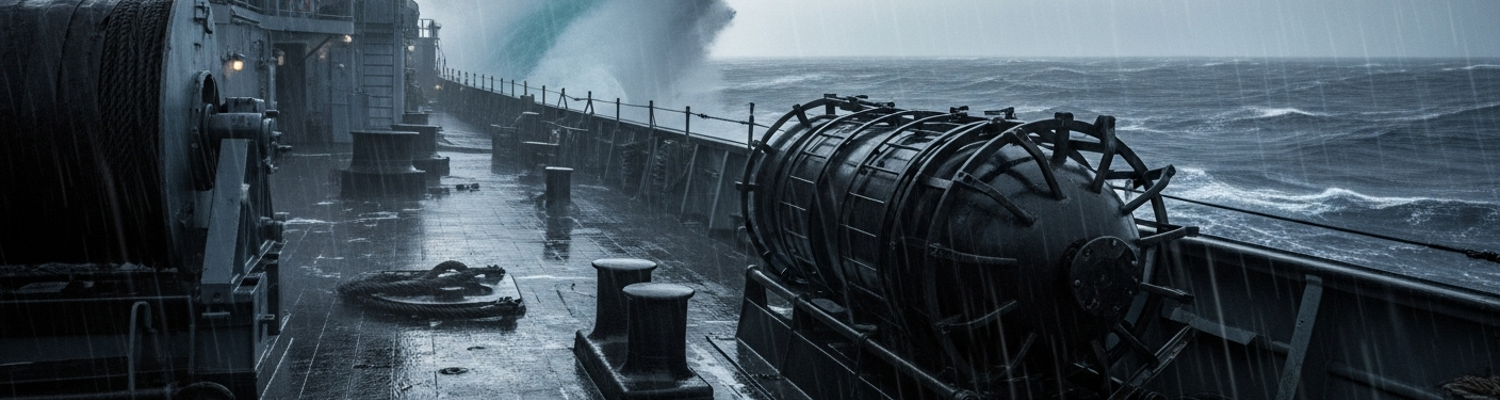
The 1st Minelaying Squadron, based at Kyle of Lochalsh, was tasked with deploying this new weapon. This specialized unit, operating the large auxiliary minelayer HMS Southern Prince and fast minelayers like HMS Abdiel, began receiving the first production batches of the Mark XX in early 1941. Their mission was to sow the deep-water gaps of the Northern Barrage with tens of thousands of these advanced mines. The operational tempo for the minelaying missions (designated with SN serials) was intense, driven by the shipping losses in the Atlantic. The ships steamed into the gale-swept North Atlantic, their decks packed with hundreds of the new mines. Each mission involved laying long lines of the weapons, a hazardous process in fog and high seas. Onboard, crews had to arm the mines and send them down rails off the stern.
Admiralty planners saw the Mark XX not just as a weapon for sinking submarines, but as a strategic area-denial tool. A successful barrage would force Admiral Dönitz to reroute his U-boats. Any alternate route would be longer, consume more fuel, and likely push the submarines into areas more heavily patrolled by Allied forces. The Mark XX was the technological core of this entire passive defense strategy. The plan called for laying over 92,000 mines in the Northern Barrage, with the Mark XX forming the critical deep-water component. The undertaking rested on the assumption that the mine would function as designed.
Widespread Mine Malfunctions
Archival evidence from the 1st Minelaying Squadron’s operations in early 1941 documents an alarming pattern. Almost immediately after the first large-scale SN-series missions began in the Iceland-Faroes gap, reports of inexplicable phenomena reached the Admiralty. Crews on the minelayers observed detonations occurring in their wake for no reason. These were not isolated events. The supposedly empty seas behind the ships became a zone of random, violent explosions. The primary suspect was the mine's complex and sensitive magnetic firing mechanism. It was theorized that the detonator circuits were so delicate they were being triggered by spurious sources, perhaps the residual magnetic field of the laying ship itself, or even by unrelated electrical activity within the mine’s casing as it settled in the deep water.
This turned the controlled process of minelaying into an unpredictable gamble.
Analysis of German U-boat transit records against the known locations of the new minefields presented an equally disturbing problem. There was a conspicuous lack of U-boat losses in areas supposedly saturated with Mark XX mines. This pointed to a catastrophic silent failure: an extremely high incidence of non-functional duds. The same technological complexity that made the Mark XX susceptible to premature detonation also made it prone to complete inaction. Its effectiveness depended on a precise sequence: a hydrostatic arming switch had to function at a set depth, an internal battery had to provide consistent power in near-freezing water, and a sensitive galvanometer had to close a circuit in response to a faint magnetic anomaly. A failure in any one of these components rendered the mine inert. Post-war assessments would suggest a significant percentage of Mark XX mines laid were useless, their intricate mechanisms having failed upon deployment. Vast sections of the Northern Barrage were a bluff.
This combination of premature detonations and a high dud rate created a weapon that was operationally incoherent. A defensive minefield is predicated on predictability. The Mark XX violated this principle. The random, spontaneous explosions posed a direct physical threat to any Allied naval or merchant vessel operating near the minefields. At the same time, the high dud rate meant the Admiralty could have no confidence in the barrier’s ability to stop U-boats. The gravest danger was the risk of mines breaking free from their moorings during North Atlantic gales. A free-floating mine with a faulty, unpredictable magnetic trigger was a nightmare scenario for Allied shipping. Such a weapon could drift for hundreds of miles into established convoy routes, becoming an unplotted, indiscriminate menace. The Admiralty had inadvertently sown a field they could not control. The Mark XX was officially deemed unsatisfactory by late 1941 and a replacement was sought.
Admiralty Deployment Directives
Admiralty records from early 1941 show a high command caught between alarming field reports and overriding strategic necessity. As the 1st Minelaying Squadron laid thousands of Mark XX mines, its after-action logs filled with consistent accounts of premature detonations. The weapon intended to form a silent barrier was announcing its presence with explosions in the wakes of the minelayers. Despite these immediate signs of a critical flaw, the Admiralty’s response was to continue the minelaying operations.
The directive was born of a brutal strategic calculation. The Battle of the Atlantic was entering its most desperate phase. The Northern Barrage was the central pillar of the new passive-denial strategy. The sheer quantity of steel and manpower already invested, combined with the scale of the U-boat threat, meant that halting the program to diagnose a technical fault was deemed an unacceptable delay. The orders from London reflected a rigid adherence to the operational schedule. Ships like HMS Southern Prince and HMS Agamemnon were to continue loading with Mark XX mines at Kyle of Lochalsh and proceed with their missions.
The strategic map overruled the engineering reports.
This pressure to continue deployment stemmed directly from the War Cabinet and a political imperative to demonstrate a robust response to the U-boat menace. Shipping losses were a direct threat to the nation’s ability to import food, fuel, and war materiel. The Northern Barrage was a tangible project that leaders could point to as a decisive countermeasure. The image of sowing tens of thousands of advanced mines across U-boat transit lanes had a potent effect on public morale and political resolve. It represented concrete action at a time when defensive escort operations appeared to be failing. A post-war analysis noted that over 80,000 mines would eventually be laid as part of the project, a massive expenditure of resources that, once started, developed its own bureaucratic and political momentum. To admit that the technological core of this strategy was fundamentally flawed would have been a significant political blow.
The Admiralty’s insistence on continuous minelaying created an impossible situation for the technical experts at HMS Vernon, the naval research and development establishment. They were starved of the evidence they needed most: failed mines recovered from the operational environment. The premature detonations occurred in deep water, and the dud mines lay inert on the seabed hundreds of fathoms down. The diagnostic process was crippled. Engineers could not physically examine units that had failed under the immense hydrostatic pressure and frigid temperatures of the North Atlantic. They were forced to work from theory and laboratory simulations that could not reliably replicate the combination of forces acting on the mines. The operational demand meant that new production batches were immediately routed to the 1st Minelaying Squadron for deployment, rather than being diverted for rigorous testing. This created a feedback loop of failure.
Improvised Field Troubleshooting
Operational logs from the 1st Minelaying Squadron in 1941 reveal a frantic, undocumented effort at shipboard diagnosis. With HMS Vernon unable to secure failed units, the burden of troubleshooting fell to the officers and ratings on the minelayers. These were not scientists in controlled laboratories. They were sailors and technical officers working on the rolling decks of ships like HMS Abdiel, often in the middle of active operations in the Iceland-Faroes gap. The environment was the antithesis of a diagnostic setting: freezing, damp, and subject to the violent pitching of a vessel in a North Atlantic gale. Their workbench was a cramped machinery space or an exposed section of the mine deck, surrounded by hundreds of armed, 1,500-pound mines.
The work was crude.
Deprived of specialized diagnostic equipment, the crews resorted to desperate measures based on theory and direct intervention. Suspicion centered on the delicate galvanometer designed to close the firing circuit. It was believed this component was either too sensitive, triggering on the residual magnetism of the minelayer’s own hull, or was being jolted into contact by the shock of the mine hitting the water. Using basic toolkits, teams would attempt to physically adjust the galvanometer’s contact points on a selection of mines before a mission, a perilous act of amateur engineering on a live explosive. In other instances, they experimented with altering internal battery connections, hoping to solve suspected power fluctuations causing the high dud rate.
This was troubleshooting by educated guess.
Each attempted fix was tested in the most hazardous way possible. The modified mine was pushed off the stern rails, and the crew would watch to see if it detonated prematurely. This ad-hoc process offered almost no useful data. A mine that did not explode could have been a successful fix, or it could have simply joined the ranks of the inert duds on the seabed. A mine that did explode provided a spectacular failure notice but vaporized any evidence of what had gone wrong.
The entire diagnostic effort was conducted under active combat conditions. The minelayers operated in waters patrolled by enemy U-boats and long-range aircraft. Any troubleshooting had to be done under the constant possibility of attack. The ships themselves, particularly the fast minelayers of the Abdiel class, were high-value targets. The pressure from the Admiralty to maintain the pace of the Northern Barrage deployment meant that ships would return to the Kyle of Lochalsh base, load a new complement of flawed mines, and immediately return to sea, leaving no time for systematic investigation. The two critical variables, extreme hydrostatic pressure and near-freezing seawater temperatures, could not be replicated on board. These factors were known to affect battery performance and mechanical switches, but without the ability to test a mine under these conditions and then recover it for inspection, the engineers were working almost completely blind.
Mine Design Flaw Resolution
Technical records from HMS Vernon show the painstaking process that finally untangled the Mark XX catastrophe. With the deployment schedule relaxed in late 1941, engineers were at last able to conduct a systematic forensic analysis. The core of the problem was traced to two interconnected areas: the firing mechanism’s environmental sensitivity and failures in the power source. The primary fuzing component, a highly sensitive galvanometer, was found to be its main point of failure. The delicate needle mechanism, balanced on a knife-edge pivot, was susceptible to the slightest shock. The impact of the mine hitting the water was often enough to jolt the needle into contact, causing a premature detonation. Conversely, the same shock could permanently dislodge the needle, rendering the mine inert.
The mine's design was at war with its own deployment environment.
This mechanical vulnerability was compounded by an electrical design flaw. The Mark XX relied on a standard zinc-carbon battery pack to power its arming circuit. Analysis showed these batteries suffered a severe voltage drop in the near-freezing, deep-water conditions of the North Atlantic. This drop in power was often insufficient to complete the hydrostatic arming sequence, creating a dud. In other cases, the battery would provide just enough power to arm the mine but would then fail hours or days later. Water ingress was the final critical issue. Post-mortem examinations of the few recovered duds showed that the rubber gaskets sealing the mine casing became brittle in the cold, allowing seawater to seep in under high pressure. This moisture would then short-circuit the sensitive electronics.
The engineering response at HMS Vernon was twofold. The first priority was to create a viable weapon from the existing stockpile of thousands of Mark XX casings. A dedicated team implemented a series of modifications, resulting in a variant designated the Mark XX Mod 1. The original galvanometer was removed. In its place, engineers fitted a more robust, oil-damped magnetic switch less susceptible to shock. To solve the power issue, the standard battery packs were replaced with a new battery using a different electrolyte that offered more stable performance in low temperatures. Every gasket on the mine casing was replaced with a new composite rubber-and-asbestos seal designed to remain pliable under pressure and cold. Each modified mine was subjected to a new, rigorous testing protocol.
Simultaneously, the Admiralty authorized development of a completely new influence mine. This project, which produced the successful Mark XXI, discarded the principle of a single, highly sensitive trigger. Designers built the new weapon around the concept of redundant, multi-sensor fuzing. The Mark XXI incorporated a simplified magnetic trigger, but paired it with a new acoustic sensor tuned to the specific frequency profile of a U-boat’s propellers. A third pressure-based sensor, which detected the change in water pressure caused by a large hull moving overhead, was added as a final layer. A submarine would have to trigger at least two of the three sensors for the mine to detonate. This design choice drastically reduced the possibility of premature detonation while making the mine far more difficult for the enemy to sweep. The Mark XX crisis permanently altered British naval ordnance doctrine, leading to the establishment of new, rigid validation protocols. The 1943 Mine Design Directive explicitly required all future influence mines to possess at least two independent firing mechanisms and be certified for a minimum six-month operational life at their intended deployment depths and temperatures.