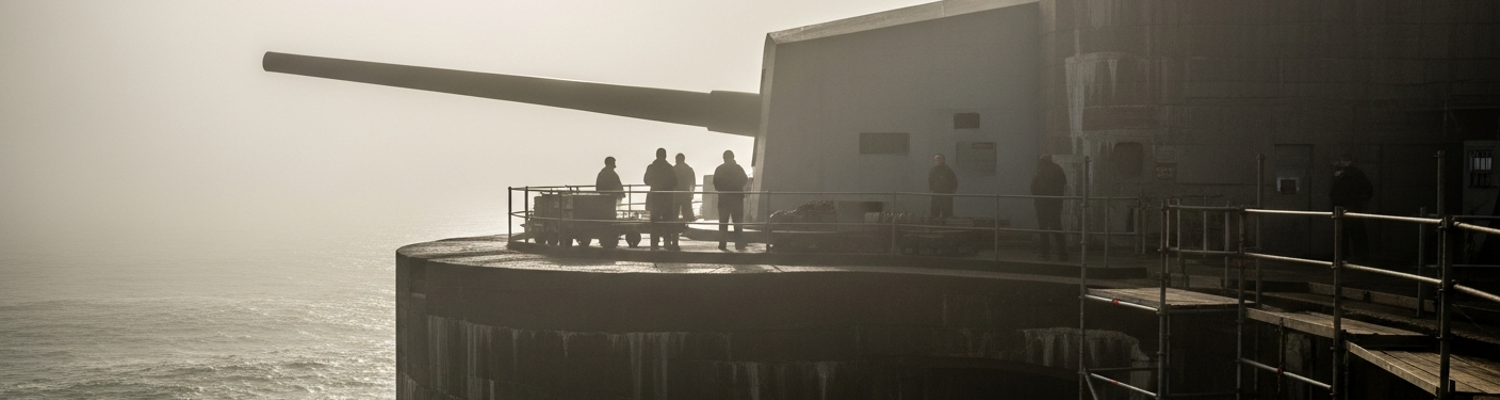

U.S. Army training manuals from the late 1930s projected an image of an integrated, modern bulwark against naval threats. They described a seamless system of long-range guns, coordinated observation, and underwater mines capable of sealing every major port on the Atlantic seaboard.
The fall of France in 1940 shattered this confidence.
War Department planners confronted a sobering truth. The existing Harbor Defense Commands were a hollow force, a relic of a bygone era. Archival evidence from NARA Record Group 165 shows a state of near panic as strategists contemplated a hostile German fleet operating from captured French bases. This brought the East Coast within operational range of surface raiders and potentially even carrier aircraft. Existing defenses, many dating back to the Endicott and Taft-era construction programs, were centered on obsolete 12-inch mortars and guns on disappearing carriages. These were designed for a static, close-range fight against battleships of another generation. Operational logs from 1940 indicate many batteries had not been fully manned or drilled in years. Some guns existed only on paper. The situation demanded not reinforcement, but a complete, panicked reinvention of coastal defense from Florida to Maine.
By early 1941, this reassessment materialized into a huge construction program. New Harbor Defense Commands were formally established to streamline a fragmented system. The Harbor Defense Board authorized dozens of new batteries centered on the 16-inch M1919 gun, a weapon capable of hurling a 2,240-pound shell over 26 miles. These were to be housed in reinforced concrete casemates designed to withstand aerial bombardment. The plans, however, far outpaced the industrial capacity to produce the weapons and their specialized carriages. While concrete structures began to rise at key points like Fort Tilden, New York, and Fort Miles at the mouth of the Delaware Bay, they often stood empty. To fill the gap, the Army rushed mobile 155mm guns, originally designed for field artillery, to the coasts. They were mounted on simple, circular concrete platforms known as Panama mounts. The result was a patchwork defense. A state-of-the-art 16-inch battery might be planned, but the actual defense was provided by smaller, less protected guns manned by hastily federalized National Guard coast artillery regiments. By autumn 1941, 45,000 troops were assigned to this function, a considerable manpower drain before the country was officially at war.
Detection technology presented its own set of difficulties. The Army began deploying its first-generation radar systems, the long-range SCR-270 and the shorter-range SCR-268, to key points along the coast. The truck-mounted SCR-270 was intended for early warning of approaching aircraft. The SCR-268 was designed to provide targeting data for anti-aircraft guns. These were novel and complex devices. Signal Corps crews dispatched from Fort Monmouth, New Jersey, were often the first people in a given region to have ever seen radar. Operational logs detail constant struggles with interpreting the returns on the oscilloscope screens, distinguishing real aircraft from sea clutter, weather phenomena, or even flocks of birds. Operating on lower frequencies, the systems were prone to performance degradation and required constant, delicate manual adjustment. Before these radar sets were in place, the primary means of aerial detection was a network of acoustic listening posts, sometimes operated by civilian volunteers from the American Legion. The devices were essentially giant horns that fed sound to an operator’s ears, giving only a crude sense of direction. Their utility diminished as aircraft speeds climbed. Integrating the raw, often unreliable data from a listening post or an early radar set with a gun battery that might be miles away, via telephone lines of questionable reliability, posed a command-and-control problem that was far from solved by the time the first German U-boats appeared off the coast.
The arrival of the first SCR-270 mobile radar sets at Atlantic Harbor Defense Commands in 1941 was an exercise in profound technical and doctrinal disconnect. A Signal Corps crew, fresh from specialist training at Fort Monmouth, would deploy their four-truck convoy and begin assembly. These men understood the art of interpreting an oscilloscope and coaxing a signal from the ether, but the Coast Artillery officers they reported to understood sound locators and searchlights. A review of operational logs from this period details a clumsy, almost unworkable process. The SCR-270 operator would detect a target, a faint return on his screen, and estimate its range and bearing. That information, often imprecise due to the radar’s wide beam and susceptibility to sea clutter, then had to be relayed by a crackling field telephone to an information center. There, a plotting officer would attempt to translate the radar contact into a usable target vector for a searchlight battery that could be miles away. By the time the instructions were passed to the searchlight crew, who then had to manually slew their massive lamp to the designated coordinates, the target had invariably moved on. The electronic sensor and the illuminating beam were not speaking the same language.
This was not a system. It was a collection of uncoordinated parts.
A Harbor Defense Command post, such as those at Fort Hancock guarding New York or Fort Miles at the mouth of the Delaware Bay, was a babel of conflicting data streams. No standardized procedure existed for integrating the different detection assets. An information center, often a hastily converted room in an existing fort, would receive reports from an Army SCR-270 radar, a civilian observer post, a Navy patrol craft, and an old acoustic listening station simultaneously. Each used its own methods and terminology. Archival evidence shows that a single incoming aircraft could generate multiple, contradictory reports on a plotting board, creating confusion for the commanding officer. The Signal Corps radar crews reported azimuths in degrees and ranges in miles. The volunteer spotters, often equipped with little more than binoculars and a telephone, gave vague descriptions based on visual landmarks. The Navy used its own grid system. Fusing these disparate pieces of information into a single, coherent tactical picture in real-time was a near-impossible task, wholly dependent on the initiative of junior officers and NCOs in the plotting room. There was no interoperability, no common doctrine, and no central brain to make sense of the noise.
The oldest layer of this disjointed network, the acoustic detection device, was also its most flawed. These systems were essentially giant mechanical ears, with large horns channeling faint engine sounds to an operator. In the quiet skies over a terrestrial proving ground, they could offer a crude directional cue against a slow-moving bomber. Along the Atlantic seaboard, the operational environment rendered them almost useless. The constant background noise of crashing surf, howling winds, and the engines of commercial shipping traffic created a persistent sonic fog. Operators experienced extreme auditory fatigue, struggling to distinguish the drone of a distant aircraft from the ambient roar of the sea. Their effective range, poor even in ideal conditions, was drastically reduced by these maritime factors. The physics of sound meant the devices always pointed to where a plane had been, a fatal lag that grew more pronounced as aircraft speeds increased. By late 1941, many Coast Artillery commanders regarded the acoustic locators as little more than a means to keep sentries occupied while they desperately awaited the delivery of more radar sets.
The Selective Training and Service Act of 1940 was a blunt instrument designed to solve a singular problem: the U.S. Army was a skeleton force, and it needed bodies. For the Coast Artillery Corps, this solution created a crisis of competence. Harbor Defense Commands from Boston to Pensacola were inundated with tens of thousands of draftees whose civilian lives as farmers, clerks, or factory workers had not prepared them for the intricate mechanics of a 16-inch gun battery. Training schedules from 1941 reveal a desperate attempt to bring these men to a minimum standard of proficiency. The process of serving a major caliber gun was a complex sequence requiring more than one hundred men to execute dozens of coordinated tasks. It involved calculating firing solutions based on shifting data, manhandling 2,240-pound projectiles and hundreds of pounds of silk-bagged powder in cramped magazines, and operating the gun’s machinery with precision. A single error in this sequence could lead to a catastrophic misfire or a shell landing miles off target. The men were green. Training was often rote, focused on passing gunner’s examinations rather than simulating the chaos of combat. The defensive line was manned by crews who knew the steps but had never heard the music of battle.
The new detection instruments of the coast, the SCR-270 and SCR-268 radar sets, introduced a technical challenge the Army was wholly unprepared to meet. These were profoundly complex machines in an era when electronics was a niche field. The entire training pipeline for the technicians needed to install, maintain, and repair them was concentrated at Fort Monmouth, New Jersey. This single installation could not produce qualified specialists fast enough to meet the demand, creating a critical shortage along the entire Atlantic seaboard. Operational logs from installations like Fort Tilden in New York and Fort Miles in Delaware detail the consequences. A single blown vacuum tube or a malfunctioning magnetron in a radar transmitter could render an early warning station blind. With no qualified technician on site, the crew could do little more than report the failure and wait, sometimes for days, for a specialist to be dispatched from New Jersey or a neighboring command. This created long periods of vulnerability, forcing commanders to fall back on less reliable acoustic locators and civilian spotters. The handful of Signal Corps radar specialists possessed skills the artillerymen they served alongside could not comprehend.
Personnel instability shattered any hope of developing lasting unit cohesion. The War Department viewed the Harbor Defense Commands as a static, secondary front and, more importantly, as a holding pool for trained manpower. Archival evidence from 1941 and 1942 shows a relentless drain of the most competent officers and non-commissioned officers from coastal batteries. These experienced soldiers were pulled to form the leadership cadres for new infantry and armored divisions being activated for eventual deployment overseas. This policy, while necessary for the Army’s broader expansion, was devastating to the readiness of the coastal defenses. A gun crew at a battery guarding the entrance to the Chesapeake Bay might spend months achieving a high level of proficiency, only to have its expert battery commander and senior NCOs transferred on short notice. Their replacements were often newly commissioned lieutenants and sergeants with minimal experience, forcing the training cycle to begin anew. This constant churn of personnel prevented the deep, instinctual teamwork required for effective gunnery and command, leaving the Atlantic shield in a permanent state of organizational fragility.
The order, disseminated by the Eastern Defense Command in late 1941 and expanded drastically after Pearl Harbor, was absolute: extinguish all coastal illumination. For cities from Portland, Maine, to the Florida Keys, this meant streetlights going dark, vehicle headlights being taped over, and civilian Air Raid Precaution wardens enforcing strict rules against any light leaking from homes. The strategic purpose was to deny German U-boat commanders an advantage they had exploited with devastating effect during Operation Drumbeat in early 1942. Merchant vessels, even those running without lights, were being perfectly silhouetted against the glow of shoreline cities, turning them into easy targets for torpedoes. For the Coast Artillery crews manning the defenses, this directive created an operational paradox. Their own doctrine relied on visual acquisition, with massive 60-inch Sperry searchlight batteries tasked with illuminating targets for the gun crews. Suddenly, the defenders were plunged into the same disorienting blackness as their enemies. A searchlight crew could no longer rely on ambient light or casual observation to spot a potential threat before powering up their 800-million-candlepower beam; doing so would instantly reveal their own position.
The psychological weight of this perpetual darkness was immense. For the thousands of draftees and National Guardsmen of the coastal batteries, many of whom were still struggling with the complexities of their new roles, the night brought a specific kind of dread. A close review of operational logs and oral histories from installations like Fort Hancock, guarding New York Harbor, and Fort Miles, at the mouth of the Delaware Bay, reveals a state of constant, low-grade fear. Every shadow on the water, every unidentified engine noise carried by the wind, could be a surfaced U-boat or a Kriegsmarine surface raider. While German reconnaissance flights over the East Coast were exceptionally rare, the possibility was a powerful driver of anxiety. Sentries on beach patrol or observers in lonely concrete towers strained their eyes and ears for hours, peering into a black void where the sea met the shore. The work was defined by long periods of intense boredom punctuated by sharp jolts of adrenaline. An unconfirmed report from a civilian spotter or a faint return on an early radar set could send an entire battery to full alert, with gun crews scrambling to their stations in the dark, only for the alarm to prove false.
This constant state of heightened alert, with no enemy to actually fight, created its own form of exhaustion. The condition, then often termed combat fatigue or simply war nerves, was a significant factor. Unlike troops in an active combat zone, these soldiers were fighting a war of anticipation. Their enemy was a phantom, a potential threat that rarely materialized but was always present in their minds. The sleep schedules of men in the searchlight and gun batteries were consistently disrupted by rotating shifts and false alarms. The strain was not one of intense, violent encounters, but of a slow, grinding vigilance that wore down morale and sharpened tempers. For young soldiers pulled from inland towns and cities, the coastal environment itself, the constant sound of the surf, the damp, salt-filled air, and the oppressive, unbroken darkness, was an alien world. Military psychologists of the era were only beginning to understand that any soldier, regardless of their initial mental fortitude, could eventually become a psychiatric casualty under sustained pressure. The men of the Atlantic defenses were proving that this pressure did not always have to come from incoming fire.
The mechanical backbone of the Atlantic Coast Defense was actively rusting away. At key harbor defenses like Fort Hancock, New Jersey, which guarded the approach to New York City, the primary armament consisted of World War I-era 12-inch guns on M1897 disappearing carriages. These were enormously complex machines of steel and hydraulics, designed decades earlier to counter a different class of warship. A review of ordnance logs from 1941 reveals a constant and losing battle against mechanical decay. The very nature of the disappearing carriage, which used a massive counterweight and hydraulic cylinders to lower the 52-ton gun behind a concrete parapet for reloading, was its weakness. The hydraulic systems, which relied on a precise mixture of glycerine and water, were prone to leaks from aging seals and gaskets. In the cold North Atlantic winters, this fluid could freeze, rendering the entire mechanism inoperable. Maintenance crews spent countless hours chipping away rust and applying thick layers of cosmoline grease to the vast traversing racks and elevation gears, a monumental task against the corrosive salt air. The open-topped nature of the emplacements meant the machinery was perpetually exposed to the elements, accelerating its decline. These were not weapons that could be brought into action quickly; they were fragile, century-old antiques that required immense effort just to remain nominally functional.
Out in the harbor channels, the ocean itself was a relentless enemy of the defensive perimeter. The anti-submarine nets, intended to block the entrances to critical anchorages like the Delaware Bay and the Chesapeake Bay, were heavy steel mesh constructions suspended from buoys and moored to the seabed with massive concrete anchors. A single 600-foot section of this netting could weigh over three tons. Archival evidence from the Army Mine Planter Service, whose vessels were tasked with their upkeep, details a constant struggle against the forces of nature. A winter nor’easter storm could generate waves and currents powerful enough to snap heavy mooring chains, tear buoys loose, and rip gaping holes in the net itself, leaving a harbor vulnerable. The continuous flexing of the steel mesh in strong tidal currents led to metal fatigue and accelerated corrosion, requiring entire sections to be hauled to the surface for repair. Divers had to descend into cold, often zero-visibility water to inspect the moorings and shackles, a dangerous and physically draining task. The operational records show a frustrating cycle of damage and repair, where a net barrier was often a patchwork of recently mended sections, with its integrity always in question.
Communication between the disparate elements of a Harbor Defense Command, from a remote observation post to a plotting room and finally to a gun battery, relied on a network of aging, vulnerable telephone lines. Many of these lines were simply copper wires sheathed in lead, strung on wooden poles that followed exposed coastlines. Signal Corps maintenance reports from 1941 are a litany of environmental failures. The persistent salt spray would coat the ceramic insulators on the poles, creating electrical shorts that made the lines crackle with static or fail completely, especially during the frequent coastal fog and rain. Ice storms could encase the wires in thick ice, their weight snapping the lines and bring down whole sections of the network. At a sprawling installation like Fort Miles, with its observation towers spread for miles along the Delaware coast, a single severed line could isolate a critical lookout post. An observer might spot a target, but without a working telephone, the information was useless unless physically run by a messenger, a delay that negated any tactical advantage. This lack of hardened, reliable communications meant that even if the new radars worked and the old guns could be coaxed into firing, the command-and-control structure was perpetually one storm away from total collapse.
A stark contradiction governed the Atlantic Coast Defenses in 1941. Ordnance manuals promised a world of interchangeable parts and rapid field repairs, a system where a damaged gun could be swiftly returned to service. The truth on the ground was a frantic scramble for components that were in critically short supply or did not yet exist in the Army’s inventory. A review of ordnance logs from the Harbor Defenses of New York and Delaware reveals a system choking on its own rapid expansion. For the new 16-inch M1919 guns being slowly installed, specialized spare parts for their complex breech mechanisms and recoil systems were nearly impossible to acquire. These parts were not sitting in depots; they were being consumed by the Watervliet Arsenal to build new guns or were being diverted to the Navy. For the much more numerous older weapons, like the 12-inch guns on disappearing carriages, the problem was industrial archeology. Gaskets, hydraulic seals, and specialized steel fittings for these turn-of-the-century mechanisms were no longer in production. A failure meant that a local machine shop had to be contracted to fabricate a one-off replacement, a time-consuming process with no guarantee of success.
The construction program itself was a monumental exercise in frustration. The Army Corps of Engineers, which had only formally taken over the full military construction mission from the Quartermaster Corps in 1941, was stretched to its breaking point. Archival evidence from the construction of Fort Miles in Delaware shows the immense difficulty. Building the casemate for Battery Smith, designed to house two 16-inch guns, required a continuous pour of thousands of cubic yards of high-strength concrete. This demanded a steady, unbroken train of supply trucks bringing gravel, sand, cement, and fresh water to the site. A single broken-down truck or a delay at the railhead could compromise the integrity of the entire structure. The sandy, shifting terrain of coastal sites like Cape Henlopen required extensive road preparation and the construction of temporary infrastructure just to get heavy equipment and materials to the battery locations. These engineering challenges led to significant delays, leaving expensive new guns sitting on rail sidings or on temporary mounts while their permanent, protected fortifications remained unfinished skeletons of rebar and wooden forms.
Underpinning all of this was a supply chain that was disorganized, inefficient, and overwhelmed. There was no single, unified logistics command for the entire Eastern Defense Command; each Harbor Defense was largely responsible for its own sustainment. A quartermaster at a new battery on the Carolina coast would file a requisition for basic materials like lumber, barbed wire, or even rations, and the request would enter a bureaucratic maze. It competed with requests from hundreds of other new installations, from the massive Lend-Lease program, and from the Navy, which always had priority. Photographic records show a chaotic mix of transport: military 2.5-ton trucks shared poorly maintained roads with contracted civilian vehicles of every description. Rail depots became choke points, with priority shipments of guns and ammunition sitting alongside piles of provisions and building materials, all waiting for the limited number of vehicles to haul them the final few miles to the coast. The result was a constant state of want in a nation of plenty, where gun crews could be on short rations while construction on their barracks was halted for a lack of nails.