
The Naval Attache's Berlin Mandate
The Teletype machine in the office of the United States Naval Attaché in Berlin was silent. A final, shuddering clack of the typebars, a sharp grinding noise, and then nothing. The flow of coded information from Washington had ceased. For Captain Albert E. Schrader, the Naval Attaché, this mechanical failure in mid-1940 was a physical manifestation of a larger operational decay. He was an intelligence officer in the heart of a hostile power, and his tools were breaking down.
A review of Office of Naval Intelligence (ONI) directives from the period shows the immense pressure on the Berlin attaché’s office. Between May 1940 and March 1941, Schrader’s primary duty was the collection of naval intelligence. This was not a general task. ONI directives specified the need for granular detail: the number and type of U-boats under construction in the yards at Kiel and Hamburg, the operational readiness of capital ships like the Bismarck and Tirpitz, developments in naval aviation, and any advances in radar or signals technology. The attaché was also responsible for monitoring broader military, political, and economic conditions that could impact naval affairs. This meant tracking steel production, oil reserves, and the political standing of key figures within the Nazi regime and the Oberkommando der Marine. The office was a small island of American observation in a city preparing for total war.
This was a city of secrets.
The scope of authorized intelligence gathering was severely restricted by diplomatic protocol. Naval attachés were accredited diplomats, not clandestine spies. Their methods were limited to what could be accomplished within their diplomatic status. Archival evidence shows their primary sources were official German publications, observation at public events, analysis of press and radio reports, and conversations with officials from other neutral embassies. A key, though perilous, method was the cultivation of contacts within the German military and industrial establishment. Post-war analysis revealed the danger of this work; the attaché’s office itself was a target of German intelligence, with locally-hired staff acting as informants and listening devices hidden within the conference rooms. Typewriter carbons from classified reports were simply thrown in the trash, providing a direct feed of information to German agents. The attaché was gathering secrets from an opponent who was simultaneously reading his mail.
The initial assessments sent to Washington painted a picture of a formidable, but brittle, German Navy. Reports from the Berlin embassy, filed alongside those from London and Rome, formed a part of President Roosevelt’s daily intelligence brief. Early analyses correctly identified the threat of commerce raiding by German surface ships, which had a disproportionate impact on Allied shipping in 1940. There was a deep focus on the Kriegsmarine’s capital ships, which, despite their small numbers, were seen as a significant threat that tied up large portions of the British Royal Navy. The full potential of the U-boat arm was not yet appreciated. While ONI was tracking U-boat construction, the strategic concept of a tonnage war as envisioned by Admiral Karl Dönitz, and the industrial capacity to sustain it, was an evolving picture. The reports from Berlin in this period reflect an intelligence apparatus grappling with the scale of a new type of naval warfare, constrained by limited access and the formal boundaries of diplomacy.
German Naval Buildup Observations
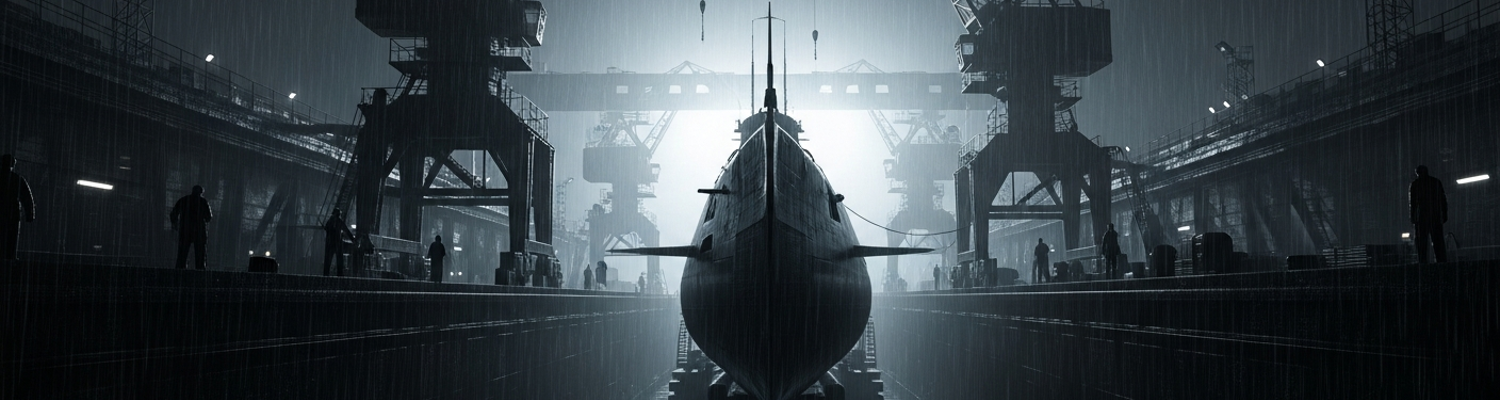
The Berlin naval attaché’s war diary and subsequent intelligence summaries sent to Washington show a constant effort to quantify the U-boat threat. The reports from 1940 are filled with fragmented data, a mosaic of shipyard observations, analysis of German propaganda, and third-hand accounts from neutral diplomats. Captain Schrader’s office tracked the launchings at major yards like Blohm & Voss in Hamburg and AG Weser in Bremen, attempting to build a reliable model of production velocity. Early in 1940, the estimates hovered around two to four submarines per month. By late 1940 and into early 1941, the attaché’s numbers began to climb, with reports indicating a surge toward ten, then fifteen boats per month. These figures, while alarming, failed to capture the true exponential nature of the buildup. German industry, through pre-fabrication and relentless prioritization, was accelerating production to a rate approaching twenty boats per month by mid-1941. The intelligence failure was not one of total ignorance, but of scale. The data pointed to a serious problem, but the reality was a strategic crisis.
While the U-boat threat grew in the shadows of production statistics, the expansion of the German surface fleet was a far more visible spectacle. The commissioning of the battleship Bismarck in August 1940, followed by its sister ship Tirpitz in February 1941, represented the tangible culmination of Germany’s naval ambitions. These were 50,000-ton vessels, armed with eight 15-inch guns and protected by over a foot of steel armor plate. The attaché’s reports would have detailed their fitting-out and sea trials in the Baltic, events that could not be entirely hidden. The operational deployment of the battlecruisers Scharnhorst and Gneisenau in early 1941 provided a violent confirmation of the surface threat. Their Atlantic sortie, codenamed Operation Berlin, resulted in the sinking or capture of 22 Allied merchant vessels. For intelligence analysts in both Berlin and Washington, these actions posed a difficult problem, forcing the Royal Navy to dedicate its own battleships to convoy escort, stretching its global resources to the breaking point.
The steel plates arriving at the shipyards in Wilhelmshaven and Kiel were the foundation of this naval power. The attaché’s office was tasked not just with counting ships, but with assessing the industrial engine that produced them. Reports from this period reflect an attempt to gauge the output of the Ruhr Valley’s steel mills and the capacity of the sprawling dockyard complexes. After the fall of France in 1940, German industry gained access to new resources and U-boat bases on the Atlantic coast, a development noted with extreme concern. The German Four Year Plan had prioritized rearmament, and by 1940-1941, a significant portion of the nation’s industrial might was being funneled into the Kriegsmarine, specifically the U-boat program which had been given priority over all other naval construction after the war began. Dispatches from Berlin attempted to quantify this shift, noting the conversion of civilian manufacturing to military production and the constant activity in the ports. This industrial output had a direct impact on asset availability; every ton of steel allocated to the shipyards was another fraction of a U-boat hull or a battleship’s armor belt.
Industrial War Machine Assessments
Economic dispatches from Berlin between 1940 and 1941 reveal an intelligence effort stretched to its limit. The core task was to look past the finished U-boats and battleships and assess the industrial apparatus that forged them. This meant attempting to quantify the raw output of the Ruhr Valley, a complex of coal mines, blast furnaces, and the massive steel works of Krupp and Reichswerke Hermann Göring. Analysts in Captain Schrader’s office tracked freight car movements and pored over official production statistics, trying to model the flow of steel, coal, and electricity. The numbers they reported to Washington were alarming, showing an economy fully mobilized for war under the Four Year Plan. Yet, the dispatches failed to grasp the true elasticity of this system. They saw an industry operating at a high tempo but did not fully appreciate its capacity for further rationalization and expansion. The German war economy was not a monolith running at peak output; it was a system of managed scarcity, capable of diverting immense resources to priority projects when ordered. The intelligence picture correctly identified a powerful industrial engine, but it consistently underestimated its horsepower.
Archival evidence shows a concerted effort to untangle the complex web of resource allocation within the Third Reich. This was a bureaucratic fight for steel, copper, aluminum, and skilled labor among the Wehrmacht, the Luftwaffe, and the Kriegsmarine, all overseen by Hermann Göring’s Four Year Plan office. The naval attaché’s office would have noted the clear victory of the U-boat program in this struggle. Following the outbreak of war, Hitler ordered that U-boat construction receive absolute priority, effectively killing the ambitious pre-war "Plan Z" for a large surface fleet. This shift was a physical redirection of Germany’s industrial might. Steel plate originally destined for cruisers was instead sent to the submarine yards at Hamburg and Bremen. Highly skilled welders and electricians were pulled from other projects and funneled into the U-boat production lines. While prestige projects like the Bismarck and Tirpitz were completed, they represented the last of a dying breed. The attaché’s analysis correctly perceived that the overwhelming mass of Germany’s naval-industrial power was being directed not at challenging the Royal Navy directly, but at strangling Britain through a tonnage war.
In their final assessments of Germany’s long-term war potential, the Berlin dispatches painted a picture of a formidable but brittle colossus. The prevailing analysis in Washington, informed by these reports, was that Germany’s economy was geared for short, violent campaigns, not a protracted global conflict. The attaché’s office identified several vulnerabilities, the most significant being a dependency on foreign raw materials, particularly oil. Despite a massive state-sponsored program to create synthetic fuels from coal, Germany remained short of the petroleum needed to power a global war machine. Reports would have detailed the output of the Leuna synthetic fuel works but also noted that it could never fully compensate for the loss of overseas imports, a situation enforced by the Allied naval blockade. This fundamental weakness directly influenced naval production; the resource-intensive thirst of a large surface fleet was a liability Germany could not afford, reinforcing the strategic shift toward the more diesel-efficient U-boat arm.
Diplomatic Posturing Analysis
The diplomatic cables originating from the American embassy in Berlin between 1940 and 1941 show an intelligence apparatus almost entirely dependent on overt sources. Captain Schrader and his counterparts were not operating as clandestine spies; their authorized world was one of official publications, carefully managed press conferences, and the public pronouncements of the Nazi state. The primary raw material for analysis was the output of the German Foreign Ministry under Joachim von Ribbentrop and the Propaganda Ministry under Joseph Goebbels. Every speech, radio broadcast, and newspaper editorial had to be deconstructed, with analysts searching for subtle shifts in tone or any deviation from the established public line. This was the practice of diplomatic Kremlinology, applied to the more volatile Nazi regime. The naval attaché’s office was tasked with finding actionable intelligence within a system designed to project an impenetrable image of strength and monolithic will.
They were forced to read the tea leaves of a government that communicated through bombast and threat.
The attaché’s interpretation of this public-facing diplomacy formed the basis of his reports to Washington. Archival evidence shows a consistent pattern of German dual-messaging. Publicly, especially after major military victories like the fall of France, German diplomats offered vague assurances of their lack of hostile intent toward the United States, framing the European conflict as a regional matter. Hitler’s speeches often contained passages claiming a desire for peace with the Western Hemisphere. These pronouncements were contradicted by the aggressive actions of the Kriegsmarine in the Atlantic and the increasingly bellicose undertones of internal propaganda. The signing of the Tripartite Pact with Italy and Japan in September 1940 was a watershed moment. Schrader’s office would have reported this not as a standard military alliance but as an unambiguous diplomatic signal directed at Washington. The pact was a calculated act of intimidation, designed to force American neutrality by creating the specter of a two-ocean war. It was overt diplomacy as a form of strategic coercion.
Based on these conflicting diplomatic signals, the assessed probability of war for the United States evolved dramatically. In early 1940, the attaché’s reports would have characterized war as a distant but serious possibility. Following the success of the German blitzkrieg in Western Europe and the signing of the Tripartite Pact, that assessment changed. Cables to the Office of Naval Intelligence began to paint a picture of a nation that saw the United States as a future adversary. The undeclared war in the Atlantic, where U.S. destroyers were beginning to clash with German U-boats, provided a violent, real-time counterpoint to the carefully worded notes from the German Foreign Ministry. While American public opinion was still largely against entering the war, the intelligence from Berlin indicated that Germany was increasingly acting as if the conflict had already begun. The final reports before the embassy staff was interned in December 1941 reflected a near certainty of conflict, a conclusion based not on a single intercepted secret, but on the overwhelming weight of Germany’s open hostility.
Intelligence Collection Limitations
A review of the intelligence collection methods employed by the Berlin naval attaché’s office reveals a near-total reliance on open-source material and overt diplomatic functions. The intelligence officers were not spies running clandestine networks; they were accredited diplomats. Their primary sources were the official Nazi party newspaper, the Völkischer Beobachter, transcripts of radio broadcasts from the Propaganda Ministry, and the official naval yearbooks, the Jahrbuch der Deutschen Kriegsmarine. Actionable data had to be extracted from this propaganda. An analyst might attempt to cross-reference a propaganda film celebrating shipyard workers with known launch dates to estimate construction timelines. They attended state dinners and diplomatic receptions, straining to overhear conversations or engage German officers in carefully worded discussions about naval affairs, a practice that yielded little more than the official, approved line. Every piece of information was filtered, manipulated, and designed to project a specific image of German power.
This reliance on surface-level information was compounded by a profound intelligence void in the electromagnetic spectrum. The United States in 1940 possessed no effective capability to decrypt the secure communications of the German military. The Kriegsmarine, in particular, relied on the Enigma cipher machine for its command-and-control radio traffic. For American intelligence, this meant that the constant stream of wireless messages directing U-boat wolfpacks, coordinating surface raiders, and organizing fleet movements was functionally just static. Listening posts could confirm the existence and volume of this traffic, noting spikes in transmissions that might precede an operation, but the content of the messages remained a mystery. There was no American equivalent to the British effort at Bletchchley Park at this point in the war. The absence of this cryptanalytic insight created a blindness; the attaché could report on a ship’s commissioning, but he could not provide Washington with any warning of its intended mission once it put to sea.
Archival records show no evidence of a developed human intelligence (HUMINT) network available to the naval attaché in Berlin. There were no recruited agents inside the German Naval High Command (Oberkommando der Marine), no paid informants on the factory floors at the Blohm & Voss shipyards, and no disaffected officials willing to leak strategic documents. This forced the attaché’s office to operate as pure observers, looking at the German war machine entirely from the outside. They could see the steel going into the shipyards, but they had no source to tell them about production bottlenecks or the true monthly output of Type VII U-boats. They could photograph a new radar array on a German destroyer from a distance, but had no engineer’s blueprint to analyze its frequency or power. This lack of penetration meant that all intelligence assessments were, by definition, reactive. The office could only report on developments after they became physically manifest.
Untrained Militia Oversight
Captain Schrader’s attaché reports dispatched to the Office of Naval Intelligence (ONI) between 1940 and 1941 reveal an analytical framework unprepared for the concept of popular resistance. The office’s mandate was clear: report on the enemy’s conventional order of battle. This meant a focus on the Kriegsmarine’s capital ships, U-boat construction rates, and the technical specifications of naval ordnance. Intelligence requests from Washington were centered on metrics of state power: steel tonnage, shipyard capacity, and the operational range of German aircraft. The dispatches reflect this thinking, providing detailed, if often incomplete, data on the tangible assets of the German war machine. An act of industrial sabotage, such as contaminated lubricant ruining the bearings in a U-boat transmission, would have been logged by German authorities as an industrial accident. For the attaché’s office, it would not have registered at all. It was an event that fell entirely outside their collection priorities.
This was a blindness born of doctrine.
The prevailing focus on conventional military threats created an inability to recognize the nascent potential of what were dismissed as 'untrained local militias'. In the U-boat pens at Lorient or Saint-Nazaire, a French dockworker intentionally miscalibrating a pressure gauge or leaving a critical weld incomplete was not seen as a combatant. To both German occupiers and American observers, he was a civilian. His actions were a matter for the Geheime Staatspolizei, not a factor in naval intelligence calculations. Early resistance activities, such as the distribution of anti-German leaflets in occupied Norway or Poland, were noted in diplomatic cables as issues of civilian morale and internal policing, not as the beginnings of a widespread, irregular conflict. The ONI’s analytical model was designed to weigh the armor thickness of the Bismarck against the HMS King George V. It had no methodology for weighing the collective impact of a thousand small acts of defiance that could corrode the enemy’s war-making capacity from within.
The attaché’s high-level reports misjudged the early resistance movements forming across German-occupied Europe. Groups like the burgeoning Polish Home Army or the first Gaullist networks in France were viewed not as military organizations but as political phenomena. Their activities—gathering intelligence, establishing escape lines for downed Allied airmen, and publishing clandestine newspapers—were categorized alongside internal political dissent. The intelligence failure was one of imagination. The attaché’s office could not conceive of a centrally coordinated, strategically significant military effort emerging from disparate bands of civilians armed with stolen pistols and homemade explosives. The paradigm was state-on-state warfare. Therefore, a report on a train derailment in Yugoslavia caused by partisans would be analyzed for its temporary disruption to German supply lines, but the existence of the partisans themselves was not integrated into strategic assessments of German vulnerabilities. They were a nuisance, not a second front.
Strategic Intelligence Gap Impact
The underestimation of German U-boat production by the Berlin naval attaché had direct and severe consequences for American naval strategic planning. Office of Naval Intelligence (ONI) assessments from 1940 and early 1941 show that planners in Washington were operating with flawed metrics. The numbers fed into Chief of Naval Operations Harold R. Stark’s strategic calculations, such as the foundational "Plan Dog" memo, suggested a serious but manageable threat to Atlantic shipping. This miscalculation shaped the material reality of the U.S. Navy. The production schedules for escort vessels, specifically the Benson and Gleaves-class destroyers, were not imbued with the urgency that the actual production rate of U-boats demanded. As a result, when the "Second Happy Time" began for German submariners off the American coast in early 1942, the U.S. Navy was short of a sufficient number of destroyers and smaller patrol craft to form effective convoys.
An American sailor assigned to an early convoy escort in 1942 was placed in extreme peril by these pre-war analytical failures. His destroyer likely possessed the early QC-series sonar gear, prone to false contacts and with a limited search capability. His vessel was armed with an inadequate number of depth charges, often deployed from simple stern-mounted racks that could only drop a small, ineffective pattern directly behind the ship. More advanced forward-throwing weapons like the Hedgehog mortar, which could have attacked a submarine without the escort losing sonar contact, were not yet widely available because the perceived threat had not justified their accelerated development and deployment. This technological deficit, born from an intelligence gap, meant the experience for ground-level personnel was one of impotence. They were hunting a technologically advanced predator with insufficient tools, aware that a single torpedo from an unseen U-boat could rupture the thin steel hull of their ship, plunging them into the freezing waters of the North Atlantic. The attaché’s miscalculations in Berlin were paid for, month after month, with lost ships and lost lives.