
FRUPAC Cryptanalysis and the NA Submarine Cordon
Stevedores swung crates of Mark 10 Hedgehog projectiles, ammunition drums, and heavy machinery parts onto the iron decks of American destroyer escorts moored at Purvis Bay. Moving hundreds of sailors, delicate electronic equipment, and thousands of barrels of fuel oil into forward staging bases required an immense logistical effort that stretched across thousands of miles of open ocean. Working parties wrestled fifty-four-pound spigot mortar bombs into cramped magazine lockers below decks while engineers pumped black bunker fuel into narrow double-bottom tanks until the hulls settled deep in the brackish water. Machinists calibrated sensitive sonar transducers and serviced stubborn steam turbogenerators under equatorial heat that drove compartment temperatures well past one hundred degrees. Every warship had to depart port mechanically sound and fully stocked with depth ordnance because hunter-killer groups possessed no forward repair tenders once detached into hostile operating areas. Supply personnel logged the last cargo manifests on the pier just as incoming radio traffic altered the sailing orders of the escort vessels.
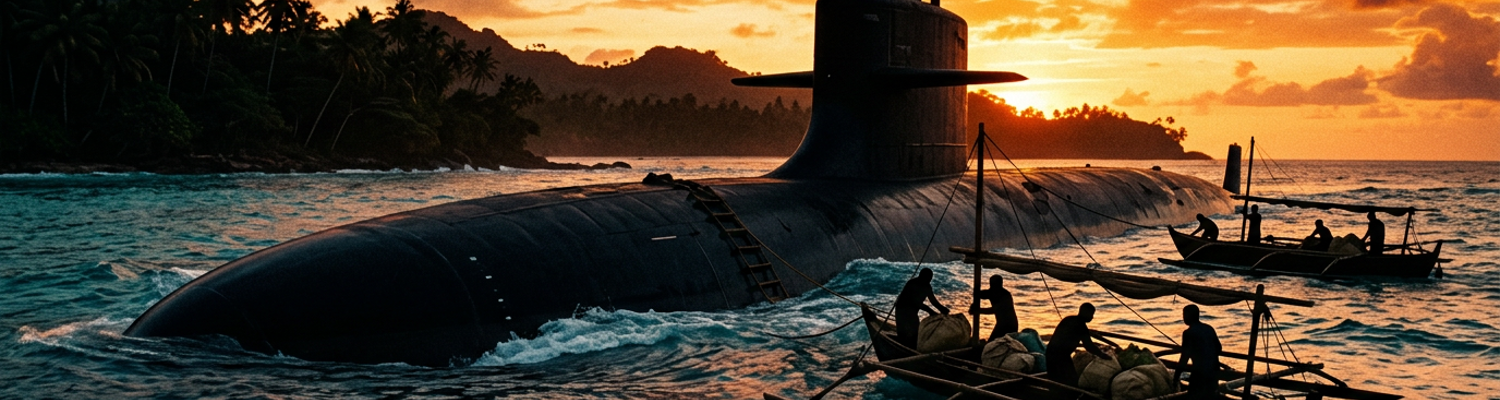
FRUPAC cryptanalysts deciphered JN-25 communications revealing the Sixth Fleet 7th Submarine Squadron deployment along the NA scouting cordon between Truk and the Admiralty Islands, providing the sudden intelligence that prompted those revised sailing orders. Imperial Japanese Navy operational planners positioned the NA line to detect forward staging movements of the United States Pacific Fleet. Japanese planners stationed seven fleet submarines at thirty-mile intervals along this oceanic barrier to track American carrier task forces advancing toward the Marianas and western New Guinea. Tokyo intended for these vessels to transmit early warning reports and execute coordinated night torpedo strikes against approaching capital ships. Japanese commanders believed their submarine cordon remained completely hidden across the wide ocean gap, but the broken code traffic exposed their exact patrol stations and surfacing schedules. Decrypted coordinates pinpointed the positions, patrol intervals, and radio schedules of the Japanese submarines, allowing Allied plotters to chart the entire ambush line on their tactical maps.
Admiral William Halsey ordered Escort Division 39 to intercept the patrol line across the maritime corridor north of New Ireland after reviewing these newly plotted enemy coordinates. Commander Hamilton Hains received the strike directive aboard his flagship, USS George, and organized an aggressive sweep alongside USS England and USS Raby. Tactical doctrine required the three Buckley-class destroyer escorts to operate as a coordinated hunter-killer unit, spacing themselves four thousand yards apart to cover wide expanses of open water with radar and sonar. Lieutenant Commander Walton B. Pendleton prepared the crew of USS England for immediate departure, running through pre-sailing checklists and verifying the readiness of their forward Hedgehog battery. Engineering crews engaged the main reduction gears and fired the boilers, pushing high-pressure steam into the propulsion turbines as the warships cleared the harbor channel.
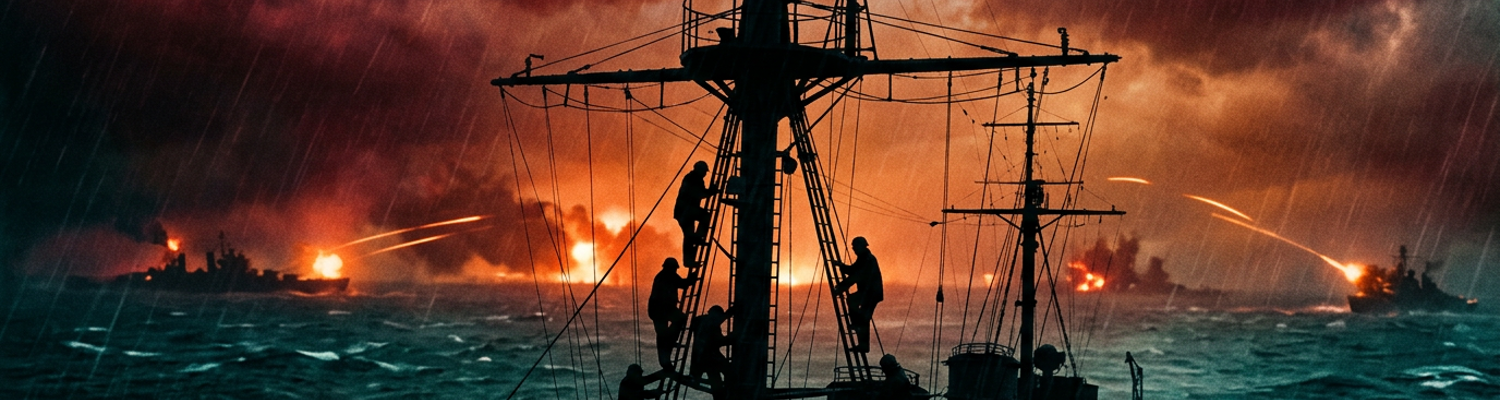
Steel hulls surged through heavy equatorial swells as the three destroyer escorts shaped a northerly course toward the intercept coordinates. Lookouts swept the dark horizon with binoculars through pitch-black tropical nights, watching for surfaced conning towers running on diesel engines to recharge batteries. Combat information teams manned the radar consoles and plotting boards around the clock, tracking every sea return along the projected track of the Japanese submarine line. Commander Hains established a strict tactical plan where the first escort to gain contact would maintain relentless sonar pursuit while the sister ships provided protective perimeter screening. Warships of Escort Division 39 closed the distance to the southern end of the NA cordon, positioning their depth weapons across the maritime path of the unsuspecting Japanese squadron.
Buckley-Class Capabilities and Hedgehog Mortar Doctrine
Steel depth charge racks on the sterns of standard escort vessels suffered from a severe operational flaw that repeatedly allowed submerged submarines to slip away during conventional attacks. Standard stern depth charge attacks lost sonar contact in the vessel wake because churning propeller wash and blind spots created by the hull broke the sound beam hundreds of yards before the ship reached the drop point. Submarine captains routinely used this blackout window to alter course, shift depth, or rig silent running while the attacking vessel passed blindly overhead. USS England broke this frustrating tactical cycle because the ship was equipped with the British-designed Mark 10 Hedgehog forward-throwing spigot mortar, capable of launching twenty-four contact-fused projectiles ahead of the vessel. The spigots were fixed to a steel mount on the forecastle, angled carefully so that an electric ripple discharge tossed twenty-four mortar bombs into an elliptical pattern roughly two hundred yards ahead of the bow. This forward-firing geometry preserved acoustic contact by allowing the warship to press its attack without ever overrunning the submarine.
QCS sonar transducers mounted beneath the hull maintained uninterrupted acoustic tracking during Hedgehog approaches, feeding continuous range and bearing readings to the bridge right up to the moment of firing. Unlike standard depth charges that relied on hydrostatic pressure fuses set for predetermined water depths, the Hedgehog projectiles carried sensitive contact exploders that detonated only upon striking the steel hull of a submarine. A single hit would trigger sympathetic explosions across nearby projectiles, tearing through the pressure hull and destroying the target instantly. If the salvo missed, the twenty-four bombs fell quietly into the mud of the seabed without detonating, which preserved the acoustic environment and prevented the blinding underwater shockwaves that typically ruined sonar searches for fifteen minutes after depth charge attacks. This tactical advantage left the surrounding ocean completely clear for immediate follow-up attacks if the first pattern failed to strike metal.
Lieutenant Commander Walton B. Pendleton and anti-submarine officer Lieutenant John A. Williamson adapted coordinated multi-ship search doctrines within Escort Division 39 to exploit this technological edge. Williamson spent endless hours inside the cramped sonar shack, studying sound reverberations and coaching operators to distinguish between true hull reflections and deceptive thermal layers. Standard navy doctrine instructed individual escort ships to conduct lone pursuit runs, but Pendleton and Williamson recognized that a coordinated division approach would eliminate escape vectors for fleeing Japanese submarines. They developed a team method where sister escorts USS George and USS Raby formed an outer perimeter, holding acoustic contact with their own sonar gear and transmitting steady range reports to England over radio circuits. This multi-ship teamwork allowed George and Raby to pin the submarine in place from long range while Pendleton maneuvered England into position for a quiet Hedgehog run directly across the submarine path.
Sailors loaded the heavy mortar bombs on the forecastle of England under a fierce tropical sun, drilling on reload cycles so the battery could fire repeated patterns without delay. Working parties hauled the teardrop-shaped projectiles from armored ready-service lockers, sliding each bomb down over an individual steel spigot and connecting the delicate electric firing leads. Salt spray and heavy humidity corroded ignition contacts quickly, requiring deck gunners to clean terminals with wire brushes and test firing circuits before every approach run. Officers in the combat information center synchronized their stopwatches and plotted the projected courses of the NA patrol line on glowing radar scopes. Division commander Hamilton Hains approved the modified search tactics, ordering all three warships to hold their search line intervals as the formation steamed into the enemy patrol box.
Strike Operations Against Submarine I-16
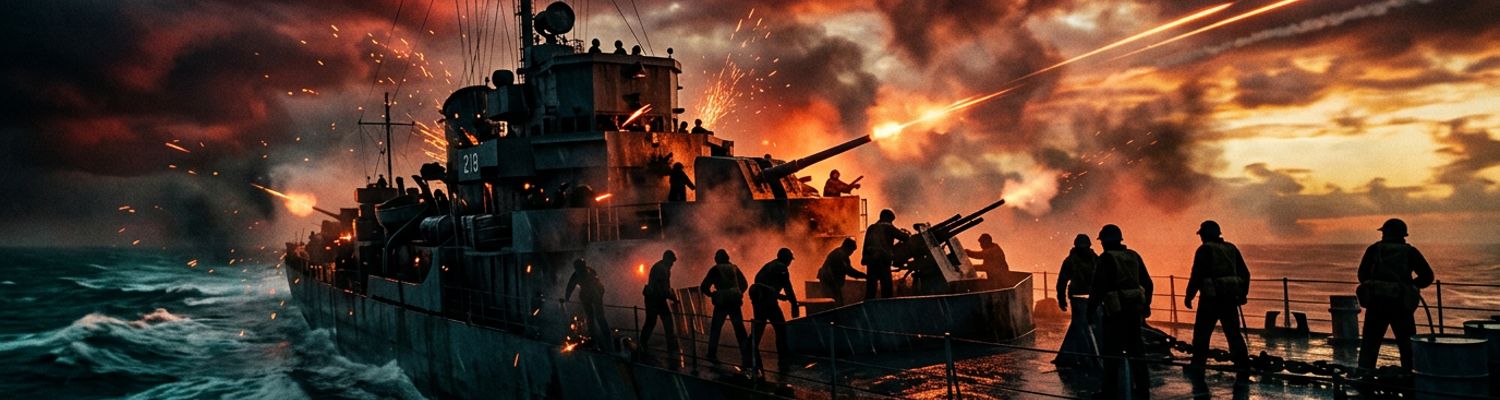
USS England gained initial sonar contact on the cargo-configured submarine I-16 northeast of Bougainville on May 19, 1944, detecting a distinct echo at a range of fourteen hundred yards. Sonar operators inside the stifling sound shack tracked the metallic target while anti-submarine officer Lieutenant John Williamson calculated the bearing change and target speed. Imperial Japanese Navy dockyards had modified I-16 into an underwater supply transport, removing internal torpedo reloads and mounting external cargo containers to ferry rice and ammunition to isolated garrisons on Bougainville. Lieutenant Commander Walton Pendleton pushed the engine telegraphs to fifteen knots, bringing England onto an attack heading while USS George and USS Raby took up blocking positions on the flanks. Deck gunners on the forecastle unhooked the safety covers from the Mark 10 mortar spigots under the heavy tropical heat, sweating through their dungarees as the acoustic range closed steadily. Pendleton ordered the release of the first Hedgehog pattern when the distance dropped to three hundred yards, sending twenty-four contact bombs arcing over the bow in a wide dispersal pattern.
Steel projectiles from that first salvo sliced into the water ahead of the escort and plummeted toward the seabed without touching the hull of the submarine. Sonar transducers retained continuous acoustic contact because the missed bombs struck only soft sediment, preventing the loud underwater reverberations that normally blinded escort sonars after depth charge runs. Pendleton swung England through an aggressive starboard turn, using range calls from Williamson to position the ship for a second attack run across the projected track of the submarine. Crewmen on the forward deck rushed to the ready-ammunition racks, loading twenty-four fresh fifty-four-pound spigot bombs into the firing mounts and reconnecting the electric contact wires within three minutes. Williamson observed the target descending steeply as the Japanese commander tried to slip beneath cold water layers that might deflect the searching sound beam. A second Hedgehog salvo scored direct contact hits at a depth of over one hundred feet, causing violent underwater explosions that lifted the hull of England and rattled the engine room floor plates.
Detonations inside the submarine hull followed the Hedgehog impacts as ruptured high-pressure air flasks, battery banks, and fuel tanks collapsed under the crushing seawater. Seawater rushed into the shattered compartments of I-16, dragging the hull down to the ocean floor while a large column of water and pulverized debris surged toward the surface. Lookouts stationed on the flying bridges of England and George watched a dark oil slick spread across several square miles of open sea. Surfacing wreckage including rubber bags containing Japanese rations confirmed the first confirmed kill of the sweep. American sailors lowered grappling hooks and dip nets over the side, fishing floating debris out of the slick to secure tangible intelligence for fleet commanders.
Rubber supply sacks pulled from the oily water revealed bundles of unhulled rice, canned meat rations, and waterproof medical kits destined for isolated troops on Bougainville. Intelligence officers examined fragments of polished cedar woodwork, pieces of Japanese deck equipment, and patches of uniform cloth to verify the identity of the destroyed vessel. Commander Hamilton Hains radioed confirmation of the sinking to the headquarters of Admiral William Halsey, verifying that Escort Division 39 had breached the southern end of the NA cordon on their very first day of operations. Pendleton logged the action in the tactical record book of England and ordered the gunners mates to replenish the Hedgehog ready lockers before sunset. Division escorts turned their prows toward the northwest, maintaining their search intervals across the Solomon Sea as they hunted for the remaining Japanese submarines along the patrol cordon.
Night Engagements Along the Equator
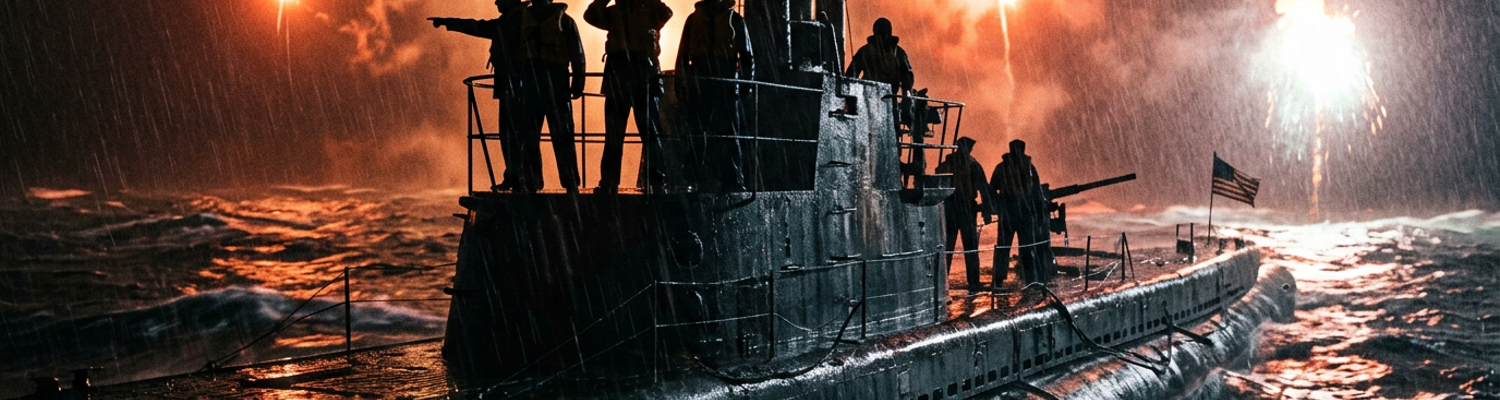
USS England intercepted a surface radar target at a range of four miles after midnight on May 22, 1944, vectoring at fifteen knots through dense equatorial squalls along the northern edge of the Solomon Sea. Heavy rain pounded the steel decks and reduced visual range to zero, but the rotating radar antenna held the small blip steady as Lieutenant Commander Walton Pendleton swung the warship into a rapid intercept run. Japanese submarine Ro-106 had surfaced between the storm fronts to run its noisy diesel engines and recharge depleted battery banks, completely unaware that the approaching escort had detected its silhouette on radar. Lookouts on the conning tower of Ro-106 finally spotted the charging warship and executed an emergency dive, but hull-mounted sound gear on England acquired the metallic echoes of the submerging hull before the submarine reached fifty feet. Pendleton steadied his course over the bubbling swirl of the dive, matched the evasive turn of the target, and fired a full twenty-four-bomb Hedgehog pattern into the dark water. Violent underwater explosions detonated sixty seconds later, sinking Ro-106 and sending a plume of diesel fuel, wood fragments, and shattered metal surging to the surface.
Machinists inside the uninsulated engine rooms of England endured tropical heat that climbed past one hundred and twenty degrees as steam lines radiated intense heat through the lower compartments. Relentless general quarters rotations kept every sailor at battle stations for days on end, pushing the bridge and sonar crews of England to their physical and mental operational limits. Sound operators sat shoulder to shoulder in the stifling sonar shack, sweating through soaked dungarees while straining to isolate true hull echoes from water turbulence and schools of fish. Lieutenant John Williamson rotated his soundmen every twenty minutes to prevent acoustic fatigue and maintain accurate tracking, but sleep deprivation caused dizziness and bloodshot eyes across the entire tracking team. Bridge officers rubbed salt-caked eyes with grimy towels as they stared across the empty ocean, steadying their binoculars against heavy hull vibrations while plotting the next search box. Division commander Hamilton Hains held the escorts in tight formation across the maritime route, demanding continuous sonar sweeps despite the exhausting conditions inside every compartment.
Escort Division 39 cornered Japanese submarine Ro-104 on the morning of May 23, 1944, after search sonars on sister ships USS George and USS Raby struck a solid metallic contact along the patrol line. George and Raby pinned the submerged target between their sound beams, maintaining constant acoustic bearings that blocked every evasive maneuver and allowed England to execute a daylight Hedgehog attack. Pendleton brought England in from the flank, using range calls from Williamson to guide the ship across the smooth equatorial swell toward the estimated depth of the submarine. Deck gunners tripped the electric firing switches at two hundred yards, hurling twenty-four contact-fused spigot bombs into the air in a tight arc across the bow. Projectiles plunged into the clear tropical water and struck the steel pressure hull of Ro-104, triggering several massive underwater detonations that lifted the stern of England and jarred every compartment. Heavy oil slicks and floating debris, including cork insulation, deck boards, and shredded personal belongings, surged to the surface to mark the complete destruction of the submarine.
Destruction of the Remaining Submarine Squadron
Seamen aboard USS England hauled floating timber and cork out of the slick to preserve intelligence evidence before the escort turned northwest toward new intercept coordinates. Sonar operators reacquired search routines, sweeping their sound beams through the warm sea until they locked onto a sharp metallic return north of New Hanover. Lieutenant Commander Walton Pendleton swung England onto the attack heading, tracking the evasive maneuvers of the submerged Japanese boat with continuous sound pulses. Deck gunners released a twenty-four-bomb salvo that plunged straight toward the target, ripping open its ballast tanks with multiple contact explosions. Submarine Ro-116 sank on May 24, followed by the destruction of Ro-108 during a pre-dawn spigot mortar run on May 26, 1944, as the division kept up its relentless forward sweep. Machinists down in the engineering spaces wiped sweat from their foreheads and adjusted steam valves to keep the turbines humming at cruising speed through the night.
Turbine power drove England through choppy equatorial waters toward the coordinates where radar detected Ro-108 attempting to recharge its batteries under cover of night. Lookouts on the Japanese boat attempted an emergency dive when England loomed out of the darkness, but the sonar of the escort locked onto the metallic hull before the submarine reached deep water. Pendleton guided England over the diving swirl and ordered the firing key tripped, sending another deadly pattern of Hedgehog bombs arcing into the pre-dawn swell. Multiple contact explosions lifted the hull of England, rupturing the fuel tanks of the submarine and sending thick crude oil churning to the surface alongside broken wooden crates and personal clothing. Deckhands quickly secured the firing gear and cleaned the spigot mounts with wire brushes while the division prepared for the final sector of its patrol.
Division commander Hamilton Hains managed outer-perimeter cordons using USS George, USS Raby, and USS Spangler while directing England onto firing tracks as the warships combed the waters north of the Admiralty Islands. Fluegel deployed Spangler, George, and Raby in an expansive acoustic box to prevent any surviving submarine from slipping through the gaps between island passages. Sound operators aboard George and Raby picked up a solid echo on the morning of May 30 and held the contact firmly between their search beams, pinning the submerged boat in deep water. Radio messages from Hains guided England across the outer cordon to take over the firing approach while the other escorts maintained acoustic bearings on the flanks of the target. Lieutenant John Williamson squeezed into the sound shack aboard England, listening through the earphones as the metallic pings verified that the cornered vessel was Japanese submarine Ro-105. Pendleton ordered the crew to general quarters and matched speed with the target, lining up the bow of England for the final forward-firing run.
Gunners mates tripped the electric firing switches on the forecastle as England crossed the estimated drop point at three hundred yards. Twenty-four mortar bombs leaped through the morning air and sliced into the swell, plummeting toward the pressure hull of the submarine with contact fuses armed. Underwater detonations shattered the morning calm as several projectiles detonated simultaneously against the steel casing, crushing internal bulkheads and sending massive shockwaves through the sea. England concluded the sweep on May 31, 1944, by sinking Ro-105, completing an unprecedented tally of six submarine sinkings within twelve days. Search parties lowered workboats into the expanding oil slick to collect paper charts, cedar fragments, and damaged gear that floated among the bubbles. Pendleton gathered the recovered Japanese artifacts on the quarterdeck and ordered his exhausted crew to set course for Manus Island to replenish their depleted ammunition lockers.
Fleet Reconnaissance Failures Before Operation A-Go
Seeadler Harbor supply piers received England as ordnance crews rolled fresh crates of Mark 10 Hedgehog projectiles across the wooden docks to restock the emptied magazines of the escort. Admiral Soemu Toyoda constructed the Operation A-Go defense plan under the false assumption that the NA submarine cordon remained fully operational. Toyoda and his operational staff aboard the fleet flagship Oyodo built their entire maritime defense on the belief that these submerged picket boats would provide several days of advance warning before American naval task forces could strike imperial territories. Communications personnel in Tokyo listened to silent radio frequencies around the clock, mistakenly interpreting the lack of contact reports as strict operational discipline rather than the annihilation of their forces. Japanese staff officers pushed painted wooden markers representing Ro-104, Ro-105, Ro-106, Ro-108, and Ro-116 across operational tracking maps north of the Bismarck Archipelago, calculating defensive interception vectors against an American battle fleet that was already steaming past their blind spots.
Charts inside Japanese command bunkers failed to reveal those blind spots because the complete eradication of the 7th Submarine Squadron blinded the Combined Fleet to the Fifth Fleet advance toward the Mariana Islands. Imperial Japanese operational doctrine required submarine picket lines to track approaching task forces, direct land-based naval aviation onto enemy carriers, and weaken American battle lines with torpedo strikes before surface combat began. Japanese strategists assumed Admiral Chester Nimitz would direct his next assault against the Palaus or western New Guinea to support the push of General Douglas MacArthur along the northern coast of New Guinea. Combined Fleet headquarters kept the First Mobile Fleet of Vice Admiral Jisaburo Ozawa anchored at Tawi-Tawi near Borneo to conserve bunker fuel, waiting for submarine contact reports to indicate the exact axis of the American advance. Japanese army and navy commanders across the Mariana Islands worked on runway construction and beach fortifications without receiving a single intelligence alert from the northern Solomon Sea, confident that their oceanic early warning cordon remained intact.
Carrier strike groups under Admiral Raymond Spruance achieved strategic surprise at Saipan due to the unmonitored eastern approaches that this shattered cordon failed to watch. Spruance steered fifteen fleet and light carriers of Task Force 58 straight through the empty ocean where the 7th Submarine Squadron was supposed to be hunting. Hellcat fighters, Dauntless dive bombers, and Avenger torpedo planes launched from American flight decks before dawn on June 11, 1944, striking Japanese air installations across Saipan, Tinian, and Guam. American aerial bombs cratered the runways at Aslito airfield and destroyed over one hundred Japanese aircraft on the ground before pilots could take off to contest the airspace. Transport ships carrying two full United States Marine divisions dropped anchor off the western beaches of Saipan without facing coordinated air attacks, catching the garrison of Lieutenant General Yoshitsugu Saito out of position. Vice Admiral Ozawa received late emergency orders from Toyoda to sortie from Tawi-Tawi, forcing nine carriers and five battleships into a hurried dash across the Philippine Sea to fight an invasion that was already established on the beaches.
Tokyo Headquarters and the Fall of Tojo
Admiral Jisaburo Ozawa launched his carrier strikes into open water without vital reconnaissance because Imperial Japanese Navy commanders failed to recognize the tactical vulnerability of fixed linear submarine cordons to forward-throwing anti-submarine weaponry. High-level naval planners had treated these stationary underwater patrol lines as reliable early-warning fences, never suspecting that American hunter-killer groups could systematically wipe them out using forward-firing spigot mortars without losing sonar tracking. Submarine captains under Japanese doctrine were trained to evade conventional stern depth charges during the acoustic blackout created by the propeller wash of an escort, but Hedgehog contact bombs struck their hulls before evasive turns could begin. Every boat along the NA line had vanished into deep water before its radio operators could transmit warning codes, leaving Combined Fleet headquarters to assume the squadron was simply maintaining strict radio silence. The intelligence collapse directly facilitated the catastrophic naval defeat in the Battle of the Philippine Sea and the subsequent loss of Saipan.
Hellcat fighters and shipboard anti-aircraft batteries shot down the incoming Japanese strike groups as soon as the unguided planes arrived over Task Force 58. American pilots intercepted the uncoordinated waves of dive bombers and torpedo planes, destroying more than three hundred Japanese aircraft in a single day. American fleet submarines Cavalla and Albacore exploited the chaotic fleet maneuvers to penetrate the screen of Ozawa, torpedoing and sinking the heavy fleet carriers Taiho and Shokaku. American carrier aircraft pursued the fleeing Japanese formation the next evening, sinking the carrier Hiyo and damaging two more carriers. Ozawa abandoned the operation and pulled his surviving warships back toward Okinawa, leaving the Imperial Japanese Navy stripped of its trained naval aviators and powerless to contest the Marianas.
Marine artillery batteries and naval bombardment guns poured continuous high-explosive fire into the limestone caves of Saipan as soon as the sea lanes opened up behind the retreating fleet. American infantry battalions pushed through dense cane fields and rocky ridges, trapping over thirty thousand Japanese defenders without food, water, or medical supplies. Lieutenant General Yoshitsugu Saito ordered his surviving troops to mount a final desperate banzai charge with bayonets and sharpened poles before he committed suicide inside his command bunker. American troops eliminated the remaining pockets of resistance along the northern cliffs and raised the United States flag over the island on July 9, 1944. Construction crews immediately rolled heavy bulldozers and steel landing mats onto Aslito airfield, converting the captured runway into an advanced base for long-range B-29 Superfortress bombers.
B-29 bombers operating from those newly seized Marianas runways placed Tokyo and the main Japanese industrial centers within direct striking distance. Senior statesmen, former prime ministers, and imperial court advisers recognized that the absolute national defense zone of Japan had been permanently breached. Prime Minister Hideki Tojo attempted to preserve his authority by reshuffling his cabinet, dismissing Navy Minister Shigetaro Shimada and offering ministerial posts to his fiercest critics, but his opponents refused to serve alongside him. The strategic disaster in the Marianas forced the resignation of Prime Minister Hideki Tojo and his entire cabinet in July 1944. Imperial officials replaced the fallen government with a coalition cabinet led by General Kuniaki Koiso, while American supply freighters began unloading thousands of tons of high-explosive aerial bombs onto the concrete quays at Saipan.