
I Corps Tactical Zone Patrols
By autumn 1967, the northern provinces of South Vietnam were a space of constant, grinding warfare. The I Corps Tactical Zone, stretching from the Demilitarized Zone south past Da Nang, was an area where North Vietnamese Army divisions, including the 324B and 320th, operated with significant freedom. A review of operational logs (NARA Record Group 472) shows these units could mass forces and achieve local numerical superiority against isolated Allied positions. This was not a conventional front. It was a saturated environment where the enemy chose the time and place of nearly every engagement.
For the United States Marines tasked with pacification, the situation was one of persistent threat. They were not defending a line; they were patrolling a hostile expanse, outnumbered and perpetually observed.
Enter the 3rd Battalion, 7th Marine Regiment. The battalion’s command history for November 1967 centers its area of operations in the volatile districts south of Da Nang. This region, known to Marines as the Arizona Territory, was a landscape of rice paddies and dense tree lines concealing a deep enemy infrastructure. The operational tempo was punishing. Following a series of Viet Cong attacks, including an assault on a platoon from Mike Company on Hill 25, 3/7 was ordered to spearhead Operation Foster. The mission was to find and destroy the specific enemy units responsible.
This directive meant a significant escalation in offensive action. Companies were pushed deep into areas controlled by the Viet Cong for years, forcing the battalion into a continuous hunt.
The night belonged to the enemy.
This fact dictated the defining tactic of the period: constant night patrols. Marine command understood that ceding the hours of darkness meant surrendering all initiative. A platoon or squad would depart its perimeter at dusk, burdened with M16 rifles, M60 machine guns, a PRC-25 radio, and as many M79 grenade launcher rounds and claymore mines as could be carried. Movement was slow, deliberate, and tense. Navigating the disorienting landscape of paddy dikes without light forced reliance on compass headings and paced distances. The psychological pressure was enormous. Every sound could signal an ambush.
Patrols were not for reconnaissance alone. They were active counter-ambushes, designed to disrupt enemy movement and initiate contact on the Marines' own terms. A unit would move to a suspected enemy trail, establish a silent position, and wait for hours in the oppressive dark.
The primary objective of these operations was specific: neutralizing concealed enemy firing positions. The adversary’s skill in camouflage was legendary. They constructed elaborate bunker systems, often using logs and earth, that were invisible from the air and highly resistant to artillery. Spider holes, small one-man fighting pits, allowed individual soldiers to seemingly materialize from the ground. Locating these positions almost always happened at the worst possible moment. The immediate action drill was violent and reflexive. Marines would hit the ground and return fire toward muzzle flashes while the squad leader attempted to fix the bunker’s location. Grenadiers armed with M79s would arc 40mm high-explosive rounds toward the suspected target. If that failed, a fire team would be tasked with maneuvering for a direct assault, a dangerous action against a fortified machine gun. This was the granular work of Operation Foster: a nightly, squad-level struggle to locate and destroy a dug-in, patient enemy.
Low-Visibility Ambush Commencement
On the moonless night of November 26, 1967, a reinforced squad from Mike Company, 3/7 Marines, moved out from their patrol base. Their mission, a component of Operation Foster, was to establish an ambush along a suspected Viet Cong resupply route designated Buffalo Trail. The fourteen-man element was burdened with standard equipment. Each Marine carried his M16 with at least twenty magazines, fragmentation grenades, and smoke grenades. The squad also included an M79 grenadier, a two-man team for the M60 machine gun, and a point man with a 12-gauge shotgun. Their movement was agonizingly slow through the viscous mud of the rice paddies. The humidity was a physical presence. Communication was by hand signal.
After nearly two hours, the squad leader identified a suitable kill zone: a narrow bend in the trail flanked by a dense tree line. He positioned his men, setting the M60 to create an interlocking field of fire. Claymore mines were set. The radioman, carrying the PRC-25, took a position near the squad leader. Then they waited.
The ambush had been reversed.
Just after 0200 hours, the night erupted. The fire came not from the Marines’ position but from sixty meters to their direct front. A single, unseen enemy machine gun opened up. The weapon, identified in after-action reports (AAR-3-7-NOV67) as a Soviet-designed RPD, fired from a heavily camouflaged bunker. Its first sustained burst swept down the paddy dike the Marines were using as cover, pinning the entire squad. The 7.62x39mm rounds cracked inches above their heads, forcing every man into the mud. The RPD gunner was disciplined, firing in long, controlled bursts that methodically walked across the Marines' position. The squad’s own M60 was silenced before it could fire; the gunner was hit in the initial burst.
The tactical geometry was devastating. The enemy weapon had complete enfilade fire on the squad’s only cover, turning the low dike into a trap.
The immediate response was a chaotic mixture of instinct and training. Muzzle flashes blossomed as individual riflemen fired into the general vicinity of the enemy gun. The distinct sound of M16s was punctuated by the deeper report of the squad’s M79 grenadier, who began lobbing 40mm shells toward the tree line with no clear point of aim. The air filled with metal. Green tracers from the American weapons crisscrossed with the red-orange tracers of the RPD. The squad leader’s shouted commands were swallowed by the roar. The radioman, lying next to him, screamed that the PRC-25’s handset had been shattered by a stray round, severing their link to the company command post.
Friendly Fire and Cascading Failure
The tactical breakdown was instantaneous. In the disorienting violence, the squad’s trained responses began to work against them. The grenadier, operating under immense pressure, continued firing his M79 on an estimated azimuth. In total darkness, estimating range for an arcing weapon like the M79 was exceptionally difficult. Muzzle flashes were the only reference.
One 40mm high-explosive grenade fell short. Instead of reaching the enemy tree line, it impacted the top of the muddy paddy dike near the center of the Marines’ own position.
It detonated with a flat, sickening crump.
The explosion was not from the enemy. A shower of steel fragments and superheated mud erupted directly within the squad’s perimeter. The blast had a kill radius of five meters, and it had landed squarely among the riflemen. Cries of pain replaced the shouts of command. Archival reports on M79 wounds note their catastrophic nature. The Marine closest to the point of impact was thrown from the dike. Another man screamed that he was hit in the legs, his M16 clattering into the mud. The squad’s problem had multiplied. They were still pinned by an enemy weapon, but now had two serious casualties bleeding in the open, one a victim of their own fire.
The scene descended into pandemonium. The disciplined fire from the RPD continued, its steady rhythm a terrifying contrast to the panicked shots from the remaining Marines. The squad leader’s tactical options were now impossible. His unit was fixed, their support weapon out of action, their radio destroyed, and two men grievously wounded. The realization that the explosion was friendly fire sent a wave of confusion through the squad. Shouts for the corpsman began to cut through the noise. The squad was no longer a cohesive fighting unit but a collection of isolated individuals being systematically taken apart.
The Five-Minute Window
The detonation of the short grenade round initiated the point of inflection. The primary threat shifted from an external enemy to an internal, cascading equipment failure. Analysis of small-unit actions shows that the moments immediately following a friendly fire incident were often the most disorienting. The squad leader’s attention was violently wrenched from the enemy bunker and forced onto the events inside his own perimeter.
The illusion of external support was already gone.
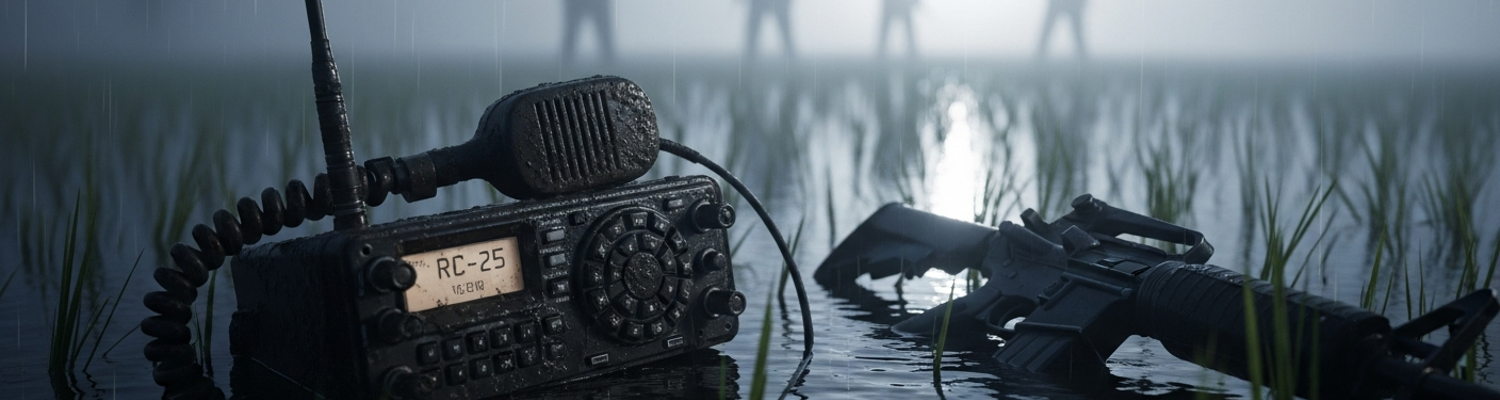
The AN/PRC-25 radio was mechanically inert before the friendly fire incident. In the initial seconds of the ambush, a single 7.62x39mm round had struck the radioman’s pack, impacting the H-189/GR handset. The damage was absolute. The round shattered the handset’s bakelite shell, destroying the internal elements and severing the coiled cord. Without this component, the radio was useless for voice communication. The twenty-four-pound transceiver was dead weight. No situation report could be transmitted. No request for suppressive fire from the 81mm mortar platoon or 105mm artillery batteries could be made. No emergency medical evacuation could be requested. The squad was an information black hole.
This was compounded by a second equipment crisis. As the squad’s Navy Corpsman moved toward the wounded, he found his ability to perform an accurate assessment had been destroyed. His Unit One medical bag had been shredded by the M79 blast. Sterile battle dressings, morphine syrettes, and tourniquets were blown into the mud and contaminated water. His stethoscope, the one tool that could allow him to check for breathing amidst the chaos, was completely negated by the continuous roar of the RPD.
He had to rely on feel.
The corpsman was forced to conduct triage under direct enemy fire, in total darkness, and with his medical equipment compromised. He could not properly check for pulse or respiration on the two casualties. Assessing the severity of the fragmentation wounds had to be done by probing with his fingers in the dark. Monitoring his patients' conditions was reduced to shouting their names and hoping for a response.
A Corpsman's Triage
The Hospital Corpsman, a Navy petty officer, began to low-crawl through the mud toward the screams. Tactical doctrine for care under fire dictated that medical intervention was secondary to achieving fire superiority. He ignored this and pushed forward. He reached the first casualty, the Marine with the leg wounds, who was screaming on the paddy dike. A frantic search with his hands confirmed multiple fragmentation wounds. The second casualty was silent. He had been blown off the dike and lay partially submerged in the paddy water.
The corpsman had two critical patients and seconds to make a decision.
His choice was immediate and counterintuitive. He bypassed the screaming Marine and plunged into the water toward the silent one. His training dictated the severe logic: a screaming man is a breathing man. A silent casualty, face-down in water, is seconds from death. Heaving the unresponsive Marine onto his side, the corpsman’s hands searched the man’s torso and back, feeling for the stickiness of blood and the unstable texture of a massive wound. His fingers found it: a sucking chest wound, a hole in the thoracic cavity preventing the man’s lungs from inflating. In the cacophony of the firefight, this diagnosis was made entirely by touch.
This improvisation saved the Marine’s life. With no access to proper occlusive dressings from his ruined kit, the corpsman found a plastic-wrapped battle dressing in the mud. Tearing the dressing out, he pressed the empty, mud-smeared plastic wrapper firmly over the chest wound. This was a field-expedient measure to create an airtight seal, preventing more air from entering the chest cavity and collapsing the lung. He then rolled the Marine further onto his side into a recovery position, allowing water and blood to drain from his mouth. Only after the silent casualty gave a ragged gasp for air did the corpsman crawl back to the man on the dike. For the second Marine, he ripped sections from his own utility blouse, fashioning two improvised tourniquets and cinching them tight above the fragment wounds. Without the corpsman’s split-second decision, the Marine with the chest wound would have died from a tension pneumothorax or drowned within two minutes.
Tactical Aftermath
The corpsman’s decision, while medically necessary, had an immediate effect on the squad’s tactical capabilities. His actions removed him from the fight, reducing the squad’s fighting strength. With two casualties, the number of effective riflemen was down to eleven. The squad leader assigned at least one other Marine to provide security for the corpsman and the wounded, further reducing the number of men engaging the RPD bunker.
The squad was now fighting at less than 70 percent strength.
This degradation of firepower eliminated any possibility of executing the standard counter-ambush drill. The squad leader lacked the manpower to form a meaningful assault team. His focus was pulled from the external threat to the internal crisis of managing casualties with no radio. He directed the remaining riflemen to concentrate their fire on the bunker's aperture in a desperate attempt to achieve suppression through volume. Then, as abruptly as it began, the enemy fire stopped.
The sudden silence was more disorienting than the noise. After-action reports from Operation Foster show a common enemy tactic was to inflict casualties and then withdraw before supporting arms could be brought to bear. The NVA squad, having broken the Marine ambush and disabled several of its members, likely slipped back into the network of trails that riddled the Arizona Territory. For several minutes, no one in the Marine squad moved.
The squad leader began a low, whispered roll call. The fight was over, but the squad remained trapped, isolated in the darkness with a shattered radio and two severely wounded men.
With the PRC-25 destroyed, the patrol leader could not report the contact. Standard operating procedure dictated that when a unit missed two consecutive radio checks, a relief force was dispatched. Just before dawn, a second squad from Mike Company located the battered element. The relief squad established a perimeter while their radioman finally called in the casualty report and requested an urgent medevac. A UH-34 helicopter landed in the open rice paddy. The two wounded Marines were loaded and flown to the naval hospital in Da Nang. Medical records confirm the corpsman’s improvised chest seal saved the first Marine’s life. The second Marine survived but faced months of surgery. The corpsman’s actions were documented in the after-action report, resulting in a formal commendation. The friendly fire incident involving the M79 grenade launcher triggered a mandatory investigation, its findings contributing to a growing body of evidence about the weapon’s dangers during night engagements at close range.