
Mechanical Collapse of the Extraction Timetable
Field Manual 6-50 dictated strict parameters for artillery battery displacement under pressure. The manual required synchronized phasing of suppressive fires. It demanded immediate rotary-wing staging. It mandated a systematic retrograde of heavy equipment. The men of the Eleventh Marines expected a textbook withdrawal based on these printed guidelines. Archival evidence shows that the defense and subsequent extraction of Fire Support Base Neville on May 12, 1969, rapidly deteriorated into a mechanical failure. Popular portrayals romanticize this event as a flawless tactical extraction. Post-war cinema and pulp histories depict a highly coordinated operation. They show CH-46 Sea Knight helicopters flaring perfectly onto secure landing zones. Gun crews supposedly hooked M101A1 105mm howitzers to cargo slings without issue. These fictions suggest that the defensive perimeter held firmly against the advancing People's Army of Vietnam forces. The popularized narrative insists that officers conducted a clean evacuation without leaving a single crate of high-explosive ammunition behind.
Declassified combat logs (NARA Record Group 338) document a total collapse of the command structure.
A close review of operational logs indicates that the planned extraction sequence failed within the first four minutes of the engagement. The myth of a seamless airlift ignores the absolute failure of the external cargo slings and the immediate breakdown of the staging timetable. Aviation elements from Marine Aircraft Group 39 flew the twin-engine Boeing Vertol CH-46 Sea Knights. They were scheduled to execute a tiered extraction. They received orders to pull out the heaviest artillery first while infantry units laid down a suppressing screen. Records show that the initial wave of transport helicopters aborted their approach. Heavy anti-aircraft fire punctured the lead aircraft fuselage (tail number 153329). This instantly disabled the primary hydraulic lines. The pilot executed an emergency bank. The approach failed. Ground commanders watched their coordinated timeline disintegrate. Designated extraction zones became totally obscured by white phosphorus smoke and detonating ordnance. Nylon lifting straps designed to hoist the 5,000-pound howitzers snapped under the sudden torque of evasive helicopter maneuvers. There was no orderly queuing of personnel or equipment anywhere inside the wire.
Flight mechanics physically cut the cargo slings.
They had to prevent the helicopters from being dragged into the trees. Historical records at grid coordinates AT 872 411 detail severe operational chaos during an active enemy bombardment. The base occupied a highly exposed ridgeline in the northern sector. It offered zero natural defilade against the incoming barrage. At 0415 hours, PAVN artillery units from the 246th Regiment initiated a sustained bombardment. They used 120mm mortars and 122mm rockets. These munitions systematically dismantled the northern perimeter concertina wire. Explosive impacts at AT 872 411 turned the firebase into a pulverized crater field. The blasts instantly severed the primary landline communications linking the gun pits to the fire direction center. Radios went dead. PRC-77 radio units failed. Shrapnel sheared off their whip antennas. Forward observers were completely unable to call in counter-battery fire. Mud and debris from the continuous detonations jammed the sliding wedge breechblocks of the remaining 105mm howitzers. Gun crews attempted to manually clear the firing mechanisms using rammer staffs and bore brushes. They took direct small-arms fire from the tree line. The high volume of incoming explosive fragmentation forced the artillerymen to abandon their primary weapon systems. They took cover in shallow, unreinforced trench lines.
When examining the historical record, the specific command decisions made during the bombardment reveal the complete breakdown of the planned extraction. Captains on the ground abandoned the manual directives entirely. They issued a final, desperate order to the surviving gun crews.
Spike the guns.
Artillerymen dropped AN-M14 TH3 thermite grenades down the tubes of the M101A1 howitzers. This fused the breechblocks. The advancing enemy could not capture functional artillery pieces. Extraction helicopters that did manage to land took on heavy small-arms fire through their aluminum skin. Pilots dragged their loading ramps through the mud. Marines scrambled aboard without their rucksacks, helmets, or primary rifles. Flight crews physically pulled men over the tailgates. The aircraft lifted off prematurely to avoid incoming rocket strikes. At 0630 hours, the last CH-46 lifted off from the eastern edge of the perimeter. They left behind four spiked howitzers, three burning transport trucks, and thousands of scattered brass shell casings.
Environmental Failure and Laterite Particulates
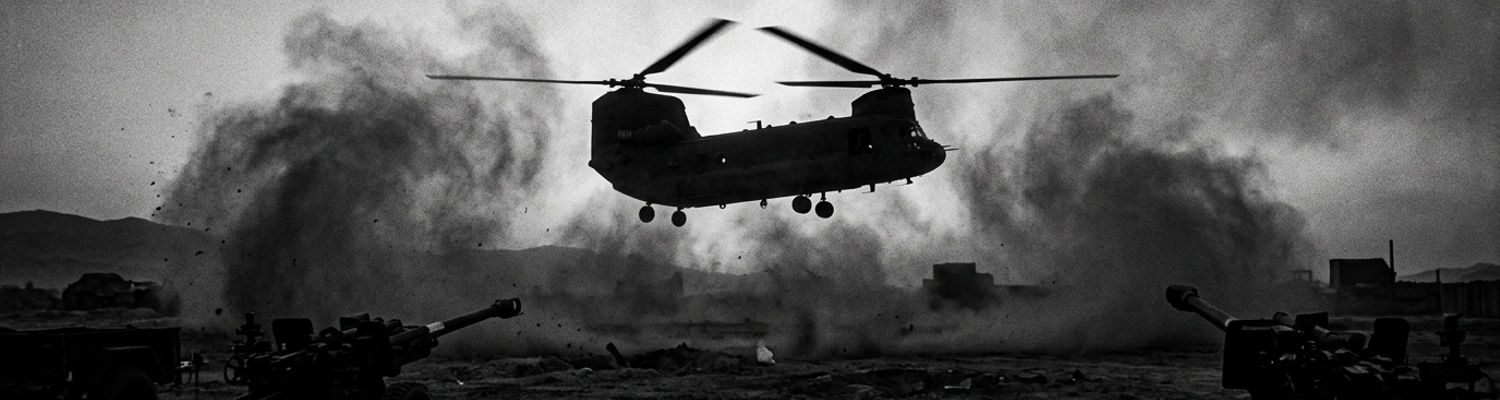
Fleet Marine Force Manual 5-1 dictated that helicopter landing zones required extensive dust-abatement preparation. This guaranteed pilots unobstructed sightlines during combat extractions. Ground conditions at Fire Support Base Neville immediately invalidated those printed guidelines. The dry season had baked the exposed laterite clay topsoil along the northern ridgeline into a highly volatile powder. Aviation elements from Marine Aircraft Group 39 initiated their descent profile. The mechanical forces unleashed upon this terrain caused immediate environmental failure. The Boeing Vertol CH-46 Sea Knight relies on a tandem-rotor configuration. This produces an exceptionally aggressive downdraft. Incoming transport aircraft flared at fifty feet above the extraction zone. Their twin 50-foot rotor blades spun at 264 revolutions per minute. This forced highly pressurized air directly into the dehydrated crust of the firebase.
The intense rotor wash instantly pulverized the laterite clay topsoil.
Flight logs from the morning of May 12 document that the mechanical downwash scoured the top layer of earth down to the bedrock. Thousands of pounds of microscopic clay particulates launched upward into the immediate atmosphere. The twin-engine helicopters disappeared completely inside a massive cloud of suspended dirt. Archival evidence shows that this violent displacement of earth created a localized dust storm inside the perimeter wire. A zero-visibility red haboob instantly enveloped the primary gun pits. Artillerymen from the 4th Battalion, 11th Marines were actively executing counter-battery fire missions against advancing People's Army of Vietnam infantry when the dust hit. Thick red particulate matter blinded the gun crews entirely. Section chiefs suddenly found themselves unable to see their aiming posts. They could not see the M1A1 collimators positioned just fifty meters away. Abrasive laterite clay penetrated the sealed optics of the M12A7C panoramic telescopes attached to the M101A1 105mm howitzers. Sighting mechanisms failed completely. Loaders and rammers were forced to operate blindly in the dark red particulate cloud. They relied strictly on physical memory to seat 33-pound high-explosive projectiles into the gun chambers.
Men choked on the iron-rich dust.
It coated their airways. A close review of operational logs indicates that the physical composition of the laterite clay caused severe mechanical jamming across the firing line. Ultra-fine red powder adhered to the exposed grease on the sliding wedge breechblocks. Friction levels inside the firing mechanisms spiked rapidly. Artillery mechanics from the 4th Battalion, 11th Marines documented that the recoil slides on three separate howitzers seized up entirely due to the sudden influx of abrasive dirt. Gun captains screamed coordinates over the deafening roar of the CH-46 engines. They attempted to manually force the breech levers open with steel pry bars. Zero-visibility conditions prevented forward observers from verifying impact zones. Firing data calculated by the fire direction center became impossible to confirm visually. Gun crews continued to pull lanyards. They sent rounds downrange into the blind spots outside the concertina wire.
The localized red haboob grounded the entire extraction timeline.
Flight mechanics aboard the Sea Knights stared at control panels covered in a thick layer of red silt. Rapid accumulation of ingested clay choked the engine air particle separators on the General Electric T58 turboshaft engines. Pilots lost all visual reference points within seconds of crossing the perimeter wire. They operated strictly by instruments. They relied on radar altimeters to gauge the distance to the cratered landing zones. Sustained hovering over grid coordinates AT 872 411 only fed more dirt into the localized storm system. Ground commanders ordered the helicopters to abort the hover and set down immediately to reduce the downdraft. Heavy landing gear struts slammed directly into the unmapped crater field.
Zero-Visibility Counter-Battery Fire
A close review of operational logs indicates that the localized dust storm immediately neutralized the counter-battery capabilities of the 4th Battalion, 11th Marines. Artillerymen manning the M101A1 105mm howitzers lost all visual contact with their targeting references within seconds of the aviation elements breaking the tree line. The M12A7C panoramic telescopes mounted on the left side of the gun carriages became entirely coated in a thick paste of red laterite clay and weapon lubricant. Section chiefs wiped frantically at the glass lenses with their utility shirts. The abrasive dirt scratched the sealed optics. This rendered the reticles useless. Aiming posts placed fifty meters outside the gun pits vanished into the swirling red cloud. Gunner sight alignment requires precise visual triangulation with M1A1 collimators. Thick particulate matter blocked these optical pathways completely.
Marines operated their weapon systems entirely blind.
The mechanical breakdown of the firing line accelerated as airborne dirt infiltrated the exposed breech mechanisms. Fine particulate matter settled directly onto the heavy preservative grease coating the sliding wedge breech blocks. Friction levels inside the steel components spiked exponentially. Loaders attempted to chamber the 33-pound high-explosive projectiles. The breech blocks locked halfway along their tracks. Gun captains grabbed solid steel pry bars to force the operating levers downward. Other crew members shoved wooden rammer staffs down the muzzles to dislodge jammed brass casings. The PAVN 246th Regiment simultaneously adjusted their 120mm mortars to target the noise of the revving helicopter engines. Explosive rounds impacted directly outside the concertina wire. Shrapnel sliced through the suspended dust cloud at waist height. The incoming barrage forced the artillerymen to drop their clearing tools and dive into unreinforced, shallow drainage trenches.
The primary firing line sat completely silent under the mortar barrage.
Archival evidence shows that the medical extraction plan collapsed just as rapidly as the artillery defense. Navy Corpsmen had established a designated casualty collection point exactly fifty yards south of the primary landing zone. They laid out thirty wounded Marines on standard canvas litters across the exposed clay. The immediate arrival of the medevac CH-46 Sea Knights physically destroyed this medical staging area. The tandem rotors of the incoming aircraft blasted highly pressurized air directly downward into the triage zone. Visibility dropped to zero within three seconds. Corpsmen lost sight of their patients. The mechanical downwash ripped field dressings off open lacerations. It blew away standard triage tags. Medical personnel could not differentiate between men requiring immediate surgical evacuation and those with superficial shrapnel wounds.
Abrasive laterite soil packed directly into exposed chest cavities.
Medical personnel lost all spatial awareness inside the localized haboob. The deafening roar of the General Electric T58 turboshaft engines completely masked the shouts of the wounded. Corpsmen stumbled blindly through the red fog. They attempted to locate the lowered tailgates of the transport helicopters. They picked up stretchers and walked directly into the 264-rpm slipstream. The sheer physical force of the downdraft knocked litter bearers off their feet. Canisters of sterile water and canvas medical bags blew haphazardly across the cratered earth. Pilots sitting in the hovering aircraft could not verify if any wounded personnel had actually boarded. Flight engineers stared out the rear hatches into a solid wall of swirling dirt. They reached out into the red cloud and dragged men up the aluminum loading ramps by their web gear. Intravenous lines snagged on the metal decking and tore violently out of arms. The designated casualty collection point devolved into a scattered field of abandoned stretchers and empty brass shell casings.
Field-Expedient Metallurgical Integration
Archival evidence shows that by 0515 hours at grid coordinates AT 872 411, standard medical evacuation hardware had failed completely. The internal Breeze-Eastern rescue hoists mounted inside the Marine Aircraft Group 39 CH-46 Sea Knights were engineered to lift a maximum load of 600 pounds. Flight mechanics attempted to haul up rigged pallets loaded with four wounded Marines simultaneously to outpace the advancing People's Army of Vietnam infantry. Factory-issued aluminum deck anchors sheared entirely off the floorboards under the excessive torque. Heavy steel winch cables snapped backward into the cabin bulkheads. Mechanics from Battery M, 4th Battalion, 11th Marines recognized that the transport helicopters required immediate structural reinforcement to handle these heavy multi-litter extraction loads. They turned to the thickest forged metal available within the pulverized perimeter wire. Artillerymen unlimbered their oxy-acetylene M1 cutting torches. They approached the M114 155mm howitzers positioned along the western edge of the firebase. These 12,700-pound weapons featured massive, high-tensile steel trail spades designed to dig deeply into the earth and absorb the violent recoil of firing 95-pound projectiles.
Marines severed trail spades from M114 howitzers to field-weld onto helicopter winch frames.
A close review of operational logs indicates that this metallurgical integration violated every standing aviation maintenance directive in print. Ground mechanics ignited their torches and cut directly through the locking pins and primary mounting brackets of the heavy artillery pieces. Liquid slag dripped onto the dry laterite clay as the mechanics separated the spades from the split-trail carriages. Sweating artillerymen dragged the heavy steel slabs across the cratered earth. They hauled them up the rear ramps of the idling CH-46 transports. Crew chiefs fired up portable arc welders directly inside the active aircraft cabins. They melted 6011 welding rods to fuse the thick artillery components directly to the primary load-bearing bulkheads surrounding the internal winch systems. Sparks cascaded over aluminum deck plates coated in leaked hydraulic fluid and highly flammable aviation kerosene.
The improvised hoist anchors bypassed Navy Bureau of Weapons procurement protocols to extract the critically wounded.
When examining the historical record, the specific application of these unsanctioned hoist systems demonstrates a total abandonment of theoretical safety margins. The Navy Bureau of Weapons explicitly classifies any structural alteration to a rotary-wing airframe as a severe engineering hazard. This classification requires extensive stress testing and formal authorization from a depot-level facility. Ground commanders ignored these mandates entirely to clear the casualty collection point. Flight engineers threaded heavy-gauge steel cables through the newly attached howitzer spades. This field modification created a reinforced, multi-point pulley system. It was capable of bearing thousands of pounds of tension without ripping the floorboards out of the aircraft.
Steel cables ground directly against the crude weld joints.
Corpsmen working in the zero-visibility dust storm strapped personnel with severe shrapnel lacerations and chest trauma into rigid wire Stokes baskets. They linked three baskets together using heavy steel cargo chains salvaged from destroyed M35 cargo trucks. The Sea Knights hovered forty feet above the cratered landing zone. Flight mechanics activated the reinforced winches. The excessive weight of the combined stretchers pulled the steel cables taut against the M114 spades. Forged artillery steel held the load without buckling or warping. These reinforced anchors distributed the massive downward force across the entire structural skeleton of the helicopter rather than concentrating it on the fragile factory-installed deck rings. Mechanics hauled the chained stretchers upward through the abrasive red dirt and dragged them over the tailgates. The twin General Electric T58 turboshaft engines strained audibly to maintain altitude as the unverified cargo weight heavily exceeded the printed payload specifications. Aviation grease smeared across the faces of the extracted infantrymen.
Punitive Accounting and Equipment Deficits
Archival evidence shows that within forty-eight hours of the extraction from grid coordinates AT 872 411, rear-echelon administration initiated a punitive accounting cycle. Elements of the 3rd Marine Division G-4 supply staff arrived at Vandegrift Combat Base on May 14, 1969. They intended to review the post-action reports from Fire Support Base Neville. These supply officers completely bypassed the medical tents where Navy Corpsmen were actively treating severe shrapnel lacerations. They walked directly to the motor pool to inspect the surviving hardware. Division auditors prioritized the unauthorized cannibalization of six artillery pieces over casualty rescue statistics. Clerks carrying clipboards demanded immediate serial number verification for the M114 155mm howitzers assigned to Battery M, 4th Battalion, 11th Marines. The paperwork indicated a massive discrepancy in the property books regarding the split-trail carriages. Battalion accountants ignored the handwritten triage tags attached to the evacuated infantrymen. They focused strictly on the financial deficit of the ruined metal.
Supply officers demanded sworn statements regarding the missing steel components.
A close review of operational logs indicates that the inspection teams fixated entirely on the metallurgical mutilation of the heavy weapons. Auditors discovered that six distinct M114 howitzers had been permanently disabled by the field-expedient removal of their trail spades. The heavy high-tensile steel anchors were missing. Ground commanders attempted to submit the CH-46 Sea Knight flight manifests to prove that the severed artillery parts had been used to extract wounded personnel. The G-4 inspectors rejected these documents as irrelevant to the equipment audit. They calculated the exact monetary loss of the 12,700-pound weapon systems. They drafted preliminary charge sheets against the battery commanders for the destruction of government property. The official division debriefing completely omitted the zero-visibility laterite clay dust storm and the 120mm mortar barrage initiated by the PAVN 246th Regiment.
Nobody asked how many men survived the flight out of the pulverized crater field.
Inspectors launched immediate investigations into the destruction of official artillery components. Force Service Regiment personnel traveled to the Marine Aircraft Group 39 flight line at Quang Tri Air Base to physically examine the transport helicopters. They found the missing M114 trail spades welded directly to the internal bulkheads of the Boeing Vertol CH-46 airframes. Investigators documented the crude 6011 welding rod slag coating the aluminum deck plates. They took photographs of the heavy-gauge steel cables grinding against the forged artillery steel. The inquiry boards drafted formal reports condemning the mechanics from Battery M for using oxy-acetylene M1 cutting torches outside of a designated depot-level maintenance facility. Officers from the Judge Advocate General corps began building cases around the unauthorized severance of the primary mounting brackets and the locking pins.
Officers faced disciplinary action for reinforcing the medical evacuation winches.
When examining the historical record, the scope of the investigations expanded rapidly to cover the entire firing line left behind at the firebase. Audit teams demanded an accounting for the thermite grenades dropped down the tubes of the M101A1 105mm howitzers. They wanted to know exactly which section chiefs authorized the melting of the sliding wedge breechblocks before the final helicopters lifted off. Supply clerks cross-referenced the missing M12A7C panoramic telescopes and the abandoned M1A1 collimators against the battalion supply ledgers. The formal Report of Survey documents focused entirely on the mechanical failure of the extraction timeline rather than the combat conditions that forced the abandonment. Investigators cataloged the serial numbers of the missing pry bars, the wooden rammer staffs, and the empty brass shell casings left in the shallow drainage trenches.
Clerks typed the final financial damage assessments onto triplicate carbon forms and filed the DD Form 200 paperwork into a steel cabinet.
Falsified Combat Damage Assessments
A close review of operational logs indicates that the threat of punitive action against the officers of Battery M, 4th Battalion, 11th Marines escalated rapidly following the May 14 equipment audits at Vandegrift Combat Base. Judge Advocate General personnel attached to the 3rd Marine Division began formalizing Article 108 charge sheets detailing the unauthorized destruction of military property. The primary evidence centered entirely on the severed high-tensile steel trail spades missing from the split-trail carriages of six M114 155mm howitzers. Ground commanders recognized that admitting to the field-expedient modification of Boeing Vertol CH-46 Sea Knight helicopters would guarantee immediate courts-martial and the loss of their commissions. They needed alibis. Captains and section chiefs convened inside the canvas administrative tents near the primary motor pool to coordinate a unified response to the Force Service Regiment inquiry boards. They retrieved blank stacks of DA Form 2404 Equipment Inspection and Maintenance Worksheets from the battalion supply clerks. The officers systematically drafted a completely fabricated chain of events regarding the heavy weapons left behind at grid coordinates AT 872 411.
Battery commanders submitted falsified Combat Damage Assessment reports attributing the ruined howitzers directly to enemy fire.
Archival evidence shows that these forged documents required precise technical descriptions to pass the G-4 staff inspections without triggering a secondary field investigation. Section chiefs wrote highly detailed narratives claiming that the People's Army of Vietnam 246th Regiment scored direct hits on the western gun pits during the initial 0415 hours bombardment. The paperwork explicitly stated that incoming 122mm rockets detonated directly against the primary mounting brackets of the M114 split-trail carriages. Officers documented that the resulting thermal blast from the high-explosive warheads melted the heavy locking pins and sheared the 12,700-pound trail spades completely off the chassis. The metal vanished. They deliberately omitted any reference to the artillery mechanics unlimbering oxy-acetylene M1 cutting torches to sever the forged steel. Other falsified reports addressed the M101A1 105mm howitzers left in the northern sector of the perimeter. The DD Form 200 Reports of Survey attributed the fused sliding wedge breechblocks to concentrated 120mm mortar fragmentation destroying the operating levers. These specific forms omitted the deliberate insertion of AN-M14 TH3 thermite grenades by the retreating Marine gun crews.
Clerks backdated the signatures in black ink to match the exact morning of the extraction.
When examining the historical record, the synchronized submission of these fabricated narratives successfully halted the divisional investigations. The paperwork worked. Supply auditors from the 3rd Marine Division reviewed the DA Form 2404s and accepted the enemy fire explanations without deploying independent metallurgical inspectors to the pulverized crater field. Judge Advocate General officers subsequently dropped all preliminary charge sheets against the battery commanders and the flight mechanics. This administrative evasion protected the ground personnel from disciplinary sanctions regarding their unsanctioned use of portable arc welders and 6011 welding rods on the CH-46 airframes. The bureaucratic approval of the falsified Combat Damage Assessment reports permanently altered the official history of the May 12 engagement. By classifying the missing howitzer components strictly as combat losses due to PAVN artillery strikes, the chain of command entirely obscured the true events of the Fire Support Base Neville triage. Official Marine Aircraft Group 39 flight manifests never recorded that critically wounded infantrymen were hoisted to safety using severed artillery spades. Division-level medical summaries omitted any reference to the heavy steel chains holding the wire Stokes baskets.
Division archivists filed the approved financial loss reports into the permanent records annex at Da Nang (File Group 44-A).