
Operation New Life Evacuation Fleet Influx
Inside the lower machinery space of the Military Sealift Command cargo ship SS Green Forest, a high-pressure feed pump lost suction forty miles west of the Luzon coast. Lubricating oil pressure dropped from sixty pounds per square inch to zero within three seconds. Deprived of oil, the pump bronze bearings ground directly into the steel drive shaft at thirty-six hundred revolutions per minute. Sparks flew through the bilge grating. The rotor locked in a spray of overheated metal flakes. The vessel lost primary auxiliary power immediately. Steam pressure in the main boilers plummeted. This shut down the single evaporator converting seawater into drinking water for the civilians jammed onto the main cargo deck.
Seawater pipes split along corroded seams thirty minutes later.
Archival evidence shows this mechanical breakdown was one of hundreds crippling the makeshift convoy fleeing the fall of Saigon. When the government of South Vietnam collapsed in late April 1975, dozens of overloaded Military Sealift Command transports and commercial merchant hulls scrambled out of Vung Tau and Phu Quoc Island. Contracted carriers including the Green Port, Pioneer Contender, and Transcolorado carried civilian loads four to six times past certified safety thresholds. Engine rooms ran far past redline temperatures. Master mariners accelerated to escape North Vietnamese artillery barrages walking toward the docks. Lifeboat capacity covered less than ten percent of the people on board. Discarded clothing, trash, and human waste clogged the suction strainers of the reciprocating bilge pumps. This flooded the lowest compartments. Merchant crews had to steer across open waters with compromised stability.
No central authority organized the departures.
Over one hundred thousand refugees arrived adrift across the South China Sea within days. They were packed shoulder to shoulder on open steel weather decks exposed to tropical rains and daytime heat exceeding one hundred degrees Fahrenheit. Freshwater systems failed under the demand. Rationing drove supplies down to less than half a cup of brackish water per person every twenty-four hours. Crews locked distribution manifolds behind armed guards to stop desperate crowds from storming the piping. Gastrointestinal infections, malnutrition, and acute dehydration spread through the unventilated holds. Lacking dedicated medical spaces, these commercial freighters carried zero surgical equipment and only twenty-man merchant first-aid kits. Dead passengers were wrapped in canvas and buried at sea. Radio operators broadcast continuous distress signals on 2182 kilohertz.
Commercial freighters burned bunker fuel to generate power while hundreds of untreated sick and wounded civilians collapsed across the decks.
When examining the historical record, inter-agency paralysis in Washington delayed the response while civilian vessels drifted without fuel. Diplomats in the State Department feared that admitting South Vietnamese naval vessels would provoke a dispute with President Ferdinand Marcos. Marcos refused to permit foreign military flags inside Subic Bay. Orders dispatched to Seventh Fleet directed task elements to stage an immediate maritime relief line off the Subic Bay approaches. This held the influx outside the twelve-mile limit.
Vice Admiral George P. Steele deployed Task Force 76 and Task Force 73 auxiliary units to establish an offshore holding perimeter.
Along the outer approaches to Grande Island, fleet tugs, repair ships, and amphibious transport docks including USS Denver dropped anchor to convert international waters into an offshore triage anchorage. Boarding parties of Navy corpsmen and Marines climbed cargo nets onto rolling merchant hulls. They disarmed retreating soldiers and treated dying passengers. Armed with portable diesel dewatering pumps and torch gear, Navy mechanics boarded civilian freighters to patch leaking boiler casings before dead-stick hulls drifted into coastal shoals. Logistics teams pumped thirty thousand gallons of potable water per hour through rubber fueling hoses rigged between naval tenders and civilian freighters by May 2, 1975.
CTF 73 Underway Replenishment Mobilization
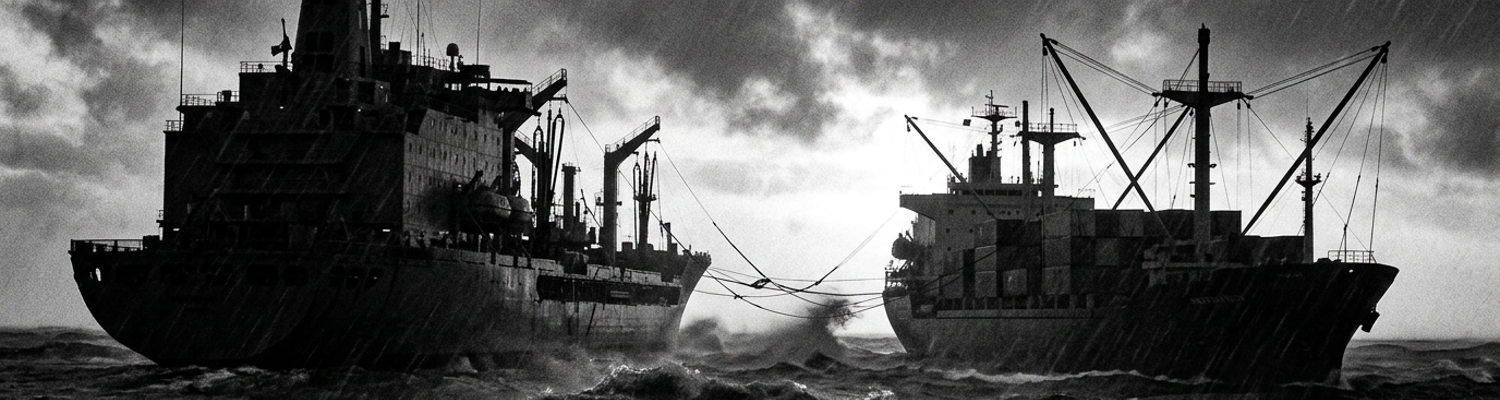
A close review of operational logs indicates Commander Task Force 73 ordered combat store ships including USS White Plains and fleet oilers USS Ashtabula and USS Kawishiwi to intercept the refugee convoy in May 1975. Inter-service protocols broke down immediately between Seventh Fleet and the civilian-manned Military Sealift Command. Commercial merchant captains refused to execute standard underway replenishment maneuvers at twelve knots. They feared collisions on hulls already destabilized by thousands of displaced persons. Navy surface warfare officers clashed with civilian masters who had never trained in standard naval close-formation station-keeping. Task Force 73 watch officers in the South China Sea recorded sustained shouting matches over bridge-to-bridge VHF radio. Naval supply ships attempted to match courses with wallowing freighters. Merchant ships lacked standard naval station-keeping indicators. This forced the crew of White Plains to shoot shot-lines across sixty yards of open water while civil mariners scrambled clear of falling brass projectiles.
Civilian masters threatened to cut the messenger lines with axes.
Archival evidence shows Seventh Fleet boatswains mates bypassed standard naval receiving stations by improvising highline transfers directly to cargo booms. Merchant hulls lacked the welded pad eyes, tensioned trolley assemblies, and certified pelican hooks required for Standard Tensioned Replenishment Alongside Method gear. Rigging teams on White Plains and Ashtabula constructed continuous highline loops using hand-cranked winches and traveler blocks secured to merchant kingposts. Crews transferred specialized five-hundred-gallon neoprene emergency freshwater bladders directly to the open decks of ships like Pioneer Contender under this makeshift system. Merchant winches lacked hydraulic constant-tension regulators. Heavy swells caused the distance between the rolling ships to fluctuate violently. This snapped half-inch wire rope travelers and dropped multiple freshwater bladders into the sea. When lines held, five-thousand-pound water bags slammed onto weather decks. The impacts crushed wooden hatch battens and scattered civilian passengers into companionways before mariners could lash the fill valves to deck manifolds.
Dehydration was killing thirty refugees every morning.
Operational logs show CTF 73 logistics officers faced resistance from mainland supply administrators at Naval Supply Depot Subic Bay. Naval bureaucrats demanded signed transfer receipts and billing account numbers before staging pallets of pediatric supplies. Seventh Fleet supply officers requisitioned stockpiles under emergency combat authorities to bypass the delays. Flight decks and highline rigs on White Plains moved non-stop across forty-eight hours. They swung wooden cargo pallets packed with cases of liquid infant formula, tetracycline capsules, and intravenous chloramphenicol over chaotic merchant decks. Medical teams on the evacuation transports had exhausted their pharmaceutical supplies forty-eight hours into the voyage. Acute bacillary dysentery swept through lower troop berths. Navy deck crews wrapped the medical pallets in waterproof canvas. They dropped loads of electrolyte powders and oral rehydration packets directly into the centers of civilian crowds before armed guards could establish drop perimeters. White Plains discharged forty-eight short tons of rehydration salts and pediatric nutrients to five separate merchant transports operating forty nautical miles southwest of Subic Bay by May 5.
Winch Failures and Span-Wire Equipment Degradation
A close review of operational logs indicates that twenty-four-hour underway replenishment evolutions southwest of Subic Bay pushed auxiliary transfer equipment far beyond planned duty cycles. Operating thirty-five miles off the Zambales coast in sea-surface temperatures exceeding eighty-four degrees Fahrenheit, combat stores ships including USS White Plains took continuous atomized saltwater spray across forward replenishment stations. Salt encrustations calcified within fairleads, snatch blocks, and ram-tensioner cylinder seals within thirty-six hours of unceasing operations. Sodium chloride crystals ate directly into unpainted carbon-steel sheave pins. This seized rotating assemblies and stripped the protective zinc coatings off seven-eighths-inch galvanized wire ropes. Grease fittings clogged with brine-soaked sand and soot blown from merchant exhaust stacks. Neoprene hydraulic seals dried, cracked, and blew out under continuous heat. Atomized fluid sprayed across transfer stations. Without standard maintenance stand-downs to flush lines with fresh water, deck machinery oxidized under baking sun and alternating tropical downpours. Flexible steel transfer cables transformed into stiff, brittle coils of oxidized metal that shed jagged fragments across deck fairleads.
Salt crust froze the tensioning valves shut.
Archival evidence shows that this structural degradation triggered catastrophic mechanical failures when naval auxiliaries attempted to hold station against wallowing civilian merchant hulls. Dynamic line shock overloaded the electro-hydraulic winches mounted on Seventh Fleet replenishment decks as displaced freighters surged through eight-foot South China Sea swells. Sustained stress caused winch drums to shudder violently against their mechanical stops. Hydraulic oil temperatures spiked past two hundred degrees Fahrenheit. Cast-iron winch pawls sheared cleanly under surge tensions exceeding twenty thousand pounds of line pull. These pawls served as the primary locking teeth engineered to prevent drum reversal. Unbraked winch drums spun backward in a blur of uncontrolled paying-out wire. Loaded cargo trolleys dropped directly into the ocean. High-pressure nitrogen-oil ram-tensioners jammed mid-stroke. Bent piston rods locked inside their guide sleeves after absorbing lateral shock loads. Span-wires alternately sagged into wave crests or snapped taut with violent shockwaves that tore padeyes directly out of merchant deck bulkheads.
Deck officers logged four major mechanical casualties every twelve hours.
When examining the historical record, Seventh Fleet damage control parties and machinist mates worked inside live zones of whiplashing wire to execute emergency repairs without breaking formation. Repair teams from Task Force 73 auxiliary ships crawled across oil-slicked, rolling decks while tensioned wires vibrated under tons of kinetic load. Hull technicians cut away warped fairlead brackets and gouged out frozen sheave pins using oxyacetylene torches while merchant hulls rolled less than one hundred and forty feet away. Machinist mates hauled two-hundred-pound portable hydraulic jacks onto open weather decks to force jammed ram-tensioner pistons back into alignment. They sledgehammered replacement steel pins into place while seawater broke over the gunwales. Deck ratings manually reeved replacement wire rope through seized blocks under driving tropical rain. They doused hot winch brake bands with buckets of lubricating oil to prevent friction fires. These emergency teams kept three of five replenishment stations operational through May 8. They sustained a throughput of twenty pallets an hour while repair parties welded fractured winch beds back to the deck plating.
Civil-Naval Communication Fractures at Sea
A close review of operational logs indicates that Seventh Fleet tactical networks broke down the moment civilian-crewed merchant vessels entered the operations area. Seventh Fleet combatants including USS Denver and USS White Plains operated on military Ultra High Frequency circuits. They relied on AN/SRC-20 transceivers encrypted with KW-7 cryptographic hardware to broadcast operational routing. Commercial merchant hulls under contract with the Military Sealift Command possessed only standard commercial Very High Frequency maritime radios restricted to Channels 13 and 16. They also carried 2182-kilohertz medium-frequency gear. Civilmar radio rooms carried zero military UHF gear and no classified cryptographic codebooks. Navy watch officers attempted to bridge the gap with portable bridge-wing VHF transceivers. Tropical downpours and continuous saltwater atomization shorted the internal circuitry within forty-eight hours. Visual signaling failed just as rapidly. Signalmen on naval bridge wings flashed directional Aldis lamps to transmit speed and course changes. Civilian mates lacked training in flashing-light Morse code. Civilian radio operators routinely secured their radio shacks between 2000 and 0600 hours to observe commercial union rest schedules. This created complete communication blackouts during the most hazardous night transits.
Civilian bridges maintained radio silence through the darkness.
Archival evidence shows that merchant captains lacked basic training in close-quarters naval conning and station-keeping protocols. Decades of open-ocean merchant operations had conditioned commercial masters to maintain passing distances of several miles. They were unprepared to maneuver within five hundred yards of adjacent hulls off the Capones Island approaches. Propulsion mechanics worsened the navigational drift. Navy conning officers coordinated formation turns using precise shaft-revolution orders calibrated directly to speed through the water. Commercial steam plants on freighters like the Green Forest relied instead on basic telegraph settings like Half Ahead and Full Ahead. This produced uncontrolled speed fluctuations between eight and twelve knots. Rudder control proved equally hazardous. Civilian helmsmen applied large twenty-degree rudder angles to correct minor drift. This repeatedly pitched heavily loaded transports across the parallel sea tracks of following ships. Merchant officers failed to calculate the lateral set of strong coastal currents sweeping southward toward Subic Bay because they lacked calibrated AN/SPS-10 planar surface search radars. Three overloaded merchantmen had drifted six nautical miles out of their designated screening lanes by dawn on May 4. They wandered directly into active acoustic submarine transit lanes.
The convoy lost all structural cohesion.
When examining the historical record, these erratic maneuvers caused catastrophic mechanical failures during alongside hookups. Fleet oilers like USS Ashtabula steamed within one hundred and forty feet of wallowing transports to rig emergency fuel and water lines. They fired standard-issue braided phone-and-distance cables between the hulls. This specialized nylon line incorporated sound-powered telephone wires and colored visual distance flags spaced every twenty feet. It served as the sole physical link between the conning stations. Hydrodynamic suction drew the civilian hulls violently inward toward the naval auxiliaries. Panicked merchant helmsmen overcompensated by throwing their wheels hard over away from the replenishment ships. Transcolorado took an uncontrolled sheer to port during an alongside transfer on May 6. The separation distance widened rapidly from eighty feet to two hundred and forty feet. Surging tension exceeded the three-thousand-pound breaking strength of the phone-and-distance line. The braided nylon snapped with a sharp concussive crack across the water. The severed synthetic line whipped backward across the underway replenishment deck of Ashtabula at extreme snapback velocity. The cable shattered safety stanchions and mangled Station 5 fairleads. It missed seven line handlers by less than two feet before puncturing a steel deck winch casing. Deck officers dropped fuel transfer hoses into the sea to prevent span-wires from ripping entire kingpost assemblies from the merchant decks.
Enteric Disease Control and Medical Provisioning
A close review of operational logs indicates that the dark, unventilated lower holds of Military Sealift Command transports rapidly degenerated into incubators for lethal enteric pathogens. Ambient temperatures below steel deck plates surpassed one hundred and ten degrees Fahrenheit. This was compounded by the body heat of four thousand civilians packed into spaces designed for crated dry cargo. Passengers defecated into corner bilges or onto canvas cargo tarps because functional latrines did not exist. Human excrement mixed directly with bilge oil and pooling seawater. Enteric bacilli swept through the confined population within seventy-two hours of embarkation. Acute watery diarrhea produced severe hypovolemic shock. Blood pressure dropped to unmeasurable levels in infants and elderly passengers. Untreated traumatic injuries accelerated systemic collapse across the holds. Scores of refugees suffered from untreated shrapnel wounds and infected burns from naval gunfire off Vung Tau. Compound fractures sustained while clambering up cargo nets left open flesh exposed to swarming blowflies and airborne fecal particulates.
Bilge water in the lower cargo bays carried over four feet of liquid human waste.
Archival evidence shows that Seventh Fleet hospital corpsmen boarding these merchant freighters encountered biological hazard zones that broke standard naval triage protocol. Dispatched from amphibious ships including USS Denver and USS Duluth, Navy corpsmen scaled oil-soaked Jacobs ladders into pitching hull sides carrying forty-pound medical field kits. The air emerging from cargo hold hatchways carried high concentrations of ammonia and airborne vomitus. Boarding teams smeared camphor under their nostrils to prevent retching. Infection vectors proved uncontainable without isolation spaces or running fresh water. Medical personnel stepped over decomposing corpses to reach dehydration casualties collapsed across steel machinery foundations. Corpsmen ran out of clean surgical gloves within ninety minutes. They treated weeping open wounds, lanced abscesses, and inserted intravenous needles using bare, unwashed hands rinsed only in iodine solution.
Medical teams marked black triage crosses across civilian foreheads using grease pencils.
When examining the historical record, Seventh Fleet medical officers fought administrative battles against Navy supply bureaucrats to restock these ships with pharmaceuticals rather than standard combat rations. Supply administrators at Naval Supply Depot Subic Bay initially refused to release emergency medical blocks without authorized Department of Defense activity address codes. They demanded that supply ships fill empty holds with bulk rice, flour, and canned rations. Task Force 73 fleet surgeons bypassed the depot requisition ladder entirely. They invoked emergency battlefield authorities to seize entire stocks of injectable ampicillin, tetracycline capsules, and sodium chloride infusions. Highline pallets loaded aboard USS White Plains were stripped of dry stores to make weight for five-gallon drums of sodium hypochlorite, lime disinfectant, and thousands of foil packets of oral rehydration salts. Helicopter crews lashed wooden skids containing fifteen thousand units of intravenous lactated Ringers solution into CH-46 Sea Knights on rolling flight decks. They dropped the liquid plasma volume expanders straight onto the cargo hatches of merchant vessels anchored thirty miles southwest of Luzon.
Bureaucratic Clashes Over Evacuee Quarantine Protocols
A close review of operational logs indicates that Seventh Fleet medical personnel enforced rigid maritime quarantine protocols the moment civilian-laden transports reached the approaches to Subic Bay. Fleet surgeons mandated that every vessel fly the yellow Quebec quarantine flag until medical officers certified the absence of high-consequence communicable diseases. Boarding parties drawn from Navy Environmental and Preventive Medicine Unit No. 6 climbed cargo nets onto rolling freighters. They performed mandatory physical examinations before ships cleared the outer harbor boundary. Doctors demanded negative shipboard screens for acute cholera, pulmonary tuberculosis, hemorrhagic conjunctivitis, and typhus before permitting any gangway descent. Corpsmen set up improvised triage checkpoints on open cargo hatches. They administered rectal swabs and collected sputum cultures while taking skin temperatures from thousands of dehydrated passengers packed into unventilated holds. Medical officers reported that unvetted debarkation would introduce active enteric and parasitic pathogens into the permanent base infrastructure and surrounding Zambales province communities.
Medical teams flatly refused to grant free pratique to unscreened ships.
Archival evidence shows that State Department civilian coordinators pushed relentlessly in the opposite direction. They demanded unscreened shore debarkations to accelerate diplomatic clearance. Personnel from the newly formed Interagency Task Force for Indochina Refugees viewed clinical holding periods as dangerous administrative obstruction. Philippine President Ferdinand Marcos had issued strict diplomatic stipulations restricting refugee transit through the country to seventy-two hours. He threatened to halt all entry if American authorities allowed processing bottlenecks to develop on the ground. State Department coordinators feared that holding merchant hulls in open water would provoke onboard mutinies and diplomatic confrontations with Manila. Foreign service officers pressured Seventh Fleet commanders to bypass shipboard medical screenings entirely. They argued that health evaluations should occur down the logistical line at receiving centers on Guam or inside inland staging facilities. State representatives demanded that transport masters tie up directly alongside the concrete piers of Subic Bay Naval Base to discharge crowds straight into customs and processing tents for direct transfer to MAC C-141 transport aircraft.
Civilian authorities treated public health inspections as unnecessary diplomatic liability.
When examining the historical record, this jurisdictional standoff brought offloading operations to a grinding halt across both Subic Bay and the Grande Island staging facility. Deep friction between Seventh Fleet command elements and civilian diplomats produced conflicting orders that paralyzed harbor movements between May 5 and May 12, 1975. Navy brass stationed Marine security detachments at Alava Wharf with standing directives to repel any uncertified landing craft. State Department officials attempted to direct Military Sealift Command captains to lower civilian ramps regardless. Overloaded merchant vessels spent up to forty-eight hours anchored dead in the water off Grande Island inside the bay entrance. Their auxiliary generators ran out of fuel while passengers baked under tropical sun. Harbor craft loaded with field kitchen components, water trailers, and sanitation bladders drifted in holding loops. Base traffic controllers could not establish whether the island or the mainland wharf possessed legal jurisdiction to accept contaminated cargo. Twenty-three ships carrying over thirty-five thousand evacuees were trapped in the outer anchorage by May 8. They awaited resolution of cross-teletype arguments between Seventh Fleet headquarters, the United States Embassy in Manila, and the Commander in Chief Pacific command center in Honolulu.
Subic Bay Operations and Mission Conclusion
A close review of operational logs indicates that Commander Task Force 73 maintained uninterrupted replenishment and stabilization operations across the Subic Bay operating area for four consecutive months. Naval authorities refused to scale down supply transfers after the initial surge. They kept combat store ships and auxiliary oilers locked into non-stop logistics cycles until Operation New Life officially concluded on August 31, 1975. Fleet repair ships including USS Hector anchored off Grande Island to manage floating repair workshops for unseaworthy South Vietnamese hulls. Replenishment vessels shuttled continuous stores between the Naval Supply Depot at Subic and reception compounds across the Marianas. Logistics personnel pumped over two million gallons of treated drinking water into temporary shore storage bladders and anchored transports each week. Daily rations exceeded eighty tons of dry food shipped across the bay using LCM-8 landing craft and harbor utility boats. Task Force 73 watch officers coordinated around-the-clock offloading sequences at Alava Wharf and Boton Wharf. They funneled arriving evacuees into medical screening stations before Philippine authorities enforced departures aboard Military Airlift Command flights.
Supply lines operated without a single scheduled maintenance stand-down for one hundred and twenty-three days.
Archival evidence shows that these prolonged non-standard support missions inflicted severe mechanical degradation across Seventh Fleet auxiliary ships. Fleet oilers such as USS Mispillion and combat stores vessels were engineered for short, high-speed open-ocean replenishment runs. They were not designed for static utility service in shallow tropical anchorages. Running shipboard evaporators at maximum throughput for weeks to generate water for thousands of ashore refugees pulled silty, eighty-five-degree harbor water straight into copper-nickel condenser tubes. Severe galvanic corrosion and marine fouling choked the cooling systems. This perforated heat exchangers and contaminated feed water with chloride salts. Auxiliary boiler fireboxes deteriorated rapidly because continuous low-load steaming prevented combustion chambers from reaching self-cleaning operational temperatures. This coated boiler tubes with corrosive sulfur deposits. Steam-driven deck winches and heavy cargo cranes suffered severe tooth pitting along reduction gear assemblies after running four hundred percent past their designated operating intervals without oil flushes. The Ship Repair Facility at Subic Bay reported an emergency backlog of forty-two auxiliary machinery overhauls by mid-summer. Machinists cannibalized copper piping and impeller shafts from decommissioned hulls to keep transfer pumps spinning.
Machinists depleted the entire western Pacific depot supply of boiler refractory brick by the end of July.
When examining the historical record, the administrative friction between the Seventh Fleet, the State Department, and the Military Sealift Command exposed major vulnerabilities in multi-agency maritime coordination. Foreign service officers from the Interagency Task Force routinely bypassed naval chains of command. They issued direct routing directives to civilian-crewed merchant masters that contradicted Seventh Fleet harbor security protocols. Commercial mariners lacked legal clarity regarding whether civilian union rules or the Uniform Code of Military Justice applied when naval boarding parties disarmed unruly passengers. Communications broke down repeatedly because civilian transports lacked compatible tactical UHF transceivers. This forced naval conning officers to rely on unencrypted commercial frequencies. The Joint Chiefs of Staff and CINCPAC launched comprehensive reviews in the autumn of 1975 that rewrote the military framework for noncombatant evacuation operations. The resulting directives mandated standardized joint civil-military doctrine. They established permanent civilian-military operations centers, pre-packaged disaster-relief supply blocks, and universal VHF and UHF tactical radio cross-banding systems for every commercial hull chartered by the Military Sealift Command. Future operational plans required forward-deployed task forces to sign binding jurisdictional agreements with the Department of State prior to loading non-combatants onto naval vessels.
The revised doctrine received formal adoption under Joint Chiefs of Staff Publication 3-07 in December 1976.