
Mid-Ocean Handover and Task Unit 4.1.5 Composition
Radar antenna cables running up the foremast of USS Lea shorted out whenever freezing seawater sprayed across the superstructure. Technicians on board could not insulate the exposed coaxial wiring from the corrosive North Atlantic brine. This failure left the escort force with only one working radar across all five warships, a Model SC set mounted on USS Nicholson. Visual lookouts offered little compensation for the failed electronic sensors because a severe supply bottleneck in optical equipment left the warships without adequate spotting glasses. Sailors on the vintage destroyer USS Bernadou shared a single pair of seven by fifty binoculars between the bridge watch officers. Enlisted lookouts on the freezing bridge wings scanned the dark horizon with bare eyes as the warships converged to take charge of the merchant fleet.
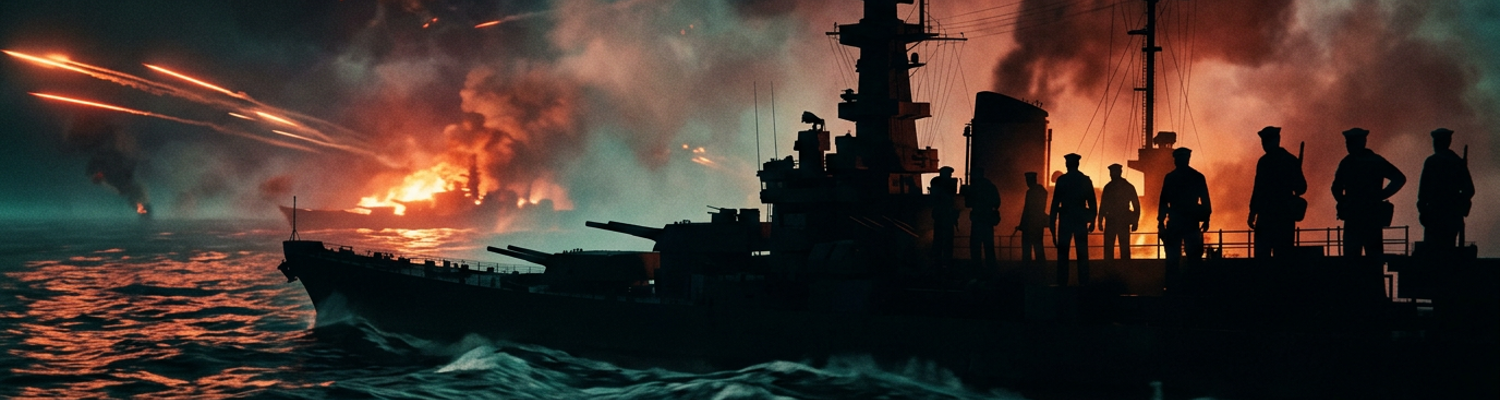
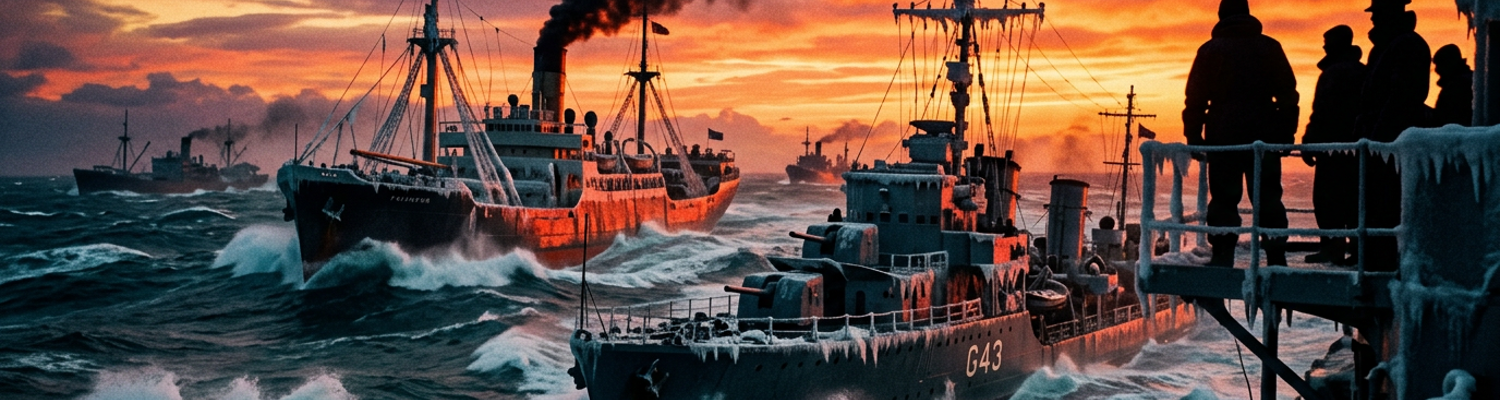
Commander Albert C Murdaugh brought Task Unit 4.1.5 alongside these incoming merchant vessels on February 19 1942. He formally assumed escort responsibility for 39 merchant ships in Convoy ON 67 at the Mid-Ocean Meeting Point. The newly assembled escort screen consisted of four United States Navy destroyers, USS Edison, USS Nicholson, USS Lea, and USS Bernadou, alongside the Royal Canadian Navy Flower-class corvette HMCS Algoma. These five warships had never trained together or practiced defensive anti-submarine maneuvers as a single tactical group. Murdaugh directed the screen from his flagship, the modern destroyer USS Edison. His crew faced their own mechanical handicap because the ship carried no side-throwing depth charge projectors and could only drop depth charges straight off stern racks.
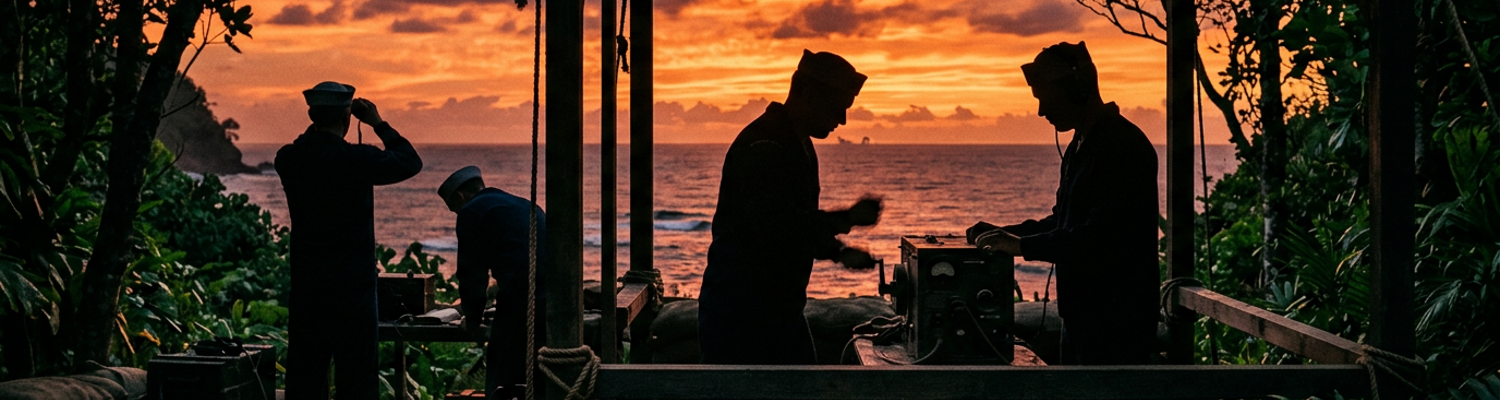
Destroyers like Edison compensated for these limited attack arcs by coordinating their movements with the British rescue ship Toward. Toward was a converted commercial vessel riding at the rear of the convoy with a high-frequency direction finder to intercept enemy radio transmissions. Radio operators inside Toward listened constantly for high-frequency signals from German submarines. Relaying those contact bearings to the bridge of Murdaugh required manual signaling across choppy open water. Signaling lamps blinked back and forth through driving sea spray between the rescue ship, the British convoy commodore aboard the merchant freighters, and the American destroyers.
Fuel shortages quickly dictated how long the American destroyers could run at speed to investigate these relayed bearings. Engineers had modified the old destroyer Bernadou for long-distance ocean convoying by cutting away its fourth boiler and smokestack to make room for an enlarged internal fuel bunker. This alteration extended its cruising radius but reduced its maximum speed. HMCS Algoma possessed a much smaller bunker capacity, forcing its Canadian crew to nurse their remaining fuel oil while fighting heavy swells alongside thirty-nine merchant vessels. Murdaugh responded to these severe endurance and coordination challenges by spreading his five escorts in a broad semicircular screen four thousand yards ahead of the cargo ships. He ordered an average patrol speed of twelve and a half knots.
Cargo ships formed up behind this moving warship screen into eight parallel columns stretching across four miles of rough ocean. The merchant vessels steamed along at eight and a half knots. Enlisted watchstanders on the escort bridges struggled to keep station in the darkness, fighting fierce freezing winds that coated their wool watch caps and heavy jackets in ice. Firemen deep below the waterlines of Edison, Nicholson, Lea, and Bernadou shoveled burners and balanced steam throttles by hand. They listened to the heavy thud of ocean waves against the steel hull plates. Lookouts gripped frozen bridge railings with numb hands, squinting into the spray to spot periscope wakes without the aid of radar displays or night vision equipment. Murdaugh kept the destroyers sweeping their zigzag courses back and forth across the front of the formation.
Sensor Deficits and Radar Failures at Sea
Seawater blasted over the plunging bows of the destroyers as they carved through these westward swells. The freezing water drenched USS Lea and coated its British-manufactured ASV radar antenna in heavy rime. Sub-zero gales turned the airborne spray into solid ice within seconds, building up thick layers of salt encrustation across the exposed dipole elements. Enlisted technicians climbed the iced ladder rungs of the foremast with wooden mallets to chip away the freezing slush. The severe structural freezing bent the fragile framework and cracked the external coaxial fittings. Corrosive brine leaked directly into the unsealed junction boxes, burning out the transformer circuits and causing the set to fail completely. Technicians shut down the smoking generator belowdecks and informed the bridge watch that the destroyer could no longer scan the dark sea for surfaced targets.
USS Nicholson served as the sole escort vessel equipped with a functioning SC radar set to replace these failed sensors. Its small radar shack shouldered the entire electronic search burden for thirty-nine merchant vessels. Enlisted operators took turns staring into the hood of the green cathode-ray tube, adjusting the gain control knobs while the destroyer rolled thirty degrees through the freezing troughs. Towering ocean waves reflected the outward pulses right back into the masthead antenna, creating blinding fields of sea clutter that swallowed the center of the display. Operators struggled to distinguish the small blip of a German U-boat conning tower from the false echoes generated by breaking wave crests and spray. Every heavy pitch of the hull threw the target bearings out of alignment, forcing the plotting sailors to recalculate distances by hand on grease-pencil plotting boards.
Officers on Nicholson signaled these tentative radar contacts across to Murdaugh on Edison. The single sensor could not track multiple sectors of the sprawling convoy simultaneously. Sonar domes lowered beneath the keels of the five escort ships failed to clarify these blind spots. Rough North Atlantic sea conditions and heavy pack-ice acoustic interference degraded ASDIC and sonar detection capabilities across the screen. Drifting ice floes and distant pack fields ground together under the heavy ocean swell, sending a continuous barrage of squealing, clicking noise through the listening headphones. Violent waves drove aerated water down along the hull plating of the destroyers, wrapping the acoustic transducers in clouds of air bubbles that scattered the sound pings and returned false echoes.
Operators on Edison and Bernadou heard deafening water crashes inside their headpieces every time the ships plunged into these deep wave troughs. Royal Canadian Navy sailors aboard HMCS Algoma rotated their ASDIC training wheels by hand through the freezing hull spaces. Temperature shifts in the water layers bent the sound beams toward the seabed and hid targets less than a thousand yards away. The acoustic screen collapsed into confusion, allowing enemy submarines to slide beneath the thermal gradients without triggering an echo return. Lookouts manned the freezing bridge wings of the five escorts to bridge the gap left by the dead sensors. They searched the ocean swells with bare eyes and whatever binoculars remained on board.
Wind chill drove temperatures down past zero as the men rotated through thirty-minute watches to maintain this visual search. They rubbed frostbite from their cheeks and squinted into the pitch-black spray. Sailors on Bernadou and Lea could see nothing beyond three hundred yards whenever squalls swept over the convoy columns, leaving the merchant ships completely invisible in the darkness. Officers on the bridge of Edison tracked their convoy progress by calculating dead reckoning intervals and straining to catch the glow of wet wake trails in the water. Murdaugh ordered his captains to tighten their patrol lines closer to the merchant flanks. He pulled the screening vessels in from their wide arcs to protect the ships by direct visual contact alone.
Visual Signaling Doctrine and Column Dispersal
Blinker lamps mounted on the destroyer bridge wings clattered incessantly as escort crews attempted to pass these repositioning orders to the merchant vessels. Strict operational doctrine mandated absolute radio silence across the North Atlantic. This rule compelled escorts to coordinate convoy movements exclusively through visual blinker lights and signal flag hoists. Enlisted signalmen worked directional shutters by hand against sub-zero winds, using narrow ten-inch carbon-arc searchlights to project focused light beams across the whitecaps toward distant bridges. Daytime operations offered little relief from this grueling physical effort. Deck crews hauled bundles of stiff bunting up the halyards while freezing spray coated the signal lines in solid ice.
Ice encrusted the bronze pulley sheaves at the yardarms, jamming the hoists. Sailors wrestled frozen lines with numb fingers that tore against the stiff canvas fibers. Lookouts on USS Edison squinted through the ocean gloom to confirm receipt of each transmission. The weak flickering replies from the freighters frequently disappeared into the driving sea spray before signalmen could read them. Convoy ON 67 arrayed itself in eight wide columns that sprawled across four miles of rough ocean. These vast distances made optical signals nearly impossible for merchant crews to identify. Thick plumes of black smoke belched from thirty-nine freighter funnels burning low-grade bunker coal, laying down a persistent haze directly over the central sea lanes.
Swells from the North Atlantic continually lifted the hulls of loaded freighters into this smoke haze. These massive waves cut off line-of-sight visibility between the screening warships and the ships riding along the opposite flank. Lookout watches on the outermost merchant ships could barely distinguish the faint tapping of a distant blinker light from the phosphorescent crests of breaking ocean waves. Relayed signals degraded with every ship that attempted to pass the message down the line. Each civilian vessel introduced new pointing errors with its hand-held Aldis lamps. Gaps between the eight columns widened steadily as cargo captains lost sight of their column leaders in the churning spray.
Signal books carried inside the merchant chartrooms compounded this physical breakdown. The books required rapid decoding of complex alphanumeric sequences, overwhelming fatigued and understaffed civilian merchant watches. Civilian deck officers endured continuous four-hour watch rotations in unheated wheelhouses for days. They shivered and suffered mental exhaustion while squinting at small print under hooded red battle lanterns. Every visual transmission arrived as a string of arbitrary code groups that lookouts had to write down on wet paper pads. An officer then thumbed through secret naval codebooks to find the translation.
Mates with frostbitten fingers struggled to turn the stiff paper pages fast enough to identify critical maneuvering signals. Misreading a single numeral or letter in the dense tables turned a routine fifteen-degree zigzag alteration into an emergency course turn or a false warning of a submarine sighting. Civilian captains delayed executing escort orders for ten to fifteen minutes while their skeleton bridge crews argued over conflicting interpretations of the decoded text. Merchant helmsmen reacted to these misinterpreted signals by throwing their rudders into uncoordinated turns. They sheared out of formation and threatened to ram neighboring freighters in the dark.
Tankers hauling volatile aviation gasoline backed down their throttles to avoid these runaway freighters cutting across their bows. These loaded ships lost momentum in the heavy seas and fell behind the protective screen. Gaps in the eight parallel columns multiplied as individual merchant masters steered independent courses rather than risk blind collisions inside the chaotic formation. Murdaugh observed this progressive dispersal from the bridge of Edison as the merchant ships separated into a disorganized cluster of isolated stragglers. Task Unit 4.1.5 destroyers burned precious fuel oil charging between the scattered cargo ships. They used loudhailers and blinker lamps to herd the wandering freighters back into their designated sea lanes.
Severe Winter Squalls and Mechanical Signal Failure
Seawater froze into solid sheets of rime across the destroyer bridge wings as darkness swallowed the scattered convoy. The extreme sub-zero temperatures froze mechanical shutter louvers on directional blinker lamps aboard the escort destroyers. Ice locked the narrow metal slats tightly within their steel casings. Enlisted signalmen pounded on the frozen operating handles with heavy canvas mittens. They attempted to break the ice seals without snapping the delicate mechanical linkages. Ice accumulated faster than deck watches could scrape it clear, wedging the louvers half-open. The stuck shutters spilled continuous, uncontrolled light rather than crisp Morse code pulses.
Crewmen on USS Bernadou and USS Lea carried buckets of hot water up the pitching ladders to thaw the mechanisms. The liquid cooled within seconds in the howling wind and coated the lamp housings in even thicker glaze. Signalmen turned to their heavy searchlights to reestablish optical contact across the widening expanse of dark water. Electricians on USS Edison and USS Nicholson energized their twelve-inch and twenty-four-inch bridge searchlights. They projected thick shafts of white carbon-arc light toward the cargo lines to pass urgent maneuvering instructions. Blinding snow squalls and freezing North Atlantic spray repeatedly obscured the beams.
Sleet reflected the powerful illumination directly back onto the warship bridges. This glare blinded lookouts and hid the silhouettes of the cargo ships riding less than five hundred yards away. Bridge crews tilted the searchlight barrels downward to bounce the illumination off the wave troughs beneath the storm ceiling. Crashing swells broke over the light paths and swallowed the pulses before merchant lookouts could spot them. Civilian deck watches on the cargo vessels saw only faint, milky flashes that vanished into the ocean spray. Murdaugh ordered urgent course alterations from the bridge of USS Edison to steer the blind merchant ships away from known submarine patrol lines.
Maneuvers for emergency zigzags went unacknowledged by merchant column leaders due to near-zero visibility. Civilian deck officers on the lead freighters never caught the obscured light pulses through the driving snow. They kept their heavily loaded vessels locked onto their previous compass tracks at eight and a half knots. Screening destroyers swung onto their new headings and pushed out into designated patrol sectors. The escort captains assumed the merchant fleet had turned behind them. They soon discovered the cargo columns steaming straight ahead on divergent courses.
Helmsmen in the inner lanes struggled against heavy crosswinds that shoved their high-sided vessels out of line. The wind narrowed the safety margins between loaded ammunition ships and deep-draft tankers. Watch officers on USS Edison tracked the separation on their plotting boards. They watched the uncoordinated convoy split into isolated clusters across miles of dark, unprotected water. The escort screen completely lost control of the merchant formation.
U-Boat Infiltration of the Merchant Columns
U-155, U-558, and U-158 slipped through these widening corridors of unprotected water between February 21 and 25 1942. The submarines exploited gaps in the blind outer screen to penetrate the inner merchant lanes. German lookouts on the low conning towers sighted the high silhouettes of the merchant freighters against the dark horizon. The American destroyers swept far out on the perimeter, oblivious to the infiltration. Submarine commanders trimmed their ballast tanks to ride low in the ocean swells. They ran on quiet electric motors to slip past the visual screening line without triggering alarms.
Seamen standing watch on unheated freighter bridge wings scanned the rough swells with their bare eyes. They failed to spot the dark steel hulls creeping directly into their column lanes. German torpedo crews worked in freezing forward compartments below the surface. They slid lubricated torpedoes into bronze launch tubes and calculated firing angles across the merchant tracks. German commanders fired spreads of torpedoes at point-blank range into the center of the merchant lanes. Deadly steel weapons surged through the dark swells toward the exposed merchant hulls.
Steel hull plates tore open as the attacking U-boats torpedoed eight merchant ships over the four-day assault. The strikes set off catastrophic explosions across six heavily loaded petroleum tankers. Petroleum cargoes ignited immediately upon impact, throwing towering columns of burning liquid and thick black smoke hundreds of feet into the night air. Shock waves from the detonations smashed wheelhouse windows and knocked civilian watchstanders to the deck. The blasts showered bridge wings in shattered glass and scorching heat. Firemen and water tenders deep in the engine rooms felt the blast hammer through the hull frames.
Seawater and burning crude oil burst through the bulkheads, drowning boiler fires and snapping pressurized steam lines. Merchant mariners scrambled up vertical iron ladders through suffocating fumes to reach the boat decks. Canvas covers and wooden lifeboats burned furiously in the heat. Ruptured tanker hulls broke in two under the weight of flooding water and structural collapse. The sinking ships dragged men and burning wreckage down into the freezing North Atlantic swells. Fuel fires and concussive torpedo detonations triggered widespread confusion across the merchant lines.
Freighters broke formation in the darkness to escape the burning oil. Civilian helmsmen panicked as rivers of burning petroleum drifted toward their vessels. They threw their rudders hard over to steer clear of the blazing water. Merchant masters on surviving freighters lost sight of column leaders and escort signals through the thick smoke and blinding glare. Freighters turned onto conflicting compass courses at maximum engine speed. They crossed adjacent lanes and nearly collided with neighboring vessels in the pitch-black ocean.
Officers on the civilian decks refused to hold steady courses in the unlit formation. They chose instead to run independently into the open sea to escape the submarine attack zone. Panic broke the organized rows of cargo vessels into disorganized clusters of fleeing stragglers. USS Edison, USS Nicholson, USS Lea, and USS Bernadou charged through the burning lanes to locate the attacking submarines. Fleeing merchant vessels cut directly across their search lines.
Operators on the sonar sets struggled to isolate submarine propeller sounds through the deafening underwater noise of exploding boilers and sinking hulls. Gun crews on the escort decks loaded star shells into their five-inch guns and fired them into the low clouds. The shells cast a harsh white glare over the scattered ships and burning oil slicks. Sailors on the stern depth-charge tracks dropped patterns of high explosives into the churning wave troughs. They hoped to force the raiders to dive deep. U-155, U-558, and U-158 slipped under the protective cover of the burning wreckage and withdrew into the dark perimeter to reload their empty torpedo tubes.
Tactical Paralysis and Fragmented Escort Countermeasures
Escort vessels flashed unanswered code groups into the blizzard as merchant tankers foundered in burning oil slicks. Signalmen on USS Edison, USS Nicholson, USS Lea, USS Bernadou, and HMCS Algoma pointed their iced shutter lamps toward the scattering silhouettes. Heavy snowfall and rolling black smoke swallowed every Morse sequence. Civilian masters on surviving cargo vessels ignored the dim flashes. They kept their engine telegraphs set to full speed as their crews fought to steer clear of spreading fuel slicks and floating debris. Commander Albert C Murdaugh watched his signaling efforts fail from the bridge of Edison.
Tankers hissed loudly as freezing Atlantic water poured over their glowing bulkheads. The suction pulled drowning sailors and ruptured cargo tanks down into the deep troughs. Destroyers lacked radar-directed gunfire control and accurate target bearings. This deficit severely limited effective counter-attacks against surfaced U-boats lingering near the perimeter of the sinking ships. Gun directors mounted above the warship pilot houses depended on visual optical rangefinders. These lenses fogged with condensation and sleet whenever mount captains trained them into the freezing spray.
Gunners on the five-inch mounts aimed their barrels manually into the dark by guessing at muzzle flashes and momentary shadows. They sent explosive projectiles splashing harmlessly into empty wave crests. Star shells burst high above the storm clouds and threw erratic shadows across the ocean. The flares blinded American lookouts more than they illuminated the low gray hulls of the enemy submarines. German watchstanders on the conning towers watched the wild salvos fall miles off target. They adjusted their diesel throttles to match the speed of the dispersing cargo ships.
Commanders of the submarines pulled their vessels beneath the surface whenever an escort closed the range. They dived into deep thermal layers to evade retaliation. Individual escorts executed isolated depth-charge patterns without voice radio to coordinate search sectors. Sonar crews on Lea and Algoma lost contact almost immediately as deafening acoustic echoes from exploding depth charges bounced off turbulent wakes and thermal layers. Deck crews rolled heavy three-hundred-pound TNT canisters off the stern racks into empty ocean water. The charges detonated massive geysers that shook their own hull plates without damaging the distant U-boats.
Officers on Bernadou and Edison guessed where their sister ships were dropping charges. This lack of coordination created vast gaps across the perimeter that left the fleeing freighters completely unprotected. Freighters fled blindly across dozens of square miles of icy ocean. Their isolated hulls presented fresh targets for torpedo attacks as the submarines resurfaced. Murdaugh gathered his scattered warships as gray morning light crept over the oily swells. He attempted to establish a makeshift defensive screen around the remaining cargo carriers.
Lookouts on the bridge wings spotted lifeboats and oil-soaked merchant sailors drifting through the freezing whitecaps. The destroyers could not stop to pull survivors from the water without exposing their own stationary hulls to torpedo attack. Warships turned their bows westward at nine knots to herd the surviving merchant stragglers back toward their convoy track. They left the burning wrecks behind in the gale.
Convoy Losses and Escort Doctrine Reassessment
Lookouts on the bridge wings of USS Edison counted the empty gaps in the battered columns as the surviving merchant ships limped toward the western horizon. Freezing spray coated the railings while civilian captains struggled to hold their damaged freighters in line. Merchant crews nursed flooded compartments and cracked hull plates through the heavy sea swells. Firemen in the boiler rooms of USS Bernadou and USS Lea pumped salt-contaminated feed water through their steam lines. They kept the old turbines spinning to prevent the remaining cargo ships from dropping out of formation. Convoy ON 67 lost eight vessels totaling over 54,000 gross register tons before reaching the protection of Canadian coastal waters.
Petroleum tankers accounted for six of the destroyed ships. The flaming cargo of these vessels had burned furiously on the water, killing scores of merchant seamen and leaving vast oil slicks behind the convoy track. Enlisted deckhands on the escorts watched the surrounding water for fresh torpedo wakes. Royal Canadian Air Force patrol bombers and local Canadian corvettes eventually arrived to relieve Task Unit 4.1.5 off the coast of Newfoundland. Logbooks recovered from the chartrooms of the relieved destroyers documented how completely the visual communications network had broken down during the crossing. The disaster exposed the lethal flaws of relying entirely on optical signals under combat conditions in harsh North Atlantic weather.
Shutters frozen shut by sub-zero gales and searchlight beams blocked by blinding snow squalls had prevented escort commanders from executing coordinated defensive maneuvers. Officers on the staff of Commander Albert C Murdaugh tallied dozens of unanswered blinker transmissions and misidentified flag hoists. These communication failures had triggered near-collisions between heavily laden ammunition ships and runaway freighters. Merchant watchstanders with bare water-stung eyes could not decipher weak Morse code flashes across miles of stormy ocean. Freighters scattered into isolated targets when torpedoes struck.
Planners reviewing the crossing recognized that strict optical signaling doctrine had not hidden the convoy from surfaced submarines. The doctrine had instead stripped the warships of any ability to control their charges. Shipyard technicians in Canadian and American naval bases scrambled to replace the failed signaling doctrine with electronic combat gear as those after-action reports reached Allied routing authorities. The engagement accelerated Allied adoption of High-Frequency Direction Finding and tactical voice radio equipment across all ocean escort units. Riggers hauled steel framework up destroyer masts to mount the birdcage antennas for direction-finding sets.
Technicians wired the sensitive receivers into soundproof radio shacks where operators could intercept German radio transmissions and plot their compass bearings within seconds. Enlisted radio operators trained for hours on the new high-frequency equipment. They learned to read visual pulses on cathode-ray tubes that revealed the exact direction of shadowing submarines long before the raiders moved into firing positions. Electricians drilled through steel bulkheads to install tactical voice radio transceivers. They placed push-to-talk microphones and speakers directly inside the warship wheelhouses. Escort captains on subsequent mid-ocean crossings picked up these voice handsets to transmit instant course alterations and target bearings across the screening line.