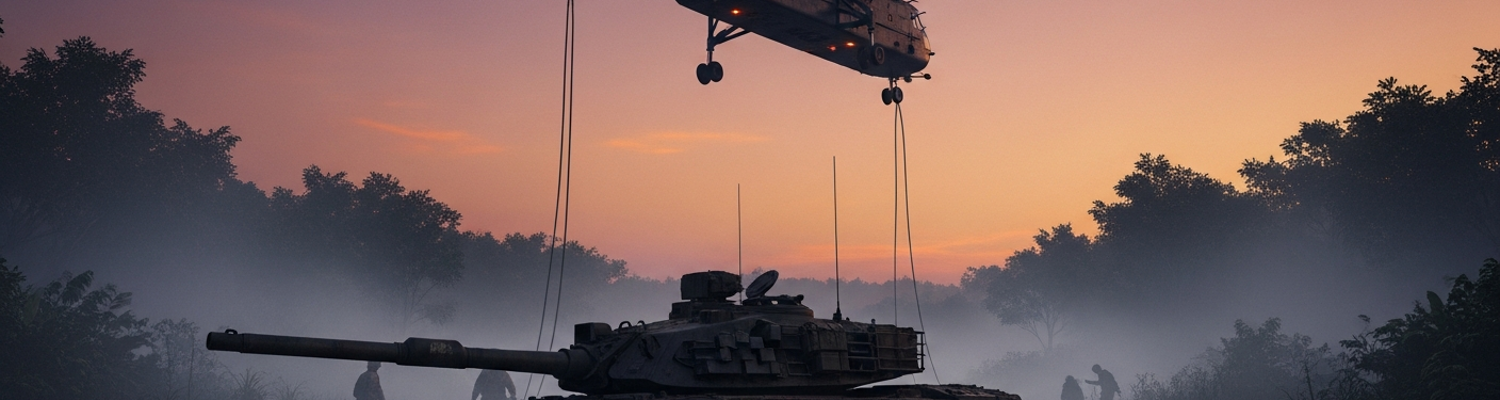

M551 Sheridan Recovery Under Fire
An M551 Sheridan light tank from the 3rd Squadron, 5th Cavalry Regiment, was immobile. It lay crippled in the A Shau Valley. A pressure-detonated mine had obliterated its left-side running gear. The blast threw the track and blew two road wheels clean off the thin aluminum hull. At sixteen tons, the vehicle was a technological prize sitting deep inside a primary logistics and staging corridor for the People’s Army of Vietnam (PAVN). The crew had escaped the compromised vehicle. A more complex problem now confronted squadron command. The vehicle itself was an asset, but its turret housed components of the M81E1 152mm gun/launcher system. This piece of advanced weaponry could not fall into enemy hands for analysis. The order was not to destroy the wreck. The order was to get it back.
The recovery operation fell to an M88 Armored Recovery Vehicle and its four-man crew. They were dispatched with an infantry platoon from the 101st Airborne for security. A review of operational logs from similar incidents (NARA Record Group 472) shows the difficulty of this task. The M88, a fifty-ton machine based on the chassis of an M48 tank, had to carve its own path through the oppressive jungle. Its engine noise was a constant announcement of its presence.
Upon reaching the disabled Sheridan, the crew began the slow, loud process of preparing the turret for removal. The M88’s commander directed the positioning of the vehicle. Its front-mounted dozer blade dug into the soft earth to provide a stable platform for the lift. The rigger and mechanic, exposed to the humid air and the unseen eyes in the surrounding jungle, worked with heavy tools to disconnect the turret ring linkages. Their objective was to use the M88’s A-frame crane to lift the multi-ton turret assembly clear of the hull for separate transport. This procedure was difficult on flat ground and perilous in a contested valley.
Every clank of metal on metal echoed.
Archival evidence from after-action reports on PAVN tactics confirms that U.S. recovery operations were prime targets for ambush. A small, patient squad of PAVN infantry had been shadowing the American force. They were waiting for the moment of maximum vulnerability. That moment arrived as the M88’s crew prepared their crane for the lift. The jungle erupted not with a massed assault, but with the sharp, distinct crack of an RPG-7 launch. The shaped-charge warhead struck the M88’s engine compartment, its intended target. The goal was simple. Kill the recovery vehicle to orphan the Sheridan. Simultaneously, AK-47 fire ripped through the small clearing, pinning down the recovery crew and the infantrymen who had formed a perimeter. The security element, caught in a 360-degree battlespace, returned fire into a wall of green that fired back.
The mission was no longer about salvage.
The recovery attempt was shattered. The M88 was now burning. Its crew were either casualties or fighting as infantrymen. The disabled Sheridan, far from being an asset on the verge of retrieval, had become bait in a deadly trap. The platoon leader, now in a desperate firefight, was faced with a tactical choice born from operational failure. He could attempt to hold the position and wait for reinforcements. Or he could execute the final option. He could place demolition charges inside the Sheridan’s fighting compartment and on its main gun, destroying the very technology they had been sent to save. This act would deny the prize to the PAVN. It would also stand as a monument to the operation’s cost, measured in casualties, a destroyed M88, and the smoldering hull of the Sheridan itself.
Combat Recovery and Friendly Fire
The loss of any aircraft presented an immediate and complex tactical problem. The downing of a UH-1 Iroquois in a contested landing zone initiated a race against time. The operational imperative was to recover the airframe, a valuable asset filled with sensitive radio and navigation equipment. This was a task of extreme hazard, often assigned to a CH-47 Chinook or a CH-54 Skycrane. These heavy-lift helicopters were large, loud, and exceptionally vulnerable during the slow process of rigging and lifting a multi-ton wreck. The recovery attempt began with the insertion of a security platoon to establish a perimeter around the downed Huey. The North Vietnamese Army forces in the A Shau Valley were masters of exploiting these moments.
A constant, harassing barrage of 82mm mortar fire began to walk its way across the hastily formed American position. The rounds, fired from well-concealed pits in the surrounding highlands, were not aimed at causing mass casualties. They were intended to disrupt the delicate and dangerous work of the recovery crew. Under this steel rain, the Pathfinder team and the Chinook’s crew chief worked to attach the sling cables to the UH-1’s rotor hub and fuselage hardpoints. The noise of the hovering CH-47’s twin rotors was deafening. Verbal communication was impossible. The mortar rounds exploded intermittently, kicking up dirt and shrapnel and forcing the ground team to repeatedly hit the deck.
The entire operation was a magnet for enemy contact.
This chaotic scene was made worse by a failure in the very system designed to protect the exposed troops. With the mortar fire intensifying, a forward observer with the security element called for counter-battery fire. The request was for a 105mm howitzer battery located at a nearby fire support base. The request went up the chain, from the platoon leader to the Fire Direction Center (FDC). There, targeting coordinates were calculated and relayed to the gun crews. Archival evidence from analyses of such incidents points to multiple potential points of failure. A forward observer could misread a map in the dense, disorienting jungle. A simple transposition of grid coordinate numbers could occur during a hurried radio transmission. A calculation error by the FDC under pressure was also possible. In this instance, the telephonic transmission of the fire mission contained a fatal flaw. The grid coordinates were transposed. The error was small, a single digit off, but on the ground, it represented a shift of hundreds of meters.
The first spotting round, intended to bracket the enemy mortar position, shrieked down and detonated directly within the American perimeter. The blast wave tore through the recovery team and the infantrymen tasked with protecting them. Before anyone could process the horror of the initial impact, the command for a full fire-for-effect mission was already underway. The FDC, believing the first round was on target, unleashed the entire battery. A volley of high-explosive 105mm shells, six rounds in total, rained down on the very men they were meant to support. The friendly fire incident instantly killed and wounded more soldiers than the enemy mortar attack had during the entire preceding hour. The recovery operation was shattered, not by the PAVN, but by a mathematical error miles away. The surviving soldiers, now dealing with devastating casualties, were forced to abandon the recovery of the UH-1, waive off the Chinook, and focus entirely on evacuating their own wounded.
The Psychological Toll on Salvage Platoons
On paper, the men of the 101st Airborne Division’s salvage and recovery platoons were support personnel. They were officially classified as rear-echelon troops, holding Military Occupational Specialties like 63H (Tracked Vehicle Mechanic). This designation created a dangerous psychological and operational dissonance. Their actual duties forced them into some of the most prolonged and hazardous combat scenarios of the war. A review of operational logs reveals that these platoons were routinely dispatched into active or recently secured landing zones and ambush sites. Their purpose was to retrieve high-value equipment, most often downed aircraft like the UH-1 Iroquois or CH-47 Chinook. The very nature of a salvage mission meant they were working in a location the enemy knew and had likely pre-registered for mortar attacks.
Unlike an infantryman whose goal was to engage and destroy, the recovery specialist’s objective was to perform complex, time-consuming mechanical tasks in the open, under direct threat. This disconnect between their non-combatant classification and their consistent exposure to intense fighting bred a unique form of resentment and stress.
A paper designation offered no protection from incoming fire.
These soldiers were mechanics working in a sniper's gallery. The psychological burden was systemic and distinct from the shock of conventional firefights. Studies of post-war trauma show that prolonged exposure to high-stress environments, even without direct engagement, was a significant contributor to conditions like Post-Traumatic Stress Disorder. For a salvage crew, the stress was sustained over many hours. The deafening noise of a CH-54 Skycrane helicopter hovering overhead to lift a wreck, or the high-torque whine of an M88 recovery vehicle’s winch, served as an audible beacon to every enemy element within earshot. The work itself was a source of intense pressure. Every minute spent rigging a downed Cobra gunship was another minute for a PAVN mortar team to find its range. Crew members had the added duty of recovering human remains from shattered airframes and burned-out vehicles. This task compounded the psychological toll far beyond that of a typical mechanic. They were performing this grim work with the constant knowledge that they were the primary target, tethered to a piece of wreckage that the enemy wanted to see destroyed or captured.
This was not matched with adequate support. The perception of salvage units as support elements often translated into a lower prioritization for security assets compared to infantry line companies. A recovery mission, centered on a vulnerable M88 or a heavy-lift helicopter, might only be assigned a single infantry platoon for security. This small force would be stretched thin, attempting to establish a 360-degree perimeter around a loud, static, and obvious target. An examination of after-action reports shows this frequently left the recovery specialists themselves dangerously exposed. The four-man crew of an M88, a commander, driver, rigger, and mechanic, were expected to operate their vehicle’s crane and winch systems while also manning its single .50 caliber machine gun and defending their position with personal weapons. This command structure, where a maintenance operation was occurring within a separate infantry commander’s battlespace, could create conflicting priorities between the need for technical precision and the tactical need for speed, further jeopardizing the undermanned team on the ground.
Terrain as a Logistical Nightmare
The physical environment of the A Shau Valley was a formidable adversary. An examination of operational logs and after-action reports from units like the 101st Airborne Division reveals a consistent pattern. Terrain and weather dictated the terms of every engagement, particularly salvage operations. The valley floor and its surrounding highland slopes were covered in triple-canopy jungle, a dense vertical prison of vegetation that blocked sunlight and radio signals alike. For a heavy equipment recovery team, this meant carving a new path for every mission. An M88 Armored Recovery Vehicle could not simply drive through this wall of green. It had to act as a bulldozer, its engine roaring at maximum output for hours, announcing its presence to any enemy units for miles.
The ground itself was a treacherous combination of tangled roots, decaying plant matter, and slick laterite clay. During the monsoon season, from May to October, torrential rains transformed this ground into a frictionless, sucking slurry that could bog down even a tracked vehicle. Steep inclines, already challenging for a heavy vehicle, became impossible death traps where a single slide could send a multi-ton machine rolling into a ravine.
The valley was an engine of mechanical destruction.
This unforgiving landscape was made worse by the limited recovery assets available for remote jungle operations. While the M88 was the workhorse, it was a machine designed for the tank battles of Europe, not the vertical, muddy confines of the A Shau. Its weight and size made it a liability, often getting stuck itself and requiring another M88 to pull it out, compounding the risk and noise. Operational records show that recovery crews were chronically short on the specialized tools needed for jungle salvage. Lightweight, air-transportable hydraulic jacks, plasma cutters for severing wreckage, and robust rigging that would not rot in the humidity were scarce. Crews were often forced to improvise with standard-issue block and tackle, hand tools, and controlled demolitions. These were crude methods for a delicate task. An attempt to recover a downed helicopter required a CH-47 Chinook or CH-54 Skycrane to hover for extended periods, presenting a static, deafeningly loud target, while the ground crew worked in the open. The lack of proper equipment extended the time on target, turning every salvage mission into a high-stakes gamble.
The air itself worked for the enemy. Every piece of equipment brought into the valley was under constant chemical assault from a climate defined by extreme humidity and heat. With humidity levels routinely exceeding 90 percent, moisture permeated everything. An examination of maintenance logs from the period shows a dramatic reduction in the service life of equipment compared to other theaters. The pervasive dampness caused electrical components to short out. Sensitive radio and navigation systems were particularly vulnerable. Canvas gear and vehicle coverings would rot directly on their frames. A more insidious threat was fungus, which grew on the glass lenses of rifle scopes, binoculars, and command periscopes, etching the surfaces and rendering them useless. For ordnance, the effects were just as severe. The constant moisture degraded propellant inside artillery shells and mortar rounds. This caused inconsistent firing velocities, which could lead to rounds falling short on friendly positions. This corrosive environment meant that the very tools of war were in a constant state of decay, requiring a level of maintenance that was almost impossible to achieve in a forward combat zone.
Unrecognized Contributions and Historical Neglect
The dominant historical narrative of the A Shau Valley is one of kinetic, direct-action combat. It is a story told through the lens of the infantryman and the airmobile cavalry scout. It is centered on intense engagements like the fight for Hamburger Hill. Archival records and popular memory focus on the search-and-destroy sweeps, the helicopter assaults into hot landing zones, and the desperate firefights against entrenched People’s Army of Vietnam (PAVN) regulars. This perspective, while accurate in its depiction of the infantry’s experience, creates a historical blind spot. It almost completely eclipses the contributions of the salvage and recovery platoons. Their work was fundamental to the operational capacity of the American forces in the valley.
Theirs was a different kind of war.
A review of operational logs from the 101st Airborne and other units operating in the A Shau reveals a stark contrast. Where the infantry mission was often defined by speed and violence, the salvage mission was a slow, methodical, and exposed technical procedure performed on an active battlefield. The recovery of a downed UH-1 or a mine-crippled M551 Sheridan was not a celebrated heroic charge. It was a high-stakes mechanical operation conducted by a handful of specialists. These mechanics, riggers, and vehicle commanders were officially classified as combat support or combat service support personnel. Their job required them to remain static and exposed for hours, methodically disassembling, rigging, or towing a piece of wreckage. The noise of their M88 recovery vehicle’s engine or the hovering CH-54 Skycrane above acted as a massive beacon for enemy mortar and rocket teams. The nature of their mission placed them in known, high-threat locations, tethered to a piece of high-value equipment the enemy was determined to destroy. This grinding, unglamorous work was the connective tissue of the American war effort, yet it is almost entirely absent from the popular chronicles of the conflict.
The official designation of salvage crews as support personnel created a dangerous disconnect that had profound and lasting psychological consequences. An infantryman expected intense combat, but it was typically episodic. For a recovery specialist, the stress was constant and sustained, a low-intensity dread that could last for the entire duration of a multi-hour or multi-day mission. Post-war research into the causes of Post-Traumatic Stress Disorder has shown that prolonged exposure to high-threat environments is a significant causal factor. The crew of an M88, working to winch a swamped vehicle from the mud, was acutely aware that they were a stationary target. Every minute spent working a crane or tightening a tow cable was another minute for a hidden PAVN forward observer to calculate their position for an 82mm mortar barrage. This sustained tension was compounded by the grim nature of their duties, which often included the recovery of human remains from inside burned-out fuselages and vehicle hulls. Studies of Vietnam veterans’ mental health reveal that exposure to the dead and wounded is a primary predictor of long-term psychological distress. For salvage crews, this was not a side effect of combat. It was a core component of their job description, performed without the status or recognition afforded to combat arms soldiers.
An examination of after-action reports from the period reveals that the lessons of these difficult salvage operations were either not learned or not implemented in a timely manner. The institutional perception of recovery units as support translated into a lower prioritization for security and resources. A critical salvage mission might only be allocated a single infantry platoon for perimeter security. This left the technicians themselves dangerously exposed while performing complex tasks that demanded their full attention. The command structure often created friction. The technical imperatives of the recovery crew clashed with the tactical desire of the security element’s commander to move quickly and reduce exposure. These units were often forced to make do with equipment ill-suited for the A Shau’s extreme environment. The lack of recognition was formally codified. Despite performing their duties under direct fire, these soldiers were often ineligible for awards like the Combat Infantryman Badge, which was restricted to specific infantry-coded Military Occupational Specialties. This denial of formal recognition for their role in combat underscored a broader institutional failure to adapt its classifications and support structures to the realities of a war with no front lines.