
As Allied armies pushed into Germany in 1945, specialized U.S. Army intelligence units operated with a focus that had little to do with the immediate fighting. A special unit of the military intelligence division, HOUGHTEAM, gathered over 200 tons of German maps and geodetic data. These teams were not tasked with capturing enemy combatants but with securing a different kind of prize. Paper. They hunted for the complete administrative and operational records of the German Wehrmacht. In the chaos of the Reich’s collapse, American intelligence operatives moved with speed to seize entire archives, often just ahead of their Soviet counterparts. Records from the German Army High Command (OKH), the Reich Ministry for the Occupied Eastern Territories, and countless other military and civil agencies were systematically located, boxed, and shipped west.
This was a highly organized intelligence operation.
A review of operational logs (NARA Record Group 242) indicates the primary target was not battlefield strategy against the Western Allies, but the raw, unfiltered data from the Eastern Front. U.S. military planners, already anticipating a potential conflict with the Soviet Union, had identified a significant gap in their own knowledge. They needed to understand the realities of a land war in Eastern Europe, a theater where their German adversaries had four years of direct, firsthand experience. The captured documents provided a granular, day-by-day accounting of that experience. American analysts poured over German logistical reports detailing the failure rates of tank transmissions in the mud of the Rasputitsa, the exact load-bearing capacity of bridges over the Dnieper, and the precise caloric intake required for a soldier to remain combat-effective in a Russian winter. Of extreme interest were the extensive German records on anti-partisan operations. Reports from German security divisions detailed the tactics, organization, and operational patterns of Soviet resistance fighters, noting which railway lines were most frequently sabotaged and the specific geographic features, like the Pripyat Marshes, that facilitated guerrilla movement. This information was a hard lesson, paid for in German blood, on how to sustain a modern mechanized army against a determined insurgency across the vast distances of the Soviet Union.
To process and preserve this collection of captured intelligence, the U.S. Army established a central repository. The paper records, numbering in the millions of pages, were transported to Alexandria, Virginia. Here, at a dedicated facility run by the German Military Document Section, a massive microfilming project began. Technicians and analysts worked to photograph, catalog, and index the vast collection. The project included everything from high-level operational plans of the Oberkommando der Luftwaffe to the mundane supply receipts of individual army groups. The process created publications and finding aids that made the data accessible to Cold War-era military planners. An analyst in Washington D.C. could now pull a specific roll of microfilm, for instance, Microfilm Publication T314, and examine the daily war diary of a German army corps from August 1939. They could review detailed maps of Soviet rail infrastructure used by the Wehrmacht. This library of failure and hard-won experience, seized from the ruins of the Third Reich and stored in a quiet Virginia suburb, became a foundational source for American strategic planning against the USSR.
The central flaw of Operation Night Fog in 1961 was its absolute, unquestioning faith in this archival data. The operational plan for the 8th Infantry Division’s push into the Hohes Venn region of West Germany was a masterwork of theoretical logistics. It was also a fiction. Planners in Heidelberg, relying on the German military documents seized in 1945, had built their entire concept for helicopter-borne air assault around information that was almost two decades out of date. The core of the mission involved a new and still-developing concept: the Forward Arming and Refueling Point, or FARP. The idea was to leapfrog mobile bases for fuel and ammunition deep into the exercise area, allowing a continuous wave of sorties by the 11th Aviation Company’s H-21C Shawnee helicopters.
Planners based their calculations on Wehrmacht-era geodetic surveys of the Hohes Venn. These maps, produced with extraordinary precision by the Reichsamt für Landesaufnahme in 1943, detailed soil composition, load-bearing capacities, and drainage across the entire region. They identified several clearings designated as future FARP locations, noting the ground as firm loam, suitable for the heavy fuel tankers and ammunition trucks required. The entire timetable for the helicopter assault depended on these FARPs being established on schedule. The H-21, a machine designed for arctic rescue, had a notoriously high fuel consumption rate. Its Wright R-1820 radial engine was prone to overheating under the strain of high-power demands. The plan called for the helicopters to fly at maximum payload, inserting infantry and then cycling back to the pre-positioned FARPs in a constant, unbroken loop. It was a perfect plan, assuming the ground in 1961 was identical to the ground in 1943.
The first 2.5-ton GMC fuel trucks, tasked with establishing FARP Alpha on the first morning of the exercise, bogged down within 500 yards of the designated site. After-action reports describe a major discrepancy between the German maps and the terrain on the ground. What the 1943 surveys had marked as firm, well-drained loam was now a waterlogged peat bog. Unbeknownst to the American planners, post-war changes to local agricultural drainage had turned the entire basin into a swamp. The heavy tankers sank to their axles in the soft ground, immobilizing the entire supply column. The H-21 Shawnees, arriving on station with fuel running low, found no refueling points. Several helicopters were forced to make emergency landings in unsuitable terrain as their engines sputtered out. The fine, abrasive peat dust, kicked up by the rotor wash, was ingested into the H-21’s low-mounted engine intakes, bypassing filters and leading to rapid power loss and engine damage in those that could remain airborne. Within three hours of the operation’s start, the 11th Aviation Company was effectively grounded, not by enemy action, but by a fatal dependence on obsolete paper intelligence.
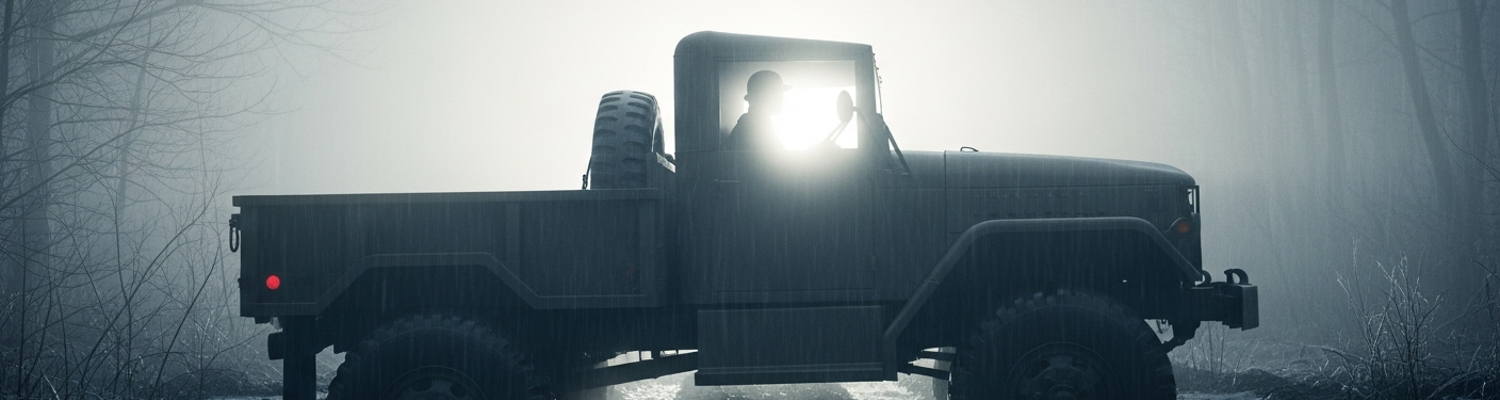
Exercise planners for Night Fog attempted to replicate the unforgiving conditions of a central European war. A review of the operational orders reveals an intent to stress every component of the 8th Infantry Division to its breaking point. The entire exercise area was under a strictly enforced blackout, forbidding any visible light from vehicles or positions after dusk. This was compounded by a weather system that moved into the Hohes Venn just as the operation commenced, bringing with it a persistent, sub-zero freezing rain. This rain, common to the region, coated everything in a veneer of ice. Radio antennas on M48 tanks and command halftracks became brittle, snapping under the strain of vehicle movement and cutting off unit commanders from their subordinates. The dense, ground-hugging fog that naturally occurs in the Venn’s high peat bogs reduced visibility to less than 20 meters. Drivers of M35 trucks and M48 tanks were forced to navigate by compass and the occasional shouted command from a dismounted guide, leading to frequent delays and vehicle accidents on the narrow, icy tracks.
The logistical plan disintegrated almost as quickly as the weather front moved in. Supply convoys from the 8th Supply and Transport Battalion, tasked with pushing fuel, ammunition, and rations forward, became the primary victims. An analysis of after-action reports points to a complete failure along the N676 route, a key artery leading toward the planned forward positions. A convoy of M35 cargo trucks, each rated for a 5,000-pound off-road payload, was brought to a standstill not by the enemy, but by the terrain itself. The combination of freezing rain and heavy vehicle traffic had churned the unpaved sections of the road into a thick, axle-deep morass of mud and ice. The M35’s ten-wheel-drive system was overwhelmed. Winching attempts only resulted in recovery vehicles sliding into the same mire. It was into this static, bunched-up column of vehicles that the opposing force (OPFOR) struck. Using the fog as perfect cover, OPFOR teams, likely from one of the 8th Division’s own airborne battalions, staged a textbook ambush. Exercise umpires, observing the action, ruled that the OPFOR had successfully disabled the lead and tail vehicles with simulated anti-tank mines, effectively bottling up the entire convoy. They then declared the fuel tankers and command vehicles as knocked out, severing the supply line completely.
The fundamental crisis of Operation Night Fog was rooted in the discrepancy between the planners’ paper and the soldiers’ ground. The Wehrmacht-era maps, while technically brilliant in 1943, failed to account for two decades of change. Post-war commercial forestry had carved new, unmapped logging roads throughout the exercise area while rendering trails marked as viable on the German surveys completely impassable with undergrowth. The OPFOR, unburdened by the rigid adherence to the official plan, had conducted its own ground reconnaissance, identifying these new routes and using them to outmaneuver the 8th Division’s main elements. A close review of operational logs highlights the declared destruction of the Roer River bridge near Montjoie as a decisive moment. With this single crossing declared impassable by umpires, the entire advance of the 2nd Brigade was halted. The 1943 maps showed no viable alternative capable of supporting the weight of M48 Patton tanks. This forced a theoretical detour of over 50 kilometers on roads that, as the supply convoys had discovered, were largely incapable of handling heavy military traffic. The entire operational timetable, which depended on a rapid advance from designated phase lines, was rendered obsolete within the first 12 hours.
The supply column intended for FARP Bravo met its end on a narrow, unpaved track designated on the 1943 maps as Route 5B. A review of operational logs from the 8th Supply and Transport Battalion reveals the convoy consisted of twelve M35 trucks, a maintenance and recovery vehicle, and a command jeep. Six of the M35s were configured as fuel tankers carrying high-octane aviation gasoline for the H-21C Shawnees; the other six were loaded with ammunition, spare parts, and rations. The OPFOR ambush was not complex. It was brutally simple. Benefitting from their own ground reconnaissance of the changed terrain, a small team used the dense fog and thick forestry, new growth not present on the planners’ two-decade-old surveys, to get within feet of the road. They allowed the lead jeep and the first two M35 fuel trucks to pass before detonating simulated mines under the third and last vehicles in the column. The attack boxed the convoy in completely. The icy mud prevented the heavy trucks from turning around or driving off the path, creating a perfect, static kill zone.
This was the moment the plan shattered.
In the command jeep, 2nd Lieutenant Wallace, the convoy commander, found himself utterly alone. His AN/VRC series radio, a common vehicle-mounted set for the period, was useless. The combination of the dense, water-heavy fog, the extreme low-lying terrain of the peat bog, and potential jamming from the OPFOR rendered his attempts to contact battalion headquarters futile. Exercise umpires materialized from the fog and declared half his convoy, including the recovery vehicle, as disabled. His security element, a single infantry squad, was ruled to be suppressed by OPFOR machine-gun fire. Wallace was left with a choice documented in his after-action report: stay with the crippled convoy and guarantee the total loss of all remaining assets, or attempt a breakout with the only vehicles that had a chance of escaping. His orders were to establish FARP Bravo at all costs, but the route forward was blocked and the route back was a morass of wrecked trucks. He made a decision that would be debated for years in after-action reviews. He ordered the drivers of the two lead fuel tankers, which had cleared the initial ambush point, to abandon the rest of the column and make a desperate run for the FARP location.
The breakout was a failure. It only compounded the disaster. Lieutenant Wallace’s jeep and the two M35 tankers gunned their engines, sliding through the mud and escaping the immediate ambush site. But without the rest of the column’s support or a clear route, they were simply lost. They were chasing a location on a map that was, for all practical purposes, fictional. The two tankers, each carrying thousands of pounds of fuel, eventually bogged down in the same swampy ground that had doomed FARP Alpha, unable to move forward or back. An umpire patrol located them hours later, declaring the vehicles and their irreplaceable cargo captured. Back at the ambush site, the remaining nine M35 trucks and their personnel were ruled as total losses. This included four tankers of aviation fuel, crates of 7.62mm ammunition for the division’s infantry, and, most significantly, a truck containing spare rotor heads and transmission components for the H-21 helicopters. The abandonment left nearly thirty soldiers, drivers, mechanics, and the infantry squad, isolated. Cut off from command and with no possibility of reinforcement, they were deemed captured by the OPFOR within the hour. The supply chain for the 2nd Brigade’s air assault was not just broken; it was annihilated on a single muddy track in the Hohes Venn.
The total collapse of the 8th Infantry Division’s logistical chain during Operation Night Fog forced a re-evaluation within NATO’s command structure. A close review of operational logs shows that the exercise demonstrated, in grim detail, that the core assumptions of the alliance’s General Defense Plan were flawed. That plan depended on the rapid, unimpeded movement of forces along pre-designated routes to meet a Soviet invasion, a concept built on timetables and phase lines. Night Fog proved that weather, minor changes in terrain, and a thinking opponent could shatter those timetables in hours. Planners in Heidelberg and at SHAPE headquarters were forced to confront the lesson that a plan based on two-decade-old maps was an invitation to disaster. The failure in the Hohes Venn directly influenced future Cold War contingency planning by forcing a shift away from rigid, terrain-dependent schedules and toward a more flexible, objective-based defense. The vulnerability of a few key bridges and road networks, so decisively disabled by umpires in the exercise, led to a renewed emphasis on expanding the capabilities of combat engineer battalions. This meant more Armored Vehicle-Launched Bridge (AVLB) systems and mobile bridging equipment to ensure multiple, redundant crossing points over the rivers of West Germany.
A new approach was required.
The most immediate lesson drawn from the chaos was the inadequacy of static intelligence. The Wehrmacht maps were not wrong; they were simply old, and the reliance upon them highlighted a doctrinal gap between collecting intelligence and using it. Archival evidence from the post-exercise reviews points to a clear demand for what planners began to call ground truth, real-time, verifiable information about the area of operations. The OPFOR had won not because it was better equipped, but because it conducted its own reconnaissance, identifying the new logging trails and the hopelessly boggy ground the planners believed was firm. This spurred a significant elevation in the importance of specialized reconnaissance units within the U.S. Army. The nascent Long-Range Reconnaissance Patrol (LRRP) companies, units designed to operate deep in enemy territory, were seen as a direct solution. Their mission profile was expanded; no longer just observers, they were now tasked with route reconnaissance, verifying that bridges could bear the weight of an M48 tank and that a mapped road was not, in fact, an impassable swamp. Investment grew in developing all-weather aerial observation platforms and more reliable, man-portable radio sets that could overcome the signal-blocking effects of terrain and weather that had so thoroughly isolated Lieutenant Wallace’s doomed convoy. The failure of Night Fog was a powerful argument that intelligence was not a library to be consulted but a dynamic battlefield function that had to be conducted continuously, before and during any operation.
Finally, the exercise forced a dramatic reappraisal of the enemy. The OPFOR in Operation Night Fog had been ruthlessly effective because it refused to act like a passive training aid. It behaved like a real Soviet adversary, using weather and terrain as weapons, prioritizing logistical targets, and using infiltration tactics to bypass frontline units. An analysis of the OPFOR’s actions reveals a textbook application of Soviet-style doctrine: achieve surprise, disrupt the enemy’s rear, and create paralysis. The ambush of the FARP Bravo supply column was not just a tactical victory; it was a demonstration of how a smaller, more agile force could cripple a larger, less adaptable one by striking its logistical jugular. This experience was instrumental in shaping the U.S. Army’s Opposing Force program, transforming it from a simple placeholder role into a dedicated, thinking adversary trained to replicate enemy doctrine with high fidelity. Future training exercises became far more uncooperative and competitive. The lessons from the Hohes Venn directly informed the creation of the Army’s combat training centers, where the entire operational environment, from terrain to the enemy, was designed to stress logistical and command structures to the breaking point. The Army began to train for a war of disruption, practicing convoy defense, rear-area security, and operations in degraded conditions with a new and desperate intensity, understanding that the first battle of the next war would be against an enemy who had read their plans and was waiting for their trucks to get stuck in the mud.