
Camp Radcliff Triage Depot After Action Inspections
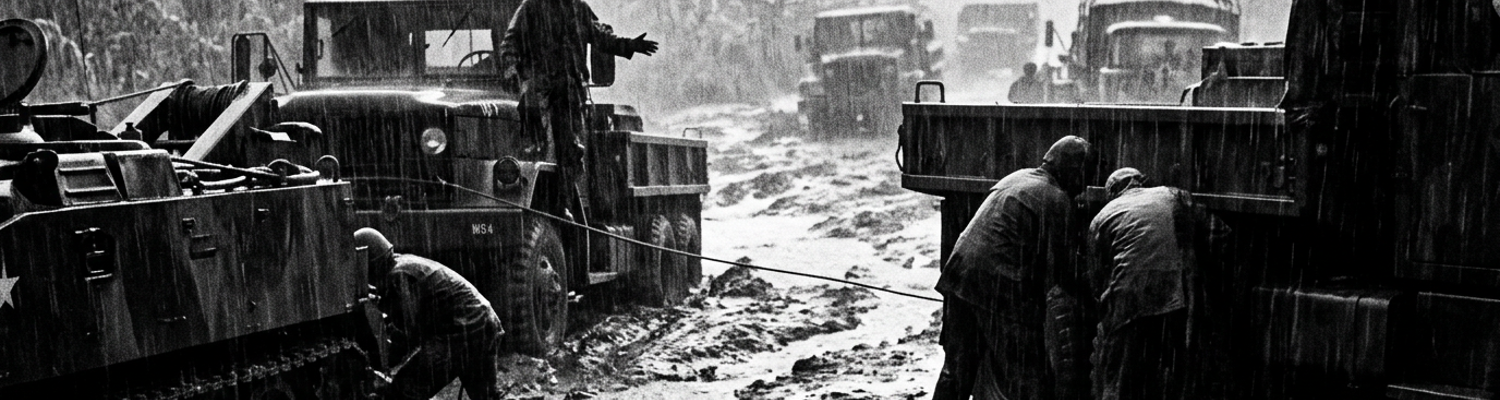
Monsoon cloudbursts delivered fifty millimeters of rainfall per hour across the central plateau. This volume of water reduced the unpaved spans of Route 19 to deep trenches of liquid laterite clay. Saturated red soil reached depths exceeding one meter between the Mang Yang Pass and the An Khe basin. Ambient temperatures held at thirty-five degrees Celsius beneath low stratus cover. Sudden squalls then dropped local readings by fifteen degrees. Stagnant water pooled in roadside drainage ditches and bomb craters.
Nothing moved through the corridor without sustaining structural damage.
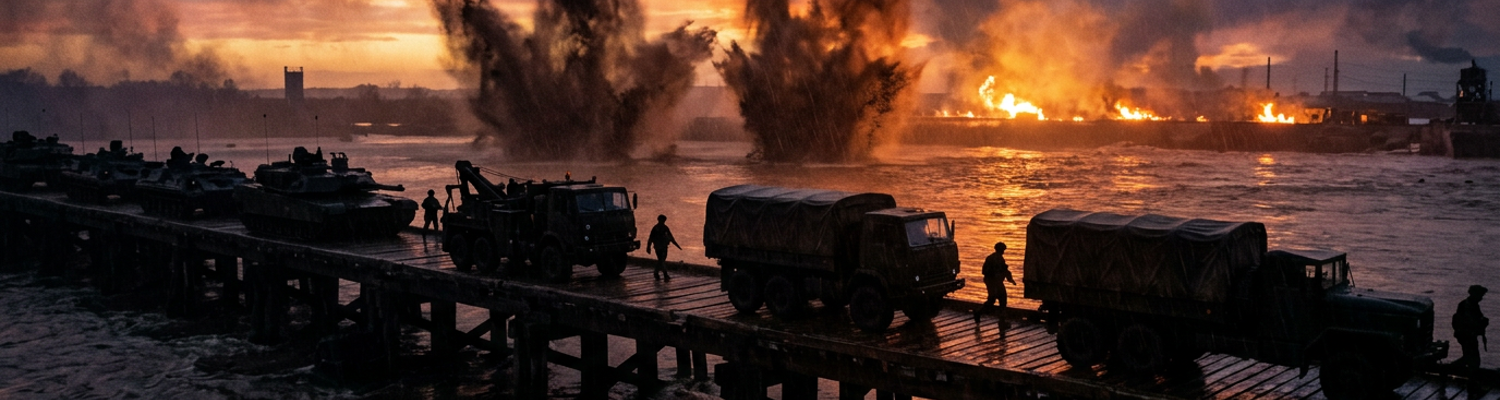
A close review of operational logs indicates that the battered elements of the 8th Transportation Group began grinding past the Camp Radcliff perimeter barriers at 1620 hours. M54 five-ton cargo trucks from the 27th Transportation Battalion entered the staging depot with stripped wheel hubs and missing canvas tarps. Engine bays were caked solid in dried basaltic silt. Behind them rolled four M37 three-quarter-ton ambulances. Their undercarriages were coated in red slurry. This locked steering knuckles and fouled drum brake assemblies. Recovery crews under the 54th Transportation Battalion made the field decision to abandon six bogged flatbeds near the bridge approach. They executed this order to prevent complete bottlenecking of the surviving convoy. Depot personnel recorded that differential housings on the M54s had ingested gritty runoff through dry seals. Internal pinion gears ground down to metal shavings. Front winches had burned out their electric motors during extraction attempts in the mud flats outside the perimeter gate. Drivers had bypassed failed transfer cases by forcing vehicles forward in low-range four-wheel drive. This blew head gaskets and melted cylinder rings across the final ten-kilometer ascent. Radiator fins on eighteen trucks were packed with dense clay. The blockage prevented airflow and boiled away engine coolant until cast-iron blocks cracked under sustained thermal stress.
Mechanics cut the fan belts off twelve overheated engines.
They needed to halt the screech of seized alternators.
When examining the historical record, triage logs at the Camp Radcliff clearing station show that clinical evaluations commenced while wounded personnel were still wedged inside cargo beds and stretcher racks. Medical orderlies found casualties coated in an adhesive layer of laterite mud mixed with stagnant ditch water. This liquid had washed over floorboards during flooded crossings. Shrapnel lacerations and compound fractures caused by roadside ambushes were packed with anaerobic microbes and decaying organic matter. Fecal bacteria carried in the agricultural runoff contaminated every wound. Surgeons faced severe septic complications due to the prolonged immersion of wounded drivers. These men had remained trapped in submerged cabs for up to six hours before recovery. Blood pressure readings plummeted as systemic toxemia set in among soldiers who had swallowed ditch water following blast concussions. Corpsmen used utility knives to slice through soaked jungle fatigues. This revealed deep tissue wounds already exhibiting localized edema and grey necrotic borders. Standard cleansing protocols collapsed when field water bladders ran dry. Surgical teams were forced to expend high-pressure saline reserves to flush gravel and contaminated silt from open thoracic cavities.
Operational records indicate that attending surgeons performed fifty-eight emergency fasciotomies before midnight.
The procedures relieved pressure caused by fast-spreading gas-forming infections.
Every single open wound logged anaerobic bacterial colonization within two hours of arrival.
Grounded DUSTOFF Flights and Diverted Casualty Clearance
Archival evidence shows that by 1300 hours, flight operations duty officers at Camp Holloway in Pleiku issued mandatory no-fly orders across the II Corps tactical zone. Southwest monsoon storm fronts pushing east from the Cambodian border had dropped heavy cloud ceilings directly onto the deck. Horizontal visibility fell to less than fifty meters across the Mang Yang plateau. Turbine air intakes on the UH-1D Iroquois helicopters of the 54th Medical Detachment ingested heavy volumes of rainwater. This created severe compressor stall risks during low-altitude hover attempts. Mountain obscuration blanketed the jagged ridgelines between Pleiku and An Khe. Navigation without visual reference points turned into a lethal hazard. Main rotor blades experienced severe aerodynamic buffet from mountain updrafts. These forces exceeded the structural control limits of the Huey airframes. Radio logs from the 54th Medical Detachment recorded seven consecutive abort calls from forward pilots. They were attempting to penetrate the zero-zero visibility shrouding Highway 19. Instruments failed to give pilots reliable horizon indicators amidst the driving downpours. By mid-afternoon, all rotary-wing medical evacuation aircraft across the central plateau sat tied down on concrete hardstands with intake covers secured.
Flight lines across the highlands went completely silent.
Not by choice. By direct order.
A close review of operational logs indicates that the grounding of the 54th Medical Detachment severed the primary evacuation chain linking frontline tactical units to the 67th Evacuation Hospital at Pleiku. Flight surgeons faced thirty-knot crosswinds that tore rain sheets sideways across revetments. Emergency patient loading on helicopter pads became mechanically impossible. Barometric altimeters inside the UH-1D cockpits gave erratic readings due to sharp pressure drops. Squall lines slammed into the western approaches of the An Khe Pass. Maintenance officers reported electrical short-circuits across radio consoles and wet avionics bays within forty minutes of engine shutdown. Air corridors were shut down. Flight clearances were revoked by aviation commanders at Pleiku Air Base. Field clearing stations along the corridor lost all direct access to airborne surgical transport. The 54th Medical Detachment dispatch desk systematically stamped tactical medevac requests as weather-denied. Calls were routed down military telephone lines to the nearest surface commands.
Commanders pushed the dying onto supply trucks.
When examining the historical record, emergency dispatchers at the An Khe operations center transferred eleven critical red priority casualty manifests directly to the 8th Transportation Group at 1445 hours. Convoy commanders with the 27th and 54th Transportation Battalions received urgent orders. They had to convert standard logistics platforms into improvised ambulance sections along the muddy tracks of Route 19. Infantry squads fighting near secondary ambush sites carried bleeding soldiers through waist-deep road gullies. They secured stretchers across the wooden sideboards of M54 five-ton cargo trucks loaded with ammunition pallets. Gun trucks mounted with twin .50 caliber machine guns took on wounded men directly behind armored gun tubs. Trauma patients were exposed to diesel exhaust and heavy water spray. Drivers removed canvas covers to prevent water pooling over litter racks. Exposed chest wounds and amputations were subjected to continuous rain and freezing runoff. Convoys crawled forward at speeds under four kilometers per hour through axle-deep red laterite mud. This mud jammed truck differentials. Vehicle vibration shook arterial clamps loose inside open wounds. Medical corpsmen attempted field dressings on shifting wooden truck beds.
Cargo beds became open-air trauma bays.
Field records from the 8th Transportation Group document eighteen casualty transfers conducted between bogged M54 transports and track-laying M578 recovery vehicles. Truck axles sheared under the strain of deep mud. Medical supplies carried in canvas aid bags were completely soaked within thirty minutes. Sterile compress packs were ruined. Surgical tape was contaminated with wet basaltic clay. Drivers had to maintain forward throttle in low gear to keep from high-centering in mud ruts. Corpsmen were prevented from stabilizing fractures or securing intravenous saline needles in collapsed veins. Ten liters of blood expanders washed down truck drainage slats during a forty-minute transit through the Mang Yang pass. Wooden stretchers slid off unsecured cargo tie-downs. Convoy manifest entries confirm that four wounded soldiers died of hypovolemic shock on the floorboards of truck number 414.
The lead vehicle had not yet cleared kilometer marker 72.
Perforated Steel Planking and Gun Truck Countermeasures
Archival evidence shows that maintenance personnel with the 27th Transportation Battalion began fabricating improvised overhead shields inside the An Khe staging yards at dawn. Motor pool mechanics welded interlocking strips of ten-gauge Perforated Steel Planking across the top rails of M54 cargo bodies. This was done to deflect indirect mortar fragments and sniper rounds. Welded angle iron brackets held two tiers of burlap sandbags directly above the steel grating. Roughly twelve hundred kilograms of ballast were distributed across standard wooden dropsides. Saturated with rainwater, each sandbag absorbed water until the extra mass exceeded the rated payload limits of the rear leaf springs. Shop reports note that thirty-eight M54 chassis suffered sheared rear spring center bolts. Structural crossmembers bent downward under the strain of carrying stacked stretchers beneath the iron plates. Litter patients rested in double-tiered wooden racks jammed beneath the perforated plating. Dripping mud mixed with engine heat created suffocating compartments. Shrapnel from roadside command-detonated mines routinely struck the outer edges of the steel planking. This successfully prevented lethal penetration into the patient bays. The shrapnel sheared through fuel return lines along the frame rails instead.
Suspension brackets sheared in half under the dead weight of waterlogged sand.
A close review of operational logs indicates that while the steel planking shielded open litter bays, the added mass altered vehicle centers of gravity along the slick mountain inclines of the Mang Yang Pass. Drivers descending six-percent grades between kilometer markers 68 and 74 reported severe frame warping. Shift linkages were prevented from engaging second gear. Brake fluid boiled inside master cylinders as operators held foot pedals down to avoid sliding into forty-meter ravines. Corpsmen wedged into the cargo bays crawled across the floorboards to monitor plasma bottles. They used flashlights to inspect tourniquets. The solid sandbag overheads blocked all ambient daylight.
The darkness inside the retrofitted cargo beds concealed arterial bleeding from attending medics.
When examining the historical record, operational debriefs from the 8th Transportation Group reveal that M54 gun trucks mounting M45 Quadmount turrets formed the sole barrier preventing the total destruction of these loaded ambulance sections. The convoy entered the narrow defile at kilometer marker 78. Elements of the North Vietnamese Army 95B Regiment initiated an ambush using heavy machine guns and B-40 rocket-propelled grenades from elevated limestone ridgelines. Gun truck crews operating the M45 systems swung four synchronized .50 caliber heavy barrels upward. They delivered sustained cyclic fires that exceeded two thousand rounds per minute into the tree cover. The Wisconsin auxiliary engines powering the electrical turret drives frequently fouled their carburetors with rain spray. Gunners were forced to crank traverse handles manually while under direct fire. Recoil forces from prolonged bursts cracked rear axle housings and vibrated front wheel lugs loose on three separate five-ton platforms. Gun truck armorers burned through twelve spare barrel sets within twenty minutes. This prevented head-space detonations caused by catastrophic overheating. Tracer fire sheared tree trunks at forty meters. Automatic weapon nests on the high ground were suppressed long enough for damaged casualty carriers to crawl through the kill zone.
Spent brass casings accumulated three layers deep across the steel floor plates of every surviving turret.
Depot inspectors at Pleiku later discovered that sixty percent of the M45 gun mounts sustained cracked ring-gear teeth.
This damage resulted from continuous maximum-elevation firing during the ascent.
Clinical Trauma Failures from Mud and Transit Delays
Archival evidence shows that field medics operating inside the open cargo beds of the 8th Transportation Group lost functional vascular access on nearly all litter patients within the first two hours of ground evacuation. Standard Baxter and Abbott plastic infusion sets carrying Ringer's lactate solution were suspended from unpainted steel canopy ribs. Medics used bailing wire and safety pins to hang the bags. Five-ton M54 trucks pounded across corduroy log sections and cratered washouts between kilometer markers 55 and 70. The constant spray of liquid laterite slurry penetrated unsealed vent needles and rubber medication injection ports. Fine volcanic grit drifted down through the drip chambers. Narrow plastic orifices were obstructed and manual roller clamps jammed. Gravity-fed lines stopped flowing entirely. Corpsmen attempted to restore the drop rate by stripping polyvinyl chloride tubing between their fingers. Hydraulic suction pulled contaminated water past unthreaded needle hubs directly into open angiocatheters. Soil microbes entered the fluid stream directly upstream of venous puncture sites.
Red silt settled into the bottom of the infusion bags.
A close review of operational logs indicates that this mechanical fouling triggered rapid clinical deterioration throughout the convoy. Attending medics could not replace dislodged eighteen-gauge intravenous needles once vehicle motion threw them against wooden sideboards. Deep puncture sites were left open to contaminated truck floorings. Unfiltered particulate matter and gram-negative pathogens entered circulatory systems already experiencing profound vasodilation. Septic bacteremia was induced within sixty minutes of infusion failure. Wounded drivers and vehicle crewmen receiving contaminated crystalloid fluids presented with sudden rigors. Spiked core temperatures reached over forty degrees Celsius. Systemic vascular resistance dropped precipitously. Concurrently, the abrupt cessation of fluid resuscitation prevented the restoration of circulating blood volume in patients with blast trauma. Irreversible hemorrhagic shock followed. Clotting factors diluted by partial crystalloid delivery washed out of open wounds before hemostasis could form. Triage surgeons at the 18th Surgical Hospital later documented that uncorrected hypovolemia accelerated metabolic acidosis across forty-two casualties. Secondary transfusion therapy was rendered ineffective once transport vehicles finally reached An Khe.
Friction buckles lost all traction against wet canvas.
When examining the historical record, clinical after-action reports from the 67th Evacuation Hospital reveal an identical mechanical collapse in tactical hemorrhage control. Standard-issue cotton-webbing tourniquets with cast-metal friction buckles failed completely when saturated with liquid laterite clay. Casualty transports traversed the sixty-kilometer mountain stretch between the Mang Yang Pass and Camp Radcliff. Fine soil particles worked into the weave of the straps. The fabric transformed into a slick ribbon that slid through clamping teeth. Heavy lateral vehicle lurching over granite boulders caused the metal buckles to back off along the wet webbing. Tourniquets applied tightly in forward combat zones loosened within fifteen minutes of continuous transit over corrugated gravel. Severed femoral and brachial arteries resumed active high-volume bleeding beneath muddy dressings. Medics kneeling in moving truck beds found the straps caked in a thick layer of basaltic mud. This mud solidified upon exposure to engine exhaust heat. Windlass rods seized. Personnel were prevented from re-tightening loosened bands without utility shears. Dried laterite created uneven localized pressure points. Peripheral nerve bundles were sheared and underlying muscle fibers were crushed without occluding deeper arterial vessels. Hemorrhage continued undetected beneath soaked field dressings.
The bandages were indistinguishable in color from the surrounding road mud.
Post-mortem logs recorded fatal blood loss in twenty-nine wounded soldiers.
Their limbs still bore loose cotton tourniquets.
Emerging Surface Evacuation Doctrine and Road Logistics
Archival evidence shows that within three hours of the final convoy entering the Pleiku perimeter, staff officers at the 8th Transportation Group headquarters began cross-referencing mortuary affairs manifests against battalion fire-incident reports. Out of seventy-two confirmed fatalities sustained during the transit between An Khe and Camp Holloway, direct hostile fire from the 95B Regiment accounted for twenty-two deaths. Fifty soldiers died directly from the physical deterioration of Route 19. Saturated washouts and lateral mudslides threw unsecured personnel from shifting cargo beds into two-meter roadside drainage trenches. Chest cavities were crushed under rolling tires. Immobilized trucks tilted onto their sides in deep laterite basins in eight separate instances. Litter patients pinned beneath shifting cargo straps were submerged before recovery winches could be rigged. Prolonged transit times through forty kilometers of continuous mud ruts stretched standard evacuation cycles from forty minutes by air to thirteen hours by road. Trauma patients with non-lethal extremity wounds bled to death as violent chassis shuddering dislodged hemostatic clamps. Others expired from uncontrolled hypothermia caused by rain immersion.
Statistical analysis proved that road deterioration caused more fatalities than direct enemy contact.
A close review of operational logs indicates that by midnight, surgeons at the 18th Surgical Hospital drafted urgent statistical reports directly to the headquarters of the 1st Logistical Command. Post-mortem examinations confirmed that fifty-nine percent of patients who died in transit had survived their initial bullet or shrapnel wounds. They succumbed to systemic shock induced by prolonged mechanical vibration and secondary drowning in road silt. Roadway ruts measuring up to eighty centimeters deep continuously bottomed out vehicle differentials. Lateral shock loads of five Gs tore apart stabilized pelvic fractures. Sepsis rates skyrocketed because open wounds spent an average of nine hours exposed to pulverized laterite clay slurry thrown up by spinning dual rear tires. Attending triage officers concluded that road conditions transformed minor treatable soft-tissue trauma into lethal systemic toxemia before casualties could reach an operating table.
Open truck beds were killing the wounded.
When examining the historical record, operational debriefs compiled by the 44th Medical Brigade reveal that field commanders immediately bypassed standard supply channels. They demanded specialized enclosed ground ambulances. Formal administrative dispatches sent to the US Army Support Command Qui Nhon demanded an immediate halt to the practice of loading litter patients into field-modified M54 five-ton cargo beds. Group maintenance officers documented that improvised wooden litter frames and welded perforated steel planking failed to provide even basic environmental seals. Open surgical wounds were bathed in diesel exhaust and airborne road grit. Command requisitions called for factory-built M725 three-quarter-ton enclosed ambulances equipped with sealed patient compartments, internal heating elements, and shock-isolated suspension mounts. Logistics officers specifically requested armored M113 tracked ambulances to bypass deep mud basins entirely. Tracked hulls could traverse Mang Yang laterite corridors without shaking arterial sutures loose. Headquarters paperwork registered thirty emergency priority requisitions for rubberized litter suspension systems before 0400 hours.
Standard five-ton logistics platforms were declared tactically unacceptable for casualty clearance.
Archival records show that 8th Transportation Group maintenance bays at An Khe received direct administrative instructions. They were to halt all further shop-level conversions of standard logistics flatbeds into makeshift casualty platforms. Medical planners cataloged eighty-six mechanical defects inherent to improvised cargo beds. These included the lack of suction apparatus, the absence of onboard electrical outlets for blood warmers, and the transmission of engine block vibrations directly into wooden litter poles. Battalion dispatches sent to the 1st Logistical Command insisted that any future ground evacuation doctrine along Route 19 require pressurized sealed patient bays. These bays had to be capable of maintaining a sterile environment against southwest monsoon runoff. Requisitions submitted at 0530 hours requested the rapid air shipment of twelve enclosed M725 ambulance bodies from depot reserves in Okinawa directly to the flight line at Qui Nhon.
The request was marked critical.
Route 19 remained impassable to standard cargo frames.