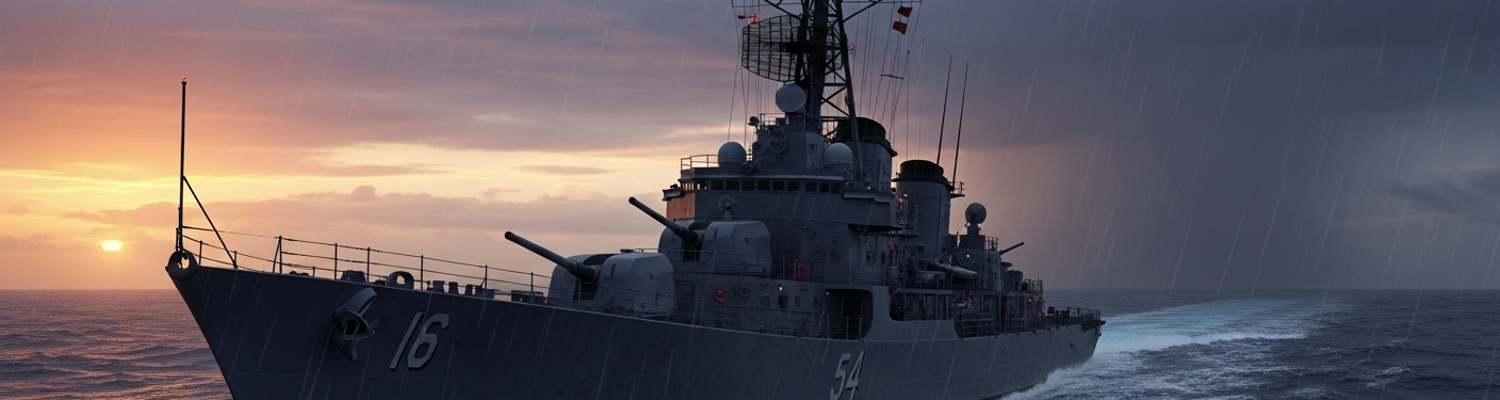

USS Ammen: A Fletcher-Class Profile
The year is 1956. The USS Ammen (DD-527) is a ghost of a previous war, her hull carrying eight battle stars from the Pacific. She is a Fletcher-class destroyer, a design born for fleet actions against the Imperial Japanese Navy, now adrift in the new realities of the Cold War. A review of her operational logs shows a demanding cycle. First Fleet training exercises off San Diego. A deployment to the Far East with the 7th Fleet on February 7th. Her return to San Diego on August 11th, followed by a three-month overhaul at Mare Island Naval Shipyard.
This was the life of an aging asset.
The ship’s 60,000 shaft-horsepower Westinghouse turbines and boiler systems were kept running by a crew mixing WWII veterans with new Cold War sailors. But the platform itself was a product of a different time, designed for open-ocean combat against conventional naval power, not the creeping threats of Soviet submarines and jet aircraft.
The Fletcher-class design, while one of the most successful of the Second World War, carried deep-seated limitations into the atomic age. These were blue-water platforms, conceived for the vast expanses of the Pacific. A standard displacement over 2,000 tons, a length of 376 feet, and a draft nearing 18 feet provided stability for long-range campaigns. In the confined, shallow waters of littoral zones, these dimensions became liabilities. The ship's wide turning circle and deep draft made it vulnerable in constricted channels where mines and small, fast attack craft could dictate the terms of an engagement. Post-war refits that added new electronic suites also made the ships top-heavy, a dangerous trait that had caused losses in earlier destroyer classes during typhoons.
Its fundamental architecture was optimized for surface gun duels and defense against propeller-driven aircraft. The complexities of near-shore operations were not part of its design DNA.
To counter the obsolescence brought by jet aircraft and advanced German Type XXI submarine technology, the Ammen underwent a series of upgrades. Her sensor suite saw the most change. WWII-era SG and SC radars were replaced by newer systems like the AN/SPS-6 air-search radar and the AN/SPS-10 surface-search radar. The Bendix-produced AN/SPS-6 offered a major improvement in detecting aircraft, with a range over 70 nautical miles. Its wide 10 to 30-degree vertical beamwidth, however, was not optimized for tracking low-flying targets against the clutter of a coastline. The Raytheon AN/SPS-10, a C-band surface-search radar, became a fleet standard but was easily confused by shoreline geography and other near-shore interference.
Armament modifications were a mixed success. Many Fletchers had their 20mm and 40mm anti-aircraft guns removed. Some lost their forward torpedo tubes to make way for anti-submarine weapons. The "Weapon Alpha" ahead-throwing rocket launcher was introduced to fire a 250-pound warhead out to 800 yards, a response to new submarine threats. It was a deep-water system, less effective in shallow littoral environments. The five powerful 5-inch/38-caliber guns were retained, excellent for shore bombardment but with a rate of fire ill-suited to countering swarms of small, fast-moving coastal craft. These upgrades were stopgaps, grafting new technology onto a hull that was never intended for it.
The Blue Water Doctrine Focus
Post-war U.S. Navy doctrine was an instrument built for a single, apocalyptic purpose. A total war at sea against the Soviet Union. For a destroyer like the Ammen, this meant one mission above all others: protecting high-value carrier battle groups in deep water. The primary anti-submarine warfare (ASW) task was not hunting submarines in shallow coastal waters, but forming a protective screen for carriers in the North Atlantic. The entire operational concept was built to counter Soviet submarines, incorporating German Type XXI U-boat technology, breaking out from the Kola Peninsula to sever sea lanes to Europe. The chokepoint was the Greenland-Iceland-United Kingdom (GIUK) gap.
In these deep waters, destroyer tactics were rehearsed and predictable. They would use active sonar like the SQS-4 to find submerged contacts, a process far more effective in the uniform thermal layers of the deep ocean than in the acoustically chaotic littoral environment. An engagement would be handled by ahead-throwing weapons like the RUR-4 Weapon Alpha. It was a deep-water weapon for a deep-water fight.
The doctrine was predicated on space and depth.
Anti-air warfare (AAW) priorities were also geared for blue-water fleet defense. The threat was envisioned as waves of high-altitude Soviet jet bombers, like the Tupolev Tu-16 'Badger', armed with early anti-ship missiles. Naval strategy centered on layered defense. The outer ring belonged to the carrier’s air wing. The inner rings were the responsibility of escorting cruisers and destroyers. A Fletcher-class destroyer’s role was often as a last-ditch shield. Its AN/SPS-6 air-search radar could detect targets at over 70 nautical miles, providing early warning. But the system’s wide vertical beam made it less effective against low-flying targets, a weakness amplified by radar clutter from nearby land. For armament, the ship relied on its five 5-inch/38-caliber guns, which were becoming outmatched by the speed of jet aircraft. The entire AAW posture was designed for fleet actions far from shore, where radar horizons were clean and engagement envelopes were wide.
This focus on a singular, massive naval confrontation shaped all destroyer operations. Archival fleet exercise reports from the 1950s consistently show scenarios centered on protecting carrier groups and Atlantic convoys. Command-and-control structures, communications, and logistics were all optimized for large, coordinated fleet movements. There was little doctrinal preparation for independent destroyer actions in the confined waters of the littorals. The operating assumption was that any near-shore combat would be a temporary phase in support of a larger amphibious assault, itself backed by a full carrier battle group. The concept of a lone destroyer fighting a protracted campaign in narrow seas was not part of the strategic calculus.
The Fast Attack Craft Threat
Naval intelligence files from the mid-1950s show a growing unease. Analysts were tracking the Soviet Union's investment in coastal defense. It was a strategy of sea denial, rooted in their World War II experience, built on minefields and swarms of small, expendable attack boats. Intelligence reports detailed a tactical philosophy built on mass and saturation. The plan was not for a single boat to score a hit, but for dozens to launch coordinated, multi-axis attacks from the cover of coastlines. They would use high speed to close the distance, fire torpedoes at near-point-blank range, and withdraw into coastal clutter before a destroyer’s larger guns could engage. This was a doctrine of attrition, trading cheap wooden boats for high-value warships.
The primary vehicle for this doctrine was the Project 183 "Bolshevik" torpedo boat, known to NATO as the P-6 class. These were not sophisticated vessels. The design was influenced by American-built Lend-Lease boats from the previous war. The P-6 was a 67-ton boat with a hull of treated plywood. Four M-50F diesel engines gave it a top speed over 40 knots. Its armament consisted of two 533mm torpedo tubes with simple, straight-running torpedoes. For self-defense, it carried two twin-barreled 25mm autocannons. Over 400 were built, forming the backbone of Soviet coastal fleets and being widely exported.
This threat was magnified by the operational environment. In the confined waters of a littoral strait, a Fletcher-class destroyer’s advantages evaporated. Its AN/SPS-10 surface-search radar was easily degraded by sea clutter and false returns from the shoreline, making it difficult to distinguish a 67-ton wooden boat from a fishing vessel. The challenge was compounded by a swarm attack. Dozens of small, fast-moving radar contacts appearing simultaneously could saturate the displays and overwhelm the Combat Information Center crew. The destroyer’s main battery of 5-inch/38-caliber guns had a rate of fire and traverse speed ill-suited for engaging multiple, high-speed, maneuvering targets at close range. The sheer number of attacking craft meant that even if the first few were destroyed, others would get through. P-6 boats could also generate smoke screens by injecting fuel into their exhausts, obscuring their movements and making visual targeting impossible.
By 1956, the P-15 Termit anti-ship missile was becoming available. The Soviets mounted this new weapon onto the Project 183 hull, creating the Project 183R, or Komar-class missile boat. This new craft could launch a guided missile from outside the effective range of a destroyer’s guns, turning a close-quarters fight into a standoff engagement where the destroyer was dangerously out-ranged.
The Doctrine Disconnect
Operational logs and tactical manuals from the period paint a clear picture. The U.S. Navy's destroyer fleet was training for a conflict that might never come, while ignoring the one that was most likely. The entire doctrinal structure was aimed at a deep-ocean battle. ASW tactics were centered on creating protective screens for carrier groups in the GIUK gap. In this environment, a destroyer like the Ammen would use its SQS-4 sonar, with an effective range of about 2.5 miles, to detect a contact. The engagement would then be prosecuted with ahead-throwing weapons like the Weapon Alpha.
This strategic focus created a dangerous intellectual and tactical void. The unique challenges of littoral warfare were almost completely ignored.
Fleet exercises of the era were highly scripted affairs, designed to validate existing doctrine. A typical exercise, like Operation Blue Trident, would involve a "Foxtrot" class submarine target at a known depth on a predictable track, allowing crews to practice deep-water ASW under ideal conditions. The acoustic environment was clean. The target was compliant. The rules were clear.
This created a false sense of mastery.
The brutal, unpredictable nature of coastal combat was absent. There was no training for how a sonar operator should interpret a screen saturated with false returns from a rocky seabed, thermal layers from river outlets, and the noise of commercial shipping. A Combat Information Center crew trained to track a handful of contacts would be paralyzed by the sudden appearance of dozens of small, high-speed radar blips from a fast attack craft swarm. The manuals contained no procedure. The training offered no solution.
This was compounded by a physical mismatch between the ship and the environment. A Fletcher-class destroyer was 376 feet long with a draft approaching 18 feet. These dimensions made her clumsy in shallow coastal zones. The ship’s large turning circle made it an easy target in constricted channels. Its deep draft made it susceptible to mines. Its 5-inch/38-caliber guns, with a maximum firing rate of 18 rounds per minute, were designed for shore bombardment or engaging large aircraft, not tracking multiple small, fast-moving P-6 boats. The AN/SPS-6 air-search radar struggled to pick out low-flying targets against a coastline. The SQS-4 sonar was similarly hampered, its performance severely degraded by the acoustic chaos of shallow water. The ship was an open-ocean predator being asked to hunt in a swamp.
Countermeasure Deficiencies
The Ammen's armament was built for another kind of fight. Her five 5-inch/38-caliber dual-purpose guns were legendary weapons. Against a swarm of P-6 torpedo boats, they were nearly useless. The gun mounts had a traverse rate of 15 degrees per second. A P-6 boat at 40 knots could change its relative bearing so rapidly at close range that gun crews and their Mark 37 Gun Fire Control System would struggle to keep the weapons on target. The fire control system was not designed to manage dozens of small, high-speed contacts appearing simultaneously from multiple axes. The problem was saturation.
Even if gunners could achieve a firing solution on one boat, two more would be closing from another direction. An individual P-6 was expendable. A Fletcher-class destroyer was not.
The ship’s technological sensors became fragile in the complex coastal environment. The AN/SPS-10 surface-search radar was designed for a clean horizon. In the littorals, its effectiveness degraded. The radar screen in the CIC would be flooded with sea clutter, spurious returns from waves that could mask the low radar cross-section of a wooden boat. The surrounding shoreline created ground clutter and false targets. A P-6 flotilla could use these deficiencies to its advantage, approaching under the cover of coastal geography before a final, high-speed dash. The P-6's own primitive countermeasures, like injecting diesel fuel into its exhaust to create a smoke screen, could blind the destroyer’s lookouts and optical rangefinders, forcing reliance on the already-compromised radar picture.
War-gaming scenarios of the 1950s actively reinforced these gaps. A typical exercise would involve a single opposing warship, often another destroyer standing in for a Soviet Sverdlov-class cruiser. These were scripted events designed to validate blue-water gunnery doctrine. Archival reports show few, if any, exercises simulating a massed saturation attack by small, fast craft in a confined waterway. Crews were never forced to confront a situation where their radar screens were saturated, communications were jammed, and fire control systems were overwhelmed. The Navy was rehearsing for a formal duel, while the enemy was preparing for an ambush.
A Doctrine Broken and Remade
October 21, 1967. The Israeli destroyer INS Eilat is on patrol off Port Said. An Egyptian Komar-class boat, still inside the harbor, fires its P-15 Termit missiles. The hits are catastrophic. The event validates every quiet fear that had been building in Western naval circles for a decade. A World War II-era destroyer, conceptually similar to the Ammen, was killed by a cheap, fast opponent from a distance. The incident shattered confidence in gun-based surface combatants and forced a re-evaluation of naval planning.
This spurred a top-to-bottom overhaul in naval procurement, championed by Admiral Elmo Zumwalt as the "high-low mix." A review of naval budget documents from the early 1970s reveals a shift away from exclusively funding expensive, high-end platforms like aircraft carriers. The high-low concept acknowledged that an all-carrier navy would be too small and valuable to risk in messy littoral conflicts. The solution was to supplement these "high" capability assets with a larger number of less expensive, more specialized "low" end ships. This thinking gave birth to the Oliver Hazard Perry-class guided-missile frigate, a vessel designed in large numbers to control the seas in lower-threat environments.
The specific lessons from the Eilat sinking were clear. The destroyer was blind to the incoming sea-skimming missiles. This led to a frantic emphasis on electronic warfare. A direct result was the development of the AN/SLQ-32, an electronic warfare suite designed to detect the radar emissions of incoming anti-ship missiles. The first production contract was awarded in 1977. Another lesson was the need for a last-ditch point defense system. This spurred the development and 1980 deployment of the Phalanx Close-In Weapon System (CIWS), a radar-guided 20mm Vulcan cannon with a firing rate of 4,500 rounds per minute, designed to automatically engage incoming missiles and small craft at very close range.
Destroyer design itself had to be remade. The result was the Spruance-class destroyer, first commissioned in 1975. These ships were a direct response to the failures of older designs. Their true innovation was internal. They were built with a large, modular hull designed for future upgrades. The design embraced a multi-mission capability. A Spruance carried hangar space for up to two SH-60B Seahawk helicopters, which acted as the ship’s long-range eyes and weapon platforms under the Light Airborne Multi-Purpose System (LAMPS) program. These helicopters could independently hunt submarines, use their own radar to target ships over the horizon, and provide a defense against small boat swarms, extending the destroyer’s reach far beyond its own hull. The ships were later retrofitted with Vertical Launch Systems, transforming the destroyer from a defensive screening vessel into an offensive power projection asset.