
At 06:00 on 30 June 1943, near coordinates 8.500° S, 157.333° E, Major General John H. Hester’s 43rd Infantry Division began landing on Rendova Island. Their objective lay five miles distant, across the Blanche Channel. It was Munda Point on New Georgia island.
The Munda Point airfield was not just another target. It was a linchpin in Operation Cartwheel, the Allied grand strategy for neutralizing the Japanese fortress of Rabaul. A direct assault on Rabaul, defended by over 100,000 troops, was considered too costly. The Allied solution was a campaign of isolation, a two-pronged advance to encircle and starve the bastion. Munda was a mandatory stepping stone. Allied aircraft operating from Henderson Field on Guadalcanal were at the absolute limit of their operational range. The nearly 1,100 nautical mile round trip to Rabaul left pilots with as little as 15 minutes of fuel for combat, making effective fighter escort almost impossible. Capturing the Japanese-built airfield at Munda would drastically shorten this distance. It would enable sustained, heavily escorted bombing raids to systematically dismantle Rabaul’s offensive power.
The objective was seizure, not denial. The Japanese had begun constructing the Munda strip in late 1942 as a forward base to harass American forces on Guadalcanal. Allied planners under Admiral William F. Halsey intended to turn this weapon back on its creators. The capture of Munda would provide a forward operating base for Army Air Forces bombers and Marine fighter squadrons, positioning them to dominate the central Solomons and support the next leap up the chain toward Bougainville. The plan, Operation Toenails, tasked the 43rd Infantry Division, supported by elements of the 37th and 25th, with securing the airfield for U.S. Navy Seabees to expand. Artillery positioned on Rendova and nearby islets would provide fire support, turning the surrounding islands into what planners considered an unassailable gun platform. The airfield became operational for American aircraft on August 5, just two weeks after its capture, confirming its high strategic value.
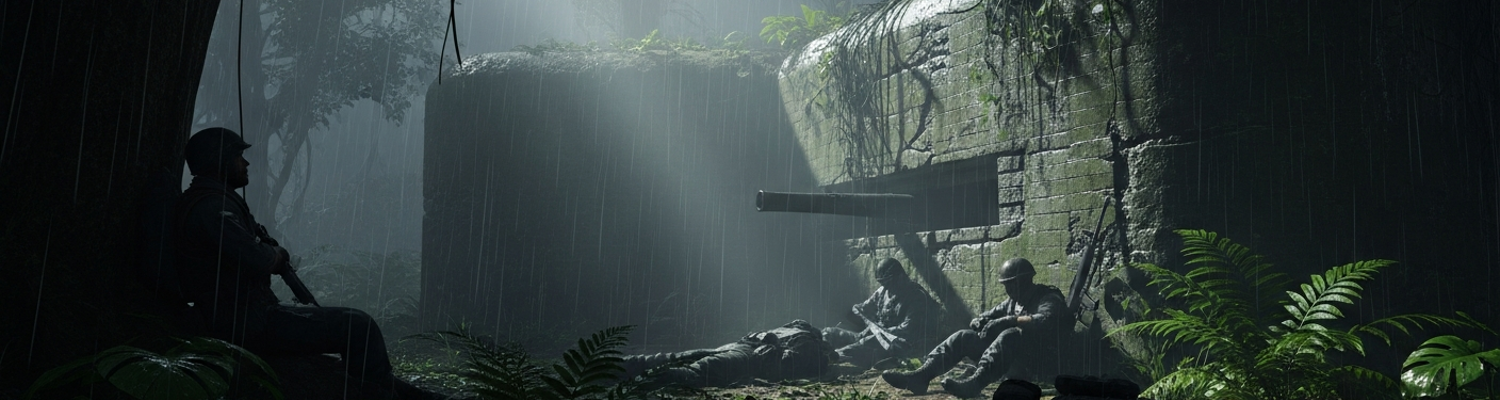
A close review of operational logs (NARA Record Group 407) indicates that the unforgiving geography of New Georgia forced radical alterations to the initial assault plans. Planners first considered a direct amphibious landing at Laiana Beach, only two miles east of the airfield. This was ruled out. Heavy Japanese coastal defenses and prohibitive coral reefs made the approach for landing craft too dangerous. The alternative was Zanana Beach, three miles further east and undefended. This decision, while safer from a naval standpoint, committed American ground forces to an overland advance of more than five miles through some of the most difficult terrain of the war. New Georgia was a patternless tangle of dense jungle, sharp coral ridges, and deep mangrove swamps. Constant, torrential rain turned the few jungle tracks into impassable rivers of mud that bogged down troops, equipment, and bulldozers. Available maps, based on aerial photography, offered no accurate indication of ground contours. Units like the 169th and 172nd Infantry Regiments were left to navigate blindly. The environment heavily favored the defenders. Japanese forces under Major General Minoru Sasaki constructed well-camouflaged, mutually supporting pillboxes from coconut logs and coral, dug several feet into the ground. The overland advance from Zanana Beach, which planners hoped would take days, became a month-long infantry slog measured in yards gained.
The defensive system established by Major General Minoru Sasaki’s forces at Munda Point was a product of deliberate engineering and a deep understanding of the island’s terrain. The core of the system was a sprawling network of subterranean tunnels and reinforced bunkers. These were not simple fighting positions but survivable habitats for a prolonged siege. Archival analysis of their construction reveals a sophisticated use of local materials. Bunkers were robust structures built from layers of coconut palm logs, found to be surprisingly resilient, and further reinforced with coral and earth. In some cases, sand-filled oil drums formed the lower walls. These fortifications were dug several feet into the ground with overhead cover often exceeding several meters of earth and timber. This made them nearly impervious to all but a direct hit from the heaviest artillery shells. These positions served as command posts, medical aid stations, and ammunition caches. They allowed Japanese units like the 229th Infantry Regiment and naval troops from the 8th Combined Special Naval Landing Force to withstand weeks of preliminary bombardment with minimal degradation of their fighting capability.
The lethality of Sasaki’s plan came from its tactical arrangement. Hundreds of individual pillboxes and rifle pits were sited for mutual support, not frontal engagement. A review of operational logs from the U.S. 43rd Infantry Division describes the experience of encountering positions that were invisible until American platoons were practically on top of them. Japanese engineers had mastered camouflage, using the island’s dense jungle foliage to perfectly conceal firing apertures. A single pillbox would be positioned to cover the exposed flanks of its neighbors, creating interlocking fields of fire. An American squad advancing on one visible bunker would suddenly come under devastating machine-gun and rifle fire from two or three other unseen positions to its sides. This doctrine was especially effective because of the weaponry used. The small report and minimal muzzle flash of the 6.5mm Arisaka rifle and Type 92 heavy machine gun made identifying the source of fire almost impossible for the American troops. The jungle itself became a weapon, forcing the American advance to halt and address each position individually.
The impact of these fortifications on the pace and cost of the Allied advance was immediate and severe. The initial American plan for a rapid overland push devolved into a grueling battle of attrition. The advance of the 169th and 172nd Infantry Regiments was often measured in mere yards per day. Standard infantry tactics were ineffective. Frontal assaults against the camouflaged pillboxes were suicidal. Artillery barrages from offshore batteries did little against the deeply buried bunkers. The terrain bogged down supporting arms like tanks, which found the steep, muddy coral ridges impassable in many sectors. This forced a tactical shift for American forces under Major General Oscar W. Griswold, who had taken over field command. The fight for Munda became a soldier’s battle, a grim series of small-unit actions where squads had to systematically identify and reduce each bunker one by one. This required the extensive use of flamethrowers and satchel charges. Soldiers crawled forward under fire to get close enough to destroy the emplacements, a process that dramatically increased casualties.
The brutal mathematics of the Munda campaign are revealed in operational logs. The initial advance by the U.S. 43rd Infantry Division devolved into a horrific meat grinder, fueled by both enemy action and the environment. For the campaign, total American casualties reached 1,195 killed and 3,873 wounded. The fight for Munda Point alone cost 4,994 American soldiers killed or wounded. The lead elements, the 169th and 172nd Infantry Regiments, were fed into a battle where progress was measured in yards against deeply entrenched positions. The terrain was an active antagonist. Constant rain turned jungle tracks into swamps of mud, exhausting troops and making the evacuation of the wounded a nightmare. Temperatures often exceeded 100 degrees with near 100% humidity, causing heatstroke and accelerating the decay of equipment.
The psychological toll of this close-quarters jungle fighting was profound. The New Georgia campaign produced the highest number of neuropsychiatric casualties of any U.S. division in a single operation during the entire war. Between late June and the end of September, over 2,500 American troops were officially diagnosed with war neurosis. Archival reports from the 169th Infantry Regiment describe the terror of night combat, where Japanese soldiers would deliberately work to unnerve the Americans. The confusion led to soldiers knifing each other in the dark and suffering wounds from friendly grenades that bounced off unseen trees. The enemy was often invisible, firing from perfectly concealed log-and-coral pillboxes that could only be neutralized by soldiers crawling forward with flamethrowers or satchel charges. The constant tension, the inability to see the attacker, and the sheer violence of the fighting caused a widespread breakdown. General Oscar Griswold, upon inspecting the front, reported that the 43rd Division seemed on the verge of collapsing.
Of the division’s losses, a stunning 1,500 were classified as psychoneurotic cases.
Beyond combat and psychological casualties, the steady drain from disease and exposure wrecked the division’s combat effectiveness. Diseases like malaria, dengue fever, and debilitating fungal infections known as jungle rot were rampant, pulling thousands of soldiers out of the line without a shot being fired. By the end of the campaign, the infantry regiments of the 37th Division were down to 5,200 men from an authorized strength of 7,000. The 43rd Division fared even worse, with only 4,536 of its 8,000 infantrymen still on hand after Munda was taken. A rifle company operating at 50 percent strength loses its ability to maneuver and sustain an attack. The 43rd Division’s poor showing and its state of exhaustion became so severe that its commander, Major General John H. Hester, was relieved of command on July 29. The division itself had to be pulled from the main effort, replaced by the fresher 37th and 25th Infantry Divisions to finally secure the objective. By the end of the fight for Baanga Island, L Company of the 169th Infantry had been reduced to just 16 men.
Postwar analysis from the New Georgia campaign reveals a battlefield where the lines of permissible conduct became dangerously blurred. The close-quarters fighting fostered an environment ripe for allegations of excessive force. This was driven primarily by the tactical realities imposed by Japanese forces. There were numerous documented instances across the Pacific where Japanese soldiers would feign surrender or injury, waiting for American troops or medics to approach before detonating a concealed grenade or opening fire. This tactic had a profound and corrosive effect on the conduct of American units. It conditioned infantrymen to view any Japanese soldier, regardless of their state, as an active and imminent threat. The result was a deeply ingrained, unofficial no-prisoners policy among many front-line squads. Reports from the 169th Infantry describe clearing an area, only to be attacked later by Japanese soldiers who had been passed over as dead or wounded. This cycle of deception and retaliation created a situation where killing wounded or surrendering enemy combatants was seen by the soldiers not as an atrocity, but as a necessary measure for survival.
The official policy of taking prisoners was almost entirely superseded by battlefield necessity.
The extreme psychological and physical attrition suffered by American units, particularly the 43rd Infantry Division, directly contributed to a breakdown in military discipline that manifested in gruesome ways. The number of neuropsychiatric casualties speaks to a force pushed beyond its breaking point. In this state of exhaustion and heightened rage, the dehumanization of the enemy was nearly complete. This psychological space allowed for the widespread practice of souvenir hunting from Japanese dead. While officially prohibited by a directive as early as September 1942, the collection of body parts, most commonly gold teeth and skulls, became a grim feature of the Pacific War. A journalist in 1943 recorded a conversation between two Marines heading to the Pacific, one of whom stated he planned to make a necklace of Japanese gold teeth. While teeth were sometimes bartered, other trophies like skulls and ears were taken as personal mementos. The practice became so common that in 1944, customs officials in Hawaii were routinely asking returning servicemen if they were carrying bones. This was not the action of a disciplined army but of men brutalized by a savage fight, where the ethical lines between combatant and corpse had been erased by trauma.
There are few records of large-scale, organized surrenders by Japanese units during the Munda campaign. The Japanese military code viewed surrender as the ultimate dishonor, meaning most soldiers were prepared to fight to the death or commit suicide. The very few who were captured were often sailors recovered from sunken vessels or soldiers found isolated and starving. Surveys of Japanese POWs from the wider war show that the vast majority expected to be tortured and killed upon capture, a belief that fueled their resistance. They were often surprised to receive medical care and adequate food from their American captors. At the front lines around Munda, this rarely happened. The prevailing American attitude, forged in the terror of feigned surrenders, meant that opportunities for capture were seldom offered. The ethical dilemma was therefore focused almost exclusively on the treatment of the enemy combatant, an issue that, for the exhausted American infantryman, had a simple, violent solution.
The first indications of a deeper problem on New Georgia arrived in Washington D.C. not as battlefield reports, but as casualty summaries. A close review of the administrative data flowing from the South Pacific in late July 1943 revealed a troubling anomaly within the 43rd Infantry Division. The unprecedented number of neuropsychiatric cases, eventually totaling over 1,500 men, combined with the official relief of Major General John H. Hester for exhaustion on July 29th, set off alarms within the War Department. These were the statistical footprints of a command on the verge of breakdown. In response, the Judge Advocate General’s Office was quietly directed to begin compiling a preliminary file. This was not yet a formal criminal investigation but an initial assessment, a discreet gathering of after-action reports, patrol logs from the 169th and 172nd Infantry Regiments, and the disquieting psychiatric evaluations of evacuated soldiers. The JAG was tasked with determining if the extreme attrition and psychological collapse on New Georgia had been accompanied by a parallel collapse in military law.
The paper trail from New Georgia led to questions of command responsibility.
The scope of the JAG’s inquiry quickly expanded beyond casualty rates to focus on specific, disturbing patterns of conduct. Investigators began a painstaking cross-reference of ammunition expenditure reports against prisoner intake logs for the entire New Georgia campaign. The near-total absence of Japanese prisoners taken by the forward infantry battalions, when set against the known numbers of enemy combatants engaged, pointed toward a potential de facto no-prisoners policy at the squad and platoon level. This was further substantiated by anecdotal evidence within medical debriefs of exhausted soldiers. A second line of inquiry concerned widespread reports of the desecration of Japanese war dead. Directives from September 1942 had explicitly forbidden the taking of body parts as souvenirs, yet the practice had become common. The JAG office began examining evidence that this was not isolated misconduct but a routine practice among certain units. The investigation sought to determine whether this behavior was simply being ignored by junior officers or if it was implicitly sanctioned as a consequence of the fighting conditions. Each allegation represented a serious breach of the Articles of War and the Hague Conventions.
The central conflict for the JAG investigators was the immense gap between the codified laws of war and the visceral experience of the soldiers at Munda. Lawyers in Washington D.C., operating within a system of legal precedents, were tasked with evaluating the actions of men pushed to the absolute limits of human endurance. The documented Japanese tactic of feigning surrender to lure in American medics before detonating grenades created a tactical dilemma with profound legal consequences. For an infantryman in the 169th Infantry, seeing a supposedly wounded enemy soldier kill his comrades transformed the act of shooting a surrendering opponent from a war crime into a measure of self-preservation. The psychological trauma induced by constant, invisible attacks turned the enemy into a monstrous abstraction, making the act of taking a trophy seem less like a desecration and more like a validation of survival. The JAG office was forced to confront a situation where the strict application of military legal standards seemed to completely disregard the environment in which the soldiers were forced to operate.
The reports of extreme attrition and potential misconduct filtering out of the New Georgia campaign arrived at the Department of State as a slow, disquieting seepage of information. While the War Department’s Judge Advocate General focused on violations of the Articles of War, the State Department, under Secretary Cordell Hull, viewed the situation through an entirely different lens: international law. Archival analysis shows that by 1943, Hull and his planners were already deeply engaged in designing a post-war international system built on legal principles. The reports from Munda Point, specifically the near-total lack of prisoners and allegations of corpse desecration, represented a direct threat to this vision. These were potential violations of the 1929 Geneva Convention Relative to the Treatment of Prisoners of War and the customary laws of war outlined in the 1907 Hague Conventions. The State Department’s legal advisers understood that the moral authority of the United States to demand adherence to these standards from the Axis powers was contingent on its own forces upholding them. The issue became a matter for quiet, high-level diplomatic consideration.
The United States was prosecuting the war on a narrative of fighting for civilization against barbarism. State Department officials were acutely aware that any official confirmation of American atrocities would provide an enormous propaganda victory for Tokyo and Berlin. It risked alienating allies and neutral nations whose support was predicated on the belief in America’s commitment to humanitarian principles. A review of diplomatic concerns from the period shows a consistent preoccupation with maintaining the moral high ground. The allegations from Munda Point threatened to collapse the distinction between Allied and Axis conduct in the eyes of the world. The department’s response was not to initiate a public inquiry, which would have been diplomatically catastrophic. Instead, it engaged in discreet, firm communication with the War Department, stressing the profound implications for the nation’s international standing and its long-term strategic war aims.
The problem extended far beyond wartime propaganda. It struck at the heart of early Allied planning for post-war justice. Throughout 1943, officials in the State Department were working with their British and Soviet counterparts to lay the groundwork for what would become the international military tribunals at Nuremberg and Tokyo. A core principle being developed was that individuals, not just states, could be held accountable for violations of international law. The creation of new concepts like crimes against humanity was underway, intended to prosecute the leaders of Nazi Germany and Imperial Japan. The allegations from the Pacific campaign created a dangerous legal and moral complication. If American forces were not taking prisoners and were desecrating the dead, it could seriously weaken the United States' legal standing to prosecute Japanese officers for identical crimes. This created a paradox for the planners. To build a new world order based on enforceable international law, America had to ensure its own conduct was, at least officially, beyond reproach. The actions of an exhausted infantry squad in the Munda jungle had the potential to send shockwaves through the highest echelons of international legal planning.
Interdepartmental memoranda from late 1943 reveal a government at war not only with the Axis powers, but with itself. The War Department, under Secretary Henry Stimson, and the Department of State, led by Secretary Cordell Hull, were set on a collision course by the reports from New Georgia. For the War Department, the issue was one of military expediency and internal discipline. The Judge Advocate General's investigation was a mechanism designed to identify and punish violations of the Articles of War, contain the damage, and preserve the fighting effectiveness of its divisions. The core objective was to resolve the matter with minimal disruption to the Pacific offensive. State Department officials, however, viewed the allegations of a no-prisoners policy and corpse desecration not as a disciplinary problem, but as a full-blown foreign policy catastrophe. Their focus was on the 1929 Geneva Convention and the customary laws of war, seeing the conduct at Munda as a direct threat to the moral and legal authority the United States sought to project.
This divergence in perspective generated heavy political pressure on the War Department, forcing it to navigate between two contradictory demands. On one side were field commanders in the Pacific, who viewed any inquiry into battlefield conduct as a dangerous distraction and an affront to soldiers fighting under unimaginable conditions. On the other was Secretary Hull’s State Department, which relentlessly stressed the long-term diplomatic consequences. A key point of friction was the handling of the Munda inquiries themselves. The War Department sought to keep the investigations internal and limited in scope, framing the issue as one of isolated misconduct by troops pushed to their breaking point. The State Department, already laying the groundwork for post-war tribunals, argued that such an approach was untenable. Any perception that the United States was covering up the very behaviors for which it planned to prosecute Japanese leaders would shatter the legitimacy of the entire war crimes trial project. This left Stimson’s department in an impossible position, caught between the tactical demands of winning the war and the strategic necessity of upholding the principles for which the war was supposedly being fought.
The War Department’s primary function was to apply overwhelming force to achieve military victory. From this perspective, the environment of the Munda campaign, where Japanese forces used feigned surrenders to kill American troops, made a no-prisoners approach seem less like a war crime and more like a necessary tactical adaptation for survival. Military expediency dictated that the war must be won first, with legal and ethical questions sorted out later. The State Department’s institutional priority was the construction of a stable, rules-based international order after the war. This long-term vision required the United States to be seen as the chief architect and defender of international law. The actions of a single infantry platoon within the 169th Infantry, if officially ignored, could create a precedent that would legally and morally hamstring American efforts to prosecute Axis war criminals and build a new system of global justice. The conduct on New Georgia forced a direct confrontation between the War Department’s focus on immediate battlefield outcomes and the State Department’s investment in the abstract architecture of the post-war world.
The Munda Point investigation files reveal an institutional crisis that permanently altered the architecture of American military justice. The Judge Advocate General’s inquiry into the 43rd Infantry Division’s conduct forced the U.S. Army to confront the chasm between the codified laws of war and the actions of soldiers under extreme duress. The evidence pointing to a battlefield-level no-prisoners policy and the desecration of enemy dead could not be dismissed as isolated incidents. They were symptoms of a systemic breakdown in discipline under the pressure of the New Georgia campaign. This forced a top-down re-evaluation of how the laws of land warfare were taught and enforced. Directives issued in the wake of the Munda inquiries placed a new, heavy emphasis on the legal responsibilities of junior officers and non-commissioned officers to prevent such breaches, regardless of enemy provocations.
This internal reckoning created a new generation of legal precedent within the military itself. It shaped the development of formal Rules of Engagement (ROE) that attempted to provide clearer guidance for soldiers in chaotic combat environments. The Munda case became a powerful example of why abstract legal principles were insufficient. The inquiries demonstrated that without explicit, command-driven enforcement and training that addressed the psychological realities of combat, official adherence to the Geneva Conventions was fragile. The result was a slow but definite shift toward making the law of war a tangible part of leadership training, moving it from legal textbooks into the practical realm of small-unit command.
The investigations on New Georgia sent a shockwave that reached the highest levels of Allied post-war planning. As the State Department was collaborating with its counterparts to construct the legal framework for the International Military Tribunals in Nuremberg and Tokyo, the reports of American misconduct presented a severe complication. The entire moral and legal authority of the forthcoming trials rested on the principle that the Allies were holding the Axis powers to a universal standard of justice. Allegations that American troops were engaging in some of the same behaviors for which Japanese commanders were to be prosecuted threatened to provide defendants with a potent victor’s justice defense. Archival records of inter-agency communications show that State Department officials expressed deep concern that the conduct on Munda could undermine the legitimacy of the entire war crimes prosecution project.
This forced a difficult, behind-the-scenes confrontation.
The American position as a chief architect of a new, rules-based world order was suddenly at risk. The response was not a public admission, but a quiet, intense pressure campaign on the War Department to ensure that official policy regarding the treatment of prisoners was rigorously enforced throughout the command chain in the Pacific. This was not merely about propaganda; it was about preserving the legal high ground necessary to prosecute Japanese leaders for atrocities like the Bataan Death March. The Munda inquiries, therefore, had a direct, albeit hidden, influence. They reinforced the imperative that for the post-war legal project to succeed, American conduct had to be officially unimpeachable, creating a clear line between Allied actions and the systematic crimes of the enemy.
The Munda campaign’s most enduring legacy is its role as a critical, and harrowing, case study in military ethics and command responsibility. The circumstances of the battle have become a foundational lesson in American military education. The campaign is dissected at institutions like the Army War College not as a simple tactical victory, but as a complex problem of leadership in the most demanding of environments. It serves as a stark illustration of how quickly the pressures of combat can erode the legal and moral discipline of a fighting force. The inquiry’s findings provide a textbook example of the friction between military necessity and the laws of war, forcing future officers to confront the same dilemmas faced by commanders on New Georgia. Future leaders are made to analyze the specific command decisions and failures that allowed the situation in the 169th and 172nd Infantry Regiments to deteriorate. They study the cascading effects of psychological trauma on unit cohesion and the absolute necessity for leaders to maintain standards even when faced with a savage and unscrupulous enemy. The Munda inquiries became a permanent fixture in the curriculum of governmental and military oversight, a reminder that the greatest threat to an army’s legitimacy can sometimes come not from the enemy, but from within.