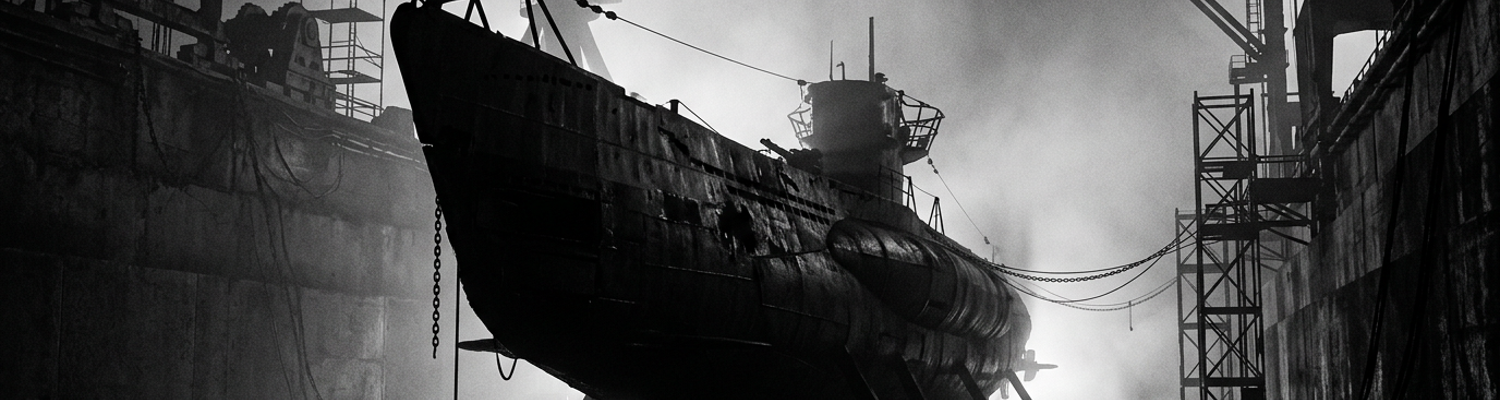

Type IXC U-Boat Design and Technical Vulnerabilities
Attempting to board and secretly tow a scuttled 1,120-ton enemy warship across 1,700 miles of open ocean defied basic naval engineering.
The target was a Type IXC long-range U-boat designated U-505.
When examining the historical record, the vessel emerges as a deeply flawed mechanical system. Deutsche Werke constructed the hull in Hamburg. The Kriegsmarine commissioned it in August 1941. The submarine was built to project naval power far beyond the coastal waters of Europe.
Task force commanders understood the physics of the problem.
Keeping a flooded steel cylinder afloat required pumps capable of moving thousands of gallons of seawater per minute. It required heavy steel towing cables. It demanded absolute radio silence.
The Type IXC blueprint demanded heavy industrial compromises.
Archival evidence shows the boat relied on a heavy propulsion block. This block consisted of twin MAN M9V40/46 supercharged nine-cylinder diesel engines. These powerplants generated 4,400 shaft horsepower on the surface. They drove two three-bladed propellers to achieve speeds of 18.3 knots.
Engineers enclosed these engines within a complex double-hull construction.
The outer hydrodynamic casing allowed for efficient surface cruising. It housed the main ballast tanks, fuel bunkers, and external equipment lockers. The thick inner cylindrical pressure hull protected the crew and internal machinery from oceanic compression down to test depths of 230 meters. Between these two layers, fuel oil was stored in unpressurized tanks feeding the main diesels.
The forward and aft sections contained specialized torpedo systems designed for sustained commerce raiding in distant theaters like the Caribbean and the Gulf of Guinea.
Four 53.3cm bow tubes and two stern tubes formed the primary offensive armament. A magazine held twenty-two G7a steam-powered and G7e electric torpedoes. Later modifications included the integration of the T5 Zaunkoenig acoustic homing torpedoes.
These weapons required specialized pre-heating equipment.
They utilized delicate acoustic sensors wired directly into the forward torpedo room. Reloading these weapons required a complex system of overhead rails, heavy chains, and hand-cranked winches located directly above the enlisted sleeping quarters.
This densely packed machinery proved highly susceptible to human interference.
A close review of operational logs indicates U-505 suffered from chronic mechanical degradation almost immediately after deployment. Stationed at the heavily fortified Keroman Submarine Base in Lorient, France, the vessel fell victim to systematic sabotage. Conscripted French dockworkers orchestrated these attacks.
Maintenance records from early 1942 (NARA Record Group 338) detail repeated instances of foreign particulate matter intentionally introduced into the diesel fuel lines.
Workers drilled microscopic holes into the copper piping of the main bilge pumps and the secondary trimming pumps. These alterations caused severe mechanical failures during deep dives. The crew had to surface prematurely to vent exhaust gases. They manually repaired ruptured seals in the dark.
Command decisions made by Kapitaenleutnant Axel-Olaf Loewe prioritized continuous patrols over extensive drydock overhauls.
This led to compounding structural fatigue across the primary drive shafts. The port engine frequently overheated due to blocked water intake valves. The outer hull integrity was compromised long before the boat faced direct aerial bombardment.
Under the subsequent command of Oberleutnant zur See Peter Zschech, the damaged submarine encountered No. 53 Squadron RAF off the coast of Trinidad.
At exactly 11 degrees 20 minutes North, 61 degrees 36 minutes West on November 10, 1942, a Lockheed Hudson maritime patrol aircraft dropped a payload of 250-pound anti-submarine bombs directly onto the surfaced vessel.
One munition detonated squarely on the 105mm deck gun.
The explosion tore through the outer casing. Shrapnel pierced the pressure hull and breached the control room. The watch officer died instantly. Water flooded the central command space at a rate exceeding the capacity of the sabotaged bilge pumps.
Zschech ordered an emergency blow of all remaining compressed air into the ballast tanks.
This prevented an uncontrolled descent into the South American basin. The crew patched the breached pressure hull with spare steel plating and raw canvas. Repeated depth charge attacks during subsequent patrols in 1943 caused the aft torpedo tube doors to warp. They became incapable of achieving a watertight seal.
The continuous mechanical failures culminated on October 24, 1943.
Zschech suffered a psychological collapse. He shot himself in the control room during a severe depth charge barrage. First Watch Officer Paul Meyer assumed command. He ordered the ballast tanks blown.
The submarine limped back to the Lorient pens on a single functioning diesel engine.
Depth Charge Engagement and Hydraulic Rudder Failure
Extracting a live submarine from a combat zone under fire required physical extraction parameters that defied basic naval engineering.
Archival evidence shows the hunter-killer unit designated Task Group 22.3 operated under the direct command of Captain Daniel V. Gallery. The formation consisted of the escort carrier USS Guadalcanal supported by five specific destroyer escorts. These were USS Pillsbury, USS Pope, USS Flaherty, USS Chatelain, and USS Jenks.
Gallery spent months training his crews specifically for the highly improbable scenario of boarding a live U-boat.
Intercepted signals intelligence routed through the Tenth Fleet plotting rooms in Washington allowed Gallery to track specific enemy transmissions down the western coast of the African continent. Allied codebreakers exploiting compromised Enigma cipher machines provided daily positional updates.
On June 4, 1944, the American ships established a tight search grid off the coast of French West Africa near Cape Blanco.
Coordinates logged at 21 degrees 30 minutes North, 19 degrees 20 minutes West placed the task group directly over the designated patrol sector of U-505. The German vessel was operating on severely depleted battery reserves under the command of Oberleutnant zur See Harald Lange.
Gallery ordered his destroyer escorts into a line-abreast sweep formation.
This tactical arrangement maximized active sonar coverage across the varying thermal layers of the target zone. The submarine electric motors generated minimal acoustic signatures while submerged at sixty feet.
A close review of operational logs indicates the destroyer escort USS Chatelain registered a sharp sonar anomaly at 1109 hours.
The contact was immediately classified as a confirmed submarine target moving slowly on a northerly heading. The hunter-killer doctrine demanded immediate ordnance delivery upon any verified subsurface contact.
Chatelain initiated an aggressive attack run.
The ship fired a full pattern of twenty-four forward-thrown Hedgehog projectiles. These contact-fused explosives sank rapidly but failed to strike the outer casing of the Type IXC boat. Reversing course immediately, the American warship deployed a string of Mark 9 high-explosive depth charges. Crews set these for shallow detonation directly over the estimated target position.
Two F4F Wildcat fighter aircraft launched from Guadalcanal spotted the submerged silhouette of the submarine.
The pilots fired their .50 caliber machine guns into the water to mark the exact location for the destroyers. Shockwaves from the resulting underwater detonations slammed into the starboard aft quarter of U-505. The kinetic force violently displaced the internal machinery.
Concussive pressure buckled the outer hydrodynamic casing.
It fractured several primary high-pressure air lines running along the inner pressure hull. Saltwater immediately breached the aft torpedo room through compromised flange seals. Total destruction of the primary hydraulic steering matrix located in the aft compartment occurred instantly.
Nearby explosive force sheared the main steering arm pins.
Both the port and starboard rudder assemblies locked firmly into a hard right position. Lange lost all physical control over the vessel hydrodynamic trajectory. Trapped in an involuntary circular turn, the submarine rapidly took on water in the aft compartments.
Heavy stern weight caused the aft section to drop sharply.
Pitching downward, the boat accelerated toward the 230-meter test depth limit. Engineering personnel in the aft diesel compartment reported severe flooding. Electrical fires sparked across the main switchboards as saltwater contacted the heavy battery cables.
Primary lighting circuits failed.
The command center plunged into total darkness. Lange recognized the structural failure of the pressure hull and the locked steering gear meant a fatal descent was mathematically unavoidable. He ordered the engineering officer to execute an emergency blow.
He directed all remaining compressed air into the main ballast tanks.
Rapidly expanding air forced thousands of gallons of seawater out of the external buoyancy chambers. The damaged submarine violently angled upward. U-505 broke the surface of the Atlantic Ocean at 1121 hours.
Sudden exposure of its conning tower and deck armament left the vessel entirely vulnerable to the waiting 3-inch guns of Task Group 22.3.
Boarding Action and Scuttling Charge Neutralization
Inserting a squad of lightly armed sailors into a sinking, unlit, explosive-rigged enemy pressure hull in the middle of the Atlantic Ocean represented an operational directive entirely divorced from physical feasibility.
Archival evidence shows the Type IXC submarine circled erratically at roughly seven knots off the coast of French West Africa.
Captain Daniel V. Gallery ordered the destroyer escort USS Pillsbury to deploy its dedicated boarding team. Launching a standard 26-foot motor whaleboat into the turbulent wake of the turning submarine required exact timing. The wooden boat relied on a single four-cylinder diesel engine.
The coxswain had to match the turning radius of the locked U-boat rudder to avoid being crushed against the steel outer casing.
Lieutenant junior grade Albert L. David commanded this nine-man detachment. The boarding party included Torpedoman Mate Third Class Arthur W. Knispel, Radioman Second Class Stanley E. Wdowiak, and Motor Machinist Mate First Class Zenon Lukosius. Five other specialized enlisted ratings joined them.
They carried M1A1 Thompson submachine guns, heavy brass flashlights, and basic mechanical hand tools.
The whaleboat pulled alongside the starboard beam of the moving submarine. David grabbed the port side grab-rail of the conning tower. He pulled himself up the slick, curved hydrodynamic fairing.
Dead German sailors lay across the wooden deck slats of the wintergarten anti-aircraft platform.
The internal layout of the Type IXC presented a dark, hazardous corridor of exposed wiring and rapidly rising seawater. A close review of operational logs indicates the German crew had initiated standard scuttling protocols before abandoning ship.
Fleeing engineering personnel left the twin MAN diesel engines running in a locked right turn.
They armed a distributed network of demolition charges. Fourteen individual explosive packages sat wired to the main structural frames along the inner pressure hull. Each charge contained a two-kilogram block of high-grade TNT. These connected to mechanical time-delay fuses and the 110-volt central battery banks.
David and his men dropped down the main vertical hatch into the central control room.
Plunging into waist-deep water, the team immediately split up to locate the acoustic triggers and burning fuses. Knispel and Wdowiak moved forward into the torpedo room. They ripped the primary detonation wires from the main explosive blocks.
They physically severed the electrical conduits connecting the charges to the detonators using standard steel wire cutters.
Finding the remaining charges hidden behind the heavy steel piping of the compressed air manifolds required searching blindly in the dark. The men moved compartment by compartment. They pulled the blasting caps out of the TNT blocks. They tossed the live components onto the dry upper bunks of the enlisted quarters.
Disconnecting these circuits stopped the immediate threat of catastrophic hull fragmentation.
Halting the inflow of the Atlantic Ocean required finding the exact point of mechanical failure within the complex plumbing matrix of the lower bilges. Standard U-boat scuttling procedure dictated opening the main sea water intake valves.
This flooded the heavy diesel engine cooling jackets and the central bilges simultaneously.
Lukosius waded into the aft engine compartment. He searched underwater for the primary intake manifolds. The water level had already submerged the heavy lead-acid battery cables. This generated severe electrical arcing.
Toxic chlorine gas filled the enclosed space.
Lukosius felt a high-pressure column of water surging upward from the floorboards. He located an eight-inch cast-iron strainer cover completely unscrewed from its flanged seating. The heavy metal lid had fallen into the oily water of the main bilge sump.
Water poured through the open eight-inch aperture at a rate of hundreds of gallons per minute.
Searching the submerged deck plates with his bare hands, Lukosius retrieved the iron cover. He forced it back over the intake pipe against the extreme water pressure. He aligned the heavy threading and manually screwed the cap down tight.
This physical action stopped the primary flooding vector.
Other members of the nine-man team moved through the forward and aft compartments. They closed secondary ventilation shafts. They secured individual cooling water lines that the fleeing German engineers had slashed with hand tools.
The combined effort of neutralizing the demolition network and sealing the intake pipe stabilized the buoyancy of the dead-weight steel cylinder.
Water levels inside the control room stopped rising exactly two inches below the main electrical switchboards.
Seizure of Intact Enigma Cipher Equipment
Archival evidence shows the flooding in the lower bilges temporarily stabilized.
Radioman Second Class Stanley E. Wdowiak and Lieutenant Junior Grade Albert L. David forced their way into the primary communications center. This claustrophobic compartment sat directly adjacent to the central control room on the starboard side of the pressure hull. It was designated the Funkraum.
Fleeing German telegraphers had failed to properly execute the strict Kriegsmarine destruction protocols for their cryptographic hardware.
Sitting completely intact on a small folding wooden desk was an M4 Enigma cipher machine. This four-rotor electromechanical device formed the absolute core of Admiral Karl Doenitz secure communications network.
Unlike the standard three-rotor variants used by the Wehrmacht, the naval M4 utilized a thinner fourth rotor and a specialized reflector.
This generated exponentially more complex cipher variations. Wdowiak recognized the heavy oak box immediately. He ripped it loose. Severing the heavy rubber power cables disconnected the unit from the submarine 110-volt direct current grid.
A close review of operational logs indicates the American sailors then tore open the locked metal storage lockers bolted to the forward bulkhead.
They used heavy steel pry bars. Inside, they located the current operational codebooks. These bound documents included the Kurzsignale. This specialized manual detailed the short signal keys used to broadcast compressed tactical contact reports.
They also found the Kenngruppenheft, the daily indicator group book.
They extracted the highly classified Marinequadratkarte. These naval grid coordinate maps pinpointed Allied convoy routes without transmitting exact latitude and longitude. Wdowiak shoved the four-rotor machine and the water-sensitive documents into heavy lead-lined canvas bags.
The Germans originally designed these bags to be thrown overboard during a catastrophic hull breach.
The recovered fifty-pound haul included every active code setting required to immediately decrypt German naval transmissions. Recording this specific intelligence seizure required specialized personnel operating under extreme physical duress.
Chief Photographer Mate Clifford V. Werlla followed the initial boarding party directly down the main conning tower hatch.
He carried fragile optical equipment. Task Group 22.3 commanders had specifically ordered Werlla to document the interior condition of a live enemy combatant vessel in real time. Operating a heavy hand-held 4x5 Speed Graphic camera inside the sinking Type IXC submarine presented severe mechanical challenges.
Each exposure required manual film plate swapping and focal plane shutter adjustments.
The internal atmosphere rapidly filled with toxic chlorine gas. This generated from saltwater reacting with the exposed lead-acid battery banks in the lower decks. Primary electrical lighting had failed completely. The narrow passageways went completely dark.
Werlla relied entirely on highly volatile magnesium flashbulbs to illuminate the flooded compartments.
He systematically photographed the exact state of the Funkraum. He captured high-resolution images of the abandoned Telefunken radio transmitters, the severed Enigma cables, and the open cryptographic safes. Moving aft, he documented the shattered pressure gauges and the manual securing of the main engine intake valves by the engineering team.
These silver-gelatin negatives provided undeniable visual proof that the hardware had been secured before the German crew could deploy their incendiary thermite grenades.
Extracting the heavy canvas bags up the vertical steel ladder of the conning tower required a coordinated physical relay. David positioned himself on the slippery metal grating of the control room deck. He lifted the heavy lead-weighted sacks upward over his head.
Knispel balanced precariously on the upper rungs of the access trunk.
He grabbed the wet canvas handles and hauled the intelligence materials out onto the open bridge. The rolling ocean swell constantly threatened to throw the men against the jagged steel edges of the wintergarten anti-aircraft platform. One slip meant death.
Working under the constant threat of a secondary scuttling charge detonation or a sudden shift in the vessel buoyancy, the boarding party transferred the Enigma machine, the daily codebooks, and the specialized grid maps directly into the waiting wooden motor whaleboat.
This unarmored rescue craft bobbed violently against the outer hydrodynamic casing of the circling U-boat.
The submarine was still settling dangerously low in the water. Atlantic swells washed over the main deck gun. Werlla stood on the slick wooden deck slats. He fired his final flashbulbs to capture the exact moment the sealed canvas bags were lowered over the starboard side by heavy manila ropes.
Tenth Fleet intelligence officers in Washington received the intact rotors and grid maps exactly sixteen days later.
Secret Towing Operation under Codename USS Nemo
Attempting to drag a partially flooded 1,120-ton steel cylinder across thousands of miles of hostile ocean presented a severe engineering problem.
The damaged vessel lacked all independent propulsion.
Archival evidence shows Task Group 22.3 initiated an emergency extraction protocol. They needed to move the degrading submarine over 2,500 miles to the isolated naval base at Port Royal Bay, Bermuda. Captain Daniel V. Gallery ordered the escort carrier USS Guadalcanal to reverse its engines.
The ship maneuvered its stern directly toward the bobbing bow of the captured boat.
Deck crews on the carrier passed a heavy 2.25-inch steel towing hawser down to the boarding party still trapped on the slippery wintergarten platform. Securing this massive cable required manual labor under extreme physical duress.
Sailors locked the heavy iron shackle onto the submarine primary forward mooring cleats while waves crashed over their boots.
The Guadalcanal slowly accelerated to a speed of exactly 8.4 knots to establish tension. Moving any faster threatened to snap the steel line under the dead-weight drag of the partially flooded hull. The submarine forward dive planes stayed jammed at a hard downward angle from the initial depth charge barrage.
This mechanical defect forced the hull to plow heavily into the oncoming Atlantic swells.
It exponentially increased the hydrodynamic resistance against the carrier primary propulsion systems. Flight operations on the Guadalcanal ceased entirely. The ship devoted all boiler pressure to maintaining the tow. Constant friction began fraying the primary tow line within hours.
A close review of operational logs indicates the fleet tug USS Abnaki rendezvoused with the task group on June 9, 1944.
It arrived to relieve the strained carrier. Transferring the heavy towing cable in open water required absolute radio silence across all participating vessels. Any broadcast would alert passing Focke-Wulf Fw 200 Condor maritime patrol aircraft to the exact coordinates of the salvage effort.
The task group altered its standard convoy route.
They steered entirely clear of established shipping lanes to avoid triggering acoustic sensors deployed by German wolfpacks operating off the Azores. Below decks on the submarine, the captured MAN diesel engines sat completely submerged.
They rested in a highly volatile mixture of heavy fuel oil and corrosive saltwater.
American engineering teams worked in total darkness using hazardous battery-powered lanterns. They relied entirely on hand-cranked portable pumps brought over from the destroyers. These pumps expelled the continuous influx of seawater breaching the fractured stern seals.
Operating continuously for seventeen days across the 2,500-mile transit, these rotating damage control units manually maintained the precarious buoyancy of the compromised pressure hull.
The flotilla arrived in Bermuda on June 19.
Hiding the physical existence of a 252-foot enemy warship required an immediate high-level bureaucratic erasure. Fleet Admiral Ernest J. King and the Tenth Fleet intelligence division understood the stakes. The German high command must officially record the submarine as destroyed with all hands lost.
Acknowledging the capture would instantly alert Kriegsmarine cryptologists.
They would realize the M4 Enigma cipher machine and the highly classified Marinequadratkarte grid maps had fallen into Allied possession. Admiral Karl Doenitz staff would immediately invalidate the current codebooks for the Triton communication network.
They would distribute entirely new rotor wiring configurations across the Atlantic U-boat fleet.
This would instantly blind Allied codebreakers at Bletchley Park and Washington. To permanently conceal this catastrophic breach of German naval communications, the Navy Department issued a classified directive. They re-designated the physical asset on all official shipping registries.
The captured vessel officially became the USS Nemo.
Base personnel at the Bermuda Naval Operating Base immediately painted over the standard Kriegsmarine gray camouflage pattern with standard American naval colors. Workers welded heavy steel plates directly over the original U-505 numerical designations stamped into the conning tower fairing.
The Navy confined the captured German crewmen to a specialized heavily guarded internment camp in Ruston, Louisiana.
This isolated them from standard prisoner-of-war populations. Guards intercepted and destroyed all outgoing Red Cross mail. This prevented any prisoner from notifying their families in Germany of their survival. The submarine itself was moved to a restricted drydock facility.
High canvas screens and armed Marine detachments surrounded the area.
Guards had orders to shoot trespassers. Naval engineers stripped the internal wiring of the Funkraum. They analyzed the exact electrical integration of the Enigma hardware without interference. Technical specialists dismantled the broken acoustic torpedo firing mechanisms. They shipped the components to the Naval Ordnance Laboratory in Maryland inside unmarked wooden crates.
Technical Evaluation of Acoustic Torpedoes and Hull Design
Archival evidence shows that on June 25, 1944, technical specialists from the Bureau of Ships Submarine Desk arrived at the restricted Port Royal Bay drydock in Bermuda.
They brought specialized acoustic equipment to dissect the physical architecture of the captured Type IXC. US Naval Intelligence performed comprehensive technical evaluations on the submarine hull construction and propulsion systems. They needed to understand exactly how the vessel withstood explosive compression.
Naval engineers stripped the wooden decking from the external casing to examine the saddle tanks.
They found the external buoyancy chambers riddled with shrapnel holes from the initial depth charge barrage. The structural ribs supporting the outer fairing showed signs of severe buckling. Engineers deployed ultrasonic thickness gauges across the 22-millimeter steel plating of the inner pressure hull.
The readings exposed severe structural fatigue concentrated around the main engine mounts.
The heavy twin MAN M9V40/46 supercharged diesel engines had warped their primary drive shafts. Measurements indicated a deflection of exactly 0.4 inches along the port side shaft. This deformation resulted directly from the continuous stress of emergency dives and the sabotaged water intake valves.
Technicians crawled into the unlit aft engine compartment to dismantle the heavy bilge pumps.
They documented extensive galvanic corrosion where copper piping met cast-iron flanges within the saltwater plumbing matrix. Command decisions from Tenth Fleet intelligence officers dictated that every compromised seal and fractured high-pressure airline be categorized.
Structural engineers mapped and mathematically modeled these failures.
This physical data directly influenced the welding protocols used on subsequent American Balao-class submarine production lines. Extracting the offensive payload required disarming unexploded ordnance inside a flooded steel tube.
A close review of operational logs indicates explosive ordnance disposal personnel from the Naval Ordnance Laboratory entered the forward torpedo room on July 2.
They extracted two live T-5 Zaunkoenig acoustic torpedoes directly from the 53.3cm bow tubes. Engineers disassembled these captured weapons to analyze the highly classified German acoustic homing guidance mechanisms. Moving the heavy bronze torpedo casings onto the drydock floor required heavy chain hoists.
The brass casings weighed exactly 3,500 pounds.
Work crews used hand-cranked winches to lower the hardware. Technicians stripped away the outer hydrodynamic shells. Disassembling the warhead required removing 600 pounds of hexanite explosive. Ordnance teams used non-sparking brass wrenches to unbolt the primary detonator fuses.
The internal cavity held delicate sensor arrays.
They located twin magnetostriction hydrophones mounted directly behind the domed nose cone. These acoustic receivers were wired into a fragile bank of vacuum tube amplifiers. German designers built these amplifiers to isolate the specific 24.5 kilohertz frequency generated by Allied destroyer propellers.
The wiring diagrams documented during this teardown revealed a highly complex pneumatic steering matrix.
High-pressure air servos physically moved the torpedo rudders based on the voltage differential between the port and starboard hydrophones. American engineers discovered that the pre-heating equipment required to maintain the internal battery temperatures of the G7es torpedoes severely drained the submarine central electrical grid during prolonged combat patrols.
The guidance system was completely blind to targets moving slower than nine knots.
Evaluating the interaction between the weapon systems and the outer hull construction exposed deep design flaws within the Type IXC blueprint. Naval Intelligence officers noted that the specialized acoustic sensors required for the T-5 integration forced German shipwrights to alter the forward ballast tank configurations.
Rerouting the heavy electrical cables from the bow tubes back to the central control room compromised the watertight integrity of the forward bulkheads.
Water pressure at test depths of 230 meters caused these modified cable glands to leak continuously. The Bureau of Ships compiled a 400-page technical assessment (Bureau of Ships Report 45-A) detailing exactly how the added weight of the acoustic torpedo pre-heating gear altered the vessel center of gravity.
This specific weight distribution failure explained the boat persistent tendency to pitch downward during rapid deceleration.
Technicians shipped the extracted hydrophones and vacuum tubes to a restricted testing facility in Maryland inside unmarked wooden crates. Specialized acoustic engineers reverse-engineered the amplification circuits to identify the exact frequency thresholds of the German homing mechanisms.
They fed this raw technical data directly to the Allied anti-submarine warfare commands.
The data calibrated the Foxer acoustic decoy systems deployed behind North Atlantic convoy escorts. The captured hardware provided exact voltage tolerances for the steering servos.