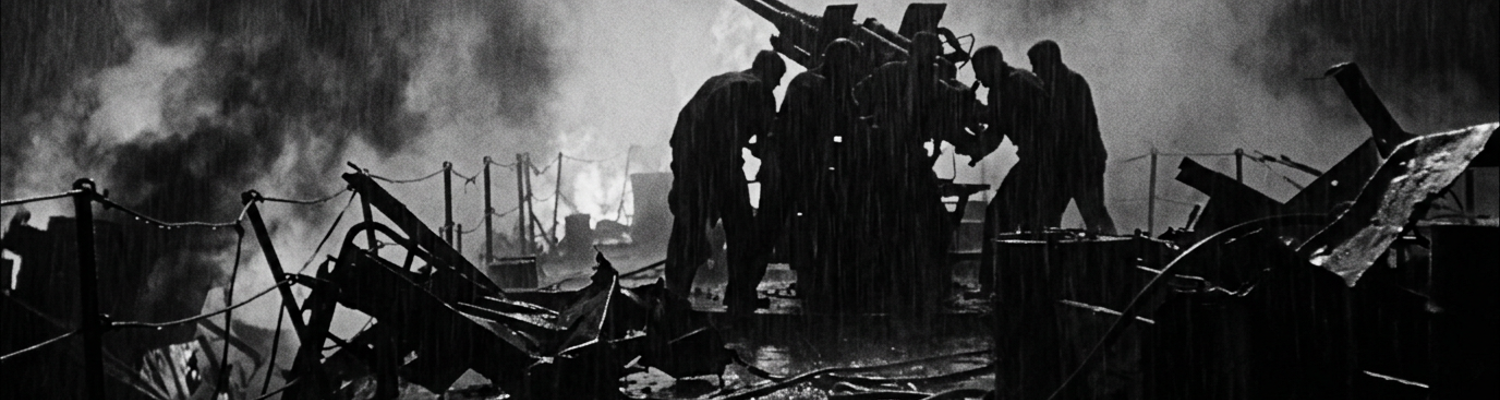

Task Group 78.3 Littoral Insertion
Inside the cramped Mark 37 gun director atop the destroyer USS Mahan (DD-364), an enlisted fire controlman wiped a thin layer of corrosive salt spray from the primary optical stereoscopic rangefinder. The brass adjustment knobs were slick with humidity. They vibrated violently from the 50,000-shaft-horsepower output of the geared steam turbines below. It was the early morning darkness of December 7, 1944. The air smelled heavily of unburned fuel oil and ozone from the primitive radar sets. This sailor was mechanically logging azimuth readings. He locked into a mundane routine of calibrating the 5-inch/38 caliber main battery. He could not see the water. He saw only the glowing green phosphorescence of the dials and the crosshairs of his optics.
He was staring directly into a prepared kill zone.
Archival evidence shows that Task Group 78.3 had just committed to a highly dangerous amphibious insertion on the western coast of Leyte. Rear Admiral Arthur D. Struble commanded the operation. The invasion force consisted of heavily laden transports screened by a vanguard of veteran destroyers. These included USS Mahan, USS Ward (APD-16), and USS Fletcher (DD-445). To reach the landing zones, the flotilla was forced to transit the restrictive littoral waters of the Canigao Channel. They then broke into the Camotes Sea and entered Ormoc Bay. This geography eliminated the American warships primary defensive advantage. Open-ocean maneuverability was impossible. The bay formed a narrow geographic pocket surrounded by elevated terrain. Japanese forward observation posts held direct visual lines of sight on the incoming vessels. These posts were deeply entrenched along the jungle ridges near Deposito and Albuera. Steering through these waters meant operating under constant direct observation. Enemy spotters tracked the phosphorescent wakes and the tall radar masts of the destroyers as they approached the shoreline. The enlisted helmsmen and quartermasters on the bridges of the American screening force struggled against tight turning radiuses. They navigated shallow shoals and restricted acoustic sonar returns in the confined harbor.
There was no room to evade.
A close review of operational logs indicates that the Japanese defenders immediately launched rapid counterattacks against the arriving American warships. Concealed shore artillery opened a continuous barrage at 0634. This consisted of Type 88 75mm anti-aircraft guns depressed for surface fire and 3-inch coastal batteries positioned behind the town of Ipil. The shore batteries bracketed the American destroyers with high-explosive fragmentation shells. Columns of displaced seawater crashed onto the steel decks. Shrapnel tore through unarmored radar antennas and communication wire. The threat of Japanese surface combatants compounded the tactical emergency. Elements of the Imperial Japanese Navy TA transport operations maneuvered aggressively into firing positions. These were escorted by fast destroyers like Ume and Sugi. These enemy surface vessels executed high-speed counter-thrusts through the northern sectors of the bay. They attempted to disrupt the amphibious landing sequence. Their presence forced American radar operators to frantically monitor the cluttered littoral returns. They searched for the catastrophic threat of incoming 24-inch Type 93 torpedoes. These weapons were capable of breaking a destroyer in half with a single detonation.
The initial battle plan devolved into immediate chaos. Gunner mates in the handling rooms of the American destroyers frantically heaved 54-pound powder casings into the mechanical hoists. They were deafened by the concussive shockwaves of their own guns answering the shore fire. Hydraulic turret motors whined in distress. The 5-inch mounts rapidly traversed back and forth between the flashes of coastal artillery on the beaches and the intermittent radar signatures of enemy ships offshore. The men in the magazines were operating blind. They relied entirely on the mechanical reliability of the ammunition elevators. The bulkheads around them shuddered from the near-misses of Japanese counter-battery fire.
At 0655, an incoming 75mm shell severed the primary electrical cables to the forward gun mounts.
Enclosed Littoral Surface Combat
When examining the historical record of December 7, 1944, the geographic trap of Ormoc Bay becomes immediately apparent through the navigational charts of Task Group 78.3. The body of water is located roughly at coordinates 10 degrees 55 minutes North and 124 degrees 38 minutes East. It is hemmed in by the steeply rising terrain of Leyte to the east and the protruding landmasses of Ponson Island and Poro Island to the west. This confined sea room restricted standard fleet maneuvering and anti-aircraft evasive tactics for the screening destroyers. Standard United States Navy doctrine for defending against incoming aerial assaults or torpedo runs dictated a specific response. A destroyer squadron was required to immediately increase speed to twenty-five knots and execute radical uncoordinated zigzag patterns. Warships required thousands of yards of open ocean to violently shift their rudders. They needed space to throw their 2,500-ton hulls into sharp turns to disrupt enemy firing solutions. Inside the narrow channels of the bay, the navigable deep-water zones measured less than three miles across. These zones lay between the shallow coastal shoals off Albuera and the coral reefs near Deposito.
USS Mahan and USS Ward had nowhere to run.
A close review of operational logs indicates that the turning radius of a Mahan-class destroyer operating at flank speed exceeded nine hundred yards. Attempting to execute standard evasive maneuvers in this constricted littoral environment carried severe risks. It would have driven the American vessels directly into the muddy seabed. It could also have caused high-speed collisions with the heavily laden troop transports they were ordered to protect. Commanders on the bridges of these screening ships were forced to maintain tight predictable formations. Japanese Mitsubishi Ki-21 bombers and A6M Zero fighters descended from the cloud cover. The enlisted helmsmen kept their steering wheels locked in shallow arcs. Quartermasters charted depth soundings continuously as the keels scraped dangerously close to the bottom.
The burden of survival fell entirely on the anti-aircraft gunners exposed on the weather decks.
Archival evidence shows that enlisted deck crews experienced extreme concussive blast pressures during continuous heavy battery defense. To compensate for the inability to evade, commanders ordered all surface and anti-aircraft batteries to engage at maximum cyclic rates. The primary defense rested on the 5-inch/38 caliber Mark 12 dual-purpose guns housed in the forward and aft mounts. These weapon systems were designed to fire high-explosive projectiles equipped with variable time proximity fuses. They operated at a rate of fifteen to twenty rounds per minute. Achieving this output required a synchronized physical effort from the enlisted gunner mates, sight setters, and hot shellmen. These men stood on the unarmored steel plates directly outside the gun houses. Every time a 5-inch gun fired, it generated an overpressure wave exceeding fifteen pounds per square inch in the immediate vicinity of the muzzle.
This atmospheric shockwave violently compressed the air around the exposed sailors.
Continuous firing subjected these men to a relentless physical beating. Standard naval medical reports (Bureau of Medicine File 44-B) later documented this as severe acoustic and concussive trauma. The blast pressures ruptured eardrums and caused capillaries in the sinus cavities to hemorrhage. Men operating the open-air 40mm Bofors and 20mm Oerlikon mounts positioned just below the main 5-inch batteries absorbed the brunt of this displaced energy. They kept their eyes pressed against the ring sights of their weapons while the deck beneath them buckled from the recoil of the heavier guns. Loaders hoisted fifty-four-pound powder casings from the handling rooms. They shoved them onto the loading trays while completely deafened. The hydraulic rammer spades slammed the brass casings into the breeches. The heavy steel breech blocks dropped shut with a mechanical crunch. The gun captain pulled the firing lanyard. This reset the cycle of extreme overpressure. Piles of smoking ejected brass casings rolled across the non-skid deck paint. They burned the ankles of the ammunition carriers slipping in pools of hydraulic fluid. A single gun crew on USS Mahan cycled over two hundred rounds of 5-inch ammunition in less than fifteen minutes.
Kamikaze Concussive Shockwaves and Hull Deformation
When examining the historical record of the December 7 engagement off Ponson Island, the physical destruction of Task Group 78.3 destroyers resulted from extreme kinetic energy transfers. At 0948, a formation of Japanese Nakajima Ki-43 Hayabusa fighters broke through the American anti-aircraft screen over the Camotes Sea. One aircraft weighing over 4,500 pounds and carrying a 550-pound general-purpose bomb struck the forward superstructure of USS Mahan. The impact occurred just behind the primary bridge structure at coordinates 10 degrees 50 minutes North and 124 degrees 30 minutes East. Striking the steel plating at nearly three hundred miles per hour, the aircraft generated an instantaneous kinetic transfer into the ship upper works. Impacts from kamikaze strikes transmitted intense structural shockwaves throughout destroyer hulls. Class B steel plating along the main deck deformed instantly under the localized pressure of the crashing engine block. Propagating downward, the concussive wave traveled through the vertical framing and transverse bulkheads all the way to the keel. Rivets securing the exterior hull plates sheared off under the sudden tensile stress. They turned into high-velocity projectiles that tore through the forward enlisted berthing compartments.
The entire 2,500-ton vessel displaced sideways in the water from the physical blow.
Archival evidence shows that this mechanical shockwave bypassed traditional exterior armor defenses. Instead of penetrating the hull like a standard naval armor-piercing shell, the kamikaze strike turned the ship own longitudinal girders into a direct pathway for destructive acoustic and kinetic energy. Hull vibrations resonated rapidly through the heavy steel beams holding the ship geared steam turbines in alignment. Below the waterline, enlisted machinist mates standing watch in the forward engine room were thrown violently against hot steam piping. The deck plates heaved upward. Frequencies generated by the hull vibrations exceeded the design tolerances of the internal rubber and wire-mesh shock mounts. Equipment bolted directly to the bulkheads absorbed the full undissipated force of the blast wave.
Internal systems failed sequentially from the bow to the amidships section.
A close review of operational logs indicates that violent hull vibrations induced severe electrical short circuits across interior distribution grids. USS Mahan relied on a complex network of varnished cambric-insulated copper cabling. This routed 450-volt alternating current from the ship service generators to the weapon mounts and damage control stations. Ripping through the ship, the shockwave violently snapped the heavy steel cable hangers securing these bundles to the overhead passageways. Unsecured electrical lines slammed against the jagged newly exposed edges of ruptured steel bulkheads. Friction from the shifting hull plates stripped the protective insulation down to bare copper wire. These exposed lines immediately grounded out against the ship conductive exterior hull. Massive electrical arcs flashed inside the enclosed smoke-filled passageways of the forward superstructure. Main circuit breakers on the primary distribution switchboards in the forward engine room tripped instantly. This prevented catastrophic generator overloads.
Watertight compartments below the main deck immediately plunged into total darkness.
Damage control parties operating below the waterline lost all automated pumping capacity. Severed connections disabled the electric motors driving the primary centrifugal fire pumps. This dropped the ship firemain pressure to zero within seconds. Up on the weather decks, the hydraulic pumps traversing the 5-inch/38 caliber gun mounts lost power. The primary defensive batteries froze in place while Japanese aircraft continued their assault. Commander E. G. Campbell operated from the damaged bridge of USS Mahan. He ordered enlisted electrician mates to rig manual casualty power cables through the flooded passageways. This was necessary to bypass the destroyed distribution grids. Carrying heavy rubber-coated three-phase lines, these men navigated the ship using battery-operated battle lanterns. They stepped over actively burning aviation fuel. They connected the brass terminals to emergency bulkheads by hand. Forward distribution panels continued to arc and spark. Localized electrical fires melted the remaining phenolic resin terminal blocks.
Mk 37 Radar Failures and Manual Optical Gunnery
When examining the historical record of the December 7 engagement inside Ormoc Bay, the cascading failure of the USS Mahan anti-aircraft defense grid traces directly back to the severed main electrical cables in the forward engine room. The sudden loss of 450-volt alternating current instantly disabled the newly fielded Mk 37 radar systems during active enemy combat runs. High above the bridge, the heavy Mk 12 and Mk 22 radar antennas stopped their continuous mechanical rotations. They froze in place facing the eastern ridges of Leyte. Inside the cramped director housing, the sudden power drop caused the vacuum tubes powering the system cathode-ray displays to cool rapidly. The glowing green A-scopes and Plan Position Indicators went completely black in front of the enlisted radarmen. The Ford Mk 1A Fire Control Computer was an electromechanical analog device located deep in the ship plotting room. It lost all incoming range, elevation, and bearing data.
The automated targeting network collapsed in less than three seconds.
Archival evidence shows that this localized blackout occurred precisely as a second wave of Japanese Nakajima Ki-43 Hayabusa fighters initiated aggressive attack vectors. Without the continuous stream of radar telemetry, the analog computer could no longer calculate the necessary lead angles or variable time fuse settings for the 5-inch/38 caliber batteries. The heavy electrical sync motors that automatically traversed the forward gun mounts based on director inputs lost all torque. The twenty-ton steel gun houses ground to a sudden halt. Their barrels locked at arbitrary elevations while the Japanese aircraft closed the distance at nearly three hundred miles per hour. Commander E. G. Campbell issued immediate orders for all active batteries to shift into local control.
Gun crews were forced to abandon automated targeting and transition to manual optical sight tracking.
A close review of operational logs indicates the extreme mechanical difficulty of this emergency procedure. Enlisted fire controlmen stationed inside the gun houses had to open the armored steel viewing hatches. They peered through the Mark 42 optical ring sights exposed to the outside air. Sight setters rapidly spun brass handwheels to input estimated range and deflection data. This was based entirely on visual approximation of the incoming aircraft. The gun pointer and trainer pressed their faces against heavy rubber eyepieces. They physically fought the violent rolling of the destroyer hull to keep the crosshairs aligned. Acrid cordite smoke from the adjacent 40mm Bofors mounts drifted directly across the weather decks. This severely obscured the kamikaze flight paths. The optical stereoscopic rangefinders required completely clear lines of sight to calculate distance through triangulation. Low cloud cover, heavy rain squalls, and continuous coastal artillery splashes from the Albuera shoreline degraded this visual clarity to less than one thousand yards.
The engagement devolved into point-blank unguided line-of-sight shooting.
Without radar guidance, the hit probability of the primary 5-inch batteries dropped sharply against the fast-moving fighters. The crew had to rely on mechanical foot pedals to fire the weapons the exact millisecond an enemy plane crossed their optical center-point. Because the automatic hydraulic drives were dead, enlisted men engaged manual hand-cranks to traverse the heavy gun houses. Four sailors leaned their entire body weight into the steel crank handles. They strained their shoulders and backs to rotate the turret just a few degrees per second. They attempted to track a Nakajima diving directly out of the smoke layer toward the starboard bow. The gun captain yelled manual fuse settings to the hot shellmen standing on the slippery deck plates.
A loader shoved a fifty-four-pound powder casing into the breech by hand.
Shattered Bulkheads and Severed Evacuation Corridors
When examining the historical record of the damage control efforts aboard USS Mahan, the kinetic transfer of the kamikaze impacts immediately triggered secondary internal detonations. The 550-pound general-purpose bomb carried by the Nakajima Ki-43 penetrated the main deck plating at frame 42. It detonated inside the forward crew berthing and adjacent ammunition handling rooms. Archival evidence shows that this confined explosion generated blast pressures far exceeding the structural tolerances of the destroyer transverse bulkheads. Class B steel partitions buckled instantly under the sudden atmospheric expansion. These were designed to maintain watertight integrity between compartments. The blast wave sheared the heavy steel rivets holding the bulkheads to the longitudinal girders. Shrapnel from the bomb casing shredded the nearby 450-volt electrical distribution panels. Short-circuiting copper cables ignited secondary Class C electrical blazes. These spread rapidly through the ruined berthing spaces. Burning varnished cambric insulation and melting phenolic resin filled the forward compartments with thick toxic black smoke. Fire control parties operating hand-cranked submersible pumps found themselves fighting fires that burned at temperatures exceeding one thousand degrees Fahrenheit. The intense thermal output caused the weakened steel bulkheads to lose their structural rigidity.
Entire sections of the forward superstructure sagged inward under their own weight.
A close review of operational logs indicates that this structural deformation instantly compromised the primary shipboard evacuation passageways. Enlisted machinist mates and water tenders attempting to escape the forward boiler rooms climbed the steel ladders. They found the main deck hatches completely jammed. The intense heat from the electrical blazes directly above had warped the heavy steel hatch coamings. This wedged the watertight doors tightly into their frames. Men beat against the locking dogs with heavy brass wrenches. The steel held fast. In the main longitudinal passageways running along the port and starboard sides of the main deck, the situation deteriorated rapidly. The concussive force of the internal explosions had blown heavy mechanical equipment directly into the narrow corridors. Shattered asbestos pipe lagging, twisted steel cable hangers, and the jagged edges of ruptured bulkheads formed an impenetrable physical barrier.
Debris reached the overheads.
Surviving sailors attempting to navigate these routes faced extreme thermal hazards. The uninsulated steel decks directly above the burning compartments conducted heat efficiently. This raised the surface temperature of the passageway floors well beyond the melting point of standard-issue rubber boot soles. Men crawling through the darkened smoke-filled corridors suffered severe contact burns on their hands and knees. The loss of the main electrical grid meant the ventilation blowers had stopped functioning entirely. Stagnant air inside the passageways rapidly reached ambient temperatures that caused exposed skin to blister within seconds. Damage control teams trying to advance forward with heavy canvas fire hoses found their progress physically blocked by the warped steel frames of the ship superstructure. The metal had twisted so violently that the corridors narrowed to less than twelve inches across in several sections.
They could not drag their equipment through the compressed steel.
Without functioning communication circuits, isolated pockets of enlisted personnel had no way to coordinate alternate escape routes with the bridge. Men trapped inside the forward damage control locker attempted to cut through the deformed bulkheads using manual hacksaws and heavy steel pry bars. The high-carbon steel resisted their physical efforts. Toxic gases from the burning electrical insulation pooled heavily in these dead-end spaces. This displaced the breathable oxygen. Enlisted damage controlmen equipped with Type A-1 Oxygen Breathing Apparatus masks exhausted their chemical canisters within fifteen minutes due to heavy physical exertion. Unprotected sailors tied wet cotton rags around their faces to filter the smoke while working in total darkness. The water level in the adjacent compartments rose steadily. Ruptured firemains and shattered cooling lines emptied directly into the bilges. Sinking deeper into the water, the trapped men listened to the continuous concussive impacts of Japanese shore artillery striking the exterior hull plates.
Improvised Emergency Triage and Exposed Gun Tubs
When examining the historical record of the December 7 surface action, the total collapse of interior medical infrastructure aboard the screening destroyers necessitated immediate exterior casualty care. Kamikaze strikes had completely severed access to the primary sickbays and forward wardrooms on USS Mahan. Heavy steel deck plates warping under extreme thermal stress trapped the ship dedicated surgical equipment below the waterline. Enlisted Pharmacist Mates carrying canvas Unit 3 medical bags were forced to adapt to the physical destruction of their treatment centers. Hospital corpsmen established frontline triage posts within open gun tubs under continuous enemy fire. They selected the elevated 40mm Bofors and 20mm Oerlikon anti-aircraft mounts situated just aft of the destroyed bridge structure. These circular platforms featured half-inch rolled steel splinter shields extending roughly waist-high. The metal barriers offered the only available ballistic deflection against the continuous barrage of Japanese 75mm high-explosive fragmentation shells detonating overhead. Moving the wounded required navigating past actively burning aviation fuel and shattered ventilation ducts.
They dragged bleeding sailors directly into the active firing rings.
Archival evidence shows that performing casualty care inside these mounts required operating in an environment of extreme acoustic and mechanical violence. The anti-aircraft crews manning these specific tubs were still actively engaging incoming Mitsubishi Ki-21 bombers. Medical personnel performed emergency stabilization on casualties directly on exposed exterior gun platforms. Corpsmen knelt on the non-skid deck paint while the heavy twin barrels of the Bofors guns recoiled violently just inches above their heads. Every depression of the firing pedal ejected smoking brass casings that tumbled across the grated flooring. The medical staff had to physically push these burning metal cylinders away from the exposed skin of the wounded men to prevent secondary contact burns. The atmospheric overpressure from the adjacent 5-inch batteries continuously compressed the air inside the tubs.
Hydraulic turret motors whined loudly as the gun captains traversed the mounts to track low-altitude targets.
A close review of operational logs indicates the specific trauma protocols executed during this chaotic surface engagement near coordinates 10 degrees 50 minutes North and 124 degrees 30 minutes East. Corpsmen ripped open standard-issue Carlisle Model first aid packets to pack deep shrapnel lacerations. They applied heavy webbed tourniquets to severed limbs while the deck beneath them buckled from the concussive force of the ship defensive maneuvers. To manage extreme pain, the medics removed the protective safety pins from half-grain morphine syrettes. They drove the needles directly into the unburned flesh of the casualties. They squeezed the small metal tubes completely flat. Open wounds were heavily dusted with crystalline sulfanilamide powder to delay bacterial infection in the humid salt-heavy air of Ormoc Bay. The continuous vibration of the ship hull caused the fine white powder to blow across the deck plates.
Blood pooled heavily around the bolted bases of the gun mounts.
Without access to intravenous plasma stands, enlisted loaders briefly paused their ammunition handling to hold glass bottles of blood substitute above the casualties. The rubber tubing ran directly down to steel needles inserted into collapsed veins. Japanese A6M Zero fighters executed low-level strafing runs across the port beam. 7.7mm armor-piercing tracer rounds impacted the exterior hull and ricocheted off the gun tub splinter shields. The corpsmen kept their heads below the rim of the steel plating and continued tying surgical knots. They clamped hemostats onto ruptured arteries while the gunners above them rammed fresh four-round ammunition clips into the automatic loaders.
Post-Action Legal Reviews and Casualty Dockets
When examining the historical record of the Ormoc Bay insertion, the bureaucratic aftermath commenced weeks later at the Seventh Fleet headquarters in Hollandia. Judge Advocate General officers later compiled casualty dockets to examine damage control operational reports submitted by the surviving crew of USS Mahan. Legal staffs operating out of humid quonset huts cross-referenced handwritten unit rosters against the structural schematics of the 2,500-ton destroyer hull. They mapped the precise location of every deceased enlisted sailor directly to specific watertight compartments between frame 42 and frame 60. Investigators scrutinized the sequence of command decisions issued by Commander E. G. Campbell during the uncontained electrical fires. Standard United States Navy regulations required exhaustive documentation whenever a commanding officer ordered a vessel abandoned under enemy fire. The JAG dockets detailed the exact timeline of the forward firemain pressure dropping to zero. Officers recorded the sworn statements of surviving machinist mates. These men described the manual casualty power cables melting directly onto the steel deck plates. The inquiry sought to determine if the enlisted damage control parties possessed adequate hand-cranked submersible pumps to counteract the flooding from the ruptured cooling lines.
The legal tribunals confirmed the forward section of the ship became structurally untenable exactly twenty-two minutes after the initial kamikaze impact.
Archival evidence shows that technical bureaus in Washington initiated separate investigations into the mechanical breakdowns experienced at coordinates 10 degrees 50 minutes North and 124 degrees 30 minutes East. After-action reviews documented technical failures in radar durability and medical evacuation doctrine across Task Group 78.3. Bureau of Ships engineers analyzed the catastrophic shutdown of the Mk 37 gun director systems. Reports indicated that the cathode-ray vacuum tubes inside the Mk 12 and Mk 22 radar assemblies lacked sufficient kinetic shock-mounting to withstand direct hull strikes. When the 4,500-pound Nakajima Ki-43 hit the main deck, the resulting acoustic wave propagated straight up the primary mast. The glass envelopes of the targeting tubes shattered instantly into the operators faces. Investigators noted that the 450-volt alternating current distribution grids relied on rigid steel cable hangers that sheared completely under the sudden tensile stress. Without power, the heavy electrical sync motors governing the automatic traverse of the 5-inch gun houses lost all torque.
The loss of these specific copper lines rendered the electromechanical Ford Mk 1A Fire Control Computer entirely blind.
A close review of operational logs indicates a total breakdown in standard casualty transport protocols. Bureau of Medicine and Surgery personnel evaluated the improvised triage centers established in the exposed 40mm Bofors gun tubs. The after-action reports heavily criticized pre-invasion medical evacuation doctrine. This doctrine relied entirely on interior sickbays and unobstructed longitudinal passageways. Navy planners had assumed stretcher-bearers could easily transport wounded sailors below decks during active surface engagements. The Ormoc Bay strikes proved that Class B steel bulkheads warped severely under extreme thermal stress from electrical blazes. This shrank standard hatchways to less than twelve inches in width. Hospital corpsmen reported the physical impossibility of maneuvering rigid wire-mesh Stokes litters through these deformed steel corridors. Evacuation teams abandoned the mandated transport methods completely. Enlisted personnel resorted to dragging sailors with severe shrapnel lacerations across the non-skid deck paint by their heavy canvas life vest straps. The blood substitute bottles required for intravenous plasma transfers shattered against the unyielding steel splinter shields during the continuous evasive maneuvering.
Canvas Unit 3 medical bags containing the ship remaining crystalline sulfanilamide powder burned to ash inside the locked forward wardroom.