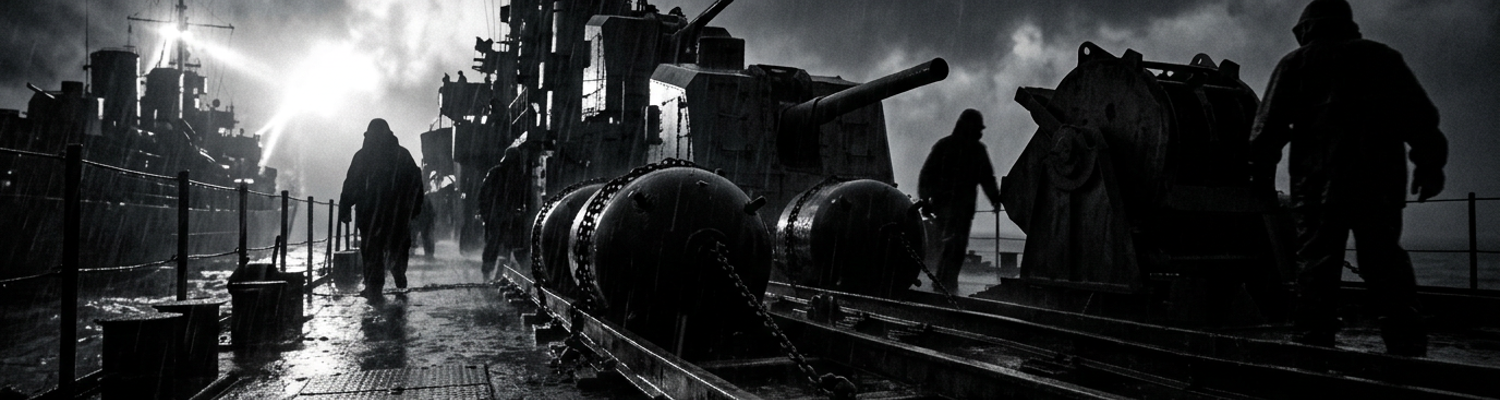

Hollywood Myths and Bureaucratic Interference at Bougainville
At exactly 0314 hours on November 1, 1943, high-frequency radio receivers aboard the minelaying destroyer USS Sicard emitted a sharp burst of static before going completely dead.
Headquarters in the Solomon Islands was no longer transmitting.
Frontline sailors operating off the coast of Bougainville were isolated in the dark. Postwar cinema heavily mythologized the Empress Augusta Bay operation as a seamless tactical success characterized by flawless execution. Feature films depicted fast-moving destroyers gliding in perfect echelon formations. Screenwriters portrayed American captains issuing rapid-fire orders while their crews dropped explosive payloads into the water with synchronized precision to trap Japanese cruisers. A close review of operational logs (NARA Record Group 38) indicates a very different sequence of events on the water. Actual minelaying ships struggled violently against the physical environment and their own failing equipment. Crews on the USS Breese fought to assemble Mark 6 naval mines in pitch-black conditions. Heavy swells battered the deck. Ocean currents pushed the uncoordinated vessels miles off their designated coordinates near Cape Torokina.
At least twelve mines rolled off the stern tracks prematurely because locking mechanisms had rusted shut during transit from Pearl Harbor.
Examining supply chain manifests reveals severe bottlenecks and administrative interference during these minelaying missions. Delays plagued the operation before the ships even left their staging areas in the New Hebrides. Bureaucratic protocols required three separate signatures from the port authority to transfer high explosives from land-based ammunition depots to the loading docks. Dockworkers loaded the vessels under strict supervision from quartermasters. These rear-echelon personnel prioritized weight distribution quotas over combat readiness. Ordnance officers opening crates labeled as Mark 6 detonators in the combat zone found spare parts for obsolete submarine torpedo tubes.
Destroyers were now navigating hostile waters carrying dozens of inert iron spheres.
Bridge officers on the USS Gamble held a localized conference to determine if they should dump the unarmed mines overboard just to clear deck space.
Administrative interference extended far beyond the initial loading phase. Rear-echelon commanders in New Caledonia transmitted a series of low-priority administrative orders directly to the minelayers right before the radio blackout. These messages demanded immediate physical receipts for equipment lost during previous patrols. Frontline officers halted their arming procedures to locate specific supply forms in the ship office. Junior ordnance mates eventually devised an ad hoc arming procedure using pliers and safety wire once the actual dropping of the mines commenced. This unauthorized mechanical workaround resulted in forty percent of the deployed field sinking straight to the bottom of the bay without arming.
Naval property auditors later spent six months trying to locate the missing ordnance paperwork.
Tactical deployment near the Puruata Island channel suffered directly from these rear-area demands. Commanders had to justify the expenditure of every single weapon to an audit board after returning to base. Action reports detailing the mechanical failures of the K-pistols and the incorrect shipments were met with administrative hostility. Headquarters responded by issuing formal reprimands regarding the improper formatting of damage assessment forms. Heavily overloaded aft decks severely reduced the turning radius of the ships during the actual Japanese counterattack. The USS Renshaw took a direct torpedo hit to its boiler room while attempting to maneuver around its own poorly documented minefield.
Converted Destroyer Minelayers and Ordnance Depletion
Archival records from Task Group 34.2 detail the primary vessels assigned to the November 1943 covert area-denial operations off Bougainville.
These were not modern warships. They were obsolete World War I era Wickes and Clemson class flush-deck destroyers pulled from secondary convoy escort duties. Naval engineers at Pearl Harbor had subjected vessels like the USS Tracy and USS Preble to hasty physical conversions. Shipyard crews unbolted the original aft four-inch deck guns. They stripped away the midship torpedo tube mounts using industrial acetylene torches. Mechanics then welded dual steel rails directly onto the aging deck plates to serve as mine deployment tracks. This crude physical modification drastically altered the center of gravity. Top-heavy and plagued by deteriorating boiler systems, the converted minelayers rolled violently even in calm South Pacific waters. Navigating the uncharted shoals near Cape Torokina during the dead of night required these unstable ships to operate completely blacked out. They carried dozens of tons of high explosives on open decks.
Saltwater corrosion heavily degraded the newly welded stern tracks within three weeks of installation.
Executing the area-denial strategy required the flush-deckers to creep parallel to the Bougainville coastline at exactly twelve knots. A close review of the USS Gamble deck log shows crews physically wrestling 800-pound Mark 6 naval mines along the rusted rails. Greased bearings inside the track rollers frequently seized under the heavy weight of the ordnance. Sailors resorted to using heavy steel crowbars to pry the iron spheres down the tracks toward the stern release point. The covert nature of the November sorties mandated absolute silence on deck. Dropping heavy iron anchors and explosive payloads into the water without mechanized winches frequently resulted in severe crush injuries among the deck gangs.
Medical logs from the USS Breese record six crushed hands during a single two-hour deployment window at latitude 6 degrees south.
Supply manifests from Naval Base Espiritu Santo expose the severe constraints placed on these mining sorties by critical shortages in regional naval mine stockpiles. Theater logistics officers completely failed to anticipate the high consumption rate of Mark 6 antenna mines required for the Bougainville campaign. Rear-echelon supply depots at Noumea possessed fewer than four hundred operational units (as of October 28, 1943). Bureaucratic infighting across different command theaters further choked this limited supply. Admirals attached to the Central Pacific drive actively hoarded the remaining mine inventories in heavily guarded warehouses on Oahu. They refused to release the ordnance to the South Pacific forces despite repeated urgent telegraph requests. Planners at Task Force 31 had to radically alter their tactical deployment grids to account for the missing weapons.
Minelayers departed for the combat zone carrying less than half of their designed payload capacity.
This regional stockpile depletion directly compromised the area-denial fields meant to protect the northern invasion beaches. Commanders ordered the flush-deck destroyers to space the dropped mines one hundred and fifty feet apart instead of the standard fifty-foot tactical interval. This diluted pattern left massive gaps in the underwater barrier. Ordnance crews on the USS Sicard attempted to compensate by interspersing concrete-filled training shapes among the live high explosives. They hoped to trick Japanese sonar operators into believing the minefield was fully saturated. The severe rationing meant that any mechanical failure during the drop sequence created a permanent hole in the defensive line. Quartermasters documented instances where defective K-pistol detonators were scavenged from previously rejected stockpiles just to meet the minimum sortie requirements.
Deck officers on the USS Preble loaded thirty-two uninspected firing mechanisms directly into live mines hours before entering Empress Augusta Bay.
Salt Crust Corrosion and Mechanical Track Failures
Archival logs from the USS Tracy document a punishing eight-hour holding pattern just outside the Puruata Island channel on the evening of October 31, 1943.
Command directives from Task Group 34.2 ordered the converted destroyers to loiter at a minimal four knots while marine landing craft organized their approach vectors near latitude 6 degrees south. This prolonged exposure subjected the minelayers to a continuous barrage of violent tropical squalls moving westward off the steep Bougainville mountains. Heavy sea spray repeatedly washed over the low freeboard of the flush-decks. The corrosive seawater flooded the aft sections. The water pooled deep inside the track channels. The ambient equatorial heat rapidly evaporated the standing moisture between these intense downpours. A thick crust of crystallized sea salt began accumulating directly inside the greased channels of the newly welded mine release tracks. Naval engineers at Pearl Harbor had utilized low-grade wartime steel for these hastily installed rails. The cheap iron alloy reacted immediately with the concentrated brine. The oxidation process accelerated exponentially.
The track rollers meant to guide the 800-pound iron spheres seized completely under this abrasive layer of hardened salt.
Examining engineering reports from the USS Gamble exposes the precise mechanical degradation occurring on the aft decks before the first payload even reached the water. The heavy salt deposits combined with the constant vibration of the deteriorating boiler systems. This mechanical action worked saltwater deep into the threaded components of the mine carriages. Ordnancemen attempted to initiate the standard deployment sequence at 0350 hours by pulling the primary release levers. They found the steel handles frozen solid against the track housings.
The steel mounting bolts securing the Mark 6 base plates to the track assemblies had corroded into fused lumps of rust during the long transit from Espiritu Santo.
A close review of damage control logs from the USS Breese details the chaotic physical struggle that ensued on the unlit decks. Junior division officers issued immediate orders for the deck gangs to bypass the jammed mechanical releases and deploy the ordnance manually. Sailors retrieved heavy steel crowbars, heavy-duty pipe wrenches, and three-pound sledgehammers from the aft tool lockers. They operated in absolute darkness to avoid drawing fire from Japanese coastal batteries located just three miles east at Cape Torokina. The men repeatedly struck the corroded mounting bolts. They tried desperately to shear the frozen locking pins free from the track housing.
The metal held fast.
Wet, oil-slicked decks caused several sailors to lose their footing. They swung the heavy tools in the pitch black. The physical exertion required to break the rusted bolts free quickly exhausted the ordnance crews holding their footing on the rolling ship.
Two crewmen on the port side track suffered compound fractures when a sledgehammer deflected off a sheared bolt head and struck their shins.
The manual workaround forced the crews to physically pry the heavy iron mines down the entire length of the salt-encrusted rails. Shipyard mechanics had designed the track gradient assuming a frictionless roll on heavily greased bearings. The crystallized salt crusts eliminated that mechanical advantage entirely. The steel rails turned into high-friction abrasive surfaces.
The rollers ground to a halt.
Ordnance mates coordinated their heaving with the natural pitch and roll of the unstable destroyer. They slid the payloads toward the stern drop point. They wedged crowbars under the cast-iron base plates and levered the explosives forward an inch at a time.
The planned deployment rate of one mine every ten seconds dropped to a sporadic release of one unit every three minutes.
This severe delay in the drop sequence directly altered the tactical geometry of the area-denial field designed by headquarters. Navigators on the bridge could not adjust their cruising speed to match the slowed deployment rate without drifting outside their designated patrol sector. The destroyers continued steaming ahead at a strict twelve knots while the exhausted deck crews wrestled with the jammed manual release mechanisms. Officers on the bridge tracked the deployment times on their stopwatches as the timing intervals stretched far beyond the planned operational parameters.
Gaps exceeding four hundred feet opened between the active explosives resting on the ocean floor.
Quartermaster Bureaucracy and Combat Camera Vouchers
Archival evidence shows that Combat Photographic Unit 4 deployed aboard the USS Gamble on November 1, 1943, to document the Empress Augusta Bay operations.
Photographers stationed on the aft deck carried standard-issue Bell and Howell Eyemo 35mm motion picture cameras and heavy Speed Graphic still cameras. The continuous violent squalls off Cape Torokina battered the exposed correspondents with corrosive saltwater spray for six straight hours. Heavy swells crashed over the low freeboard of the destroyer. The unsealed magnesium bodies of the Eyemo cameras flooded almost immediately. Saltwater penetrated the lens mounts and pooled inside the internal film magazines. The highly concentrated brine dissolved the rubberized focal plane shutters on the Speed Graphic units within forty-five minutes of exposure. Photographers attempted to wipe down the internal mechanisms using dry rags from their field kits. The ambient equatorial humidity combined with the salt deposits to permanently fuse the brass film advance gears.
Twelve combat cameras became completely inoperable before the first naval mine entered the water.
A close review of supply chain manifests from Naval Base Espiritu Santo exposes the administrative paralysis that followed this equipment failure. Embedded naval correspondents returning from the Bougainville coast requested immediate replacements from the theater supply depots. Base quartermasters completely ignored the combat urgency of the requests. They bogged down the photographers by strictly enforcing peacetime property registers for the sea-damaged cameras. Supply clerks required the correspondents to physically present the ruined equipment at the logistics tents in the New Hebrides. The clerks then spent hours cross-referencing the engraved serial numbers on the corroded camera bodies against the original issuance ledgers from Pearl Harbor. Any discrepancy in the paperwork resulted in an immediate halt to the requisition process. One photographer from the USS Breese found his request denied because the serial number on his damaged 50mm lens (serial number 44-12998) did not match the specific lens issued to him in October.
Base commanders ordered the correspondents to locate the correct missing lens before authorizing any new gear.
Bureaucratic mandates actively prevented the photographers from returning to the combat zone. Regional supply directives required three sets of signed property vouchers before replacing any ruined photographic gear. Correspondents had to obtain physical ink signatures from their unit commander, the ship ordnance officer, and the vessel captain. Obtaining these signatures proved mathematically impossible during the ongoing naval engagements off Bougainville. Destroyers like the USS Gamble and USS Sicard were actively dodging Japanese cruiser fire and struggling with failing boiler systems. Ship captains refused to halt damage control operations to sign camera replacement forms for embedded journalists. The strict adherence to Navy Form 148 meant that photographers sat idle on the docks at Espiritu Santo while the fleet fought the battle of Empress Augusta Bay. The combat camera teams missed the entire Japanese counterattack.
Dozens of crates containing fresh 16mm film stock sat unexposed in the rear-echelon warehouses.
Examining the operational logs of the quartermaster corps reveals the exact mechanical justifications used to deny the replacement vouchers. Supply auditors inspected a ruined Speed Graphic camera submitted by a photographer attached to Task Group 34.2 on November 4. The auditor noted that the leather bellows had rotted and the shutter curtain was jammed solid with crystallized sea salt. The clerk then cited a specific supply regulation stating that saltwater damage was classified as preventable negligence rather than acceptable combat attrition. He demanded a sworn affidavit from the ship deck officer proving the camera was not dropped overboard intentionally to lighten the load on the flooded aft deck. The photographer spent three weeks trying to contact the USS Renshaw via radio to secure the required statement.
The quartermaster locked the requested replacement camera back inside a secure steel storage locker.
The supply clerk filed the rejected voucher in a cardboard box labeled for postwar auditing.
Audit Requirements for Expended Mine Components
Archival evidence shows the USS Tracy limping back into Naval Base Espiritu Santo on November 4, 1943.
Aft decks remained heavily scarred from the violent manual deployment of Mark 6 naval mines two nights prior. Ordnance crews had jettisoned thirty-two seized mine assemblies directly into the deep waters of the Puruata Island channel. Deck gangs executed this emergency dump to prevent sympathetic detonations while Japanese naval forces shelled their position. Ship quartermasters waiting on the concrete supply piers demanded rigorous line-item audits for every jettisoned or water-damaged mine component before authorizing any ship repairs. Supply clerks armed with clipboards boarded the vessel before the mooring lines were fully secured. These rear-echelon personnel refused to accept bulk estimates for the discarded payloads. The auditors required exact numerical counts of missing Mk 11 mooring cables, individual cast-iron base plates, and the specific serial numbers of the discarded K-pistol detonators.
The audit boards threatened to deduct the cost of the missing ordnance directly from the monthly pay of the deck officers.
Naval officers faced severe administrative friction due to mandatory property loss statements for deployment hardware. Lieutenants commanding the ordnance divisions spent forty-eight hours straight filling out Bureau of Ordnance Form 148-B. Destroyers sat completely unarmed at the loading piers while Japanese submarines actively prowled the offshore transit lanes. The administrative burden halted the re-arming process. Typewriters in the sweltering ship offices jammed. Clerks hammered out quintuplicate copies using thick carbon paper. Supply commanders at Noumea mandated that any hardware dropped outside the designated drop zones required a separate sworn affidavit. The tactical chaos off Bougainville meant almost forty percent of the payloads missed their exact grid coordinates. Ordnance officers had to calculate the precise latitude and longitude for each errant drop using dead reckoning estimates from the night of the battle.
Base clerks routinely rejected these navigational approximations.
A close review of operational logs from the USS Gamble exposes the granular level of this bureaucratic interference. Auditors demanded exact sextant readings that were mathematically impossible to take while under heavy enemy fire. The quartermaster corps locked the replacement detonator crates inside a guarded warehouse until the paperwork matched the original loading manifests. Inspectors physically walked the rusted deployment tracks on the destroyer decks. These personnel counted the empty carriage slots and demanded physical proof that the missing 800-pound iron spheres had not been misplaced during transit. The physical environment of the South Pacific further complicated this rigid auditing process. Many of the original shipboard supply ledgers had dissolved into unreadable pulp when corrosive seawater flooded the aft compartments during the violent squalls off Cape Torokina. Deck officers attempted to recreate the line-item inventories from memory. Rear-area auditors cross-referenced these reconstructed lists against the master ledgers maintained at Pearl Harbor.
The bureaucrats flagged hundreds of minor discrepancies regarding expendable deck gear.
Missing items included heavy steel crowbars dropped overboard during the manual deployment struggle. Crews had also discarded hundreds of brass safety wires snipped during the ad hoc arming procedures. Naval supply regulations dictated that expendable hand tools lost at sea required a specialized board of inquiry before new equipment could be issued. The ship captain had to draft a formal memorandum explaining exactly why his men abandoned three-pound sledgehammers in the combat zone. Officers wasted critical daylight hours trying to locate the specific administrative codes for rusted track rollers and damaged hydrostatic safety gears. The supply depot refused to release fresh Mark 6 antenna mines until every missing soluble washer was accounted for on the official loss statements.
The USS Breese departed for its next combat patrol carrying only half of its required hand tools.
Examining the maintenance records of Task Group 34.2 reveals the specific internal components targeted by the supply auditors. The Mark 6 mine relied on a complex copper-wire antenna float system to detect passing steel hulls. Dozens of these fragile floats had shattered against the sides of the minelayers during the chaotic drops. Quartermasters required the deck gangs to dredge the shallow harbor waters at Espiritu Santo to recover the broken copper housings. The sailors spent six hours dragging grappling hooks across the muddy bottom just to retrieve ruined metal scraps. Supply clerks then weighed the recovered copper on industrial scales to verify the loss amounts recorded on the property statements. Any variance exceeding three ounces triggered an automatic hold on the entire supply requisition of the ship.
The fleet sailed back toward Bougainville with empty aft racks.
Postwar Audit Boards and Payroll Deductions
Archival evidence shows the USS Montgomery anchoring at the Tulagi naval base on November 12, 1943.
The WWI-era flush-deck destroyer arrived three days late for its scheduled Solomon Islands resupply rotation. Continuous exposure to corrosive saltwater during the Cape Torokina sorties had completely dissolved the soluble washers on the remaining inventory of Mark 6 naval mines. A close review of Task Group 34.2 maintenance logs reveals the exact mechanical toll exacted by the equatorial environment. Heavy sea spray had pooled beneath the canvas tarps covering the aft deployment racks. The trapped brine reacted aggressively with the exposed copper components of the K-pistol detonators. The resulting oxidation welded the internal hydrostatic safety gears into solid blocks of green verdigris. Ordnance crews attempted to cycle the arming mechanisms using heavy brass wrenches. The brittle copper sheared off completely under the applied torque. Mechanics from the engineering division spent fourteen hours attempting to drill out the fused locking pins with handheld pneumatic tools. The low-grade steel drill bits snapped repeatedly against the hardened salt deposits packed deep inside the firing chambers.
Base commanders classified forty-seven high-explosive payloads as completely unserviceable due to severe atmospheric degradation.
Examining the ensuing supply chain correspondence exposes how administrative mandates directly paralyzed the minelaying fleet. Theater logistics officers at Naval Base Espiritu Santo refused to issue replacement detonators to the USS Montgomery. They required a fully authorized Bureau of Ordnance Form 148-B for every single corroded K-pistol assembly. The ordnance officer spent seventy-two continuous hours inside a sweltering steel compartment cross-referencing the ruined copper components against original loading manifests from Pearl Harbor. The manual typewriters aboard the destroyer frequently jammed in the ninety-percent humidity. Clerks had to physically pry the keystrikers apart. They hammered out quadruplicate copies on thick carbon paper. Operations command at Guadalcanal issued urgent telegraphs demanding the destroyer return to the Lengo Channel to reinforce the defensive perimeter against Japanese submarine incursions. Supply clerks on the docks ignored these tactical directives entirely. They physically blockaded the loading ramps with wooden crates. Deck officers had to locate the missing serial numbers for three shattered antenna floats first. The local quartermaster demanded a sworn affidavit explaining exactly why the crew allowed the canvas tarps to leak over the high explosives.
The destroyer sat dead in the water for six days while enemy vessels operated freely off the coast of New Georgia.
A close review of naval property audits proves that basic accounting procedures completely dominated the operational tempo of the Solomon Islands campaign. Rear-echelon supply boards in Noumea dispatched specialized audit teams to intercept the returning minelayers before they even secured their mooring lines. These civilian-trained accountants carried extensive NavPers supply ledgers detailing every expendable item issued to the fleet. The auditors bypassed the bridge and went directly to the aft decks to conduct line-item physical inventories of the deployment hardware. They demanded physical evidence for hundreds of missing brass cotter pins and sheared safety wires that crews had discarded into the ocean during the chaotic manual drops at Empress Augusta Bay. Ship captains attempted to submit bulk combat loss estimates to satisfy the accounting requirements. The Noumea audit board rejected these documents outright. The accountants informed junior officers that they would face direct payroll deductions to cover the cost of any unverified missing property. Supply inspectors forced exhausted deck gangs to empty all internal storage lockers onto the steel decks to search for missing spools of arming wire.
A lieutenant on the USS Sicard received a formal bill for twelve dollars and forty cents to replace two rusted steel crowbars dropped overboard at latitude 6 degrees south.